I have a piece for Vital City arguing that, to succeed in the negotiation and compromise that will be required to build a ton of new housing, YIMBYs have to stop engaging in convenient and false caricatures of who opposes new construction. Check it out.
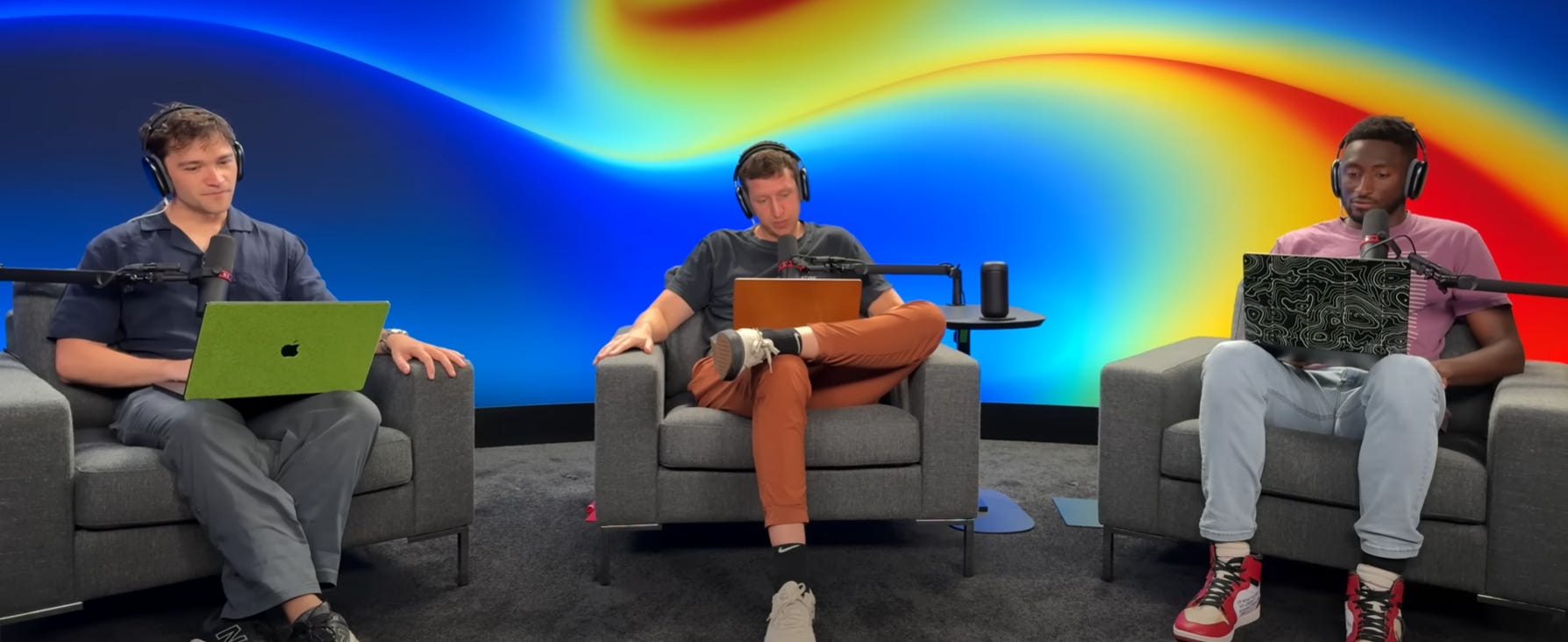
If you’re unaware, these despondent fellows are Marques Brownlee, Andrew Manganelli, and David Imel. Brownlee is widely regarded as the most influential voice in tech journalism, and his cohosts are experienced in that space as well. (There’s also two JV guys on that podcast who I can never keep straight.) They host the popular Waveform podcast, which is a prominent but typical example of the tech podcast archetype, which means it’s a bunch of dudes sitting around and gabbing about the latest rumors, news, and developments in the world of consumer technology - gadgets, that is. In this episode, they’re reacting to the recent Apple iPhone “WWDC” event; annually, these are among the most important in the gadget press world, as the iPhone has long been the most obsessed-over (and profitable) gizmo on the entire market. For a decade and a half, news of the next iPhone has been one of the most consistent click-generators in modern media, a matter of obsession for much of the affluent world.
And yet….
The persistent difficulty the Waveform guys have generating any excitement about Apple’s biggest reveals of the year speaks to a real cultural change: organic interest in these events has never been at lower ebb, since the reveal of the first iPhone in 2007. They do their best to fake it, but the bodies betray the voices: these are three dudes who have seen this all before and don’t see much to get excited about. Being a tech blogger/YouTuber/podcaster requires the ability to regularly summon enthusiasm for the latest products. Some of this is personality, some of it is skill, and certainly these are three guys with lots of natural interest in technology and plenty of experience. But fundamentally, you have to have something to react to. And the iPhone, like its major competitors from Samsung and Google, is fundamentally a commodity product; the period of manic development in smartphones is long over, we’re in an era of trying to sell people on ancillary “improvements” like titanium casings, and advertising tries to get us amped up with endless incremental improvements to smartphone basics. But who, exactly, feels that they have insufficient storage on their flagship phone? Feels unsatisfied with the camera? Wishes the screen was sharper and brighter? Maybe you do, I concede, but clearly not the vast majority of users, especially given slowing sales. More and more people are hanging on to their phones for longer and longer, and why not? What are they missing out on?
If these professional tech guys can hardly contain their boredom about the latest slate from the world’s most important designer of consumer technology, what about your cousin who doesn’t know what NFC is but used to reliably buy a new iPhone every year, out of pure cultural pressure, but no longer bothers?
In the video, Brownlee dutifully gestures at the new shiny toys, the way a man might gesture toward a salad he doesn’t want to eat, while Manganelli nods along with all the vigor of someone agreeing to help a friend move. Imel, for his part, seems eager to sink into his seat and fall asleep. Their words say “this is cool,” but their shoulders say “we’ve been here before.” Even when they try to hype the new orange phone (IT’S ORANGE EVERYONE) or how thin the iPhone Air is (IT’S THIN EVERYONE) the energy feels off, more like an accountant describing a bold new spreadsheet font than professionally-invested tech guys dazzled by revolutionary gadgets. You could feel them groping for enthusiasm the way you grope for your keys in the dark. You might contrast this with their discussions of Apple’s Vision Pro VR headset “spatial computer” or the AI gizmos the Humane AI Pin and Rabbit R1, all of which released last year as something genuinely new - and all of which were major commercial failures. This is a basic reality in tech coverage right now: the things that are interesting don’t sell and the things that sell aren’t interesting.
For a similar but funnier experience, you might try this episode of the Vergecast dedicated to the same iPhone event, which is very high on the unintentional comedy scale. (Transcript.)
They describe an ecstatic reaction in the Steve Jobs Theater when Apple finally gave the base iPhone a 120Hz “ProMotion”1 display - something $200 Android phones have had for years. “Actual cheering, there was real cheering!” they say. For, again, a 120Hz screen, which was available in Android phones in 2017.
They acknowledge that the iPhone Air, a phone with the killer feature of being a few millimeters thinner than other phones, is kind of a silly gimmick, but still search for justifications for it: “I really do buy the theory that [the fact that] it looks kind of cool means something, right? Like especially these things are such a commoditized [product] in our life, but also like everpresent things in our lives. And I think making it nicer to look at and hold for its own sake is actually fine.” That’s the highest praise the tech press can muster these days: actually fine!
They identify the ability to take landscape photos in selfie mode (without physically turning the phone) as the killer new feature. “It might sound like slight hyperbole, but I honestly think the ability to take landscape selfies while holding your phone in portrait is like the most exciting iPhone upgrade in years.” This does sound useful! But also a) this has been available in alternative camera apps for Android phones for years and b) this just isn’t the caliber of development that once would have excited anyone.
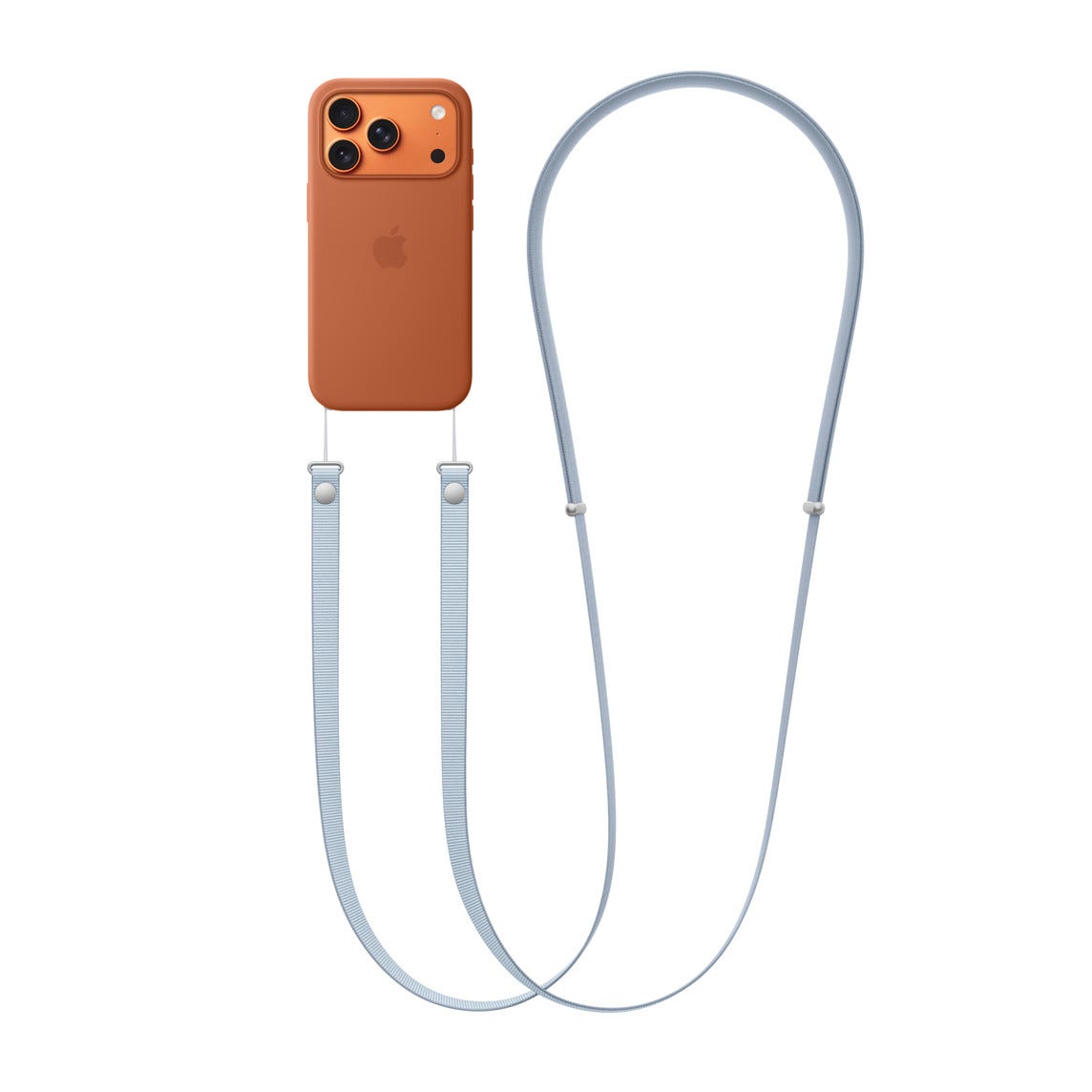
They spend a bunch of time on this new crossbody strap that Apple is selling for people to holster their iPhones, described as a “lifestyle brandy thing.” I mean, do I need to say anything here? You’ve been able to buy third party versions off of Etsy with identical functionality for a lot less money for more than a decade.
As I mentioned before, one of the new SKUs comes in orange. An orange iPhone! The Verge crew are self-aware about how stupid this is, but they still make a valiant effort at treating this development as meaningful. After all, how many years in a row can you say “the chip is marginally faster, the camera is marginally better, the screen is marginally sharper, also it’s $100 more than last year’s version”?
To be fair and to be clear! I’m picking these two podcasts not because I think they’re particularly bad but because I think, in general, they’re particularly good - they are usually quite disciplined about avoiding tech hype. This is, I think, the secret superpower of Brownlee and Verge head honcho Nilay Patel (who’s not on the podcast episode) - they’re even-keeled guys in a tech press that’s filled with hysterical overreaction, for hype-and-click generating purposes. And in both episodes, there is indeed some degree of self-knowledge about all of this; the hosts are clearly aware that trying to find excitement in modern smartphone releases is a tough task, particularly in comparison to the effortless hype of the 2010s, when smartphone technology improved at a breakneck pace and ordinary people tracked new developments with religious zeal. But they’re still in the business of reporting tech news, which means they’re still professionally obligated to get hyped over this stuff. The effect is like watching a bored RA who’s paid to be enthusiastic on move-in day at your local college - the peculiarly depressing spectacle of obligatory enthusiasm.
Smartphone innovation has been real, these past fifteen years, with truly dramatic levels of technological development squeezed into a short period. It reminds me, oddly enough, of the development of aircraft in World War II; at the beginning of that conflict, wooden biplanes were still playing a meaningful role, while by the end, we were flying jets. But this just speaks to a recurring theme around here: human scientific and technological development is neither constant nor linear, we have periods of stagnation as well as periods of innovation, and the notion that we’re entitled to constant exponential growth has simply set people up for disappointment. The period from 1870(ish) to 1970(ish) was truly an extraordinary time for human advancement; we have since been in a half-century-plus long slump, at least relatively. Dramatic improvements in information science (that is, computing) have helped to obscure this slowdown. But now, consumer technology itself is reaching a plateau. And watching these tepid, obligatory reactions to the latest gizmos - from so many tech journalists who so recently experienced near-religious ecstasy over these products - makes me wonder what comes next.
We are, unmistakably, in a doldrums of consumer technology. Smartphones were a genuinely noteworthy invention, albeit a pernicious one; though the internet has still not had the productivity benefits it was assumed to, phones have colonized most people’s lives in a way that would have been hard to fathom beforehand. (This is me to the pre-smartphone era.) But they’re now as functionally mature as toasters; the tech companies picked all the low-hanging fruit in development and now phone releases just aren’t special. What else is there left to develop? What do you need to do with your phone that you can’t already? You need to call your mom, text friends, check email, doomscroll, lose money gambling, take regrettable selfies, and occasionally watch porn. (No judgment here.) Most of that has been frictionless for a decade. So every year the companies trot out a few cosmetic tweaks - lighter, thinner, flatter, shinier - and urge the press to act like civilization just leapt forward. And the press complies, because what else can they do? Admit that their beat is boring?

You see it in the contortions of language, in the desperate euphemisms. A camera that adds 5% more sharpness in low light is heralded as a “revolution in computational photography.” A phone that weighs slightly less is called a triumph of engineering, as if someone shaved a gram of metal off the chassis using tweezers in a NASA cleanroom. Every keynote involves phrases like “our most advanced model yet,” which is not a boast but a tautology. Your latest phone is your latest phone? You don’t say! Imagine if Honda unveiled a new Civic and declared, “This is the most recent Civic we’ve ever made.”
I don’t even blame the tech companies that much. Apple, Google, Samsung… they’ve got shareholders to appease. Their job is to milk the cow until it dies, not to stage an existential crisis about whether milk itself is boring. What’s remarkable is the embarrassed theater of the tech press. These are smart people. They aren’t naive. They know the score better than I do. They know we’ve plateaued. They know that nothing meaningful has changed in most consumer electronics product categories since around the time Obama left office. But they have mortgages and kids and need to keep the clicks coming, so they overheat their adjectives. You can feel their despair leak through the prose: the desperate attempt to spin a lighter case into a “new era” of design, the half-hearted analogies to car racing or space travel. They don’t believe their own copy, but what choice do they have? They’re beat reporters in a beat that no longer produces news. Apple’s great new innovation is a new visual design that looks like liquid glass, which as many have pointed out was also a development in Windows Vista, released in 2007. As a bonus, it hurts your battery life!
This is not another post about AI, but you’re aware of how I feel - LLMs are being pushed as transformative technology, when they are clearly profoundly limited and mundane, precisely because the tech giants know that they’re running out of new product categories. It’s not just stagnating phone sales. Smartwatches saw declining sales for the first time last year. The tech world doggedly insists that VR as a mass interest is coming, but it just keeps not happening. The money-printing cloud services business has finally started to slow. Apple, long the most dominant company in America’s most competitive sector, has lately been perceived to be a company adrift. Google, beset with (very legitimate) monopoly complaints, is facing a future where search is finally a declining phenomenon, in terms of profits, market share, and consumer perception; the company long ago ceased to be the beloved incubator of moonshots and became a relentless profit maximizer. Microsoft has pursued AI in its usual ruthless, consumer-indifferent way. These companies know that they’ve maximized their existing product categories. They need AI to work, and they will insist it does even in the face of all evidence, and unfortunately our gullible press is going along with it.
Even if you’re more of an AI believer than I am, take a look at how AI has actually been integrated into these devices so far: “Now, your phone can write an email for you!” A truly thrilling vision of the future - who doesn’t dream of outsourcing the mindless busywork of asking your boss if Tuesday at 3PMstill works? It’s a technology capable of staggering feats, according to the marketing, but as I and others have exhaustively pointed out, the real-world application of LLMs remains woefully behind its promised purposes. And so the consumer-facing applications boil down to grammar-checking and auto-summarizing meetings. AI may indeed reshape the world, decades from now, but in consumer tech it’s just another checkbox bullet point to inflate the press release - and one which Apple has notoriously struggled to get a handle on.
The problem with media premised on innovation in an era of stagnation is that the myth of progress has to be maintained at all costs. The tech industry sells itself as synonymous with dynamism, as though you’re not just buying a phone, you’re participating in the relentless march of human development. If they admitted, “Hey, we’ve really just perfected this form factor and don’t have anywhere interesting to go,” the entire charade collapses. So they pump up the marketing, the journalists play along, and the rest of us are supposed to clap like seals because a phone is 0.2 ounces lighter. I don’t think the average tech journalist is naive or corrupt. I do think that all tech journalists live in a discursive world that has been built entirely on the notion of endless, revolutionary innovation, and that was never sustainable, and now it’s not being sustained. And we’re stuck in this weird place where the perpetually-optimistic tech press seems jaded and sad to me, but unwilling to admit it.
I want to be clear: it’s not that these products are bad. At some things, they’re excellent, and the engineering feat that a modern smartphone represents is truly incredible. They’re refined, durable, absurdly powerful little slabs that can do essentially anything you want. The cameras on these phones! The screens! They’re remarkable. But that’s the point - they were already remarkable. They’re finished! It is accomplished; the strife is over, the battle won. Again, what would you like your phone to do that it can’t already do? No one is sitting around waiting for tremendous innovation in chair design, because the chair is a mature product category that has more or less been figured out. Smartphones aren’t quite there yet, but they are closer to the end of their useful development than the beginning. The marginal improvements are just that, marginal, and the grown-up response would be to accept that fact, treat phones like the appliances they are, and stop expecting a messianic leap every September.
But you can’t build a hype economy on stability. You can’t keep the pageviews flowing by telling people “buy last year’s model, it’s fine.” So every year, we’re treated to the spectacle of people who know better breathlessly telling us that orange is the future. And every year, fewer and fewer of us believe them.