
Devon Price, who I’ve interacted with before, has written this piece about me and Jon Machnee of Christianity on the Spectrum. Price declines to link to or name who they’re talking about, but they have screengrabbed sections of things Jon and I wrote. (This is a fairly common social justice set tactic, to hold someone else’s work up for ridicule in an image rather than in copy-and-pasteable text, which makes it harder for readers to find the text that’s being mocked.) There’s also this image from Price’s Instagram:
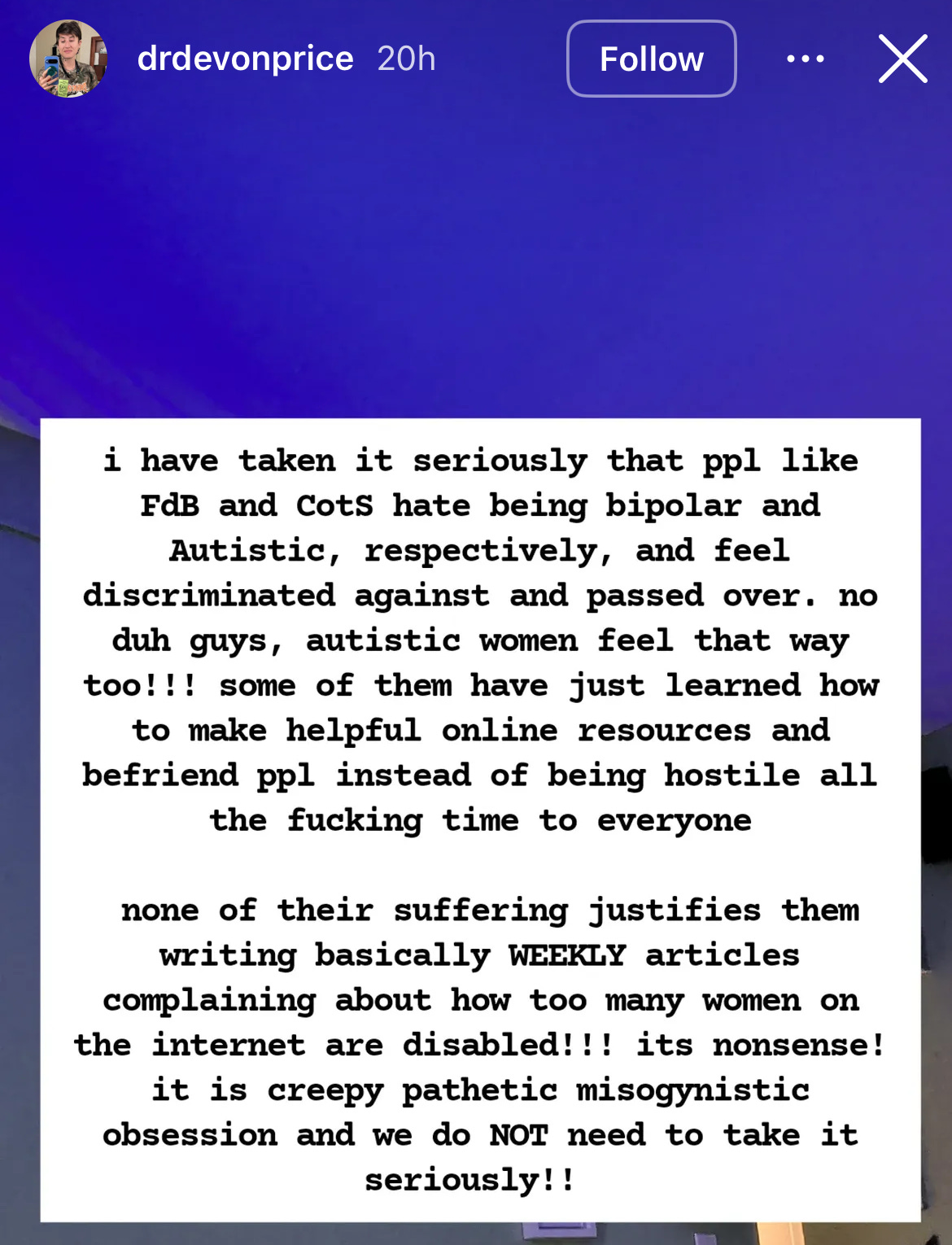
So, yes, this is about me and Machnee.
I encourage you to read the piece, in part so that you can see that I’m not exaggerating when I say that the sole argument in it, the one and only critique, is the evidence-free assertion that my thoughts on contemporary disability law and culture are motivated solely by misogyny. Again, that’s not an exaggeration or a distortion; that is the only claim Price’s essay advances. The tactic in the piece is to create an increasingly-elaborate fantasy about me and what I believe about women who claim to be disabled. This should be easily dealt with - never, in all my years of writing about this, have I claimed that it’s solely or predominantly women who knowingly fake disabilities or who have convinced themselves that they genuinely have them. I am not shy about making controversial identity claims when the evidence points me in that direction, yet I have never said, suggested, implied, hinted, or otherwise signaled that women drive the phenomenon of disability fakery. Price includes literally no evidence to suggest that I do, so there’s nothing for me to rebut in that regard.
I have pointed out when the specific trends are highly gendered, such as the TikTok Tourette’s phenomenon. (For the record, almost all of the adolescents who participated in that moment have since stopped pretending that they have Tourette’s, and some have admitted that they had fallen into a social contagion when they did; no word from Price or their cohort on what that might tell us more broadly.) But it is simply not true that I’ve ever said that factitious illness, illness anxiety, or out-and-out fraudulent claims of disability are solely or mostly found among women. Arguably the most consequential example of disability fakery is people defrauding the government for disability payments, and like most crimes it’s disproportionately committed by men. Just recently I discussed people requesting wheelchairs at airports solely to skip lines, which by all accounts is a gender neutral behavior. The remarkable rise in people receiving extra time to take the LSAT, I’m sure, is being powered as much by men seeking convenient diagnoses as women, or at least in proportion to overall test-takers. (The LSAT is now a 60%/40% female/male participant exam.) Operation Varsity Blues, which among other kinds of admissions fraud found parents securing fake disability accommodations for their children, involved fathers as well as mothers and sons as well as daughters. I’m confident that it’s mostly men who buy fake handicap parking placards like the ones at the top. (There are untold thousands of such products sold online, which means someone is buying them.) I could go on. I have never suggested that women are to blame for where we’ve gotten to, in this culture, regarding disability. The fundamental underlying claim of Price’s piece is untrue and asserted entirely without evidence.
My book is about a lot of things, and factitious illness is only a part of what it concerns. And I take care to disentangle various forms of imagined or invented disability in the book - there’s a difference between a sincere but erroneous belief that you have a disorder, knowing that you don’t but acting like you do for psychic and emotional benefit as in Munchausen’s, and deliberate fraud. The distinctions matter. But you can’t sort any of this out unless you confront the fact that people represent themselves as having disabilities they don’t have, and the system will collapse if there is no effort to police that behavior. As the book details at great length, these are not victimless crimes. In so many cases, accommodation is zero sum, or else it requires drawing on a pool of limited resources.
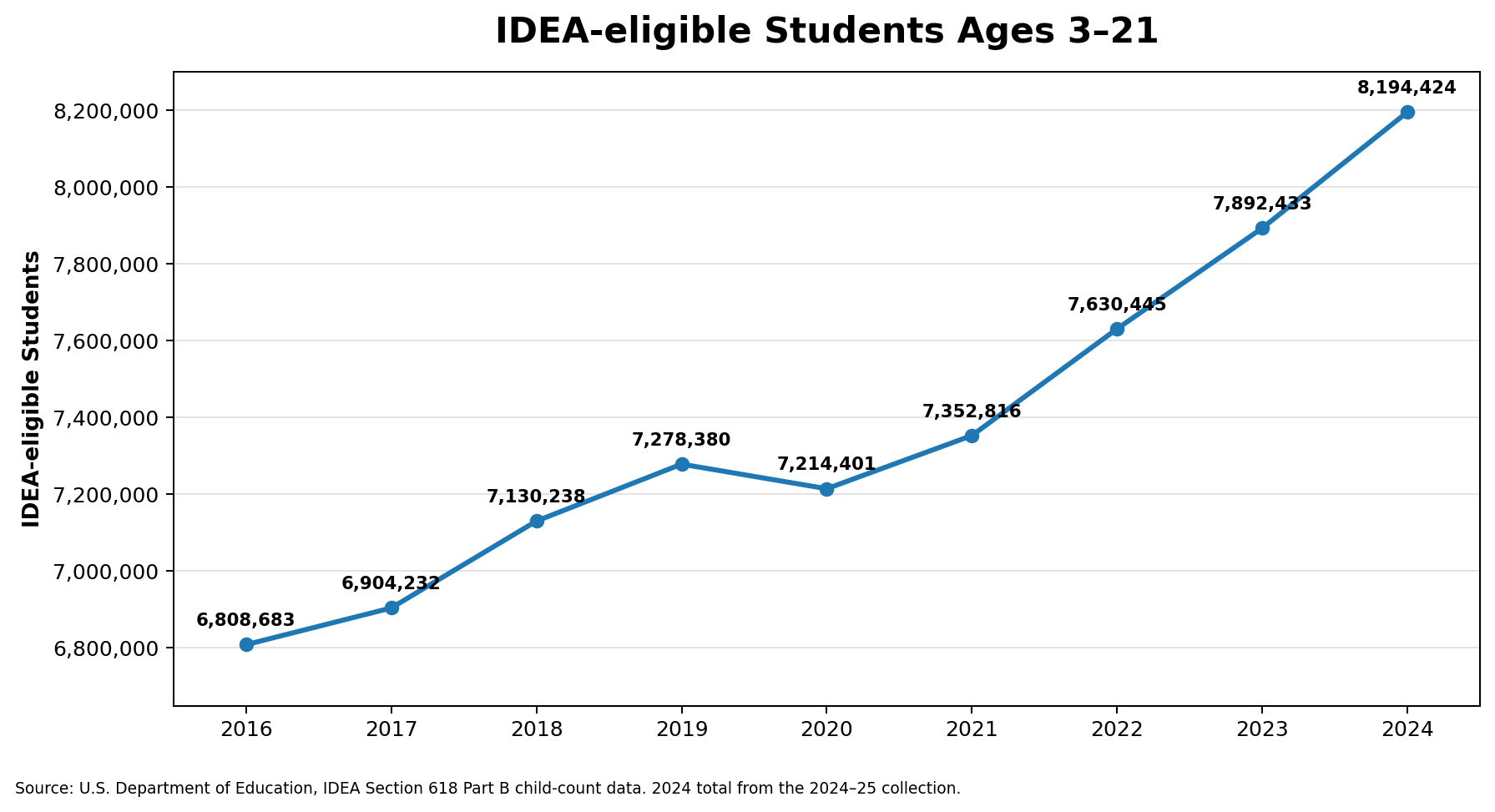
Here are two things that are true: providing special education is one of the best things our society does; our K-12 system is facing an immense fiscal crisis thanks to special education funding. And what we have to recognize, if we’re going to be adults, is that recognizing the latter is an important part of defending the former. The increase in special ed funding over time is staggering - staggering, and unsustainable. The system simply cannot continue to accommodate the relentless growth in students with IEPs, not in terms of funding and not in terms of manpower. And I have talked to dozens of stakeholders, including parents of severely disabled students and teachers who have dedicated their lives to helping disabled students, who have made it clear that a large part of that problem lies in more and more resources being sucked up by kids who do not in fact have any serious impairment at all but who do have aggressive and litigious parents. Price dismisses such talk in their essay but does not answer it, and in fact, they have no actual arguments at all about people who incontrovertibly have faked disability. People in that camp never out-and-out deny that such fakery exists, but they also say nothing about how society should handle it. They can’t; their ideology does not permit them to even ask such questions. But we have to.
I’m not talking about the crisis in special ed funding because I don’t care about special education. I’m talking about it because addressing this unsustainable burden is the only way to defend special education. And the heart of adult morality is a willingness to address those uncomfortable tensions when doing so is a necessary part of defending a true public good.
It’s so strange, to be in my position - I am criticizing people who do not actually have disabilities, not the disabled. I write about known and obvious fakery and the disability rights class quotes statistics at me about how many disabled people are in poverty. But those people are actually disabled! They are definitionally not the people I’m criticizing! The disability activist’s reflex to defend those who manipulate and abuse the system is deranged. Price is the kind of person who’s hyper-fixated on the concept of privilege. Well, how about those Operation Varsity Blues kids, Devon? Those kids were some of the most privileged people on Earth; their parents were wealthy, connected, sometimes celebrities. And we know beyond a doubt that they were in fact receiving disability accommodations fraudulently. The government produced texts and emails and similar in which parents openly discussed securing bogus diagnoses. So… how does Price feel about that, about them? It’s exactly the behavior they suggest doesn’t happen, behavior benefitting rich, powerful people who could hardly be more spoiled and entitled. Incredibly, activists and academics of Price’s stripe seem entirely content to protect those people, to defend them as The Disabled despite the fact that in some cases the fraudulence of those disability claims was admitted to as part of plea deals. Defend them, in the name of disability rights? What? Why?
Look: this was always coming. This heat was always coming. Price’s piece, and their subsequent trawling of social media to borrow from my preexisting unpopularity, is a particularly personal version, but I engaged in all of this knowing that this is coming. I have fought with every kind of activist in my life; no group is more aggressive, nasty, and vindictive than the “disability rights” people who insist that they get to speak for everyone who has ever dealt with a disability. Luckily, I was born to do this, and I like it, and we will see who’s more comfortable in this kind of fight in the months to come as the book is released. I do all of this for a lot of reasons. One reason is that I have paid a high price for my own disability and thus will not defer to a bunch of self-diagnosed ivory tower theater kids who playact infirmity as a surrogate for having a personality. Another reason is because I look out at the world and see people like the young lady in this video, and I see that, incredibly, she and people like her have essentially no presence in the “neurodiversity” or “disability rights” world; the depth of their impairment is too inconvenient for those who insist that autism is a superpower, the ones who stare into their selfie cams and brag about being “neurospicy.” And if anyone thinks that they can bully me out of doing this kind of advocacy by inventing misogynistic motives for what I’m doing, with no evidence whatsoever, they are out of their fucking minds.
Please, if what I write about on these topics moves you, preorder the book.