One of the pieces I’ve posted to this newsletter that’s most dear to me is this one, published in the first month of this publication’s existence. Written when we were still at Peak Woke, its argument is pretty simple: liberals constantly debate censorship of the right as a normative question, as a “Should we?” question, when in fact censorship is first an empirical question, a “Can we?” question. That is to say, so much of the abstract debate about censorship that has sprung up on the left in the past several decades - a debate in which more and more progressive people express eagerness to silence right-wing “extremism” - proceeds based on the notion that we could censor the right whenever we want to. We just have to choose to silence our enemies, and we’ll silence them! In a highly polarized two-party country, that seems politically unworkable to me, but more, the historical evidence tells me that censorship doesn’t work even when you have an infrastructure in place to use the government to censor. As I pointed out in that piece, Germany and France both have forceful legal systems in place designed to restrict and criminalize the far-right, and yet both have a far-right problem that exceeds that of the libertarian United States. Because censorship doesn’t work.
(Speaking of Peak Woke, back when it came out TechCrunch linked to that piece and claimed that it “endorses hate speech,” which isn’t remotely true; I had to get them to post a correction. The piece is still sometimes linked to in bad faith under the theory that it defends far-right extremism. So it goes.)
I certainly would oppose censorship of the right even if we could achieve it, on the level of basic values. But that conversation is preempted by the fact that everywhere we look, censorship fails. Even in a genuinely authoritarian country like China the government has been unable to stamp out Falun Gong, to pick an example. The 2010s period of rampant social media crackdowns on conservatives coincided with a massive backlash against the liberal establishment, one that saw far-right attitudes flourish online right in the heart of those heavy-handed “moderation” efforts. If censorship ever worked, it certainly doesn’t now, in the internet age; there’s always some Russian server somewhere that can host the bad thing, always some forum that will spring up to house the ugly discussions. We can’t build the better world by shutting down speech we don’t like. We have to convince the public that our way is better; there is literally no alternative. Again, look at France and Germany: when the government dissolves far-right parties, they start new parties; when they jail far-right leaders, they choose new leaders; when they ban far-right symbols, they come up with new symbols. It turns out that “you can’t kill an idea” isn’t just an aphorism, it’s literally true.
Recently, Germany has seemed intent on proving my point.
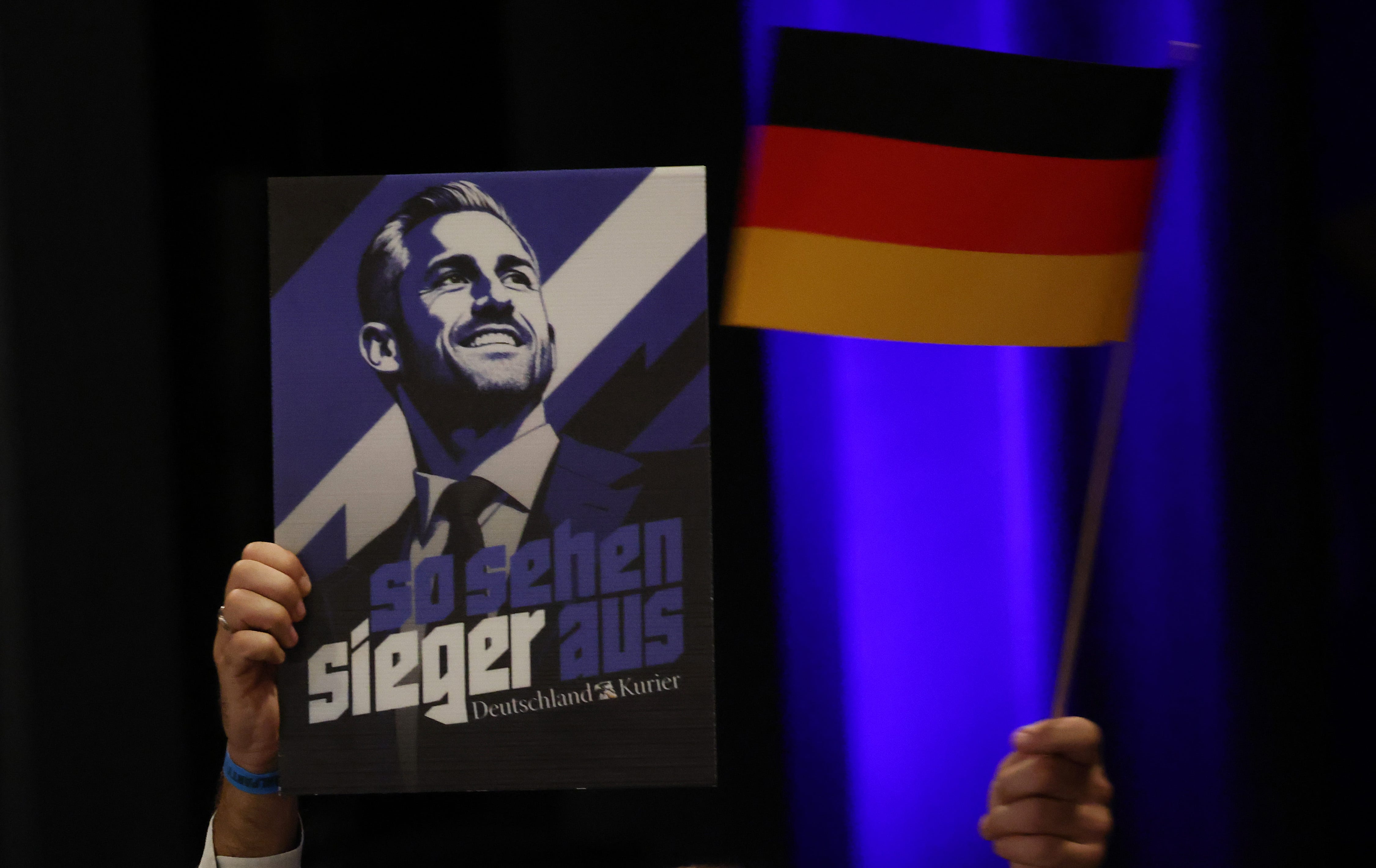
This past weekend the far-right German political party AfD (Alternative for Germany) won 43.8% of the vote in Saxony-Anhalt, more than twice the 17.2% secured by CDU (Christian Democratic Union), the center-right party long led by Angela Merkel. Nationally, AfD now leads the polls at roughly 28%, compared with about 21% for the CDU/CSU. (If these numbers look small, remember that Germany’s is a proportional representation system with substantially more viable parties than in the United States.) In Mecklenburg-Vorpommern, AfD polls around 37%, more than double its share of the vote in 2021. The German establishment is clearly back on its heels, increasingly unable to address rising economic and cultural concerns that have become highly important in German local and national politics. By any reasonable measure, the German far right is in its strongest position since 1945, a year which I hope you will agree has certain resonances when it comes to German history. And we’ve gotten here despite Germany having built perhaps the most elaborate legal and bureaucratic system for restricting far-right speech in the democratic world.
As I said in that earlier post, Germany and France (among other countries) go to great lengths to actively criminalize far-right parties and rhetoric, specifically because of the legacy of Nazism. These aren’t toothless civil penalties, either, but a matter of criminal law. Germany has capacious laws against “incitement,” they’ve long banned Holocaust denial, they’ve dissolved entire political parties on multiple occasions, their list of illegal political symbols grows and grows…. There’s an entire domestic surveillance system set up to squelch far-right political movements, the Bundesamt für Verfassungsschutz. Last year the AfD was officially designated as an extremist organization by that system, a ruling which has since been set aside thanks to ongoing legal wrangling since but which may be reinstituted. Every mainstream German party has pledged not to form a government with AfD. A magazine associated with AfD was banned by the Interior ministry; police have raided homes over posts on social media. And in the face of all that resistance, the far-right is ascendant, attracting more and more voters. A party that the state itself has called extremist just came in first in an influential state and is polling in first place in the country writ large.
Now I imagine some of you will insist that the United States has just as big of a far-right problem as Europe does. But, I’m sorry, that’s wrong. Certainly Trump and MAGA are nativist and prey on racial anxieties and invoke all kinds of ugly ethnic tensions. But in the United States, Nick Fuentes is one half a somewhat influential but largely-marginalized pundit and one half a meme, a jokey persona; in supposedly urbane, progressive Western Europe there are people with Fuentes’s politics that are the equivalent of Senators here. The Republicans have dug themselves into a very dark hole, but they’re not an explicitly racialist party of the type that have made recent progress in countries like Italy. They retain an identity as the party of genteel Wall Street guys as well as the party of the Proud Boys, and as annoying as the Never Trump GOP types are, their ongoing influence and visibility demonstrate the fact that our system is not producing as direct and unambiguous and unapologetic far-right parties as those in other parts of the world. This isn’t an argument that the Republicans aren’t bad, that movement conservatism isn’t bad; in some ways, a really rapacious free market party is just as bad as a white supremacist one. The point is that no American political party is getting 28% of the vote after being designated an extremist organization by the government.
As for why…. It’s kind of like the Drug War. Critics of our drug policy have pointed out for forever that you can’t solve the drug problem on the supply side - as long as there’s demand for drugs, someone is going to produce and traffic them, because demand means money. (I happen to think that stopping demand for drugs is no more realistic than stopping supply, but that’s a discussion for another day.) It’s sort of similar here: there’s demand for a real alternative to the German establishment, and the far-right is filling it. The sources of that demand are multiple: immigration is the biggest, but Germany’s threatened identity as a global manufacturing powerhouse, the legacy of deindustrialization in the east of the country, and inflation also loom large. I’m not naive enough to think that a left-wing party could convert all of those AfD voters, especially given the Western left’s current incoherence when it comes to immigration. But I think some of those voters could be reachable if they thought that another party offered a better choice, and anyway, there is no alternative; when voters believe bad things, there’s nothing you can ever do but persuade them.
For the record, two points that should go without saying but apparently don’t: first, censorship always plays into the hands of conspiracy theorists and helps the censored look like cool rebels who maybe have a point, and second, when you try to quarantine bad political ideas, you perversely do them the favor of keeping them from being implemented and failing. Extremists love a persecution narrative, so why do them the favor of persecuting them? And cordoning off far-right politics, for whatever brief period it works, only robs ordinary people of seeing those politics in action and just how little they have to offer said ordinary people. Meanwhile the more that the government’s extremist label gets thrown around the less it means and the more the stigma associated with it is reduced. No, it’s all a mess. I’ll take the First Amendment, thanks, especially given that a lot of the left-wing politics I support will always be vulnerable to claims of extremism too. In Germany longstanding and heavy-handed laws designed to prevent just this occurrence failed to prevent it, and for perfectly predictable reasons. Sooner or later American liberals have to accept that there’s no shortcuts, that they can’t demand that Big Mommy chase away the bad guys. All you can do is do the work, make your points, win the argument. That’s all of it.
For seventy years, mainstream German parties have been relieved of the obligation to win arguments with the far right because the state used its censorship system to handle it for them. Seventy years of such handling has produced this nightmare. Maybe it’s time to try something different? And maybe it’s time for us to take the lesson ourselves?