In anticipation of my book’s release NEXT WEEK (!), I recently appeared on Christianity on the Spectrum and Autism Confidential, two podcasts representing points of view which have been systematically marginalized by “neurodiversity” activists and which deserve your attention.
Two recent useful pieces on AI were published recently. Not useful in the sense that the people who wrote or featured in them are right, but useful in showing the reality distortion field that the media has erected around this topic.
First, of course, is Ezra Klein. His recent column is valuable because it’s such a stark statement of a decision that he made (subconsciously, probably) long ago: to insist that the only possible outcomes are AI doom or AI utopia, that the only possibilities are maximalist in one direction or another. He refuses to really entertain the possibility that, in fact, life will not be radically ruptured, that LLMs could prove to be significant and consequential software but ultimately just software, normal technology. He has crafted an exquisite mental safehouse for himself, such that he never has to entertain the possibility that tomorrow will be much like today - which is always a safe bet. He frequently says that “everyone he talks to” says AGI is coming soon, but “everyone he talks to” is someone with direct financial incentive in that being true. It’s a similar story with his show; Klein, now primarily a podcast host, uses the booking process in much the same way that Joe Rogan does - as a screening mechanism to make sure that he doesn’t have to encounter this particular opinion he doesn’t like, without having to actually forbid any opinion in one of his conversations. It’s an effective tactic, if you want to appear evenhanded. But it doesn’t help us to understand anything.
And this Kevin Roose interview with New York really epitomizes a certain AI Guy approach to defending the outlandish claims made about the technology, a lot of patronizing answers based on speculation and unfulfilled promises that Roose insists are simply going to be fulfilled. He and interviewer Benjamin Hart both exhibit a lot of condescension, suggesting that every skeptic is just a sad denialist who can’t accept the changes coming. That affect has become inescapable among the AI maximalists: put-upon, impatient, a countenance more in sorrow than in anger, paternal, forever theatrically sighing. It amounts to an assertion that skeptics have a fundamentally emotional relationship to AI… which is rich coming from guys who refuse to confront their own emotional relationship to the technology. If they get to suggests that skeptics are just afraid to face the future, I get to point out that they’re nerds who grew up dreaming of living in Star Wars and who now credulously rush to believe that we’re about to live in a much cooler sci-fi future. It bothers people when I point that out, how a refusal to let go of fantasy colors the AI debate. They don’t like considering people’s unspoken motivations. But if podcasters get to pull the world-weary Cassandra routine, then I get to point out that they seem unable to accept the likelihood that the world will just go on going on in the same old mundane boring way it always has.
I left the interview thinking the same thing I think when I listen to Klein’s podcast or read Scott Alexander’s newsletter or browse AI Reddit or just absorb the endless hype on Substack Notes: that is not an argument. That is not an argument, Mr. Roose! Ezra, performatively sighing in mock exasperation that not everyone agrees that you will soon have a groovy robot butler is not an argument. The commenters here and on Substack Notes who say “Are you serious???” are not making an argument. Redditors heaping derision of skepticism without actually proffering evidence of anything are not making an argument. Affect is not an argument. This reflex, for the record, is called argument from incredulity, and it’s a fallacy. That you think something is so obvious that it should not have to be defended does not mean that you actually don’t have a responsibility to defend it. And what I find particularly frustrating is when this pose, this affect, of world-weariness and benevolent superior wisdom is used to avoid the very reasonable and important questions skeptics ask.
Roose would like you to know that he finds skeptics very unserious, that we don’t engage sufficiently with the facts. Well, two can play at that game: I’m tired of AI maximalists dodging very basic questions about not just AI but about epistemology, the burden of proof, their own emotional motivations, and when and how they could be proven wrong. So here are four questions, just four little questions from little old me. If you’re an AI hype-type and would like to actually argue, here are questions that you should be able to answer.
If everything is changing, why has nothing changed?
This is the big one, and it’s the one that most often prompts this phenomenon of people pretending that rolling their eyes is an argument: if we’re living in the AI revolution, why does nothing seem revolutionary? If this is the most consequential technology of our lifetimes, and maybe in human history, why aren’t average people experiencing more consequences? Why has day-to-day life barely changed for most people? Why is so much of human life in 2026 indistinguishable from 2016, or indeed from 2006 or 1996? Another way to frame this question is to ask, What have LLMs enabled human beings to do that they simply couldn’t do before? I periodically ask this question on Notes, and the first wave of responses is always filled with “Are you joking???” and “Uh, have you been under a rock for four years???” and similar - arguments to incredulity. Then I challenge people to actually name changes that are required to meet any reasonable definition of revolutionary change: they have to be significant, material (as in, not happening purely in software), and relevant to ordinary people. And they struggle. Some examples I’ve gotten have included automating note-taking, avoiding phone calls with the cable company or other corporate entities, streamlining laborious spreadsheet work…. This is all quite convenient, I’m sure. But that’s not exactly species-altering, history-shaking epochal change - and it’s not going to pay for the trillions of dollars that LLMs have to generate in order to earn back their truly incredible costs.
Technologies that make things we could already do cheaper, or easier, or more efficient, or more automated, or safer, etc, can be important technologies, definitely. That kind of technology is in fact underrated. But to reach the heights that AI maximalists have imagined proposed predicted promised, we have to go much, much further than that. Self-driving cars are likely to be among the most consequential of current AI technologies, and I think the rise of self-driving cars as a mass option is more or less inevitable. (Mandating self-driving is no such thing; if you think it’s hard to get Americans to give up their guns….) But a) less than 1% of the population has been in a self-driving car to date, and b) cars already exist. Self-driving will be a real boon for safety, for convenience, potentially for efficiency. But the transition from human-driven cars to self-driving cars is nothing like as consequential as the transition from horse-based travel to the train or the automobile. Most of what LLMs are currently used for involves automating tasks that humans already do - economically, politically, and culturally meaningful, potentially, but not revolutionary. Meanwhile the more outlandish promises of unlimited clean energy, a cure for all disease, radical life extension, colonizing the stars, etc., are all firmly in the realm of science fiction even by the most generous and optimistic assumptions.
Now, I often get people suggesting that my standards for what constitutes significant change are too high. But I must again point out that the standards of significance here aren’t mine at all; they’re the standards created by the AI hype industrial complex. I didn’t say that LLMs constitute a radical break in human history, such that we’ll forever identify pre-LLMs as humanity’s “before” and post-LLMs as our “after.” The people hyping LLMs did that. I didn’t say that what’s happening is a revolution, a new epoch, a fundamental paradigm shift in world history. The people hyping LLMs did that. I didn’t say that we’re living through a new Industrial Revolution. The people hyping LLMs did that. I didn’t say that LLMs are a bigger deal than electricity or fire. The people hyping LLMs did that. I am always and only holding them to the exact standards they insist on; I’m taking their own rhetoric more seriously than they themselves do.
The ongoing failure of consequences to emerge that are a) significant, b) material, and c) of meaning to average people appears to bug the AI people. I think it bugs them a lot; you can see them picking at the idea over time, getting more and more fretful about it. They’re clearly bothered that no smoking gun has emerged, especially as it’s become clear that LLM protein folding is not leading to immediate massive breakthroughs. (And, for the record, protein folding is a pretty good example of LLMs assisting in what’s still fundamentally human research, not some new AI-directed paradigm.) The failure to find that one killer app for proving the efficacy of LLMs in the material world is making AI enthusiasts antsy - and making them sloppy.
Many were taken with the story of Claude running a lab and directing important biology experiments that discovered new enzymes. Surely the future has arrived! There are several problems here. The first is that Claude did not run the lab and did not direct the experiments. The reality seems to be pretty quotidian: ordinary scientists in an ordinary (albeit impressive) lab did some experiments and used Claude to analyze the results. And it doesn’t even appear that there was anything novel about that analysis; they just used Anthropic’s LLM to automate conventional analysis. That’s useful! I use LLMs to do regressions and make scatter plots etc. myself, where I once would have used R or JASP or similar. LLMs represent a consequential evolution in software, after all. But that’s not the same as an AI doing novel science, which is still in the realm of “plans to,” which is to say, speculation and extrapolation, where far too much AI hype lives. Let’s suppose, though, that the story was true as told, that Claude itself had decided on an experiment and ran it itself (whatever that means) and the outcome had been what it was - the discovery of a new but not-particularly-interesting enzyme. How meaningful is that, then? I would argue that it’s no more meaningful than if human scientists had discovered a novel enzyme that was of no particular interest other than being new. That is to say, you would never hear about it because it wouldn’t be worthy of reporting.
(I beg you to bear in mind the fact that everyone who depends on investors or grant funding has direct and major incentive to overstate the degree to which AI is aiding them in their work.)
When people search for a potential consequence of AI that would really move the needle, they often suggest that AI will cure cancer. This is misguided on all manner of reasons. Cancer, famously, isn’t one disease but rather hundreds of different diseases that share certain elements, each of which is driven by different mutations, in different tissues, and each individual cancer evolves inside each individual patient…. There won’t be one moment where cancer is cured any more than there’s ever going to be one cure for infection, writ large. Researchers in oncology tend to scoff at the notion that LLMs will cure cancer, even as they tend to acknowledge how the technology could be useful for analyzing results. After all, cancer research isn’t held back by a shortage of analysis or a failure to read all the literature, which is what LLMs are good at. It’s held back by what current AI models aren’t good at. LLMs can’t shorten the time it takes to see whether a tumor comes back, can’t make a drug less toxic by crunching more numbers, can’t get test subjects to adhere to a study’s protocols or stop them from dropping out. LLMs can help at the margins by sorting data, by suggesting potential molecules to try, by speeding up paperwork. But “AI will cure cancer” mistakes a problem that’s fundamentally a matter of stubborn tissues for a problem of intelligence, which misunderstands both the disease and the technology.
Here’s the bigger perspective: as miraculous as such a thing would be, as much of a human victory it would be, eliminating every cancer on Earth would only increase human life expectancy by about three years. I certainly need no lectures about how incredible it would be if humanity no longer had to face cancer. (Trust me.) The human impact would be enormous, obviously. But comparison is useful here. From 1930 to 1950, average human life expectancy rose by more than a decade. We didn’t get there through any one remarkable discovery. Rather, a combination of many changes, most of them fairly small bore, improved public health enormously: greater access to indoor plumbing brought clean water, the removal of waste, and the potential for routine hand washing; improved food safety standards reduced the risk of foodborne illness; advances in agriculture helped make hunger and famine far more rare; a focus on sanitary conditions helped prevent the transmission of disease in medical settings, particularly among children and women giving birth; improved emergency services reduced preventable sudden deaths; vaccines and antibiotics became more commonly available…. All of this slow chipping away increased average human longevity by more than three times what curing cancer would do, in about 20 years.
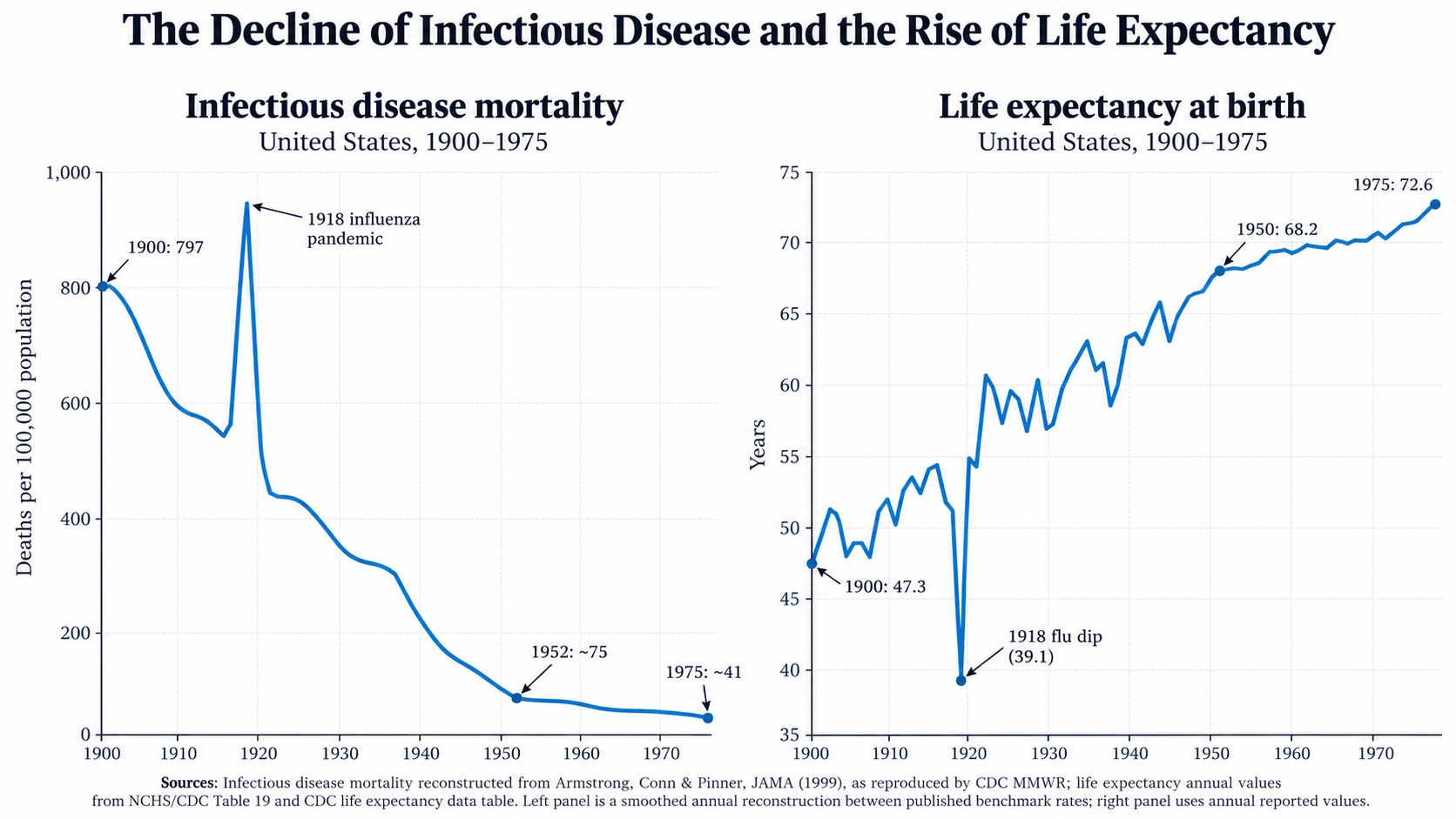
Of course curing cancer would be a miracle. The point is that, when you insist on invoking the most consequential changes in the history of the human experience, you invite questions like “What would that do to average longevity?” And the answer is underwhelming compared to the miraculous medical progress of the remarkable period from 1875ish to 1975ish. One core lesson of the past 50 years has been that, when you eliminate one disease, people die of something else, often in fairly short order, capping life-expectancy gains. Young people die at much lower rates than older people, obviously, which makes it harder to find low-hanging fruit to increase longevity given that old people will likely die fairly soon after being cured of a particular disease. That amounts to a kind of rubber-band effect that prevents curing diseases from having as big of an impact in large-scale longevity numbers as you might think. In fact, a big part of what life expectancy increases we’ve seen in that time period have come not from curing disease but from preventing disease with behavior, most notably dramatically lowering the rate of cigarette smoking - a public health victory, not a triumph of technology. Also, like I said… LLMs are not going to cure all cancers. That’s not a thing software can do and it may not be doable at all.
Recent progress in treating sickle-cell anemia, cystic fibrosis, hepatitis-C…. These are absolute goods, miracles for the people who suffer from those illnesses and their families. But compared to the gains in public health experienced in the 20th century, they have numerically tiny impact. And the kind of rhetoric invoked in AI hype demands we think on those scales.
This is where every consideration of the impact of LLMs should begin, in the realm of meaningful, material significance for the average person. It’s a standard that AI maximalists have failed to meet for years. You have things that are net negatives, like the fact that we’re drowning in slop and that it’s getting harder and harder to make a living in the creative arts. You have LLM affordances that create novelty and increase convenience, a state of affairs which merely intensifies what Silicon Valley has contributed for the past decade or two. (Seriously, think about how much technological development is devoted to novelty or convenience, it’s staggering.) And then you have the big “we’ll all own asteroid mines” stuff that hasn’t happened and is very unlikely to ever happen. None of it meets what should be our basic standards for revolutionary change. The observation that human life in 2026 appears to be almost entirely similar to human life in 2021 is not some irrelevance, nor is it a trick, nor is it a dodge. It is quite literally the single most important fact in this debate. None of this matters until and unless actual human life is meaningfully changed for most people in the material world. Until then, it’s all hype and speculation. And AI guys can’t keep handwaving that reality away. You keep telling everybody that everything has changed, but the vast mass of humanity has not experienced their life changing at all. And if you’re the ones still insisting that everything has in fact changed, you’re the ones who have to prove it. The burden of proof is on you. Don’t tell me what you think is going to happen. Show me what has already happened! It’s a fair, simple, wise standard.
If the apocalypse is coming, why haven’t you radically changed your life?
Many, many people now claim to believe that AI doom is coming. It’s an entirely common belief, these days, which is unsurprising given that our media and culture industries have been running wild with the idea for years. Every day I read people who have never before been “longtermers” or rationalists or similar insisting that, soon, we’ll be facing the AI apocalypse, that the robots will kill us all, and before you know it. There’s a lot you could say, but first I would ask… if that’s true, why then are you still just living your regular life? Shouldn’t you be attempting to change your individual fate, even if you don’t think you can save humanity? If you think the world is about to end, shouldn’t you be building a bunker somewhere? Shouldn’t you be learning to live off the land? Shouldn’t you be developing robot-killing armaments? Shouldn’t you be doing something different, anything other than what you’ve always done?
When I ask this question, the answers I get are pretty feeble. People say things like “Hey, it’s expensive to build a bunker!” But, again, the people I’m talking about believe that they’re facing the literal extinction of humanity. Would that really be your response? “Ah, it’s too expensive to do anything, I guess I’ll just prepare for death”? Wouldn’t you beg, borrow and steal to try and set yourself up with at least a chance at survival? Wouldn’t you sell your house and your car to buy a little chunk of land far from civilization in Alaska? Or a sailboat? Wouldn’t you learn to hunt, forage, and farm? Wouldn’t you study the ways of John Connor? Another response is that there’s nothing to be done - there is literally no chance to survive what’s coming, so why bother. To which I say… really? Nothing can be done? Nobody can be saved? Even Skynet didn’t stamp out every last one of us. There are 8 billion-plus human beings out there, after all. Is the machine god really going to invest a ton of resources chasing down a handful of people in the deep wilderness? In the middle of the Pacific? They’re hyper-rational thinkers, after all. And don’t people usually fight and claw and try to survive even when it’s hopeless? I think they do. I think you would, if you actually believed that you were facing imminent death. I don’t think you actually believe that.
My American politics teacher in high school had a bunch of bumper stickers on a pinboard in his classroom. One read “The Rapture is Coming! Can I Have Your Car?” This was the height of the Christian right’s influence in American politics, and the bumper sticker was poking fun at the millenarian tendency within that culture. The point is a good one: if you sincerely believe that Jesus will imminently return, you shouldn’t care about your worldly possessions. In fact, the inevitable and looming return of the messiah should be the single most operative fact in your entire existence. Your entire life should be oriented around preparing for it. There is quite literally nothing that’s more important! And yet so many conservative Christians who claimed to believe that Armageddon was at hand went on living the same old lives they always had - which would seem to suggest that they didn’t really believe it at all. Well, you can see that the logic applies equally here. People take the idea of imminent AI doom very, very seriously, and many will insist you’re unserious if you engage in healthy doubt. But I’m not seeing people reacting as if they take the threat seriously themselves.
The Silicon Valley guys who have taken up smoking because they’re convinced the world is about to end are suffering from AI psychosis and are likely making a bunch of other truly terrible decisions based on that psychosis and it’s all very sad. But they’re at least acting rationally, in line with their greater irrationality. They’re being consistent with their own beliefs. They’re taking their own ideas seriously, in a way. Why aren’t you?
Why do most of the predictions say that the AI utopia/apocalypse is coming within the lifetime of the person making the prediction?
This may look like the least important of these, but I actually think it’s very important. It’s important to understand why people are so certain about what are still fundamentally matters of guessing, speculation, and projection. I’ve asked this question over and over again, and the responses I’ve gotten have mostly been both nonresponsive and angry: isn’t it a remarkable coincidence that you happen to live in the most important period of human history? If the history of the species is about to be divided between a long past (~300,000-350,000 years) of the pre-AI era and a long future (?) of the AI-dominated era, isn’t it just quantitatively extremely unlikely that you happen to occupy this rare, precious interregnum? People try to chop this up in other ways - well, actually, if you look at modern history, it’s not that unlikely, or they show that graph showing that we’re living in a brief period of exponential progress, never mind that said period ended a half-century ago…. I just find this all to be obviously motivated reasoning. Why is it always #AGI2027 or whatever? Wouldn’t it be safer to predict #AGI2077? Ah, but you see… they’ll be dead by then. They won’t live to see the new world. They would just miss it, in the same way that they think that someone who dies this year will just miss it. Somebody’s got to be unlucky that way….
But, OK. Set aside the various epistemological questions here about the odds that you would exist in the time period in which you exist. I’m obviously attempting to inject a little basic human psychology here: it’s hard to fight the desire to live in the next epoch, particular one that will supposedly be free of disease and war and famine and maybe even death. The outlandish claims about what AI is going to do, very soon, have obvious appeal. Indeed, that appeal is quite similar to the appeal of religion. Look at the things that the AI maximalists claim the technology is going to do: end work, end scarcity, end disease, end death. We’ll have fusion producing endless clean energy1, we’ll have immense economic growth2, we’ll all upload our consciousness to the cloud so that we never have to die3, we’ll colonize the stars4…. In much the same way, religious evangelists insist that our lives have transcendent meaning, that the righteous and the wicked alike shall have their reward, that we’ll see the people we have loved and lost again someday, that we’ll live forever in glorified bodies…. I’m an atheist, in part, because I recognize that the stories religion tells are too convenient, that the promises of religion match our desires too closely. I’m an AItheist, in part, for similar reasons. Of course this reasoning can’t prove anything about what is or isn’t coming. But there’s far too little willingness to consider what motivates people to believe so fervently and so irrationally. It is, yes, like religion.
Ah, but you were just saying that people say they believe in an oncoming AI apocalypse! But of course people want the apocalypse almost as much as they want utopia. Just check the bestseller lists. What people want, fundamentally, is radical change, away from this mundane, sad, same-old world. And they really don’t want to miss the end of the old world and the birth of the new.
I’ve always seen Ray Kurzweil as a tragic figure. His decades-long insistence that “the Singularity” will occur within his lifetime seems so obviously motivated, so yearning. Hey, Ray - why not twenty years after you’re dead? Ten? Five? What makes the lifespan of Ray Kurzweil so special? Well, it’s certainly special to Ray Kurzweil. And this is an apprehension of basic human psychology that I find to be really lacking in this debate.
How could your AI predictions be falsified? And when will I be able to say “I told you so”?
Most AI predictions, whether they’re of the utopian or apocalyptic variety, refer to a) concepts like “AGI” or “superintelligence” that nobody has defined precisely enough to check and b) a future with no fixed date. That means that when the next development isn’t revolutionary, it can be said to fail to meet the standards of AGI rather than to be a failure of AGI, and when next year is mostly like this year, the response can always be “wait until next next year!” When a given actually-existing AI technology fails to achieve what’s been promised, they can say that it isn’t superintelligence or AGI or the Singularity or whatever, and that the real thing will surely get the job done when it comes. When a predicted breakthrough or catastrophe fails to arrive, the true believers can just say, hey, the timeline slipped, or the threshold hasn’t really been crossed, or disaster was narrowly averted, so that nothing that actually happens ever counts against them. Just wait awhile!, for the rest of time. In this way, AI maximalists has developed a remarkable immunity to admitting when they’re wrong: every success is treated as confirmation of the technology’s potential, every failure is represented as evidence that said potential simply hasn’t yet been fully realized. But a prediction that can survive indefinitely regardless of what actually happens is not really a prediction at all, is it?
Or consider the probabilistic versions, favored by the rationalists - a 20 percent chance of doom or a 50 percent chance of transformative AI by 2040, etc. I guess the numbers give your prediction an air of quantitative certainty. But this runs into the same problem as all predictions with a probability assigned that refer to a single unrepeatable event: either outcome is consistent with the forecast. If you say there’s a 99% chance, and it doesn’t happen, well that’s just the 1% outcome. You don’t expect a 99% probability chance to hit 100% of the time, after all! This is a generic issue with assigning probabilities to one-shot events and I frankly don’t understand why they’re so often taken seriously; probability, after all, is a function of replicability. There’s no way to confirm or disprove such estimates. Well, presumably the AI utopia/apocalypse only happens one time. So what is the value of saying “There’s a 70% chance that AGI arrives in the next three years” if you can always point out that you predicted a 30% chance it wouldn’t arrive? There’s just a remarkable lack of stakes and accountability in this domain.
Falsifiability is important in philosophy of science, but it isn’t everything; there are certainly some claims that are true but non-falsifiable. But the lack of falsifiability of outlandish AI claims is still a real big problem, particularly given that they’re made with such confidence, and especially given their enormous economic and political consequences. Karl Popper’s concept of falsifiability wasn’t meant to represent a clear dividing line between legitimate knowledge and mere speculation. (And he never said it did, for the record.) After all, many reasonable beliefs can’t be subjected to decisive empirical tests, and many scientific theories are useful long before we know how to test them. (General relativity predicted gravitational waves in 1916; they were first observed, empirically, in 2015.) But there’s a profound difference between acknowledging the limits of the falsifiability framework and treating those limits as a license to make extravagant predictions without any accountability. One more time: extraordinary claims require extraordinary evidence. If we’re going to reorganize our economy on the basis of predictions about AI, we’re entitled to demand more than mere promises that the revolution is just around the corner.
And, yeah - you need to define what “just around the corner” means. The completely unbounded time horizons drive me batty. When is this stuff coming? It’s not just important for figuring out what we really believe the world will look like in one/three/five/ten/twenty-five years. It’s important for establishing the accountability I’m talking about. If you can just push the predictions further and further back into infinity, those predictions will never be really tested and your credibility can never be truly evaluated. And we should be past all of that now. You need to ante up with a) specific guidelines for what would disprove your predictions and b) a specific date by which they will in fact be proven or disproven. “AI is going to supercharge our economy someday” is not a prediction. It’s not testable; it’s not falsifiable. “I am willing to stake my credibility on the idea that the United States will experience double-digit GDP growth per annum by New Years Day, 2032” is a prediction. There’s a specific way to say whether it’s true or false and a specific point in time past which we can definitively say that it did or did not come true. Here’s Jay Samit, in 2015, saying that driving your own car will be illegal by 2030. Not looking good, Jay! But good for you for making a testable prediction with a clear and explicit time horizon. That’s how you do it. That’s how you make predictions. I made a bunch, in an effort to do AI skepticism responsibly. AI maximalists should do that too.
So - what are your specific, falsifiable, time-bound predictions, Ezra Klein? Kevin Roose and Casey Newton? Scott Alexander? Tyler Cowen? Ross Douthat? Any of you, out there? Let’s hear them. You think I’m wrong about everything, fine. You think I’m a crank, fine. You are certain you will soon bathe immortal in the digital bath of AI-directed neurotransmitter fugue, fine. If nothing else, the lack of falsifiability and the failure to assign specific time horizons to specific predictions is a real demerit of contemporary AI fortune telling. So please, give me specific predictions that have a specific time horizon, preferably about significant changes in the material world that can be observed by ordinary people. I’ll put them in a spreadsheet and keep track of them for ya.