A data study of ~53,600 Steam game releases from mid-2023 to mid-2026.
Since January 2024, Valve has required developers to disclose AI-generated content on their Steam store pages. That disclosure is a small, machine-readable footprint — and if you collect it for every game, month by month, you can watch the entire generative-AI wave roll through the games industry in real time.
So I did. This post is built from a full census of 53,597 games released between July 2023 and July 2026 — not a sample. For each one I recorded whether its store page carries the “AI Generated Content Disclosure” section, when the flag first appeared, an estimate of its revenue, and the actual text developers wrote. Here’s what the data says.
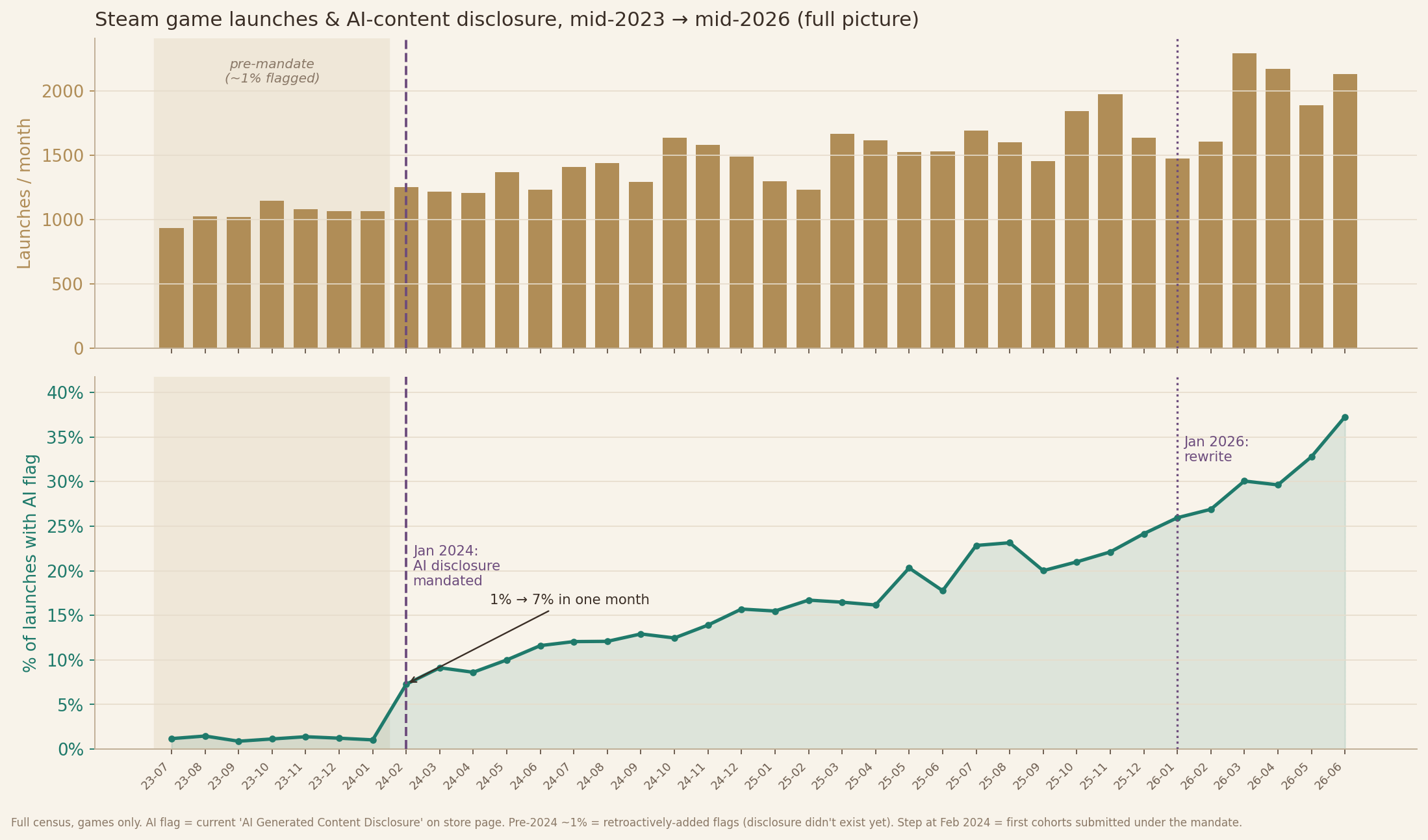
One caveat first, because it’s essential to reading this chart: Steam’s AI-disclosure mechanism did not exist before January 2024. There was no field to fill in and nothing to show on a store page, so contemporaneous AI disclosure in 2023 was structurally zero — not low, impossible.
So what’s the ~1% sitting under the shaded 2023 stretch? It’s entirely retroactive: a small number of older games later went back and added the flag once Valve’s system went live (more on that in §7). Read the pre-2024 portion as a near-zero baseline that only exists because I’m measuring today’s flags against historical release dates — not as early adoption.
What the data shows cleanly is the moment the mechanism turned on. The first cohorts submitted under the new rule surface in February 2024, and the flagged share jumps from ~1% (retroactive noise) to ~7% (real, at-submission disclosure) in a single month — then climbs steadily:
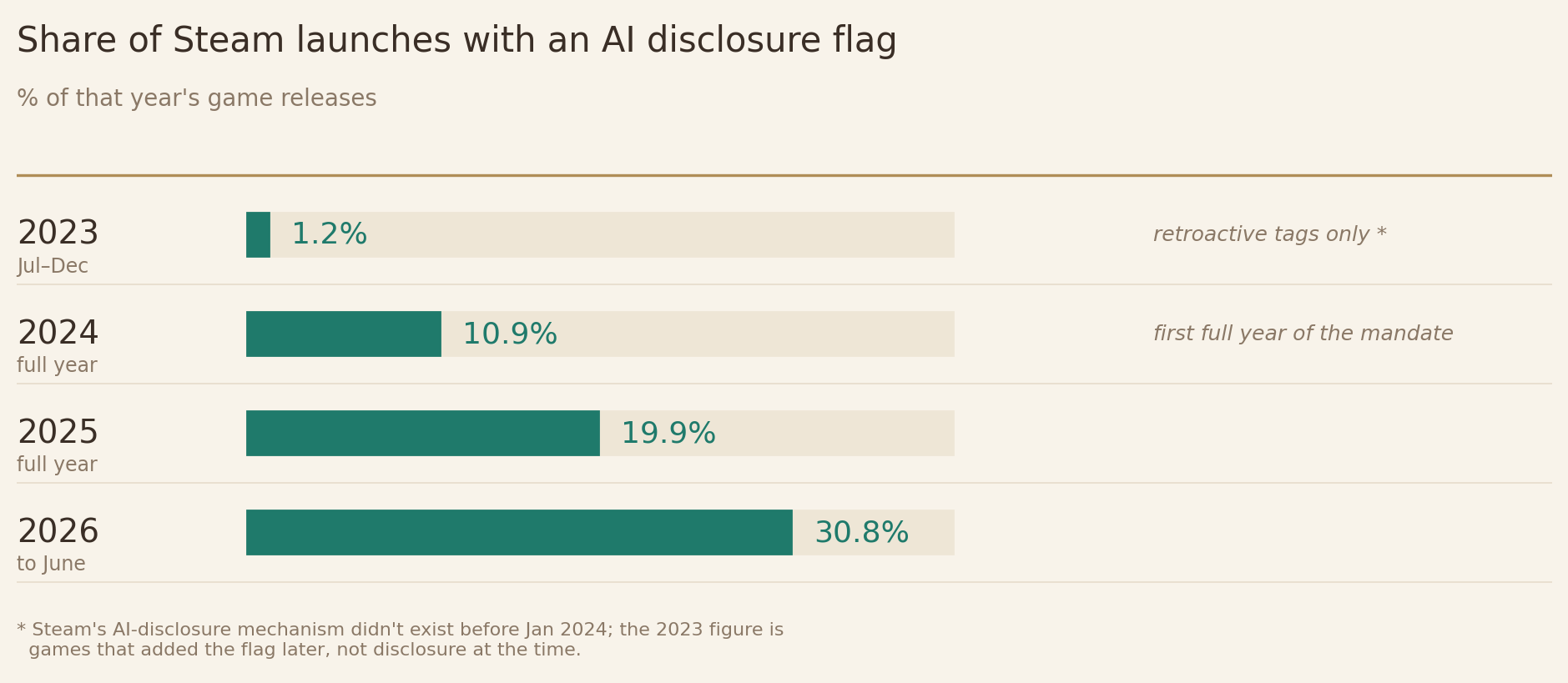
By mid-2026, roughly one in three new Steam games carries a genuine, at-submission AI disclosure — a real adoption ramp built on top of a baseline that started at literal zero.
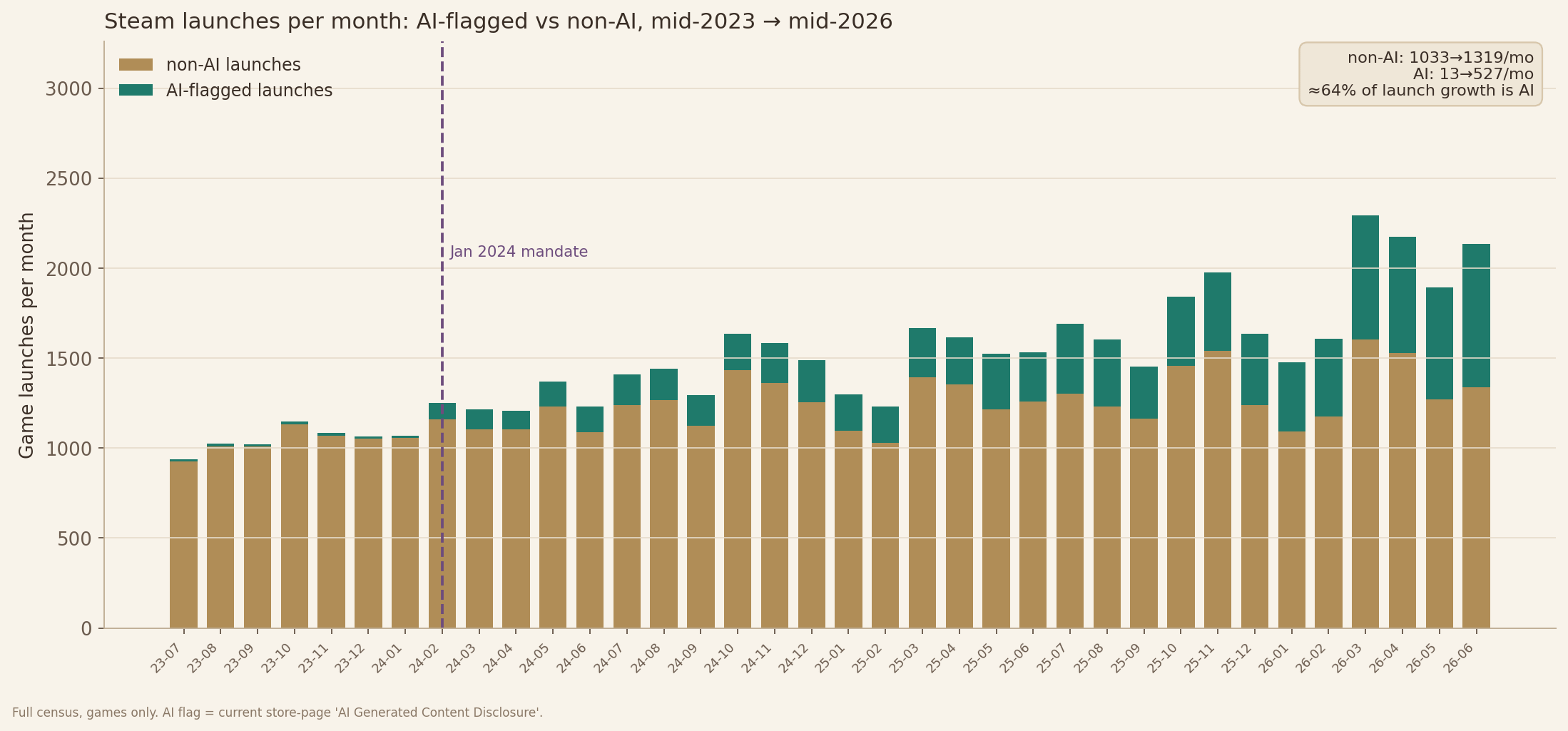
Steam’s release volume has grown a lot — but the growth isn’t evenly spread. Non-AI launches have risen only modestly (~1,030 → ~1,320 per month), while AI-flagged launches went from a rounding error (~13/month pre-mandate) to ~530/month. Depending on the window you pick, 60–90% of the growth in monthly Steam releases is AI-flagged games. The record-setting months of 2026 are the blue layer stacking up, not a surge in traditional development.
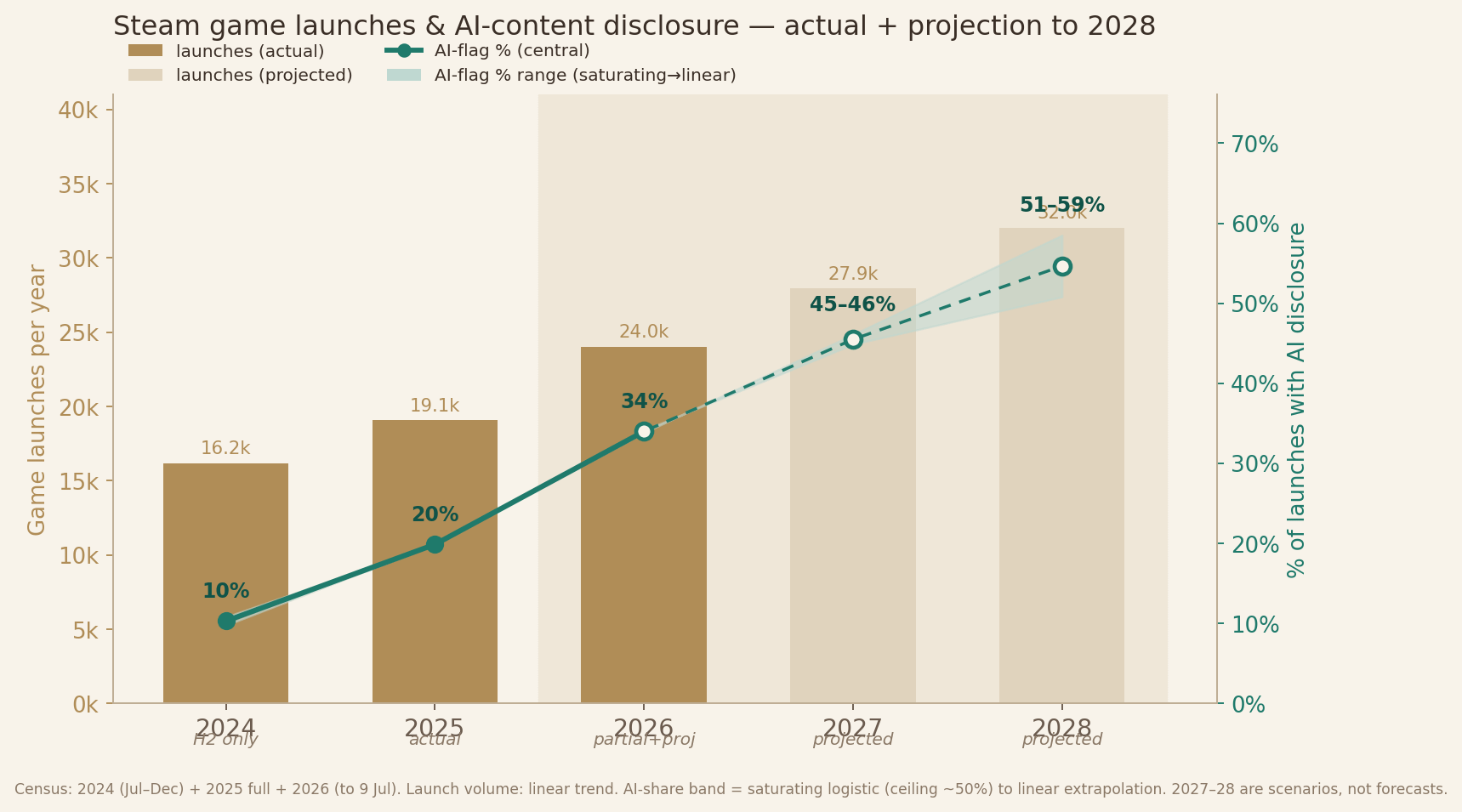
Extrapolation is not prophecy, so this is a scenario, not a forecast. But if the current trajectory holds, AI-disclosed games cross ~50% of all Steam releases somewhere in 2027–2028. The band reflects two models: a saturating curve (plateau near 50%) and a straight-line continuation.
Before comparing AI to non-AI economically, you have to internalize how brutally hit-driven the platform is. Across the measured games:
The top 1% of titles capture ~94% of all estimated revenue.
The top 10 games alone account for ~62%.
The median game that gets any reviews at all makes an estimated ~$300; about 28% get zero reviews (≈ no measurable sales).
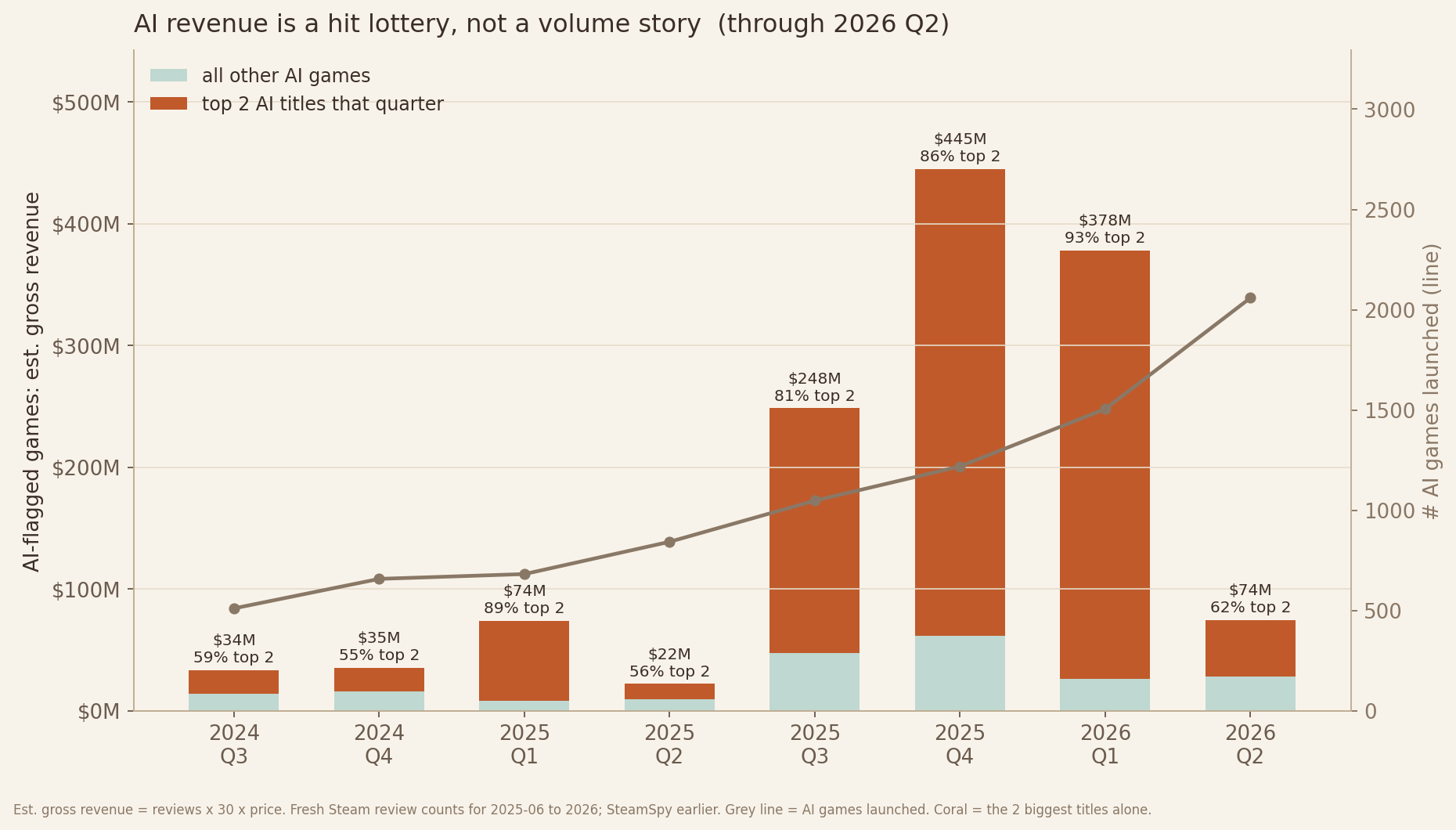
This is why “AI revenue” lurches around quarter to quarter: it’s not a broad trend, it’s whether one or two AI titles happened to hit. In the chart above, the coral slice is just the top two AI games each quarter — routinely 45–79% of all AI revenue. More AI games shipping barely moves the needle; landing a hit moves everything.
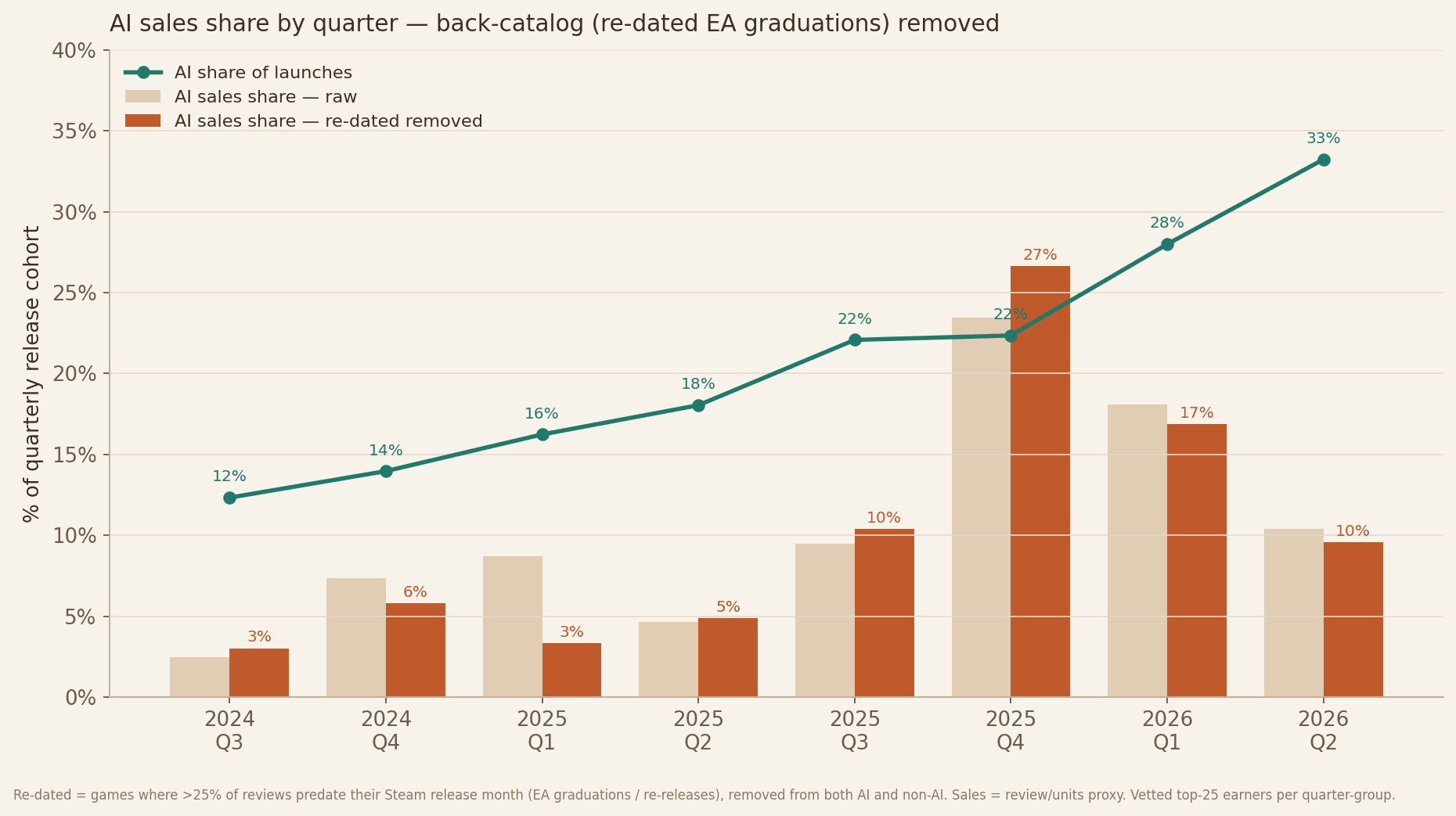
Measuring AI’s share of sales (using review counts as a units proxy, and stripping out re-dated back-catalog titles whose reviews span years), the share grew from ~3–6% in 2024 to ~10–27% across late 2025 and 2026. It’s real growth — but it still sits well below AI’s ~33% share of launches, and it’s volatile because it rides on hits.
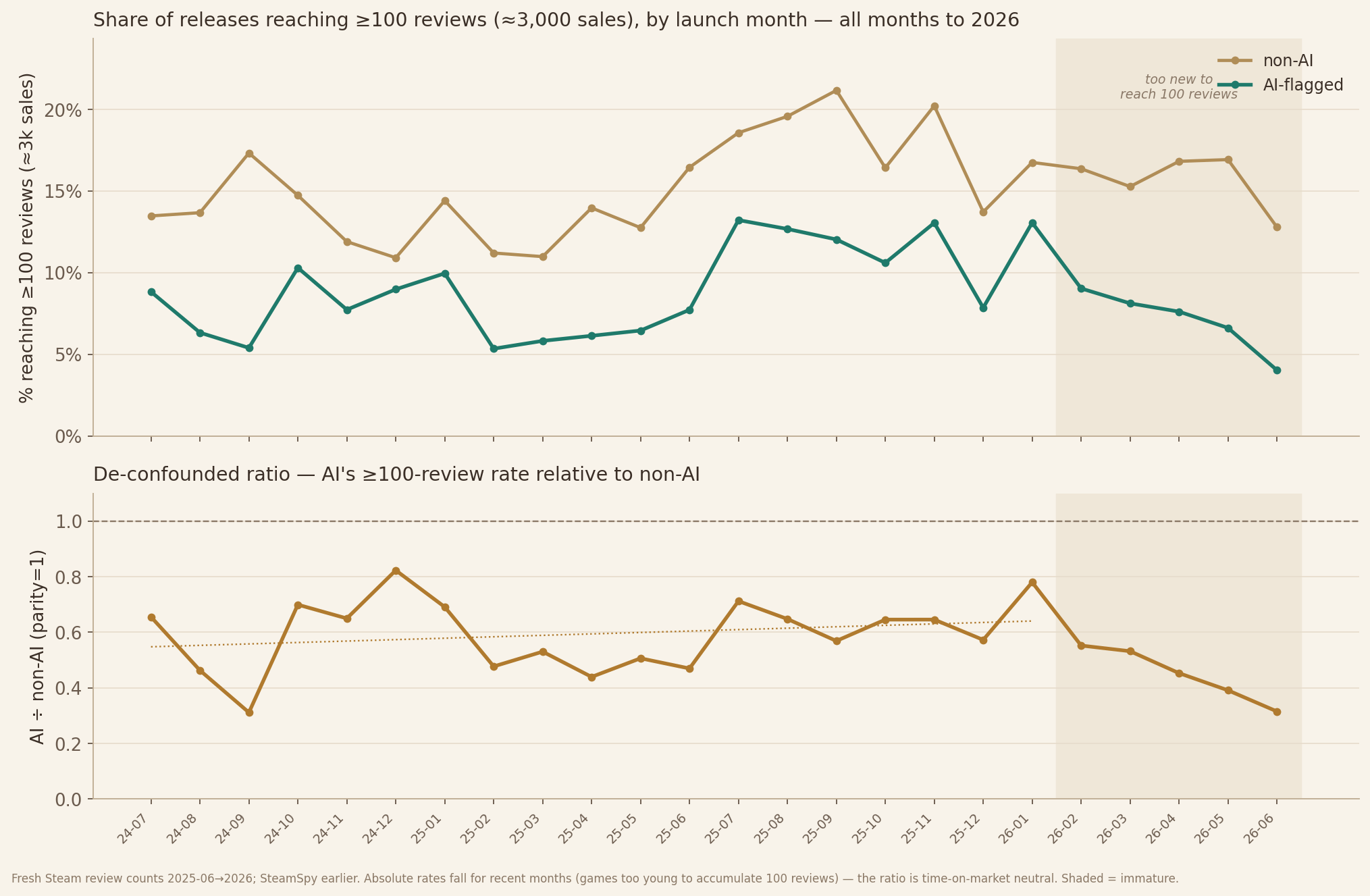
Crucially, when you control for time-on-market by comparing AI to non-AI within each launch month, the per-game picture is flat. An AI-flagged game reaches a real modest-success tier (≥100 reviews ≈ ~3,000 sales) at only about 55% of the non-AI rate — and that ratio hasn’t improved in two years. So AI’s rising sales share is currently a volume story, not a quality story: more shots on goal, not individual AI games converting better. With models improving this might change, and it’s maybe worth noting the games using latest models & other AI tools are still in development.
There’s a trap here: looking only at successful AI games tells you what winners do, not what the population does — and the population is 87% commercial non-performers. So I scraped the disclosure text for two groups: the 138 that succeeded (≥1,000 reviews) and a random 400 that flopped (<50 reviews, on the market ≥9 months).
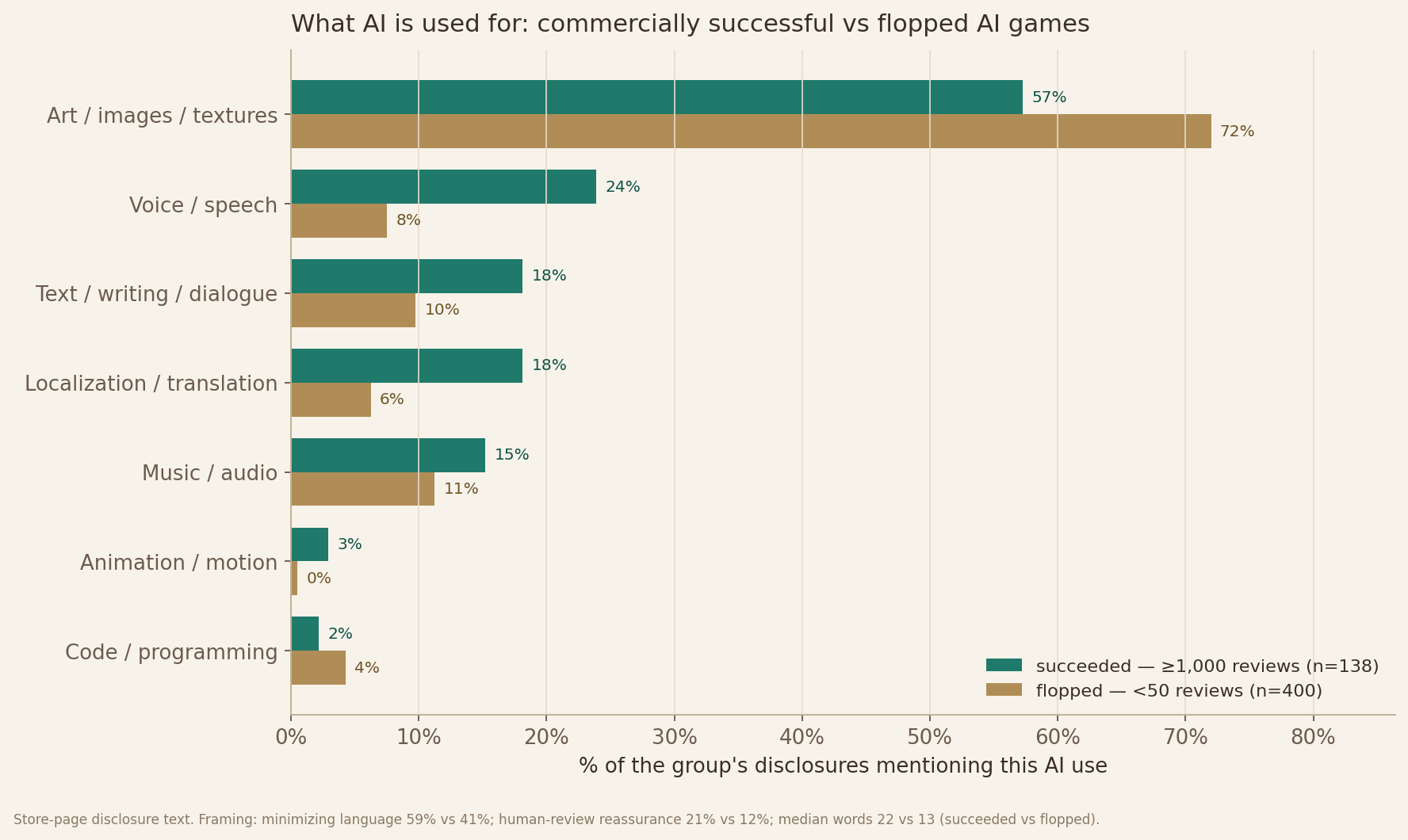
A bit surprisingly, across both, disclosed AI is overwhelmingly visual — but it’s more concentrated among the flops: 72% of flopped AI games mention AI art/images/textures, vs 57% of successful ones. The successes are more multimodal and market-oriented — 3× more likely to disclose AI voice (24% vs 8%) and localization (18% vs 6%), and more likely to use AI for text and music. The median flop is an art-asset play and little else.
The framing diverges just as sharply:
Flopped disclosures are barer. Median 13 words vs 22 for successes; 35% of flops are a single ≤10-word line (”There are some AI generated paintings…”) against 13% of successes.
Successful games hedge and reassure more — 59% use minimizing language (”assist / auxiliary / supplementary”) vs 41% of flops, and 21% add human-oversight reassurance (”reviewed and manually refined”) vs 12%. The higher the commercial stakes, the more careful the wording — AAA boilerplate (”Generative AI may have been used…”) and outright downplaying (”We do NOT use AI-generated art”; “voice lines, disabled by default”).
This reinforces the revenue picture from §4–5: the mass of AI games that go nowhere skew toward low-effort, single-modality art generation with a throwaway one-line disclosure, while the rare commercial successes use AI more broadly (voice, localization, text) and treat the disclosure as something to word carefully. Genuinely AI-native games (like inZOI’s player-facing generation) exist, but across ~9,400 AI-flagged titles they’re a tiny minority.
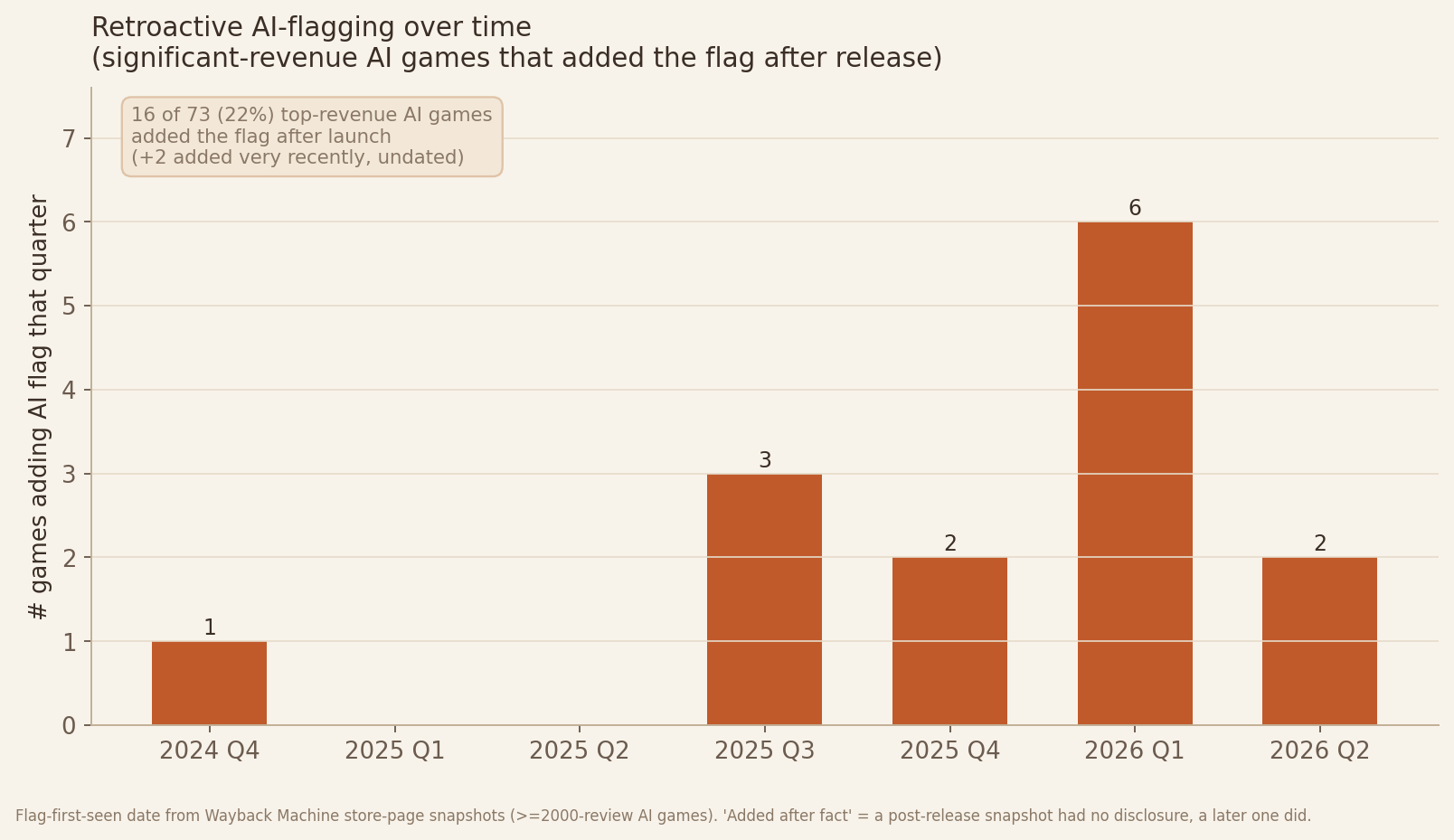
Using the Wayback Machine to date when the disclosure first appeared on each store page, I found that 22% of significant-revenue AI games added the flag after release — sometimes years later (Crime Scene Cleaner: +20 months). These retroactive additions cluster tightly around Valve’s January 2026 policy rewrite, exactly the signature you’d expect from a compliance sweep. In other words, part of the 2026 uptick in the current flag counts is the back catalog being relabeled, not just new AI games shipping.
Census: every “Games”-category release, mid-2023 → mid-2026, enumerated from Steam’s search and checked for the store-page disclosure section. ~53,600 titles.
Revenue is estimated, not reported. I use the Boxleiter method: units ≈ reviews × 30, revenue ≈ units × price. These are gross, at list price (before Steam’s 30% cut, discounts, and regional pricing) and are only order-of-magnitude accurate — fine for comparisons (AI vs non-AI, hit vs tail), not for any single game’s real earnings.
Review counts come from Steam directly (current, all-language) where possible, flag timing from the Wayback Machine.
The flag means “disclosed,” which spans everything from one AI-made painting to fully generative gameplay. It’s a “touched AI” signal, not a measure of how much.
Newest cohorts are young, so their absolute success rates are time-censored; the AI-vs-non-AI ratios control for this.
Data and all figures were generated from the raw census; revenue and disclosure text are available as CSV.
Want to support generating more writeups like this? Subscribe to this Substack.
I had too much fun with this data, so here’s part 2 with even more analysis.
AI flagged games on Steam, Part 2

Follow-up to the full-census study of AI-disclosed games on Steam. Same ~53,600-game corpus (mid-2023 → mid-2026), now with developer/publisher, user ratings, price, and genre pulled in — and a scorecard on the claims everyone repeats.