I made posts on Bluesky and Twitter about a lawsuit against Valve a long time ago. Someone recently found the Bluesky posts and liked them. I figured it’d be fun to write a blog post about what I found.
When you buy an app, 30% of the money you spend is taken by Apple or Google before it reaches the developer.
I strongly believe (and think court records show) that their revenue is highly disproportionate to the amount of economic value that they create, and that this is the result of a series of predatory behaviors by both firms.
To summarize, though: if you are a developer of an app then, through fees, Google and Apple will take approximately 30% of all revenue you earn through their platforms.
Unfortunately, as a non-gamer, this seems to garner (in my experience) less attention online than alleged problems with “the Epic Games Store.” The Epic Games Store is a storefront for games with 0% fees for developers up to the first million in sales, and 12% fees after. Gamers seem to prefer Steam, a storefront run by a company named Valve, where fees for successful games are 30%.
(Note: a 30% fee for developers might be expressed as a 1 / (1-0.3) ~= 43% tax on buyers.)
Further, because the issues with App Store / Play Store fees are also so well documented by the major newspapers, there’s not much I can add to the discussion.
For the n-th time, I am not a gamer. But in a quest to answer how Valve can charge such high fees (when my belief has always been that a competitive market could not bare them), I’ve come to the conclusion that there’s a story here others have missed:
A lawsuit is convincingly showing Valve’s fees to be extortionate.
I am hopeful that this blog helps show that the fees charged by Valve, Apple, Google, etc., are not just a necessary industry standard, and that lower fees (as set by market forces) are possible.
Wolfire Games, a game studio I know absolutely nothing about, has been in court against Valve for a while. Details of the lawsuit are on CourtListener. They’re pretty juicy.
In a fair market, a store with much less overhead than another should be highly competitive with it. The Epic Games Store has much less overhead. Why hasn’t Valve felt pressure to cut fees?
We can acknowledge some truths, first. But one of these is more important than the others:
Users like Steam’s UI, integration with the Steam Deck and Linux support, etc.
Steam has strong network effects. This goes hand in hand with the next bullet.
Steam has huge market share, serving as a sort of universal marketplace (all gamers use it, and every other store has little market share) and so developers forgo a lot of revenue if they aren’t on Steam.
It doesn’t explain why, though, developers don’t sell stuff off Steam for less money, and then pass those benefits on to consumers. Indeed, many have shown skepticism about this:
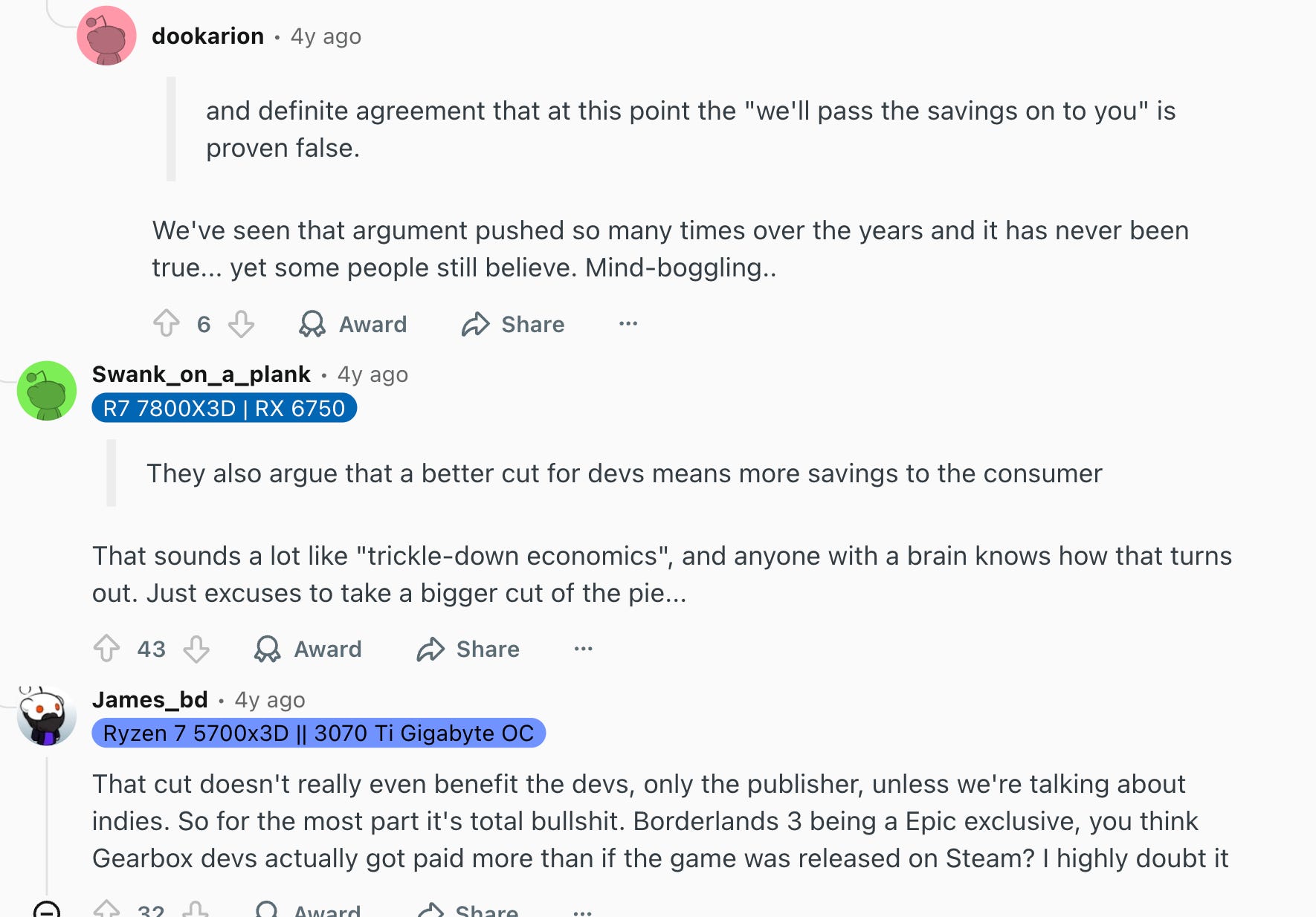
(Brief response to those comments: this has nothing to do with “trickle-down economics”; developers pocketing the money and not lowering prices means that they have more money to invest in games, and so that’s still a good thing; and publishers pocketing the money is fine because, even if publishers did eat all of the benefits, they still compete with each other, and this gives developers more room to negotiate—plus, self-publishing is a thing! Steam famously pioneered it with Greenlight!)
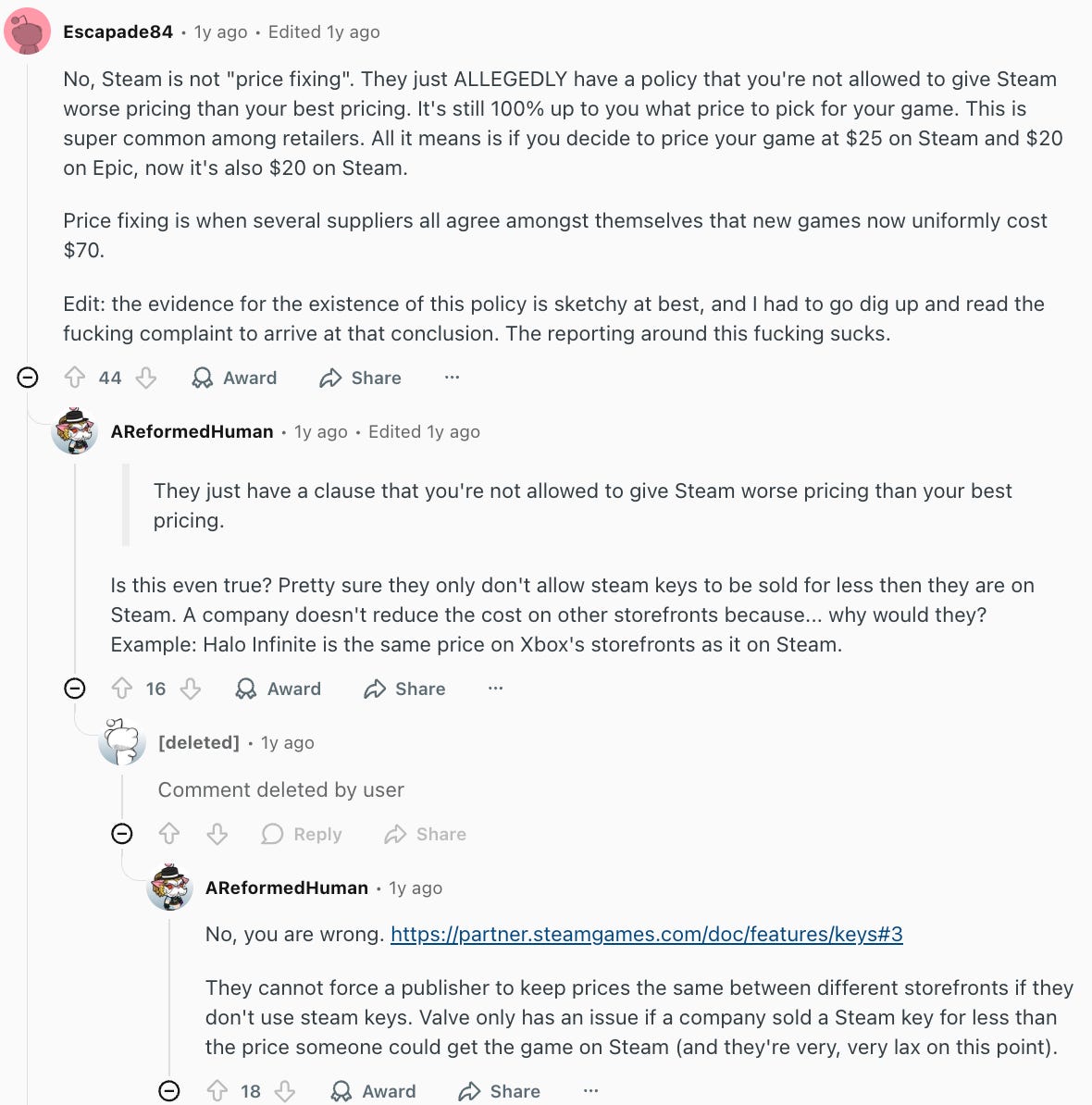
So how does Valve do it? For a while, the most common explanation—that Valve used its market share to make developers agree not to sell any game on Steam for a lower price on another storefront—has been considered debunked. See, e.g., this Reddit comment thread. These people are debunking the argument by pointing out that, actually, Valve’s “most-favored-nation clause” is only about selling redeemable Steam keys for a game for less than the Steam price, not about selling a game for less on other sites in general. See e.g. these comments:
Some will also cite, for example, the fact that there are clearly exceptions.
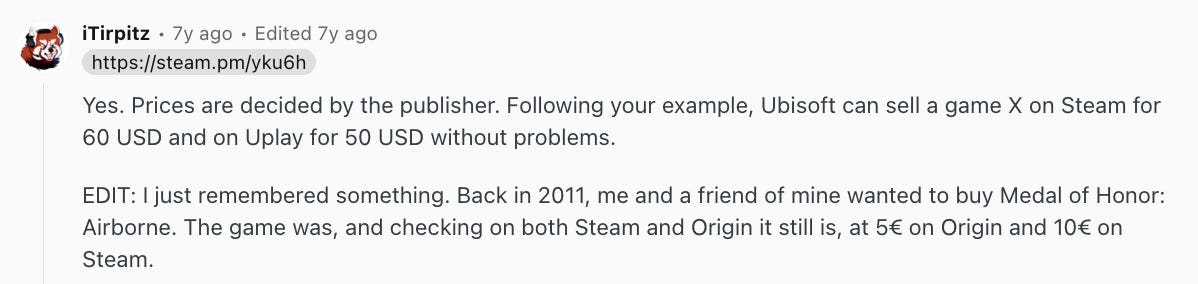
(Brief response: Valve is not omnipotent, so they would have to notice; and they are not clearly incentivized to fight a giant like EA over an ancient game.)
But what if I told you that these debunks are, themselves, debunked? And what if I told you that, moreover, Valve goes far beyond requiring pricing favoritism?
I’ll go over one court filing, attached below, and review it in no particular order. But I’ll summarize here: if you are a developer, you are punished for doing anything that might make a customer use another storefront, including (but not limited to) making the decision not to use Steam for a future product.
These are things that are probably popular with end users but nevertheless harmful in the long run because they make it hard to justify investing in the creation of a competitive platform.
(Note for the following quotes: SDA = “Steam Developer Agreement” and “DLC” = “Downloadable content”)
Investment in non-Steamworks (a Valve library that uses Steam’s services to let developers enhance their games) capabilities is difficult, because you can’t do anything not supported in Steamworks. Accordingly, there’s not much of an incentive to compete:
Valve’s SDA imposes a contractual requirement of content parity for all games sold on Steam. This prevents developers from adding any features to their games elsewhere that they do not offer on Steam.
Developers can’t work with other storefronts to launch partnered, timed exclusives, something you might need to bootstrap a storefront against a competitor that benefits from network effects:
If a publisher distributes a game elsewhere and “distributes any material DLC for the Application through that other channel, it will deliver the DLC to Valve at the same time such that Steam Account Owners will receive comparable DLC…”
Again, differentiation is banned:
“If a game on Steam is going to be materially different from the game on other PC platforms, we’d rather just not have the game on Steam in the first place.”
“In that situation, the only Steam version would be materially worse than the non-Steam version. We’re not really comfortable with that scenario.”
“We ask that digital content you offer outside of Steam be made available to Steam users directly so that the Steam version is not disadvantaged.”
Again, these all sound minor and not that important, and probably even pro-consumer. But consider the message it sends to a business that might want to compete with Valve: they need to compete with Steamworks, but their customers literally cannot use anything that they do better than Valve, must put Valve first (or on equal footing) in terms of release priority, even if Valve has slow developer support, etc (and so you can’t compete by being faster than Valve), etc.
Let me give an example: suppose Epic Games made a modding system much better than Steam’s “Steam Workshop,” an area where there must be some room for competition. Suppose, then, a developer creates DLC or game update that can take advantage of these Epic Games features to do things not doable on Steam. Well, that developer would be punished by Valve. And because it’s not an option for most developers not to ship on Steam, that means almost all developers will be punished, and so almost none can use Epic Games’ new modding system. Epic Games knows this, and so there’s no reason for them to even try to beat Valve.
The debunked claim that Valve’s most-favored-nation clause is only for Steam Keys comes from this:
It is important that you don’t give Steam customers a worse deal than Steam Key purchasers.
However, it’s actually universal. This means storefronts cannot compete with Valve by cutting fees to lower prices:
Giardino testified that price parity is a “platform goal that goes beyond Steam keys” and that Valve “doesn’t want Steam to be a ‘disadvantaged place to buy your game’.”
Valve has stated, in writing, that you cannot give other storefronts better deals. No wonder you don’t see savings passed on to buyers that much:
“Do-able: Sell the same content and make sure the price on Steam is competitive with where it’s being sold anywhere else (using keys or not, in a bundle or not).
Not doable: Sell the content to another store at a better price than Steam customers get (using keys or not, in a bundle or not). Even if the content isn’t being sold via Steam keys, we generally just choose not to sell games/DLC if we’re not getting the same prices as other stores.”
Seriously:
“We just opt to stop selling games if partners don’t treat our customers fairly.”
They even said “keys are pretty irrelevant” and that differences in discounts are what they care about:
Valve told a publisher it would “just choose to stop selling a game if it was always running discounts of 75% off on one store but 50% off on ours… Keys are pretty irrelevant to the root concern: treat Steam customers fairly.”
If a developer’s price on one store makes Steam look more expensive (the sort of thing that matters for competition), the developer gets a phone call:
“In this situation, we usually reach out to the developer and explain that the price on [other store] makes the price on Steam look high. We believe this will result in regret purchases by Steam customers… The ask from us to the partner is to match the lower price.”
“We will not knowingly invite customer regret” (remember this phrase) means they’ll stop selling stuff to minimize it:
“One of the things we try not to do on Steam is have a customer regret their purchase… We will not knowingly invite customer regret by offering your game at a premium to other retailers. Our general attitude historically has been that if Steam customers don’t get a fair shake compared to customers on other stores, we just opt not to sell the game in question, rather than make a bad offer that erodes user trust in the store.”
An internal (from Valve employees) description of Valve’s approach to “standoffs” over pricing:
If Valve and a publisher “end up in a standoff” over price, Valve would “often limit marketing of the title on Steam” until “pricing is competitive among platforms.”
Valve shuts down platform exclusives. If you, as a developer, choose not to sell a game on Steam over the fees, everything else you sell on Steam will suffer. Consider the ramifications in conjunction with their other policies: competing storefronts have almost no way to meaningfully entice both sellers and buyers, and a storefront cannot succeed without both.
Kassidy Gerber on enforcement options when content isn’t on Steam:
“If a developer is promoting content, and we are aware of it, and we don’t have it on Steam, then I will ask that we can make it available on Steam… We might delay some curated promotion. There’s a bunch of different things we might do.… Q: ‘You might take down their game?’ A: ‘… I guess, technically, it’s an option, yes.’”
“Customer fairness,” “customer regret,” “customer treatment” and such:
Giardino described the policy as being about “how customers get treated”, saying Valve wants to “make sure people buying on Steam get treated fairly compared to people buying the PC version anywhere else.”
And:
“One of the things we try not to do on Steam is have a customer regret their purchase.”
If there’s any benefit to having used a competing platform for a transaction instead of Steam, this would cause customer regret. Accordingly, Valve’s explicitly-stated priority is not to allow users of other platforms to enjoy any benefits whatsoever from those other platforms.
Again, monopoly power =/= 100% monopoly. It is a term of art. But yes, they have monopoly power, and it translates to unusual profitability, not just revenue.
“Valve has recognized that Steam’s profitability is an ‘outlier’, even among other powerful and successful companies that produce software platforms, including Apple, Alphabet, and Netflix.”
In other words, they know they don’t have to compete, so they can make a ton of profit that wouldn’t have been earned in a competitive marketplace:
“Valve’s incentives to innovate and improve Steam’s features are diminished by its monopoly power, with Valve itself admitting that Valve’s failure to innovate and create value for customers has not hurt Steam competitively, because Steam has eliminated all meaningful options for gamers and developers.”
If you are a gamer or game developer, you are seeing fewer games, lower quality games, more bankrupt studios, harder negotiations against publishers, lower game developer wages, fewer game developers, lower-quality game engines, and/or more expensive game prices because of Valve’s anticompetitive behavior.
This blog is just a hobby, but it is one that I would like to take seriously. Accordingly, I have a new blog schedule: I will be blogging every other week. Ideally, a blog post will go up every other Sunday from here on out.
The new, official purpose of this blog will be to share thoughts on topics that people might wonder about but lack either the insider knowledge or the interest to spend time on.
Accordingly, the set of topics covered by this blog will be extremely broad, while the focus of individual posts will be extremely narrow.
Some fun, miscellaneous other and/or fuller quotes, directly ripped from the PDF. I did not want to belabor the point, but some of these are good:
(165) In April 2019, a publisher named [REDACTED] asked Valve whether its parity requirement extends beyond Steam Keys (while mistakenly assuming this requirement was documented in the SDA): “I can’t find the contracts. Where [is it] about selling the game on other platforms and not going cheaper than on [S]team: is this only about keys or also about selling the game independently [sic], not using Steam keys at all?”
In response, Valve confirmed it took fundamentally the same stance regardless of whether Steam Keys are at issue: “[W]e try not to focus too much on whether the game is being sold via Steam key or not. It is a specific thing we ask people to respect when they sell keys, but we’re also uninterested in operating a store that gives people bad offers—so we just stop selling games if we aren’t able to secure the equivalent price for them.”
Valve then gave a specific example: “(For instance if another service like Uplay or Origin was selling a game for $15 and we were selling it for $20, we’d ask the dev to give us that lower price or opt to not sell the game, even if the sales at the other store weren’t using Steam keys.)”(166) Steam publishers, including the largest publishers in the PC game industry, are aware of Valve’s parity requirements. For example, in an internal email among Microsoft employees, one employee asks whether Steam requires price parity, and in response, another Microsoft employee replied “Yes — they absolutely do. … Its [sic] not formally listed in documentation in Steamworks, but always addressed in-person.”
Another internal Microsoft email states:
“[T]he Steam publishing agreement historically has required product and price parity. When I looked at it pre Age:DE a few years ago, I found that we could sell at any price we wanted before Steam release, but once we released on Steam we needed to give Steam price parity to our other digital channels. In the case of a GoW5 Steam/Windows Store (Garrison) simship, I’d assume Steam demands you don’t undercut them once you release on Steam.”(167) As another example, when Valve threatened to delist a major [REDACTED] game from Steam because its price on Steam was higher relative to the retail price in the [REDACTED], [REDACTED] responded: “We’ve been thru this before.”
(161) Publishers are also aware that Valve’s parity requirements for Steam Keys apply more generally to pricing. Valve has repeatedly explained to publishers that it could choose to stop selling non-compliant games.
For example, in a March 2013 email to a publisher named [REDACTED], Valve explained that its parity requirement applies regardless of whether Steam Keys are at issue:
“If your long term strategy is to sell the game super cheap, that’s fine. But constantly offering your products at way better prices on other stores isn’t OK, whether you sell at better prices on other stores, even if they didn’t use Steam keys. If you wanted to sell a non-Steam version of your game for $10 at retail and $20 on Steam, we’d ask to get that same lower price or just stop selling the game on Steam if we couldn’t treat our customers fairly.”
Valve confirmed this was not a new policy: “No, we’ve always asked that partners treat our customers fairly, and we’ve often opted not to promote games or stop selling them altogether if we aren’t able to get fair treatment for our users.”
The practical effect of the PMFN is to make sure that Steam customers have little incentive to go elsewhere to purchase and play games.