(This article originally appeared at PricingFromTheStart.com)
Early in my career and in the early days of SaaS, I built a time tracking system for the agency I worked at. Twenty people, eighteen – including me – billable at $200/hour.
I was the only employee comfortable writing code and managing web servers so I was an obvious choice. But this alone, not to mention I was also billable, suggested the company should have just subscribed a time-tracking system from someone else. It didn’t take me long to get an initial version running – let’s say 2 weeks. Then when my co-workers started using it, the bugs became obvious. Bugs on the data input side were frustrating my team mates, bugs on the output side were frustrating the CFO and account team. Fixing those bugs took time, time that competed with billable hours. When a client project needed me, development stopped.
All told, the internal app build cost more than $16,000 in opportunity cost. If we said a commercial SaaS version cost $2,400/yr and covered the entire company, the breakeven on the internal build was 6.6 years (and that’s presuming zero ongoing maintenance cost). The firm itself only existed for 2.5 years.
Fast forward to today, where we have LLM copilots.
Over the past three weeks, I’ve vibe-coded an app from scratch to help manage the homebrew competition I run. It took about 12 hrs to get a functional prototype running, the rest of the time spent tuning algorithms, testing with my co-organizers, and cleaning up the UI. All of this for 2 features the default, free and open source, solution didn’t have.
Admittedly, I could have also forked the existing app, and vibe-coded my must-have features. ClaudeCode and GitHub CoPilot don’t care if we’re starting from scratch or an existing codebase.
But now, I own this codebase and like I used to say about blogs, “they’re free like a puppy.”
Owning Availability.
At minimum, ownership means the app is available to users when they want it. SaaS vendors have already solved this. Internal teams? Depends on if they already have a process for deploying software. From many, getting software from a development machine to ‘the cloud’ is still a mystery. Plus, the world is constantly changing, dependencies are constantly being updated, previous versions can quickly become a threat vector.
The question isn’t “can we build it?”
The question is “do we have an ongoing incentive to maintain it?”
Or more strategically: Should we invest our competitive advantage here?
During my time inside a corporate venture studio, I collaborated with dozens of business leaders curious about whether a prototype could be built internally – highly reticent to commit the time, people, and capital for much beyond. There were bigger fish to fry.
The Hurdle of Opportunity Cost
The brilliant thing about SaaS is just how cheap it is to experiment – even just for a month, $10, $25, even $100 is an absolute bargain to figure out which time-tracking system, which CRM, which project management tool, which team chat, which word processor you and your co-workers prefer.
But you have the job you were hired for, and because of that, you can only spend so much time on these enabling tools. Now the math changes when we’re talking about the software the business operations are built on.
At the $60,000/year level, the math is finally competitive enough to build and maintain the custom software in-house – there’s finally a strong enough incentive to continually invest in it and a supporting team. Or more specifically, the internal entropy due to turnover.
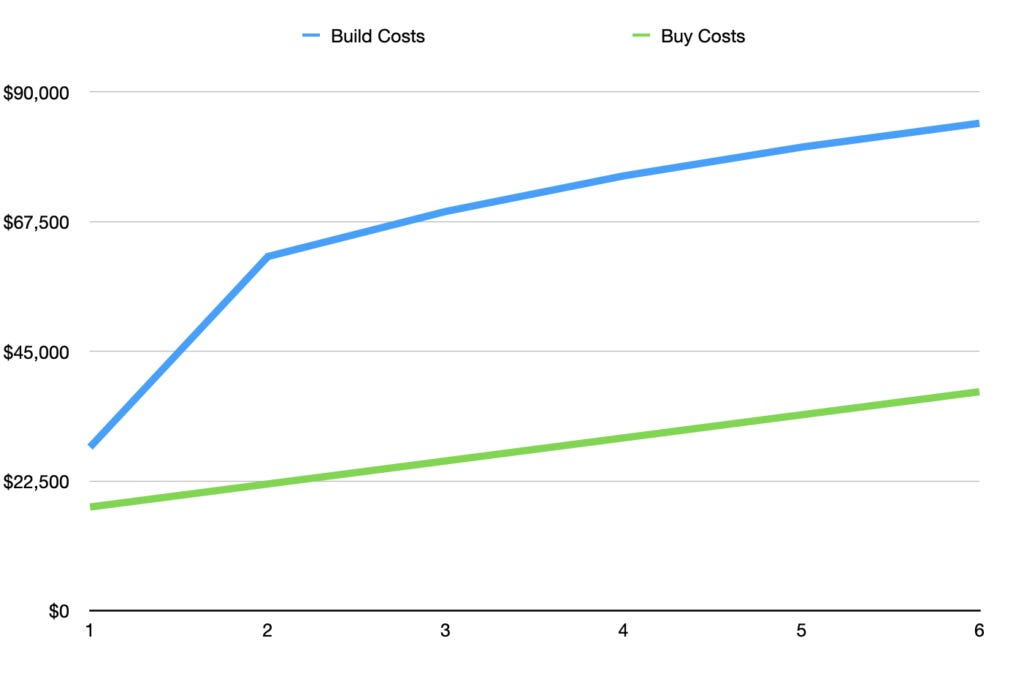
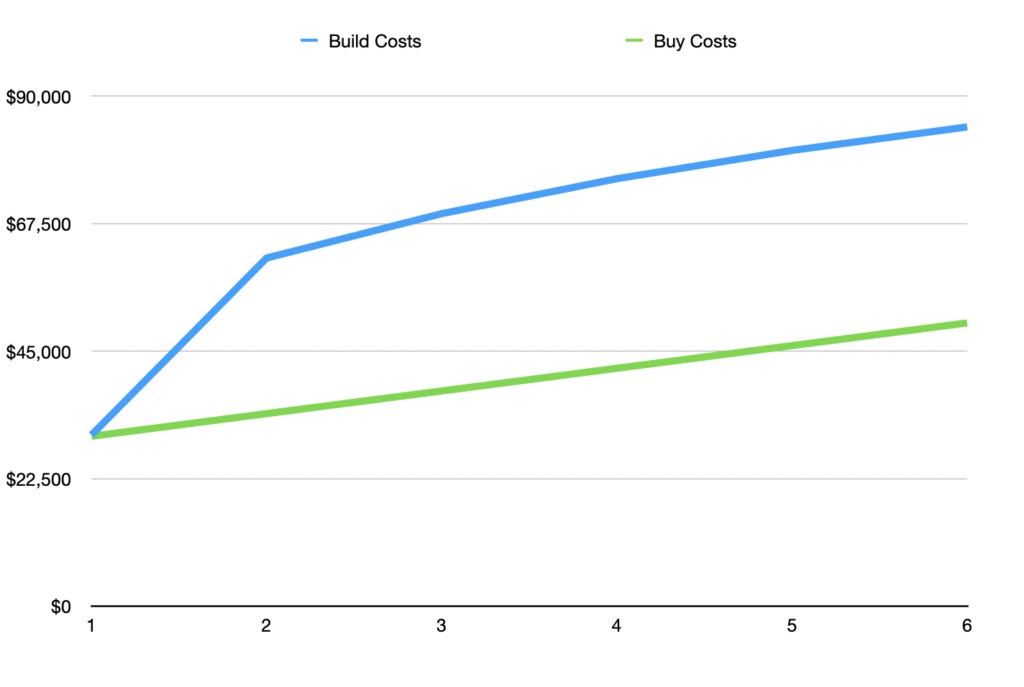
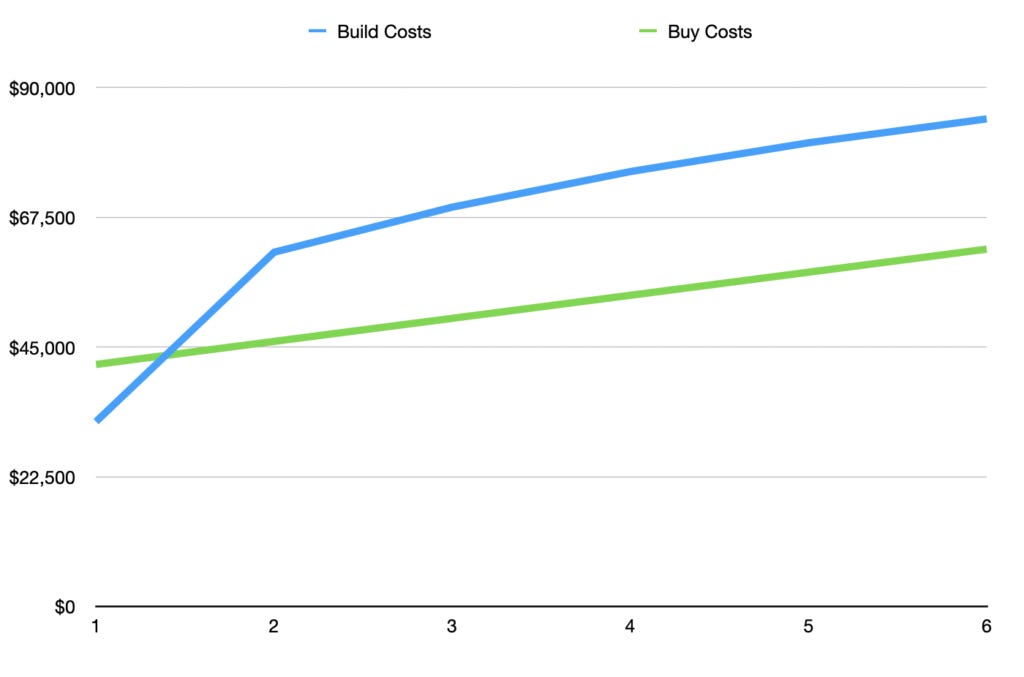
Here’s four risk adjusted Build vs. Buy charts both based on vibe-coding an app in 4-weeks or less and maintained by one full-time $200K employee, 1 day a week (<20%).
A $12K/year ($1K/mn) SaaS:
A $24K/yr ($2K/mn) SaaS:
A $36K/yr ($3K/mn) SaaS:
A $60K/yr ($5K/mn) SaaS:
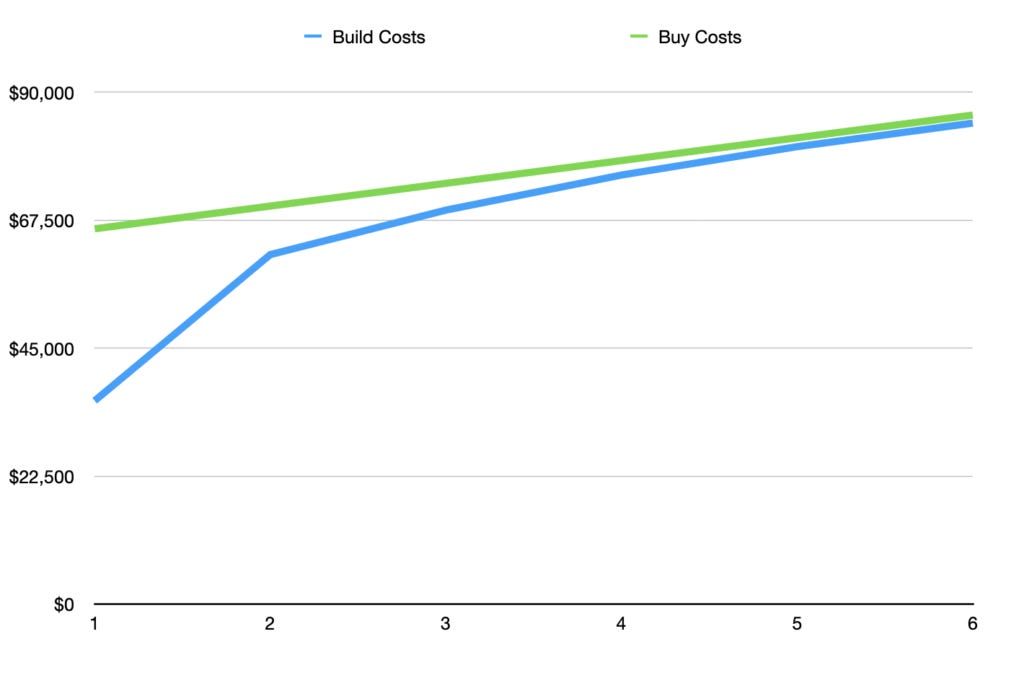
It’s not until the fairly significant $60K/yr fee level where building gets even close to buying. At that level we’re likely talking strategically significant software tailored to the specific organization and its competitive advantage.
If you’re interested in playing with these numbers yourself, grab the Build vs Buy calculator from the Tools and Templates section. Reach out if you’d like some help estimating the numbers.