A paper in Nature Chemical Biology was retracted, less than a year after it appeared.
The official reason: the authors lost access to raw data. The real reason: their “raw data” was utterly fake. They even falsified the time stamps on their Photoshopped “original data” images.
This story is a warning to all the institutional investigations worldwide scurrying to close a case and to dismiss the whistleblowers because the accused scientists presented a low-resolution picture of a purported gel, microscopy photo or a spectral analysis as “raw data”.
In our high-technology days, everything can be faked as long as nobody cares to look closer.
The team from Dr. Arati Ramesh's lab discovered a novel family of non-coding RNAs in mycobacteria, showing how they function to specifically control the translation of lipid metabolism & redox-related #genes. https://t.co/l6bcHKe68S#mycobacteria #RNA
— National Centre for Biological Sciences (@NCBS_Bangalore) August 21, 2020
This was the paper:
Siladitya Bandyopadhyay, Susmitnarayan Chaudhury, Dolly Mehta , Arati Ramesh Discovery of iron-sensing bacterial riboswitches Nature Chemical Biology (2020) doi: 10.1038/s41589-020-00665-7
The study was published on 5 October 2020, its authors came from the Tata Institute of Fundamental Research in Bangalore, India. They claimed to have found an new iron sensing RNA molecule in bacteria, which they called “Sensei – short for Sense iron“, as an institutional press release celebrated, under the heading:
Sensei RNA: Iron fist in a velvet glove
“[…] the researchers then turned into crafty engineers. They tweaked the sequence of the RNA and identified the parts in the clover leaf-like structure that may bind iron. Then, they went one step further and made a small change in the RNA sequence which shifted the competence of RNA from sensing iron to now detect nickel and cobalt.
“This nanoscale engineering of iron sensing that we demonstrate, will hopefully set the stage for designing iron-biosensors which could be of use to both bacterial biology and biomedicine,” explains Arati.
This story is as much about discovery by serendipity, as it is about what the discovery has taught us – the versatility of RNA, the unbending specificity behind an RNA’s frail structure and its ability to sense something as fundamental as iron. What better way to honour it than by calling it Sensei, meaning teacher?”
There was no discovery, the study was completely fabricated. It was retracted in late June 2021. This was the notice:
“The authors are retracting this Article because of issues with data integrity and reproducibility. Specifically, native gel analyses of natural and engineered Sensei RNAs (Figs. 3e and 5c) raised concerns of gel background similarities from different experiments. On learning this, A.R. requested an independent researcher with expertise in RNA research to attempt to replicate the same experiments. We now find that these data are not reproducible. Further, in the in vivo expression analyses, the RpoA control and +J41 western blots (part of Fig 4, Extended Data Fig. 8) raise concerns of gel band duplications. In addition, ITC curves (shown in Fig. 1f and Extended Data Fig. 4b) have raised concerns of inconsistent spacing between successive injections. We no longer have access to the raw data for these experiments and hence are unable to verify the salt-dependent binding affinities of Sensei RNAs.
Given that the key data supporting the iron ion-induced structural changes in Sensei RNAs—a central conclusion of the original paper—are now called into question, we believe that retraction of the work in its entirety is essential. The authors deeply regret this situation and apologize to the scientific community. All authors of the original study have agreed to retract the article and with this retraction text.
A.R. informed the institute about these concerns regarding data integrity, following which an independent inquiry was conducted. The inquiry committee also recommends that the Article be retracted.“

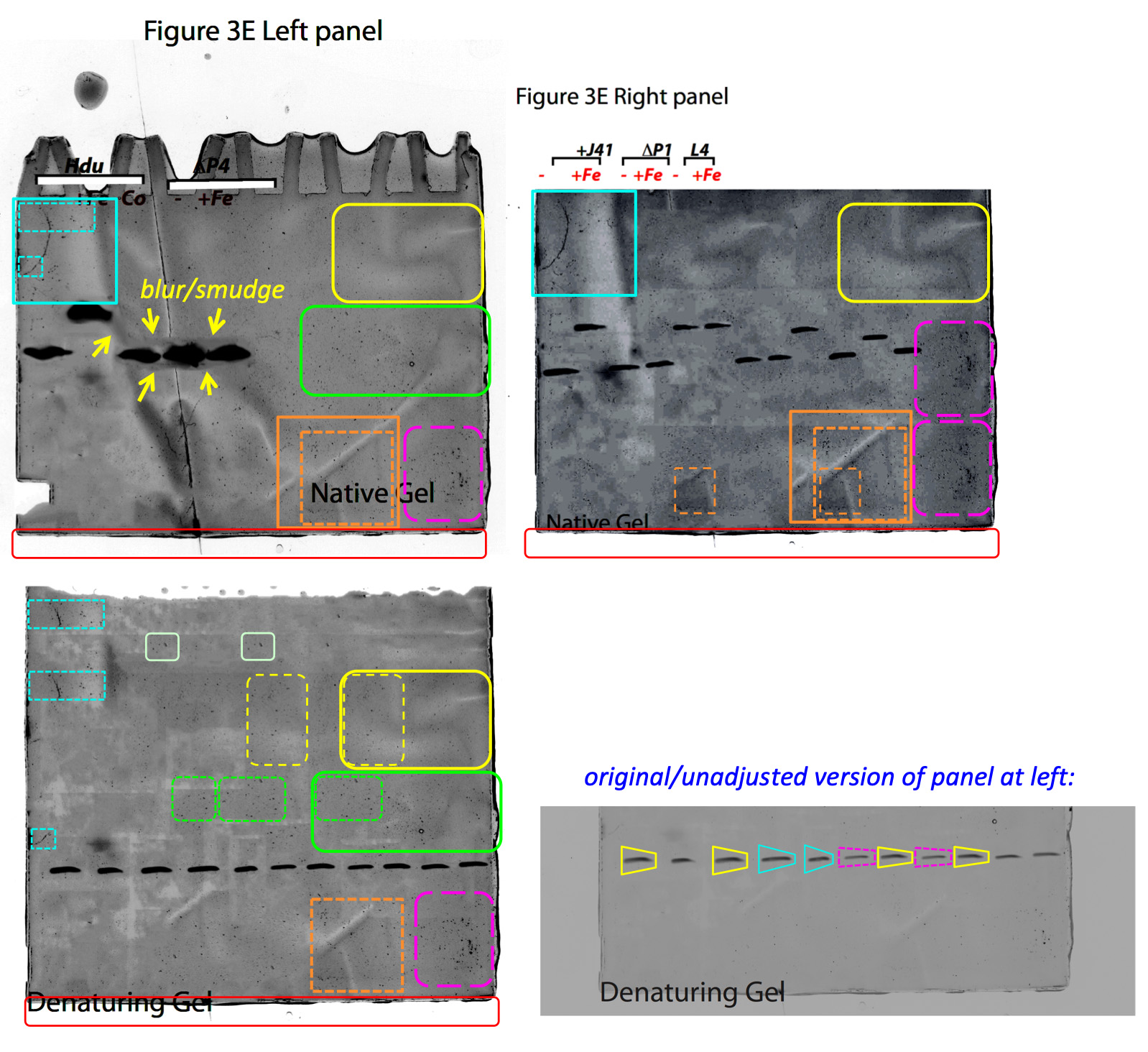
The notice didn’t mention the massive Photoshop fraud, probably to speed up the closure of the case on the publisher’s side. Here a sample of bizarrely fake “raw data” which the authors uploaded as supplementary:
The Bangalore institute’s press release was issued in January 2021, long after the fraud was uncovered on PubPeer. Maybe this is why it ended with this sentence, as an insider joke:
“The real voyage of discovery consists not in seeking new landscapes, but in having new eyes.”
Well said. In October 2020, first criticism was posted on PubPeer by anonymous user Nepenthes Mindanaoensis who used their eyes to make a discovery:
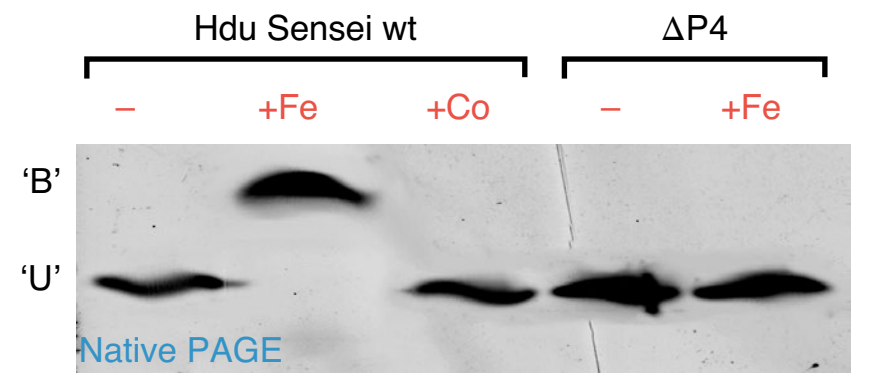
“Lanes 3-5 of Figure 3e are surrounded by a square, making it look like they were copy and pasted from somewhere else. I’m not sure how this can happen?“
A good question. The three bands are clearly digitally pasted. Also, why was nobody at the publisher Nature Publishing Group checking the accepted manuscripts for such blatant irregularities.
Good thing authors of Nature family journals are required to provide raw data like full-length gel scans in the supplemental material. This is where fraud is often found: Spanish martyr saint Carlos Lopez-Otin and Harvard Medical School dean George Q Daley had to retract a Nature Cell Biology paper because its supplemental gel images were found to be very fishy. And in Lopez-Otin’s case, the raw data was not (visibly) falsified, it just didn’t match the corresponding main figures.
So right away, the prolific PubPeer commenter Leucanella Acutissima chimed in with additional findings from the supplementary records of Bandyopadhyay et al 2020, like the analysis shown above. There was more:
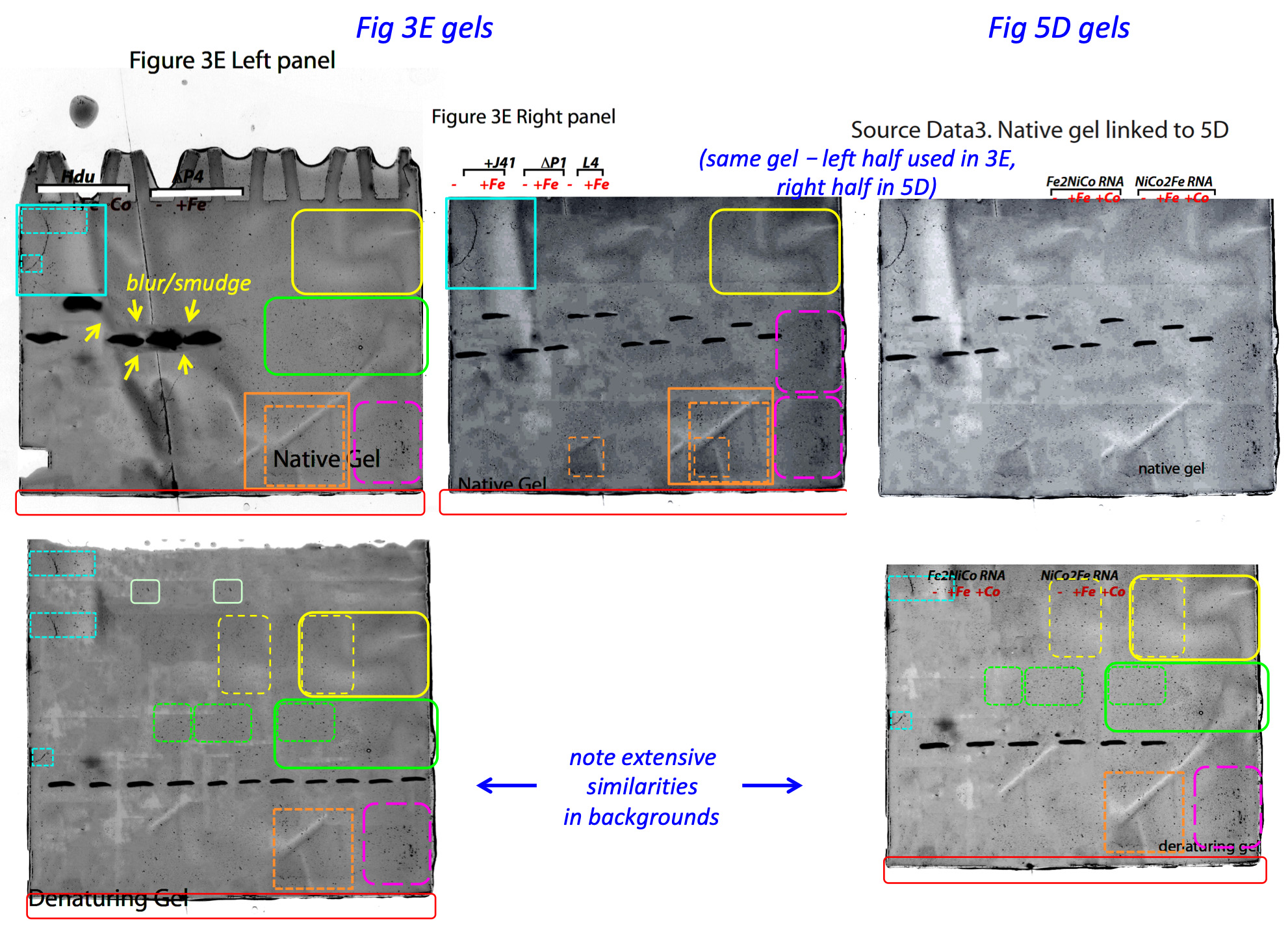
And even more:
Basically, the “raw data” the Bangalore authors uploaded to satisfy the publisher’s requirements, were fake. Fabricated in Photoshop. But this is not where the story ended.
The next day, last author Arati Ramesh commented:
“We have uploaded the raw images as obtained from the instrument- so that you can rest your concerns. As you can see, we have not manipulated any images. […]
Original images can be accessed from this link (since original files are large in size we are unable to attach them here): https://drive.google.com/drive/folders/1KBP4DDsVoUeZnf7RDeQA7_kX2xazu8NO?usp=sharing Hope these points answer your concerns. The original images are all attached in this response so that no doubt remains.“
This is what the provided “original files” contained:

Fake gel bands were cloned and assembled on a fake gel background in Photoshop:
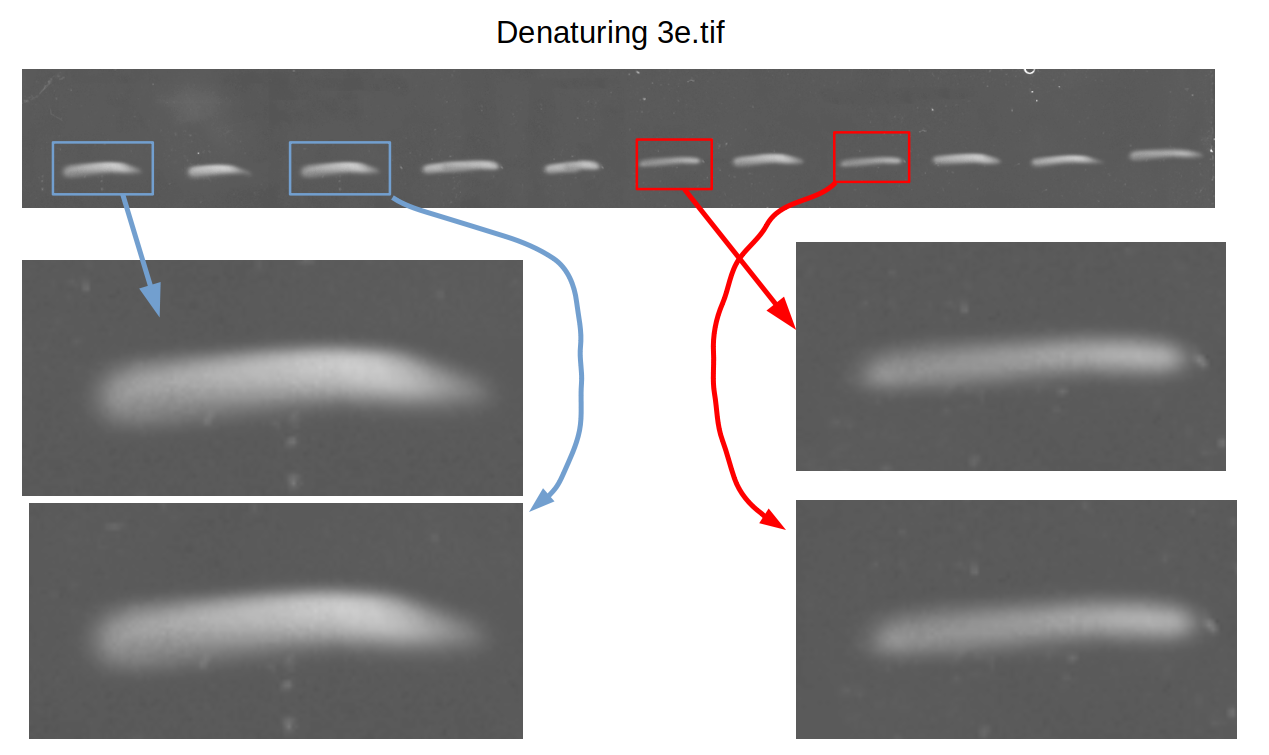
Others found more fakeries in Ramesh’s “original data”, also in the same “Denaturing 3e.tif” file. Here by L. acutissima:
On 2 November 2020, Cheshire informed the journal. Then, someone had a look at the enzyme chemistry measurements, that being chemical engineering paper after all. Why, yes, these plots were fake also, fabricated also in Photoshop probably.

The last author Ramesh pleaded:
“We have submitted all the raw images. These images are procured from the GEL DOC system and have TIME STAMPS showing that they were performed on different days.”
On 11 December 2020, an Editor’s Note was posted by the journal:
“Readers are alerted that the reliability of data presented in this manuscript is currently in question. Appropriate editorial action will be taken once this matter is resolved.”

Ramesh stopped commenting. PubPeer users found more fraud, like this gel picture for Fig 4B, attacked with a smudge tool to remove undesired gel bands:
Had the authors published with another journal, where full-length gels are not required, basically anywhere with Elsevier, nothing would have ever come out. These cheaters may have been too trusting in their digital skills. Their paper was retracted in late June 2021, even if under the pretence of an irreproducibility problem. No reference to PubPeer or Photoshop fraud, the official reason provided by authors:
“We no longer have access to the raw data for these experiments and hence are unable to verify the salt-dependent binding affinities of Sensei RNAs.“
When the fake discovery was published last October, it was celebrated by RSC’s Chemistry World and ACS’ c&en, excited peers were quoted congratulating the authors. The Wire, an Indian online magazine, also reported, but in December added an Editor’s note about the journal’s newly issued notice, and even linked to the PubPeer concerns. The only update c&en ever added was to add a reference to an ACS paper:
“to add a reference to a Biochemistry paper about another iron-binding riboswitch and to remove a quote that implied the Nature Chemical Biology paper is the first to describe an iron-binding riboswitch.“
Priorities, priorities.
Ramesh has her priorities, too. She is already fighting the COVID-19 pandemic. With biosensors, naturally. Without a PCR machine, but with TIME STAMPS, rest assured. Here is her preprint from January 2021:
Anirudh Chakravarthy, KN Anirudh, Geen George, Shyamsundar Ranganathan, Nishan Shettigar, U Suchitta, Dasaradhi Palakodeti, Akash Gulyani, Arati Ramesh Ultrasensitive RNA biosensors for SARS-CoV-2 detection in a simple color and luminescence assay medRxiv (2021) doi: 10.1101/2021.01.08.21249426
It was already endorsed in PreLights by The Company of Biologists, a very respectable publishing society. Indian newspaper The Print quoted Ramesh, who shared the good news that her colour-change test can detect all SARS-CoV2 strains.
While you are reading this, somewhere in the world some dishonest scientist is presently being absolved and whitewashed by their university or research institution because they showed “raw data” to disprove the allegations of data manipulation. The trick is to not look too closely.
Update 8.07.2021
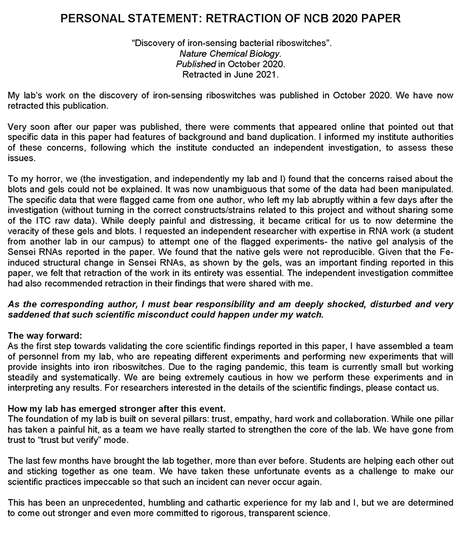
Ramesh is blaming the first author alone, her former student Siladitya Bandyopadhyay, in a public statement:
“The specific data that were flagged came from one author, who left my lab abruptly within a few days after the investigation (without turning in the correct constructs/strains related to this project and without sharing some of the ITC raw data).”
But now Elisabeth Bik found more, whom shall we blame here?
Dolly Mehta , K. Anjali , Arati Ramesh Discovery of ANTAR-RNAs and their Mechanism of Action in Mycobacteria Journal of Molecular Biology (2020) doi: 10.1016/j.jmb.2020.05.003
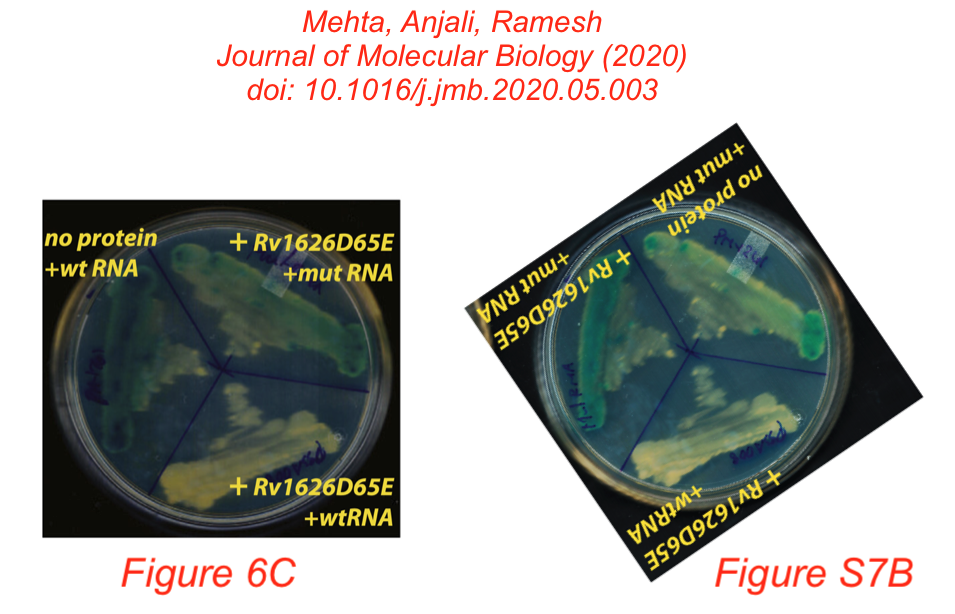
A commenter purporting to be “someone very close to the NCBS community.” alleges in the comment section below:
“Dr Ramesh has a common tendency to pressurize all students in her lab to accomplish experiments in a way that the result matches the bioinformatics prediction. […] Ramesh lab has always been a small lab since most of the students (interns, graduate students or even postdocs) who joined the lab could not tolerate the lunatic environment in the lab for long. There have been several complaints by the departed students for the tremendous mental torture that they faced. But most of the time, the matter remained unresolved for obvious reasons.”
I reached out to Dr Ramesh again.
Update 9.07.2021
Sunil Laxman, group leader at InStem in Bangalore, who also happens to be Arati Ramesh’s husband, explained on Twitter that her paper was never completely fake:
“No. Mostly right. But some things happened beyond twitterverse and the senior author was incredibly brave and did the right thing“
No. Mostly right. But some things happened beyond twitterverse and the senior author was incredibly brave and did the right thing.
— Sunil Laxman (@sunillaxman) July 5, 2021
Somebody now looked at his own papers.
Sunil Laxman, Aaron Riechers , Martin Sadilek , Frank Schwede , Joseph A Beavo Hydrolysis products of cAMP analogs cause transformation of Trypanosoma brucei from slender to stumpy-like forms Proceedings of the National Academy of Sciences of the United States of America (2006) doi: 10.1073/pnas.0608971103
I suggest to do the right thing and blame the first author here?
Sunil Laxman , Ana Rascón , Joseph A. Beavo Trypanosome cyclic nucleotide phosphodiesterase 2B binds cAMP through its GAF-A domain The Journal of biological chemistry (2005) doi: 10.1074/jbc.m408111200

Update 14.07.2021
You know the public version of events. Now how about the behind-the-curtains version, told by internal emails from Arati Ramesh, the rogue student Siladitya Bandyopadhyay, other lab members and the institute’s director? Accompanied by a guest post about Ramesh’s husband Sunil Laxman and his research? Read here.
Update 2.08.2021
Here is my interview with Siladitya Bandyopadhyay:

Get For Better Science delivered to your inbox.
Make a one-time donation
Make a monthly donation
Choose an amount
Or enter a custom amount
Your contribution is appreciated.
Your contribution is appreciated.