I’ve recently had several run-ins with people who believe strictly in the calories-in, calories-out hypothesis of obesity. I just read Herman Pontzer’s book Burn, so I’ll continue to pick on him for the moment.
In Pontzer’s estimation, humans are just calorie-burning machines. Slightly complicated machines, but machines nonetheless. We have a more or less fixed metabolic rate that can’t be increased but which can be decreased with caloric restriction. We cannot increase total calories burned by exercising because the body compensates by, for instance, spending less energy on immune function. Therefore, the only way to stay lean is to limit calories-in.
The reason that the obesity epidemic started is because we live in an obesogenic environment where we are surrounded by highly palatable food options which overwhelm the pleasure centers of the hypothalamus. Our brains are simply overwhelmed with pleasure, we overeat, calories-in exceed calories-out and we become fat.
The theory is very logical but a problem with it is that it utterly fails to explain the events of the 20th century.
The French diet is unapologetically rich in butter, cheese, sausages, baguettes, croissants, chocolate, bonbons, etc. This sounds like an obesogenic environment to me, and yet the obesity epidemic in France lagged decades behind the one in the US. When I point this out, people are quick to respond with these three arguments::
- The French walk a lot.
- The French don’t snack.
- The French eat small portions.
Pontzer’s own research suggests that point 1 – the French are more physically active – probably does not have a lot to do with French leanness. The real trick is points 2 and 3. By eating small portions and not snacking, the French are actually managing to achieve a reduction in calories-in compared to Americans.
Nutritionists will tell you at length how hard it is to get an accurate assessment of how many calories an individual has eaten unless you literally follow them around with a kitchen scale, weighing every morsel. Calories are usually estimated from Food Frequency Questionaires where people write down everything they ate in the last 24 hours. People tend to underestimate portion sizes, they forget about that late night snack, etc.
Because of this, the data set that I prefer about calories consumed on a national level is economic in nature. It is called “food disappearance” or “food balance”. National governments keep fairly exact records of how much wheat flour, milk, white sugar, potatoes, etc are produced in the country, imported and exported. The difference between the expected inventories (production + imports – exports) and actual inventories is food “disappearance”. All that food was either wasted or eaten. If we make the presumption that wealthy industrial countries waste similar amounts of food, this gives us a pretty good estimate of which countries ate more food than others.
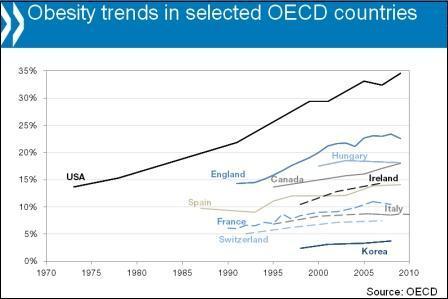
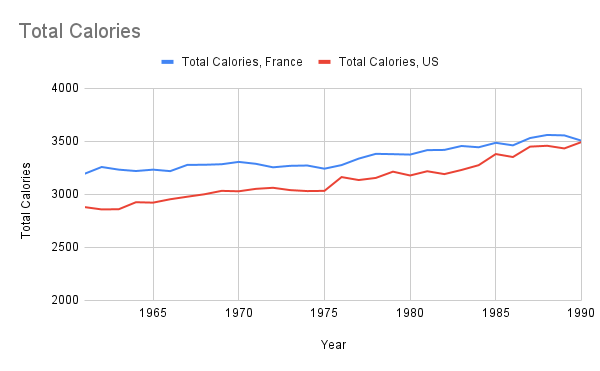
The obesity epidemic was well on its way in the US by 1990, but had barely started in France. The FAOSTAT country by country food balance data goes back to 1961. So it’s fairly trivial to ask if points 2 and 3 are actually true? Did the French eat less than Americans in the 30 year period when the obesity epidemic was exploding in America. The answer is absolutely not! The french “disappeared” an additional 214 calories per day per person during this time. This means that a 50 year old living in America in 1990 would be four times as likely to be obese as a French person despite being responsible for disappearing 2.4 MILLION less calories between the ages of 20 and 50.
If you look at the chart of obesity rates, the only European country that had significantly fewer obese adults in the 90s was Switzerland. The Swiss diet combines the tastiest eating traditions of France – baguettes and gruyere – with those of Germany – wiener schnitzel and bratwurst – and adds its own specialties like fondue. Despite the highly palatable cuisine, certainly the Swiss are paragons of moderation? They must’ve eaten less calories to be this lean, at least compared to the gluttonous French. Let’s layer them onto the chart.
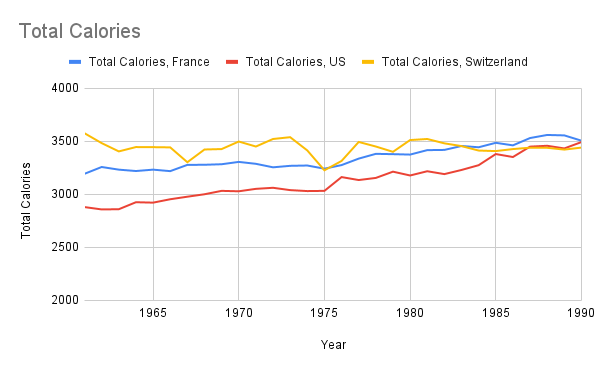
During the decade from 1961-1970 the average Swiss person disappeared a whopping 500 more calories PER DAY than the average American. The same 50 year old Swiss person in 1990 would have disappeared a whopping 3.4 million more calories over the last 30 years than the American and would be 5 times less likely to be obese.
Do you remember the Swiss bread riots of the 60s and 70s, when the Swiss were burning baguettes in the streets? You don’t because they didn’t happen. The Swiss probably ate those baguettes.
If the French and Swiss ate far more calories than Americans yet remained leaner, there are really only three options.
- They burned off the huge caloric excess through physical activity. Based on Pontzer’s work this seems unlikely.
- They have high metabolic rates due to inflammation. I can’t imagine why the entire populations of France and Switzerland would be particularly more inflamed than those of Americans.
- They have higher basal metabolic rates. It seems like this has to be the answer, but why.
The ROS Theory of Obesity
In the ROS Theory of Obesity, I argue that saturated fat drives mitochondrial ROS production which is a thermogenic loop that regenerates NAD+. I have further argued that linoleic acid is converted to Oxidized Linoleic Acid Metabolites (OXLAMs) by cytochrome P450 enzymes that are triggered by the Aryl Hydrocarbon Receptor which have the long term effect of increasing lipogenic genes including SCD1, which unsaturates your body fat. Burning unsaturated fat lowers your metabolic rate.
Let’s look at the consumption over time of the two main polyunsaturated fats (PUFA) consumed in the US, France and Switzerland from 1961-1990: soybean and sunflower oil. The ROS Theory of Obesity would predict that a rise in PUFA consumption would be the trigger causing obesity rather than a rise in calories. Once people begin to gain weight, calories will go up because larger bodies burn more calories. You can see calories rising in France and the US from 1975 and 1990. But even in 1990 they’re still only eating the amount of calories that the Swiss always ate, so it’s hard to argue that the rise in obesity in America was caused by the rising calories. Furthermore, since the Americans were fatter, even in 1990 – as calories between France, Switzerland and the US reached parity – the French and Swiss were still eating more calories per lb of fat free mass.
Here’s what happened:
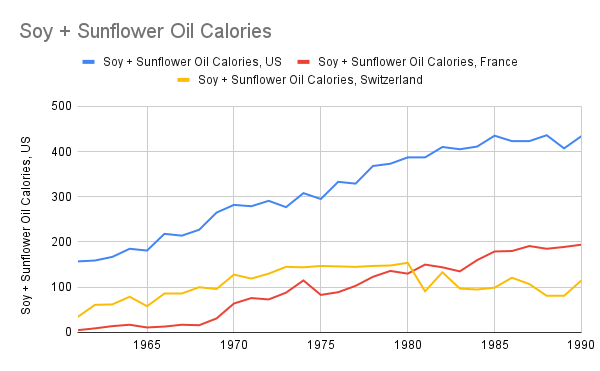
Switzerland and France had very low levels of vegetable oil consumption in 1961. Vegetable oil consumption in Switzerland never rose to even the baseline level seen in the US in 1961, then declined after 1980 to a fraction of US consumption. The Swiss were the leanest in 1990. The French level of veg oil consumption first passed US 1961 levels in 1985. French levels of obesity then roughly doubled between 1985 and 2005.
Conclusion
All of this happened in the context of the Swiss disappearing the most calories. So is it the calories or the PUFA?
I argued in my last article that starch eating cultures have very saturated body fat and therefore high metabolic rates. The data from France and Switzerland suggest that the same is true of cultures which combine saturated fat (butter, cheese, sausage) and starch. Once PUFA is added to the mix, obesity ensues over the next decades.