Firecracker is an open source virtualization technology that is purpose-built for creating and managing
secure, multi-tenant container and function-based services.
Firecracker enables you to deploy workloads in lightweight virtual machines, called microVMs, which provide
enhanced security and workload isolation over traditional VMs, while enabling the speed and resource
efficiency of containers. Firecracker was developed at Amazon Web Services to improve the customer
experience of services like
AWS Lambda
and
AWS Fargate
.
Firecracker is a virtual machine monitor (VMM) that uses the Linux Kernel-based Virtual Machine (KVM) to
create and manage microVMs. Firecracker has a minimalist design. It excludes unnecessary devices and guest
functionality to reduce the memory footprint and attack surface area of each microVM. This improves
security, decreases the startup time, and increases hardware utilization. Firecracker is generally available on
64-bit Intel, AMD and Arm CPUs with support for hardware virtualization.
Firecracker is used by/integrated with (in alphabetical order):
appfleet,
containerd via
firecracker-containerd,
Fly.io,
Kata Containers,
Koyeb,
Northflank,
OpenNebula,
Qovery,
UniK,
Weave FireKube
(via Weave Ignite),
webapp.io, and
microvm.nix.
Firecracker can run Linux and
OSv
guests. Our latest roadmap can be found
here.
Benefits
Firecracker microVMs use KVM-based virtualizations that provide enhanced security over traditional VMs.
This ensures that workloads from different end customers can run safely on the same machine. Firecracker
also implements a minimal device model that excludes all non-essential functionality and reduces the
attack surface area of the microVM.
In addition to a minimal device model, Firecracker also accelerates kernel loading and provides a minimal
guest kernel configuration. This enables fast startup times. Firecracker initiates user space or
application code in as little as 125 ms and supports microVM creation rates of up to 150 microVMs per
second per host.
Each Firecracker microVM runs with a reduced memory overhead of less than 5 MiB, enabling a high density
of microVMs to be packed on each server. Firecracker provides a rate limiter built into every microVM.
This enables optimized sharing of network and storage resources, even across thousands of microVMs.
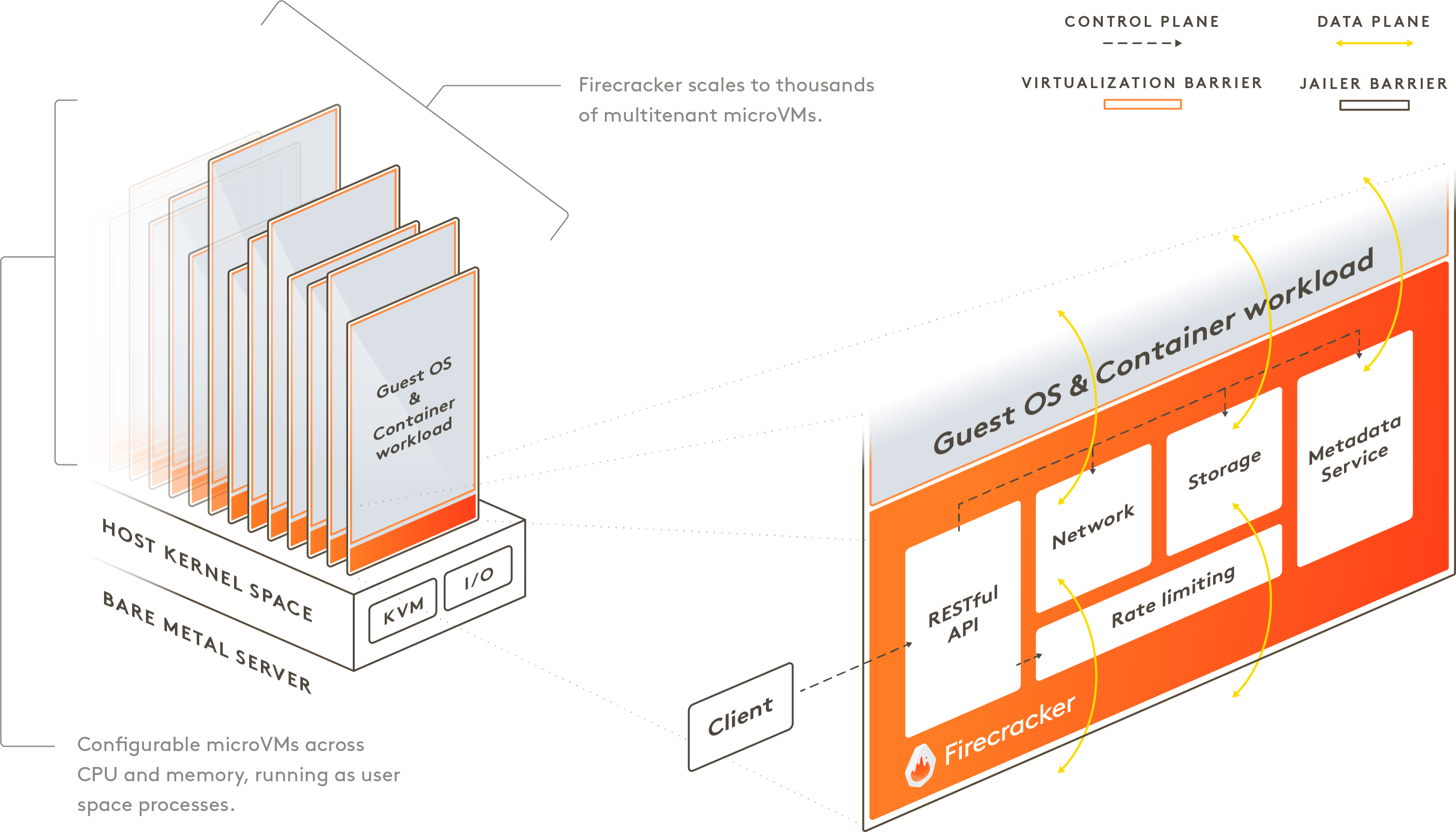
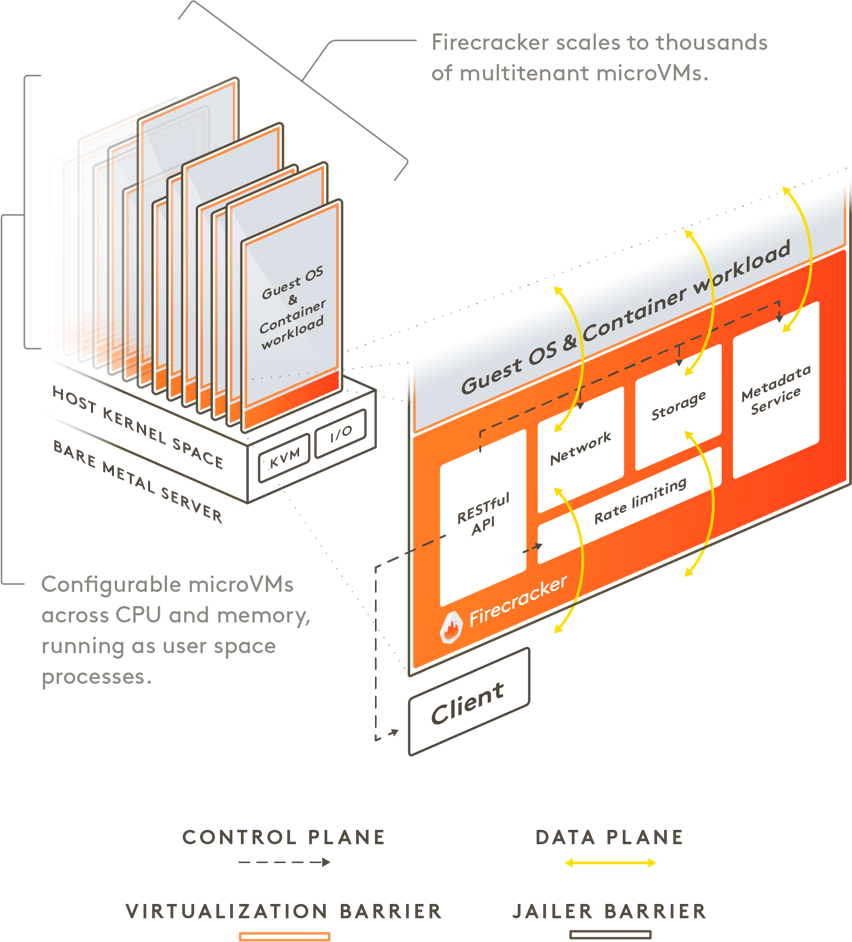
Firecracker runs in user space and uses the Linux Kernel-based Virtual Machine (KVM) to create microVMs. The
fast startup time and low memory overhead of each microVM enables you to pack thousands of microVMs onto the
same machine. This means that every function, container, or container group can be encapsulated with a
virtual machine barrier, enabling workloads from different customers to run on the same machine, without any
tradeoffs to security or efficiency. Firecracker is an
alternative to QEMU
, an established VMM with a general purpose and broad feature set that allows it to host a variety of guest
operating systems.
You can control the Firecracker process via a RESTful API that enables common actions such as configuring
the number of vCPUs or starting the machine. It provides built-in rate limiters, which allows you to
granularly control network and storage resources used by thousands of microVMs on the same machine. You can
create and configure rate limiters via the Firecracker API and define flexible rate limiters that support
bursts or specific bandwidth/operations limitations. Firecracker also provides a metadata service that
securely shares configuration information between the host and guest operating system. You can set up and
configure the metadata service using the Firecracker API. Each Firecracker microVM is further isolated with
common Linux user-space security barriers by a companion program called "jailer". The jailer provides a
second line of defense in case the virtualization barrier is ever compromised.
FAQs
Who developed Firecracker?
Firecracker was built by developers at Amazon Web Services to enable services such as
AWS Lambda
and
AWS Fargate
to improve resource utilization and customer experience, while providing the security and isolation
required of public cloud infrastructure. Firecracker started from Chromium OS's Virtual Machine Monitor,
crosvm
, an open source VMM written in Rust. Today, crosvm and Firecracker have diverged to serve very different
customer needs.
Rust-vmm
is an open source community where we collaborate with crosvm and other groups and individuals to build and
share quality Rust virtualization components.
Why did you develop Firecracker?
When we launched Lambda in November of 2014, we were focused on providing a secure
serverless
experience. At launch we used per-customer EC2 instances to provide strong security and isolation between
customers. As Lambda grew, we saw the need for technology to provide a highly secure, flexible, and
efficient runtime environment for services like Lambda and Fargate. Using our experience building isolated
EC2 instances with hardware virtualization technology, we started an effort to build a VMM that was
tailored to run serverless functions and integrate with container ecosystems.
What processors does Firecracker support?
The Firecracker VMM is built to be processor agnostic. 64-bit Intel, AMD and Arm CPUs with hardware
virtualization support are generally available for production workloads.
What language is Firecracker written in?
Firecracker is written in Rust.
Can Firecracker be used within the container ecosystem?
Yes. Firecracker is used by/integrated with (in alphabetical order):
appfleet,
containerd via
firecracker-containerd,
Fly.io,
Kata Containers,
Koyeb,
Northflank,
OpenNebula,
Qovery,
UniK,
Weave FireKube
(via
Weave Ignite
),
webapp.io, and
microvm.nix.
What is the difference between Firecracker and QEMU?
Firecracker is an
alternative to QEMU
that is purpose-built for running serverless functions and containers safely and efficiently, and nothing
more. Firecracker is written in Rust, provides a minimal required device model to the guest operating
system while excluding non-essential functionality (only 5 emulated devices are available: virtio-net,
virtio-block, virtio-vsock, serial console, and a minimal keyboard controller used only to stop the
microVM). This, along with a streamlined kernel loading process enables a < 125 ms startup time and a
< 5 MiB memory footprint. The Firecracker process also provides a RESTful control API, handles resource
rate limiting for microVMs, and provides a microVM metadata service to enable the sharing of configuration
data between the host and guest.
What operating systems are supported by Firecracker?
Firecracker supports Linux host and guest operating systems with kernel versions 4.14 and above, as well
as
OSv
guests. The long-term support plan is still under discussion.
What is the open source license for Firecracker?
Firecracker is
licensed
under Apache License, version 2.0, allowing you to freely use, copy, and distribute your changes under the
terms of your choice. Read more about the
Apache 2.0 license
. Crosvm code sections are licensed under a
BSD-3-Clause license
that also allows you to use, copy, and distribute your changes under the terms of your choice.
Firecracker is an AWS open source project that encourages contributions from customers and the developer
community. Any contribution is welcome as long as it aligns with our
charter
. You can learn more about how to contribute in
CONTRIBUTING.md
. You can chat with others in the community on the
Firecracker Slack workspace
.