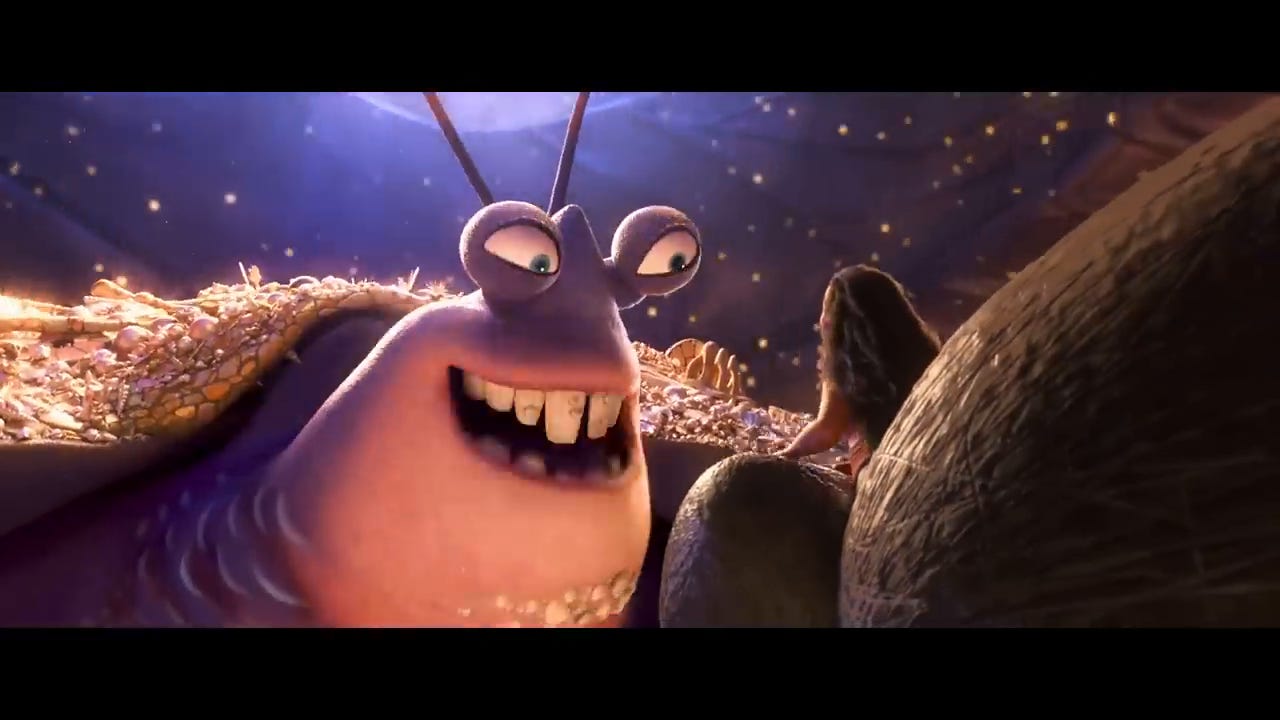
At the bottom of the ocean, in a place the Moana film calls the Realm of Monsters, there is a crab.
He is enormous. Fifty feet wide, if you were to measure him, which no one has tried to do, for obvious reasons. His shell is the color of deep water at night—blue-black, shifting, ancient. And covering that shell, layered over every inch of it, is treasure. Gold. Coins. Artefacts from sunken ships. The accumulated glitter of a thousand years of very deliberate collecting.
In the dark, he glows.
His name is Tamatoa.🦀
The movie treats him as a villain, and in the technical sense of the word, he is one. He’s on the wrong side of the plot. He has the thing the heroes need. He tries to eat them when they come to get it.
But here’s the thing about Tamatoa.
He is the only character in the entire film who has thought seriously about who he is, what he wants, and what he is willing to do about it.
And he has been thinking about it for over a thousand years.
He tells you himself, in the song.
He was a drab little crab once.
He says it plainly, almost cheerfully, the way you can be cheerful about a past that no longer has any power over you. He was small. He was dull. He was the kind of creature that no one looked at twice. A bottom feeder, in the most literal sense—scavenging along the ocean floor, invisible, unimportant, unremarkable.
And something in him decided that this was unacceptable.
Not with rage, exactly. More like a very clear-eyed assessment. He looked at the world and he understood how the world works. He understood that beauty is power. That shine attracts. That the fish don’t think—they just follow the light.
There is a line used in connection with Oscar Wilde: that one should either be a work of art, or should wear a work of art. Tamatoa became the light.
He started collecting. One piece, then another. Gold here, a jewel there. He built himself up from the outside in, one shining layer at a time, until the drab little crab was gone entirely and in its place was something that demanded to be seen.
The movie’s message—the message it states plainly, repeatedly, with great sincerity—is that what matters is who you are on the inside. Listen to your heart. Be true to yourself. Your inner beauty is what counts.
Tamatoa’s response to this is essentially: have you met fish?
He’s not wrong. Fish are not philosophical creatures. Fish chase the brightest thing they can see. And so do most people, most of the time, if we’re being honest about it. The world rewards shine. It always has. The ones who pretend otherwise are usually the ones who already have enough shine to afford the pretense.
Tamatoa didn’t have that luxury. He came from nothing. He built everything himself. And he is not ashamed of that.
There’s a moment in the song—just a small one—where he turns to Maui.
Maui, the demigod. The shape-shifter. The hero of a thousand stories, covered in tattoos that record his own legend. A being who has spent centuries doing great deeds, specifically so humans would love him. Specifically so that he would feel wanted.
And Tamatoa looks at him and says:
‘Just like you, I made myself a work of art.’
He’s not wrong about that either.
Maui and Tamatoa are the same creature, underneath. Both of them were once small. Both of them were once unloved. Both of them built an exterior—tattoos, treasure—to cover the place where the wound lives. The film gives Maui a redemption arc and Tamatoa a defeat, but the difference between them is mostly circumstance. Maui had a magic fishhook and a starring role. Tamatoa had neither.
He just had himself. And what he made of himself.
The things he knows about other people are almost uncomfortably accurate.
He knows why Maui does what he does. He says it right there in the song—‘far from the ones who abandoned you, chasing the love of these humans who made you feel wanted’.
(He also says ‘Get it?’ and ‘Look it up’. ‘You can’t expect a demigod to beat a decapod, look it up’, he says to the audience—the meaning of decapod.)
He reads the demigod’s entire psychology in about eight bars, correctly, while performing a full production number and also trying to eat him. That’s a level of emotional intelligence that the film never quite gives him credit for.
He knows how perception works. He knows that the fish come to the brightest thing. He knows that if his name were Sebastian, and he had a cool Jamaican accent, people would feel happy to help him.
That last one he says at the very end, after everything, stuck on his back at the bottom of the ocean.
He’s still right.
Let’s talk about that ending for a moment, because it’s the thing that reframes everything.
Tamatoa loses. The heroes trick him—Moana dangles a fake heart made from a barnacle covered in bioluminescent algae, and he chases it, because he’s exactly what he says he is: a creature who follows the light. He gets knocked onto his back. He can’t right himself. And the heroes escape.
The movie ends. The credits roll. And then there’s one more scene.
He’s still there.
Still on his back. Still stuck. Singing a slow, quiet version of his own song to himself in the dark. And then he stops, and he looks directly at the audience, and he asks—genuinely, without embarrassment—if anyone could ‘help me’ up. He notes that if he were Sebastian from The Little Mermaid, they’d probably feel happy to do it.
And then presumably he just... stays there. Waiting. Immortal. Alone.
Tamatoa is over a thousand years old. He has been in that lair for centuries. He has outlasted empires. He was there when Maui was young and reckless, and he will be there long after the story of Moana has passed into myth. He cannot die, or at least the film never suggests that he can. He is, in the truest sense, permanent.
And in a thousand years of living, he made a choice about who to be. He chose shine. He chose beauty. He chose to be the brightest thing in any room, or any ocean trench, or any darkness.
And yes—he is on his back at the end. And yes—he is alone.
But here is the other thing that is true.
He asked if you enjoyed his song.
Not whether you would spare his life. Not whether you would call for help. Not whether you felt sorry for him.
Whether you enjoyed the song.
Because the song was the point. The performance was the point. He built a palace at the bottom of the ocean and filled it with everything beautiful he could, and when visitors came he put on the greatest show he knew how to give. He sang. He glowed. He turned the lights down and let his shell illuminate the darkness like something out of a dream.
And then he asked: did you like it?
The film says no. The film says his philosophy is wrong and his values are shallow and his defeat is the natural consequence of a life spent on surfaces.
But I think Tamatoa would find that very easy to disagree with.
He is still down there. Still glittering. Already adding new pieces to his collection, if I know anything about him. The little barnacle algae trick won’t work twice. The heroes are gone, back to their ocean, their island, their story.
And Tamatoa still has his lair. And his treasure. And all the time in the world.
You know what’s at the bottom of the ocean, in the places too deep for light to reach?
Creatures that make their own.
They’ve been doing it for hundreds of millions of years, long before anything walked on land, long before anyone had a philosophy about inner beauty or listening to your heart. They just glow. In the dark. For no one. Because that’s what they are.
Tamatoa understood this. He just dressed it up a little.
Added some gold. Put on a show.
Asked if you enjoyed it.
He’s still down there.
Still shining.🦀
Related