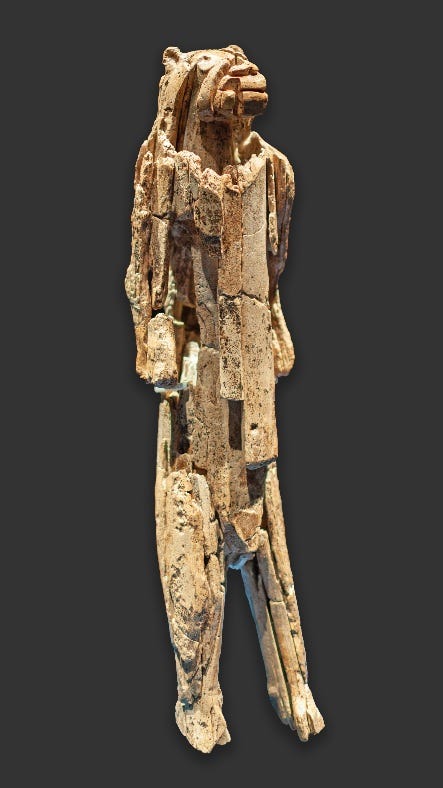
Somewhere in southwestern Germany, roughly 40,000 years ago, a person sat down with a piece of mammoth ivory and began to carve. What they produced was not a lion. It was not a human. It was something that had never existed and could never exist: a figure standing upright like a person, with the head of a cave lion, arms slightly raised, face turned as if looking at something just out of frame. Researchers estimate the carving required somewhere around 400 hours of work, weeks of sustained, deliberate effort. The result, known today as the Lion-Man of Hohlenstein-Stadel, is one of the oldest known works of figurative art in the world. It sits in a museum in Ulm, and if you look at it long enough (in my case, unfortunately, only as a photograph), something quietly vertiginous happens. You realize you are looking at a mind like yours.
The question I want to sit with in this post is deceptively simple: what kind of mind makes this? Not in the neurological sense – though that’s interesting too – but in the philosophical sense. What cognitive capacity does this object prove its maker possessed? And why does that capacity matter so much?
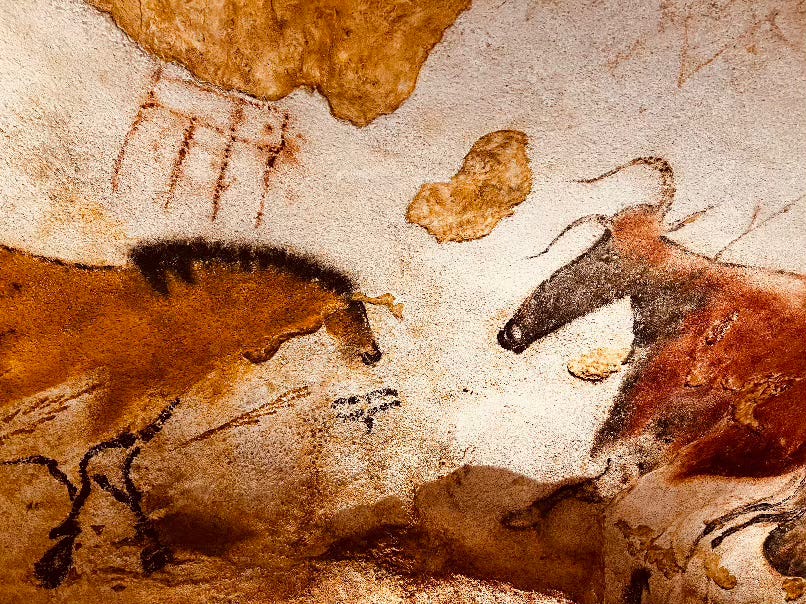
The Lion-Man belongs to a broader moment in the archaeological record that researchers used to call the “cognitive revolution” or the “Upper Paleolithic explosion,” a relatively sudden burst of symbolic behavior concentrated roughly between 40,000 and 30,000 years ago, particularly visible in Europe. Think of the Cave paintings at Chauvet and later Lascaux, the Venus figurines across a wide geographic range, and a number of bone flutes, some still playable. There is also evidence of long-distance trade in shells and pigments, as well as standardized blade toolkits replacing the more improvised tools of earlier periods. Something, it seemed, had switched on.
The picture has recently gotten more complicated, and more interesting. Archaeologists working in Africa have found symbolic behavior considerably earlier: engraved ochre at Blombos Cave in South Africa dating to around 75,000 years ago, perforated shell beads at Pinnacle Point, also in South Africa, going back perhaps 165,000 years. Some Neanderthal sites show possible use of pigments and eagle talon jewelry, suggesting our closest evolutionary cousins may have had some version of symbolic life as well. The “explosion,” therefore, may have been less like a detonation and more like a long accumulation with regional pulses, with fire catching in one place, dying down, catching again elsewhere.
And yet. The Lion-Man exists, and so do the flutes. Not to mention the paintings at Chauvet – horses rendered with confident, fluid lines, woolly rhinoceroses charging toward each other. Whatever its prehistory, something remarkable is fully present in the archaeological record of this period, and it demands explanation.
What makes things more knotty is that Homo sapiens had been anatomically modern for at least 150,000 to 200,000 years before any of this. The brain size was there (it stabilized about 300,000 years ago), though the vocal apparatus had evolved gradually and had reached the modern configuration fairly recently, roughly 50,000 to 100,000 years ago. For most of that vast stretch of time the same tools were made the same way generation after generation: handaxes, scrapers, more handaxes. Then, relatively quickly, Lion-Men and flutes and paintings that still take your breath away. What changed?
Geneticists have looked for a smoking gun mutation, something in a gene known as FOXP2 or in related language-associated genes, but the results are not conclusive. Demographers like Joseph Henrich have argued that the change may have been less about individual brains and more about population size and network density: larger, better-connected groups accumulate and retain cultural innovations that smaller groups lose. On this view, the “explosion” was at least in part the result of reaching a demographic threshold, not a neurological one. Other researchers suspect that the key was language, specifically the emergence of fully recursive syntax, which would have unlocked the ability to represent absent objects, nested propositions, and hypothetical states of affairs.
All of these hypotheses are probably capturing something real. But for our purposes, for the philosophical question underlying the Lion-Man and the other artifacts, the causal story matters less than what the objects themselves prove about the minds that made them.
Let us consider again the Lion-Man. To carve it, its maker had to do something that no physical process in the environment could prompt or model. A lion exists; a human exists; but a lion-human does not exist and never has. To produce this object, the carver had to entertain a representation of something absent from reality, not just absent from the immediate perceptual field, the way a hidden berry is absent, but absent from reality altogether. They had to hold in mind something impossible, combine features from separate domains of experience, and then laboriously externalize that mental combination into durable material form.
This is, when you think about it, a staggering thing to do. And it is qualitatively different from what we see in the behavioral repertoire of other animals, including our closest relatives. Chimpanzees solve problems, use tools, deceive rivals, mourn their dead, and exhibit what looks like genuine affection. But there is no chimpanzee Lion-Man, no chimpanzee myth, no chimpanzee hypothetical. The capacity to represent what isn’t, what philosophers sometimes call “displaced reference” or, more broadly, the faculty of counterfactual imagination, appears to be a distinctive human achievement.
The cognitive scientist Steven Mithen proposed an influential framework for understanding how this capacity might have emerged. Earlier hominins, he argued, possessed multiple domain-specific intelligences: a natural history module attuned to animals and plants, a social module tracking relationships and intentions, a technical module for toolmaking, and so on, all of which operated largely in parallel, without much cross-talk. What the Upper Paleolithic transition may mark is the integration of these modules into what Mithen calls “cognitive fluidity”: the ability to combine concepts, draw analogies, and generate metaphors across domains.
The Lion-Man, on this reading, is cognitive fluidity made visible in ivory. To conceive it, the maker had to import a lion’s body from the natural history module and a person’s upright stance and identity from the social module, and fuse them into something that is neither – a mythological entity, a spirit, a god, a character in a story. This kind of cross-domain synthesis is exactly what metaphors, myths, and rituals require, and what philosophy requires too.
Mithen’s theory has been criticized on a variety of grounds, the most crucial being that, of course, we have no fossil record bearing on the functional integration of brain modules and their evolution. Nevertheless, Mithen’s concept of cognitive fluidity remains a powerful conceptual structure for understanding how the unique human capacity for metaphor, religion, and complex culture might have emerged from the reorganization of our ancestral minds.
What I find philosophically striking about all this is the way a single underlying capacity seems to ramify into almost everything we recognize as distinctively human.
Take language in its full recursive form. The ability to say “the hunter who killed the lion that attacked our camp” requires embedding propositions inside propositions, something that only makes sense if the mind can represent states of affairs that are not currently present to the senses. Displacement, that is, talking about the past, the future, the possible, and the hypothetical, is arguably language’s most important feature, and it presupposes exactly the capacity the Lion-Man demonstrates.
Consider also science. At its core, it involves constructing models, representations of how things would behave under conditions that may not yet obtain, or may never obtain. A hypothesis is a Lion-Man: something that doesn’t exist yet, rendered precise enough to test against reality.
Or take morality. Genuine moral reasoning requires imagining the inner lives of others, projecting yourself into experiences you’re not having, taking seriously the pain of someone you cannot see. It requires the counterfactual move: what would it be like to be them? Without the capacity for this kind of imaginative displacement, ethics collapses into mere self-interest or conditioned response.
Think also about religion. Supernatural agents, be they gods, spirits, ancestors who still act in the world, are by definition entities that cannot be directly perceived. They are representations of things that, no matter their ultimate status, are absent from the immediate perceptual field. The earliest religions we can reconstruct archaeologically involve exactly this: invisible agents, mythological beings, ritual performances directed at presences that are real only in the shared imagination of the community. The Lion-Man may well be a religious object. If so, it is not a coincidence that symbolic art and religious behavior appear together in the archaeological record.
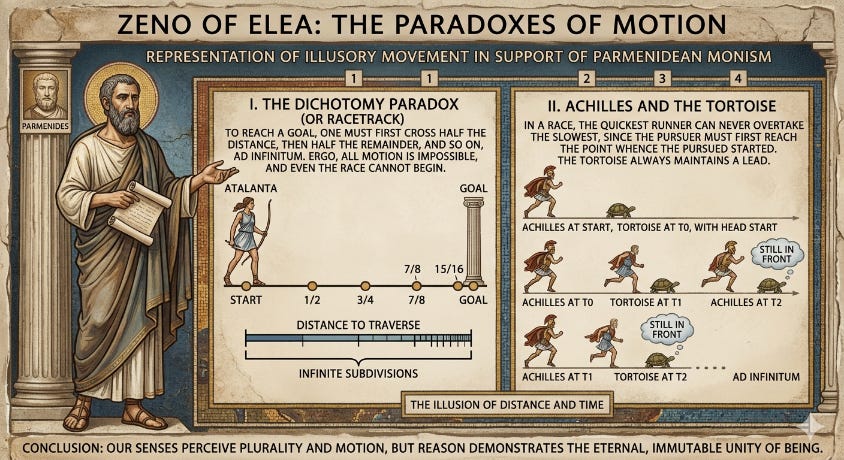
And finally, consider philosophy itself. Thought experiments, the original tool of the discipline since at least Zeno of Elea, are pure exercises in imagining the impossible or the counterfactual. What would a just city look like (Plato)? What would you choose behind a veil of ignorance (Rawls)? What would it be like to be a bat (Nagel)? If there is a universal solvent of philosophical inquiry, it is the question what if things were otherwise?, which is precisely the question the Lion-Man’s carver was already asking, in tangible ivory, 40,000 years ago.
It would be dishonest, though, to celebrate this capacity without noting what comes with it. The same cognitive move that generates art, philosophy, and science also generates ideologies, elaborate representations of how the world is organized that can be completely detached from evidence. It generates the willingness to die, and to kill, for fictions: sacred lands, racial hierarchies, apocalyptic futures. Mythology shades into propaganda. The ability to imagine impossible beings makes possible not only the Lion-Man but the blood libel [1], the Protocols of the Elders of Zion, the stab-in-the-back legend [2]. We are, as a species, extraordinarily vulnerable to compelling representations of things that do not exist.
This may be a good reason to be pessimistic about human cognition, but it is also a reason to take seriously the disciplines – philosophy, science, critical thinking – that developed precisely to regulate and interrogate our representational capacities. The carver who made the Lion-Man gave us art and myth and religion. Socrates, many thousands of years later, was essentially asking: now that we can imagine anything, how do we figure out which imaginings are worth taking seriously?
The Lion-Man is a strange object, and its maker is utterly unknown to us: their name, language, beliefs, the texture of daily life, all gone. But in a philosophically important sense, they are not alien. They could do what you are doing right now: entertain a representation of something that doesn’t exist, hold it steady in the mind, turn it over, examine it from different angles, and ask what it means.
That is an old capacity. Older than writing (3,400 to 3,200 BCE), older than cities (4,000 to 3,500 BCE), older than agriculture (12,000 to 10,000 years ago). It is, I want to suggest, the capacity, the one from which the others flow. And it was already fully present when a person sat in a cave in what is now Germany, with a piece of mammoth ivory and a stone tool, and began to carve something impossible into being.
_____
Post-scriptum: This essay was inspired by yet another conversation, over dinner, with my Turin friend Maurilio Orbecchi.
[1] The blood libel is a false and malicious antisemitic accusation that Jewish people murder non-Jewish children (usually Christian) to use their blood for religious rituals, such as baking matzah for Passover.
[2] The stab-in-the-back legend (German: Dolchstoßlegende) was a conspiracy theory widely believed in Germany after World War I. It claimed that the German Army had not actually been defeated on the battlefield in 1918, but had instead been betrayed by civilians on the home front, specifically politicians (the “November criminals”), socialists, communists, and Jews, who forced the government to sign an armistice.