This week I realized that over the past 45 years I’d been preparing for the news of the past nine days. I’ll list the reporting steps I’ve taken, because they set up the questions and reactions I have now.
-In 1981 I published a book called National Defense, which was serialized in the Atlantic.1 Its purpose was to interview people who’d spent their lives waging war, or studying warfare, and ask what realities of combat they think the rest of us misunderstand.
One of its messages was that the ability to think many steps ahead of the adversary—if we do this, they’ll probably do that, and then we’d have to imagine something else—distinguished the victors from the defeated. This applied on the battlefield and in other arenas of competition. So did the related-but-different ability to re-orient and change plans more quickly than the adversary, when circumstances inevitably changed.2 These points may seem obvious, but you’ll see why I’m returning to them now.
Another message involved “quantity vs quality.” The historians, combat veterans, and technologists I spoke with also emphasized that in warfare, having more weapons, could sometimes matter more than having “better” weapons. One gruesome example from Vietnam was the cheap but reliable AK47 rifle used by the Vietcong, versus the more “advanced” American M16, prone to deadly jams in the arms of US troops.
Drones did not exist in those days. But since 2022 Ukraine has shown how a $2,000 “first-person-view” drone can destroy a $5 million Russian tank. Right now, Iran can buy at least 150 of its Shahed “suicide missiles” for the cost of a single US-made Patriot missile to defend against them.
-In 2002, I published a series of Atlantic pieces applying this logic to the upcoming war in Iraq, and arguing that the US should not invade, unless it was thoroughly prepared for the decades-long consequences.3 The main message of a pre-war piece, based on interviews with historians of combat and of the Middle East, was: Do not choose to begin any “war of choice,” unless you have exhausted all other possibilities, and thought through everything that could go wrong. The main message of another article a year into the chaotic post-war scene was, Here’s what happens when you fail to ask, What if? What next?
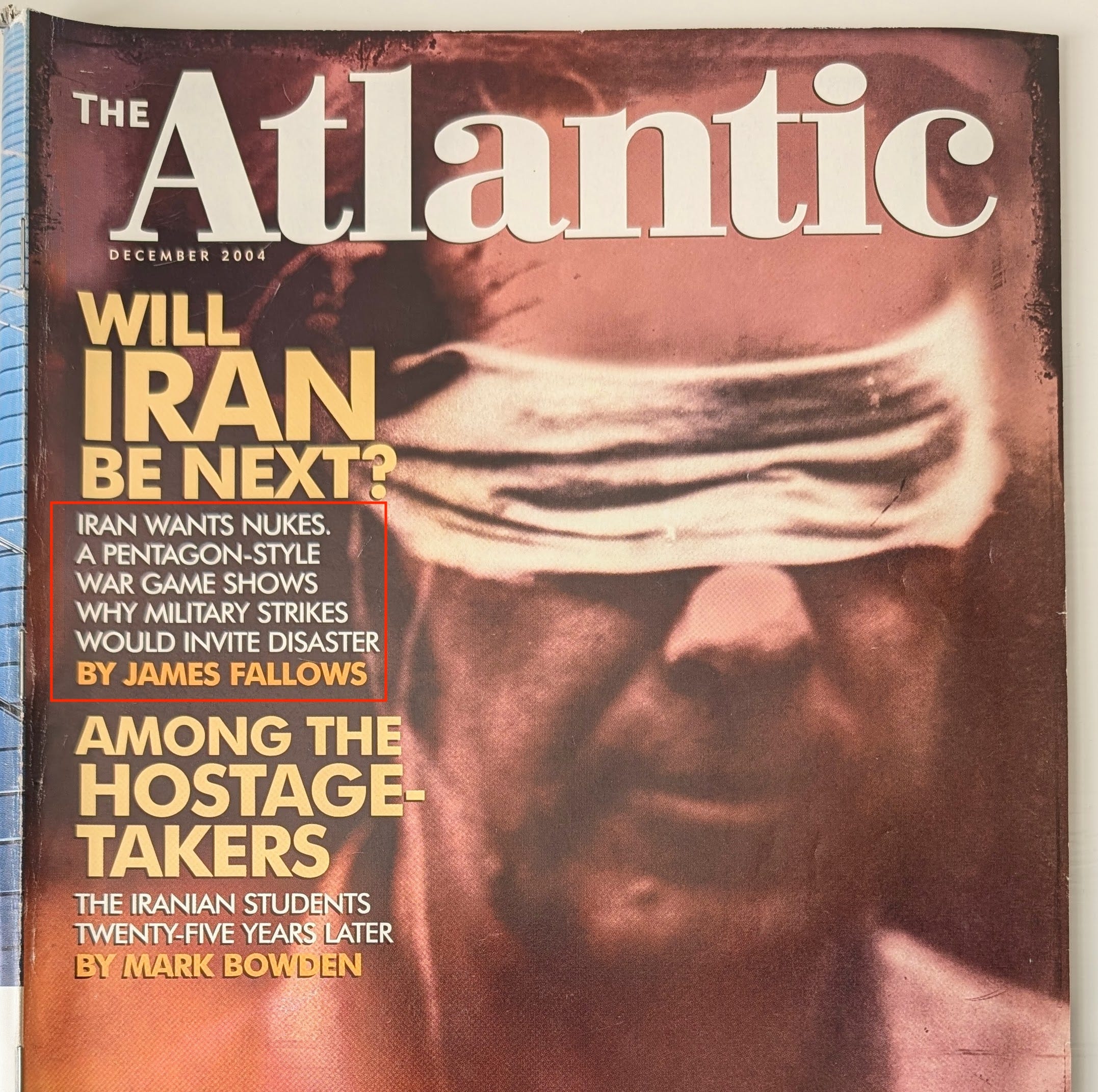
-In 2004, I published a long Atlantic story applying this logic to Iran. It was called “Will Iran Be Next?,” and it was based on a formal, Pentagon-style “war game” about the long-term moves and counter-moves that were foreseeable (and unforeseeable) if the US, or Israel, decided to bomb Iran’s nascent nuclear facilities out of existence.
The retired Air Force colonel Samuel Gardiner, who had managed many “real” Pentagon war games, assembled participants of varying political views and military and strategic experience, and led them through a series of what-ifs.
The main message of the piece was in these concluding lines:
This is how the war game turned out: with a finding that the next American President must, through bluff and patience, change the actions of a government whose motives he does not understand well, and over which his influence is limited. "After all this effort, I am left with two simple sentences for policymakers," Sam Gardiner said of his exercise. "You have no military solution for the issues of Iran. And you have to make diplomacy work."
-In 2015, on return from years of living in China, I published an Atlantic piece whose official title was “The Tragedy of the American Military.” But our in-house working title was “Chickenhawk Nation.” That is because its main argument was that it had become far too easy for political leaders to strut and posture about “honoring the troops”—the Hegseth term “warfighters” was not yet in common use—but then to commit them in half-thought-through “forever” wars, since so much of the public was so insulated from the consequences.
One of its conclusions was in this passage:
The vast majority of Americans outside the military can be triply cynical in their attitude toward it. Triply? One: “honoring” the troops but not thinking about them. Two: “caring” about defense spending but really viewing it as a bipartisan stimulus program. Three: supporting a “strong” defense but assuming that the United States is so much stronger than any rival that it’s pointless to worry whether strategy, weaponry, and leadership are right….
I interviewed retired Admiral Mike Mullen, appointed by George W. Bush and then re-appointed by Barack Obama as chairman of the Joint Chiefs of Staff:
Mike Mullen thinks that one way to reengage Americans with the military is to shrink the active-duty force, a process already under way.
“The next time we go to war,” he said, “the American people should have to say yes. And that would mean that half a million people who weren’t planning to do this would have to be involved in some way. They would have to be inconvenienced. That would bring America in. America hasn’t been in these previous wars. And we are paying dearly for that.”
His closing words to me were:
“It’s become just too easy to go to war.”
The article also quoted recommendations from a panel commissioned by then-president Barack Obama, and led by former Senator (and defense-reform pioneer) Gary Hart, about managing combat in the “chickenhawk” era. One of the points from its report is haunting now:
Clarify the decision-making process for use of force. Such critical decisions, currently ad hoc, should instead be made in a systematic way by the appropriate authority or authorities based on the most dependable and persuasive information available and an understanding of our national interests based on 21st-century realities.4
That is, something other than a serving president having a “feeling” that it was time to attack.
Below is a set of five questions, and quotes, and even clichés that have stayed with me since first writing about Vietnam-era debacles. And that together make me view the past nine days as the most wantonly self-destructive for the United States in my long life time.
This has seemed in a way worse than the immediate aftermath of the 9/11 attacks. Or of the multiple horrific assassinations of the 1960s. Those previous tragedies were things done to America. Now the people at the controls have taken every hard-earned lesson about war and peace and set it ablaze.
Here are some questions and sayings that come to mind for me:
It’s the question everyone is asking, except those in control.
It’s the question the most powerful single military commander in US history—Dwight D. Eisenhower, in charge at D-Day—asked as president, in 1954, about supporting the French effort at Dien Bien Phu. And in 1956, about supporting the British effort in Suez. And, most cold-bloodedly, again in 1956, about supporting the Hungarian freedom fighters in their doomed uprising against the Soviet Union. Eisenhower, who had planned so carefully for the war against Hitler, looked three moves ahead and did not like what he saw. He asked “how does this end?” and decided not to commit the US.
It’s the question John F. Kennedy was reportedly preparing to ask about the trickling-upward commitment of US forces in Indochina, at the time he was killed
It’s the question the first George Bush asked about extending Gulf War combat from Kuwait all the way into Baghdad. He knew the bloody consequences of leaving Saddam Hussein in power in Iraq. But he did not see how an invasion of Iraq could end well. So he stopped.
It’s the question the second George Bush did not ask seriously enough about invading Iraq, ten years later.
And it’s a question that appears not to have been taken seriously by the top of our current chain of command.