This essay is a collaboration between Farida Khalaf and Jose Antonio Morales exploring how fear shapes our choices and what changes when we learn to tell the difference between alarm and panic.
There’s a version of you that doesn’t exist yet.
That version applied for the role that scared you. Spoke up in the meeting where you stayed silent. Learned the skill you told yourself was too hard. Had the conversation you’ve been rehearsing for months but never started.
That version isn’t braver than you. They just learned to tell the difference between the alarm and the panic.
Look at your last year at work honestly. Not the resume version, the real one.
How many ideas did you not share because they felt half-formed? How many opportunities did you scroll past because you didn’t meet every requirement? How many times did you type out a message, read it seventeen times, delete it, and tell yourself you’d send it tomorrow?
Now ask: Who decided all of that?
Most of us think we’re being careful. Strategic. Realistic. But here’s what’s actually happening: an alarm rings somewhere in our chest, and before we can even hear what it’s saying, our mind writes a fifteen-act tragedy about everything that could go wrong.
The alarm says: “This matters to you.”
Your mind says: “You’re not ready. They’ll judge you. You’ll look foolish. Wait until you’re more prepared. This isn’t the right time.”
And we’ve been listening to the wrong voice.
Warren Buffett is worth over $150 billion today. He speaks to thousands without hesitation. But at twenty-one, he couldn’t say his own name in front of a group.
“Just the thought of it made me physically ill. I would literally throw up.”
He arranged his entire college schedule to avoid presentations. He designed his life around keeping that panic quiet. And it was working, until he realized what it was costing him.
He wanted to be an investment advisor. But how do you advise people when you can’t speak to them? He wanted to marry the woman he loved. But how do you propose when you can’t get the words out?
The panic wasn’t protecting him. It was imprisoning him.
So he saw an ad for a Dale Carnegie public speaking course and signed up. Wrote a check. Then immediately stopped payment on it.
“I just couldn’t do it. I was that terrified.”, Months later, he saw the same ad. This time he paid in cash. “I knew if I gave him the cash, I’d show up.” He showed up. And in that first class, he discovered something that changes everything: “We all had trouble saying our own names.”
Thirty other people. Same alarm ringing. Same mind turning it into a catastrophe. That’s when Buffett understood: the alarm was just telling him public speaking mattered. His mind was the one saying he’d fail.
What’s the one thing you’ve been avoiding this week?
Not the apocalyptic stuff, just the normal career thing. The message. The conversation. The application.
Got it? Good.
Now notice: your alarm already rang. That’s why it came to mind. The alarm said “this matters to you.”
Everything else, the seventeen reasons why you’re not ready, why it’s not the right time, why you should wait—that’s your mind interpreting the alarm.
Feel the difference?
Some time ago, after several successful months with a consulting client, I started noticing a change in the attitude of the person I was working with. My intuition sounded the alarm.
I ignored it, things were going well, and I didn’t want to complicate what seemed like a good collaboration.
Weeks later, when the projects were nearly finished, that subtle discomfort turned into something clear: an open attack, straightforward bullying tactics. My strategic mind and my moralistic mind decided to strike back with truth and clarity.
But my fear-based response only made the problem visible, not better. It actually damaged the relationship.
If I had acted earlier, I wouldn’t have been defensive. I wouldn’t have reacted from a wounded place. I might have created a better outcome.
Now I know to listen to what the alarm is trying to say, not to ignore it, but to learn from it and trust my intuition.
I even realized my consulting contract was missing something: mechanisms to open channels of communication when similar situations arise.
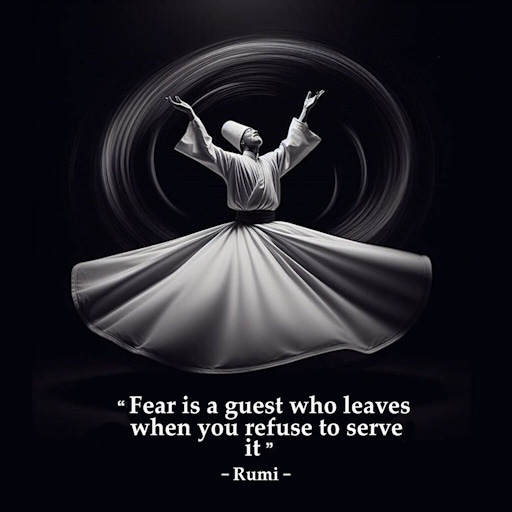
Eight hundred years ago in Persia, the philosopher Rumi was watching talented people make themselves small. Not because of danger, because of their interpretation of the signal.
He said something that, once you really hear it, changes everything:
“Fear is a guest that leaves when you refuse to serve him.”
Here’s what he meant: The alarm (fear) is just a visitor. It rings, delivers its message “this matters” and waits.
But we’ve been treating our mind’s interpretation like an honored guest. We’ve given it the best seat. We’ve organized our entire lives around keeping it comfortable. We’ve let it make all our decisions.
“Should I speak up?” The mind says no. We stay quiet.
“Should I try this?” The mind says it’s too risky. We don’t try.
“Should I grow?” The mind says it’s uncomfortable. We stay the same.
Rumi understood: when you stop accommodating that interpretation, when you stop serving it, it leaves. Not because you fought it. Not because you became fearless. Simply because you stopped organizing your life around what your mind tells you the alarm means.
Buffett got this. After his twelve-week course ended, he immediately asked the University of Omaha if he could teach a class. He knew that if he didn’t keep practicing, his mind would go right back to running the show.
“I just kept doing it, and now you can’t stop me from talking,” he says with a laugh.
The only diploma hanging in his office? Not from the University of Nebraska. Not from Columbia Business School. His Dale Carnegie certificate.
“That $100 course gave me the most important degree I have.”
He learned to hear the alarm without obeying the panic.
While Rumi wrote in Persia, on the other side of the world, the Inka people were building Machu Picchu at eight thousand feet, where the air is thin, where earthquakes shake the ground regularly, where every condition argues against permanence.
They built structures so precisely fitted that five hundred years later, you still can’t slide paper between the stones.
My colleague Jose and I have been exploring how our different cultural traditions speak to this same challenge. The Inkas had three principles:
Ama Sua: Don’t steal. Don’t take shortcuts when integrity matters. Don’t cheat the foundation because your mind tells you the work is too hard.
Ama Llulla: Don’t lie. Don’t deceive yourself about reality. Don’t let your mind’s exaggeration replace truth.
Ama Qhella: Don’t be lazy. Don’t avoid the hard work because your mind tells you it’s too difficult.
The Inkas understood: you cannot build anything lasting on panic. It shifts. It exaggerates. When the ground shakes, and the ground always shakes, everything built on your mind’s interpretation crumbles.
Buffett was building on panic when he stopped that check. When he paid in cash and showed up anyway, he started building on something real, his actual capability, not his mind’s story about his capability.
Rumi from Persia. The Inkas from the Andes. Eight hundred years ago. Five thousand miles apart. Same insight:
You are not your mind’s interpretation.
The alarm is just information. Your mind’s panic is just an interpretation. And that interpretation is a visitor with opinions, not an authority with power.
The Inkas called the alternative munay, sacred will, empowered intention. Not the absence of the alarm, but the presence of something stronger than panic: purpose. Commitment. The decision to build on what’s real.
Buffett found his munay in that classroom. Not because the alarm stopped ringing, but because he stopped letting the panic decide.
He wanted to advise investors more than he wanted to stay comfortable.
He wanted to propose to Susan more than he wanted to avoid awkwardness.
He wanted to build something more than he wanted to serve his mind’s story.
That’s the shift. Not fearless, just refusing to let the panic set the agenda.
When Buffett stopped accommodating the panic, something specific changed.
He could have dinner with potential investors without rehearsing every sentence in the bathroom first. He could propose to Susan without needing three drinks. He could pick up the phone without his stomach dropping.
The alarm still rang. It said: “This conversation matters. This call matters. This moment matters.” But he learned the alarm wasn’t his enemy. It was just information.
So when it rang, he’d think: “Oh, this matters to me.” And get to work.
Not heroically. Not perfectly. Just... next.
He’d send the message. Have the conversation. Make the call. And discover that most of the catastrophes his mind predicted never happened.
Some things worked. Some didn’t. But he survived all of it. The thing he’d been protecting himself from, looking foolish, being wrong, not being perfect, wasn’t actually dangerous.
It was just uncomfortable.
And on the other side of uncomfortable was everything he wanted.
Here’s what happens next.
The alarm will ring. Maybe in five minutes when you think about that thing again. Maybe tomorrow before a meeting. Your mind will start its story.
When it does, try this: Name it out loud.
“That’s my mind interpreting.”
Just that. You don’t have to do anything heroic. You don’t have to send the message or have the conversation yet.
Just notice the gap between the alarm and the story your mind tells about it.
That’s it. That’s the practice.
The alarm: “This matters to you.”
Your mind: “You’re not ready / They’ll judge you / It’s too risky / Wait.”
You: “Oh. I see what’s happening here.”
When you see the gap clearly enough, something shifts. Not always immediately. Not always dramatically. But it shifts.
You might send the message. You might have the conversation. You might apply for the role.
Or you might just sit there, heart pounding, and notice: the alarm was right. This does matter to me. And my mind was just making things up.
That moment, that seeing, is where everything changes.
Buffett saw the same ad twice. The first time, panic won. The second time, he paid in cash because he knew: if he gave panic another inch, it would take his whole life.
The alarm will still ring. Your mind will still react.
The difference is, you’ll recognize it now.
“Oh, that’s the alarm. And that’s the panic. I hear you both. And I’m not accommodating the panic today.”
And then you’ll do the thing anyway.
Every week in Lights On, I uncover the hidden systems shaping technology, culture, and the human mind. Not quick fixes or trends, just clear insight into the structures beneath the noise.
If this exploration of fear and awareness resonated, you’ll find more in Lights On, where we turn the light on what’s unseen, and why it matters.
If you enjoyed this collaboration, visit Jose, he writes Growing Fearless is an Adventure, is the author of Fear Enough, and is building a community for independence-driven people seeking support and guidance.
No fluff. Just the stuff that matters when the alarm rings and you have to decide: listen to the signal, or obey the story?
The choice has always been yours.