Adventure, British Columbia, News, What’s New Wednesdays
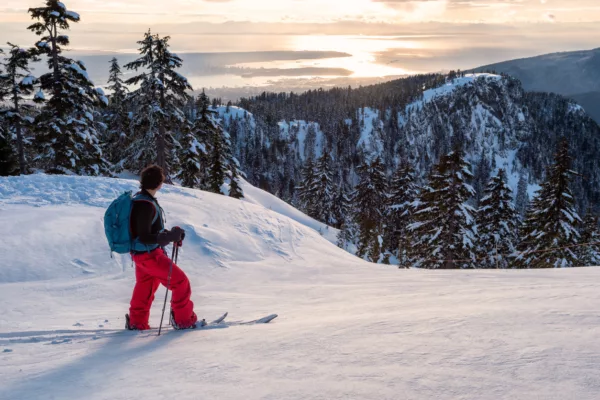
“What is winter going to look like in 60 years?”

I’ve gotten used to smelling smoke in the summer. Usually, it starts in July. If we’re lucky, it’s August or even September.
But this year, it started in early May.
On May 4, I woke up to a wildfire burning less than five kilometres from my front door. The BC Wildfire App on my phone said the fire was “out of control.” It wasn’t that surprising. The weeks leading up to the fire had been hot and dry. The two days before were an unseasonably scorching 30 C. Add in a historic snow drought in the region, and the deck was stacked for fire weather.

I took a morning walk to the lakeshore to watch a column of smoke billow. Somewhere in the forest, fourteen firefighters were cutting lines into the dirt to contain the blaze. Overhead, a helicopter buzzed, lifting buckets of water from Cultus Lake for the short flight to douse the flames. By the end of the day, the fire was “being held,” but not before BC Parks closed two campgrounds and a section of the Seven Sisters Trail.
By midweek, the fire was “under control.” But with no relief from the hot, dry weather in sight, the province wasn’t taking any chances. On May 7, a campfire ban came into effect across the Coastal Fire Center, covering Vancouver, the Fraser Valley, Vancouver Island and up the coast to Haida Gwaii. The ban also came into force in parts of the Prince George Fire Centre, including the Robson Valley.
Update: As of May 12, the campfire ban is scheduled to be rescinded starting on Friday, May 15 at noon for the long weekend. Please check local news and follow all updates for more information before having a campfire.

According to BC Wildfire fire information officer Jennifer Lohmeyer, the 2026 bans are the earliest since the province started tracking them in 2003. The previous record was a full month later, when a fire ban was announced on June 8, 2023.
Lohmeyer told the CBC that the ban is necessary because “we’ve been experiencing warm, dry conditions for the last three weeks and that’s expected to continue.” It’s a reality that explore covered a few weeks ago that has the potential to upend summer outdoor recreation.

As we already saw in Cultus Lake, fires can close down campgrounds and trails. They can also shut down roads and highways, making travel to and from recreation destinations difficult. Then, there’s the smoke.
According to a 2024 guide published by the BC Centre for Disease Control, “exercising outdoors can drastically increase your wildfire smoke exposure.” Another study, published in 2021, found that wildfire smoke is up to 10 times more harmful to humans than other forms of pollution like smog and car exhaust.

It gets even worse when you combine wildfire smoke and heat. A study published last summer in the journal npj Clean Air looked at what happens to people when they’re exposed to both.
“When it’s very hot, your body is fighting hard to maintain its core temperature and keep cool, and when it’s smoky, your body is fighting hard to reduce the inflammation caused by smoke exposure,” Dr. Sarah Henderson, the study’s author, explained in an interview with the University of British Columbia Magazine. “When these things happen at the same time, it puts more stress on your body.”
That should worry anyone planning summer hikes or camping trips. Especially since the study concluded that “the risk of death spikes when people are exposed to both elevated levels of fine particulate matter from wildfire smoke and temperatures above 26 degrees Celsius.”

For many Canadian families, the upcoming Victoria Day long weekend marks the start of camping and campfire season. And while campfires are still allowed in most of the country, the bans in BC show just how quickly that can change. It all raises a question: could we be seeing the end of the campfire as we know it?
It’s a question that former Outside columnist Wes Siler posed back in the fall of 2016. He was writing after what was then, one of the hottest summers on record. It was also the last time that North America was affected by a “super El Niño,” the same weather pattern expected to arrive this summer.

In his piece, Siler broke down a slew of arguments against campfires. They contribute to air and water pollution, are harmful to our health, and facilitate littering. Too many people see campfires as an excuse to cut down or damage healthy trees, he argued. Then there’s the way that firewood sales contribute to the spread of invasive species and the fact that people tend to hurt themselves when cutting wood and tending fires. But it’s the confluence of climate change, wildfire and outdoor recreation that really drove the point home.
“With massive wildfires raging all summer long and exhausting state budgets, and with participation in outdoor recreation booming to record numbers, maybe the negative impacts of the campfire now outweigh tradition and comfort,” he wrote.
I remember being intrigued the first time I read the piece, but not convinced. Looking back at it now, it’s hard to argue with Siler’s conclusion. And it’s an idea that others are grappling with too. Explore’s president and publisher, David Webb wrote about it back in 2021, and editor Alison Karlene Hodgins (forgive the pun) explored it last week.

The reality is that Canada spends more than $1 billion a year on wildfire suppression, a number that is only likely to grow as warmer, drier summers become the norm. And that’s just the cost of suppression.
Wildfires are threatening homes, communities, trails and landscapes. Rebuilding comes with a hefty price tag. The 2016 Fort McMurray wildfire was estimated to have cost around $9 billion. In Lytton, where they’re still rebuilding, the cost hit $239 in 2024, the same year that a fire tore through Jasper National Park. The price tag for that one recently hit $1.23 billion. And those are just a few of the big-name fires.
The hard truth is that climate change is making wildfires hotter, bigger and more dangerous. And more than half of Canada’s wildfire ignitions are caused by humans. In some provinces, that number is even higher. Take Nova Scotia for example, where more than 90 percent of wildfires are human caused.
It reminds me of a pair of signs that once stood along Highway 3, astride the remains of a massive wildfire in E.C. Manning Provincial Park.
The first sign, erected by the Parks Division of the BC Forest Service, read “One Camper Made This 5,700 Acres Look Like Hell! Don’t YOU be careless.” When the government of the day took issue with the word “hell” on a public sign, they replaced it with a burning cigarette hung in a noose.

But the 5,700 acre fire the sign was erected to call attention to wasn’t caused by an errant cigarette butt. Nor was it an all-terrain vehicle or even a natural cause like a lightning strike. That fire, which was known at the time as “Big Burn” was sparked by an unattended campfire.
Join over 70,000 readers getting trail conditions, gear analysis and industry news—written by the team behind Canada’s longest-running outdoor magazine.
By providing us your email, you will be signed up to receive emails from Explore and agree to our Privacy Policy and Terms & Conditions.
READ MORE: British Columbia, Editors' Picks, Spring, What's New Wednesdays
Cam Fenton is a writer, guide and educator based on the Canadian side of the North Cascade mountains. Follow him on Instagram (@camfenton604) and Substack (camfenton.substack.com).
Adventure, British Columbia, News, What’s New Wednesdays
“What is winter going to look like in 60 years?”
Adventure, British Columbia, News, What’s New Wednesdays
A long-promised recreation strategy raises questions about money, trails, resource roads and wildlife.

Adventure, British Columbia, What’s New Wednesdays
Despite these misgivings, the new fees don’t appear to be driving down summer campground reservations at BC Parks.

Adventure, environment, Nova Scotia, What’s New Wednesdays
With warmer-than-average temperature forecasts for the summer, that could mean another summer of dangerous fire conditions.

Adventure, environment, Summer, What’s New Wednesdays
Smolders explained that it starts with trip planning and research, looking at both weather and conditions, as well as changes to the landscape.