Last week I talked about the peculiar pricing of the very popular TI ADC, the ADS1115. In a nutshell, you can buy it for either about $4 or for $0.50, depending on the supplier. US suppliers like Mouser and Digikey sell at the high price, Chinese LCSC sells at the lower. This definitely prompted a lot of discussion. This week the authentic ADS1115 arrived, and I have some new findings to report.
I’ll do my best to describe the theories, and then list objections.
Price discrimination is the economics term for charging different prices to different customers. For example in some places taxis charge different prices for tourists and locals. It’s a well-understood phenomenon, and the excellent MRU economics course explains it in full.
This situation looks like price discrimination. TI is the monopoly supplier of ADS1115 chips — nobody else can make and sell an ADS1115. TI knows that US customers are much less price-sensitive than Chinese customers, so sets a higher price in the US.
Alternately, US distributors (Mouser and Digikey) set the higher price, using their dominant supply position and reputation to sell to customers who are prepared to pay a premium to be certain about authenticity.
In the MRU video, note that the price setters in the examples like ambiguity. They won’t confirm or deny that they’re selling the same product at two different prices. In fact they often do things to increase ambiguity, because the uncertainty encourages people to buy the premium parts.
During manufacturing, some chips fail. What happens to them? Well, it depends. They might get destroyed, or they might get sold on to a third party. The failed parts can be packaged up and sold through gray market channels. I’ve experienced this with LCD panels for the Gameduino.
Something similar happens when a contract manufacturer makes the official part, but does extra production that they then sell themselves. This is called “third shift” — the idea being that two shifts are assigned to legitimate production, the third to this extra contraband production.
In both these cases, the parts get sold at a lower price than the genuine article.
Many have pointed out the striking similarity between the ADS1115 and the Analogy ADX111. Here is the (part-Chinese part-English) datasheet. The datasheets are so alike it’s like an old spot-the-difference game:
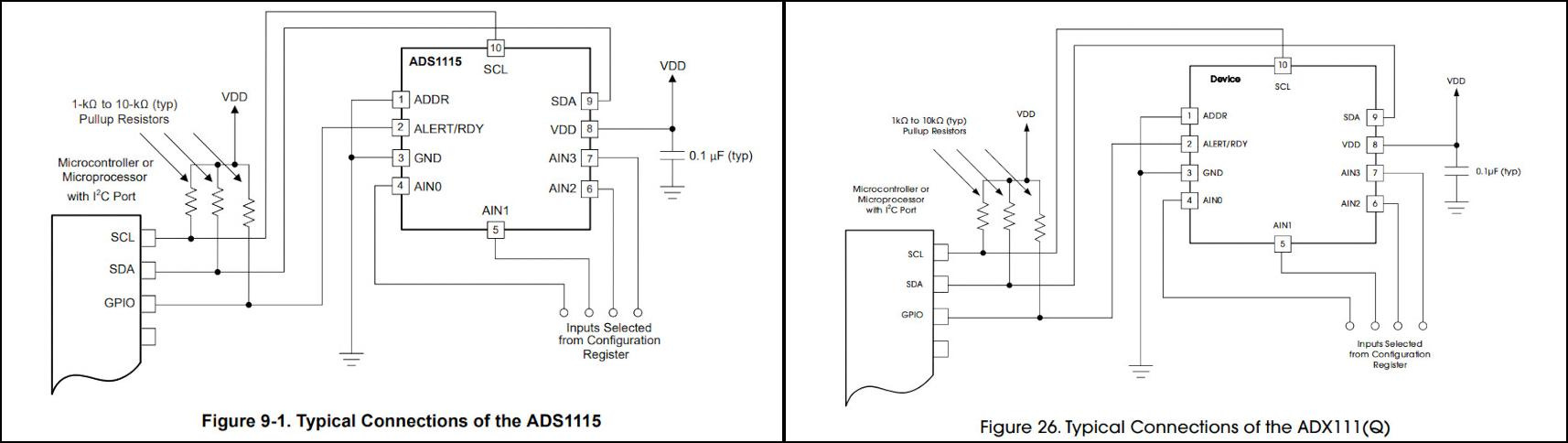
Certainly at the I²C register level, I can see no way to distinguish between an ADS1115 and an ADX111. The TI datasheet says that timing is guaranteed within 10%, the Analogy 7%. So that might be a way. On the other hand the fact that the Analogy data sheet switches at random between two languages, and copies large sections of the TI sheet makes me skeptical of its truthiness.
The ADX sells for $1.77 qty 1K on LCSC.
Several people expressed the opinion that LCSC is a reputable supplier, and that they have never received counterfeit parts when buying from them.
Some also stated that TI runs tight manufacturing operations, which makes sense given that they are a top-tier brand. Part of this is (a) making sure that failed parts get destroyed, and don’t escape through the factory back door, and (b) preventing “third shift” production.
When I tested the four cheap samples, three were ~5% out of timing spec. The fourth had a completely non-functional clock generator, but in a way that most customers would probably not notice. The accuracy of all four did not match the claims in either the TI datasheet or the Analogy sheet. All had gain errors of about 0.5%.
The marking on the cheap chips’ packages looks authentic to me. Of course this means nothing. The days of easily detectable fakery are long past.
One Hacker News commenter suggested decapping the chips and comparing microphotographs of the two dies. Apart from the effort involved in doing this, it might not actually prove much. The ADX111 die could look very much like the ADS1115 die, depending on whether it’s a functional replica or a straight die copy. Third shift production is the same product as legit production, but potentially with less stringent QA. The same goes for upcycled failed units. So you could easily spend a whole day sloshing boiling nitric acid around and be none the wiser.
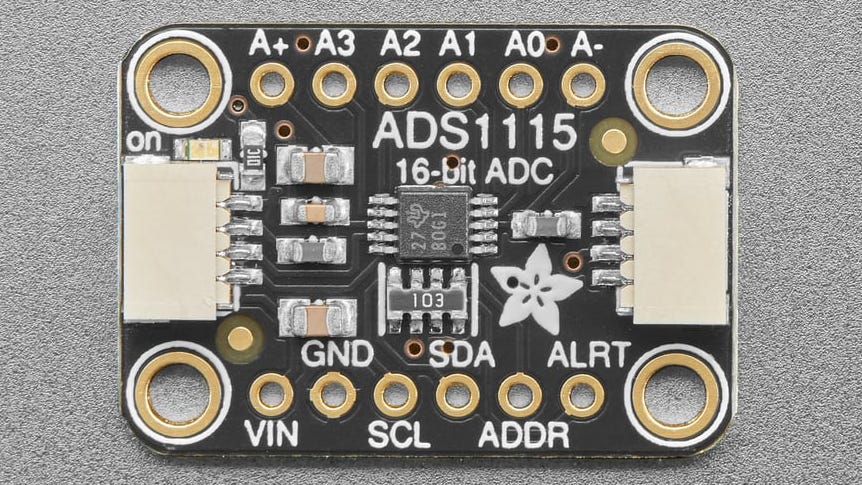
Dropping the Adafruit ADS1115 breakout into the test setup was a breeze. The build quality of the PCB is in a different league from the no-name parts. There’s a power LED, dual Stemma/QWICC ports, and a separate analog ground. So the testbench changed from a wire tangle to this minimalist setup.
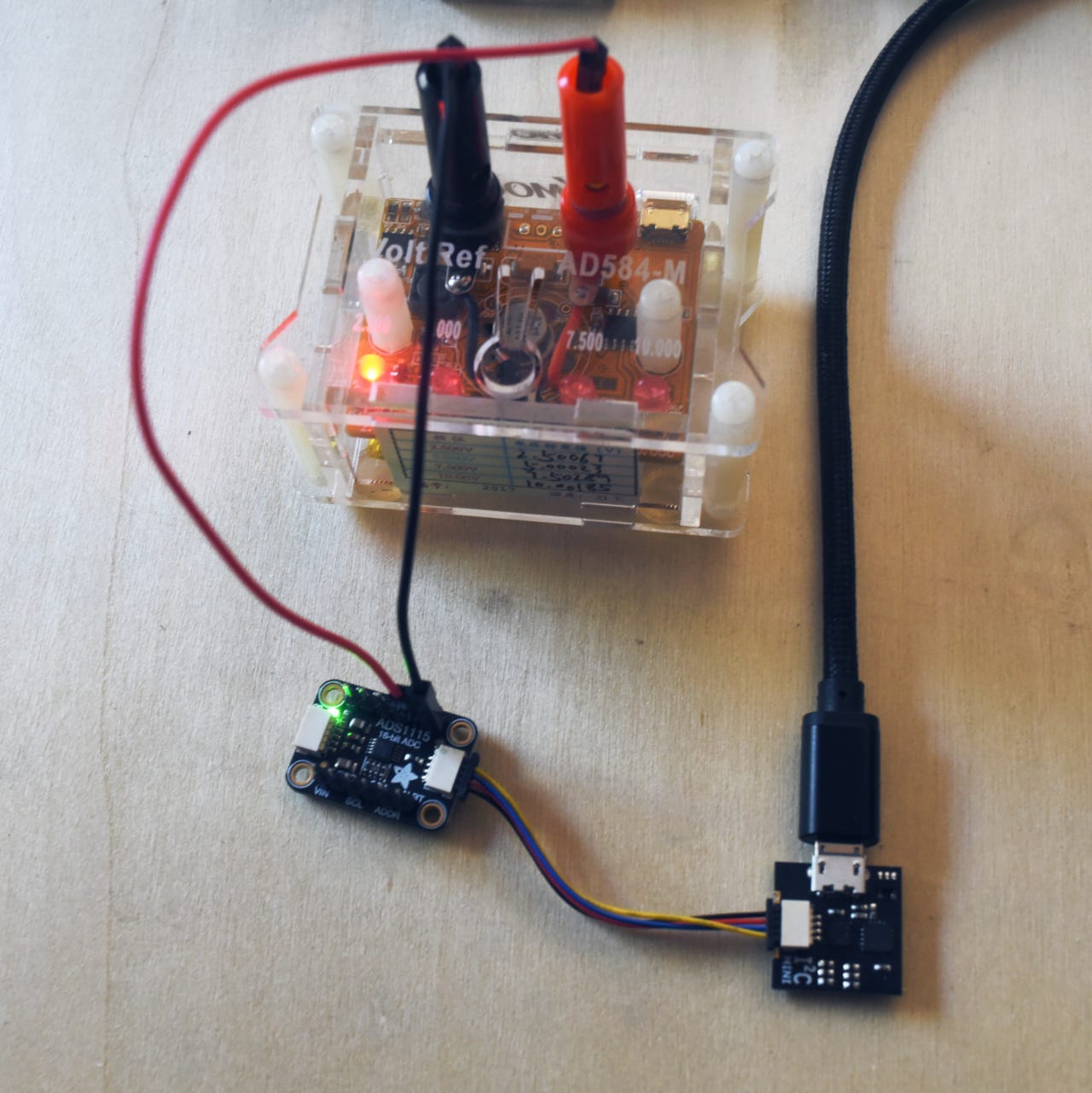
Running with the same test script immediately showed the differences. Timing is within 2% of nominal, better than the 10% promised in the TI datasheet. And the gain error is so low there’s not much point in calibrating it.
timing difference 99%
       raw=03415 v=2.4999
timing difference 99%
       raw=03415 v=2.4999
timing difference 98%
       raw=03415 v=2.4999
timing difference 99%
       raw=03415 v=2.4999
Overall, I was surprised at how much better this thing is.
There’s a clear difference in the performance of these parts. The Adafruit board was a lot better than claimed in the TI datasheet. The cheap boards were much worse. So that rules out price discrimination by TI.
Looking at the pricing and gain accuracy, I’d say that the cheap ADS1115 parts in the breakouts are fails, either from TI (unlikely), from Analogy, or from some other nameless vendor selling fakes.
I’m still curious about the bare chips from LCSC. I might use them in a short run of breakouts for Electric Dollar Store to see how they perform.
There’s a scene in the Matrix where Cypher simply decides to live without knowing the truth.
“You know, I know this steak doesn’t exist. I know that when I put it in my mouth, the Matrix is telling my brain that it is juicy and delicious. After nine years, you know what I realize? Ignorance is bliss.”

At the end of the day, if the imitation is so like the real thing you can’t tell the difference, then how much it does it matter if it’s real or not?
It’s a choice for each of us. Be like Cypher and settle for “close enough.” Or like Neo and pay the high price for insisting on the real thing.
Thanks for reading. Next week: my somewhat impressive chicken coop tech stack.