Our Chatbot Course is Almost Full!
Tired of missing out on AI? Want to learn how to build a GPT-4 Chatbot?
We just re-launched our How To Build a GPT-4 Chatbot course—designed to do exactly that.
It's an online cohort-based course that will teach you how to make your own GPT-4 based knowledge assistant in less than 30 days. You'll want to act quickly though! Over 80% of the seats for the course are already full. Click the link below to learn to build in AI?
“It is absurd that I could achieve what I did in four weeks!” — Henry F., former student.
In part I, we explored why the best decisions are emotional. In part II, we’ll look at the phenomenon of emotional debt and explore tools to mitigate its consequences.
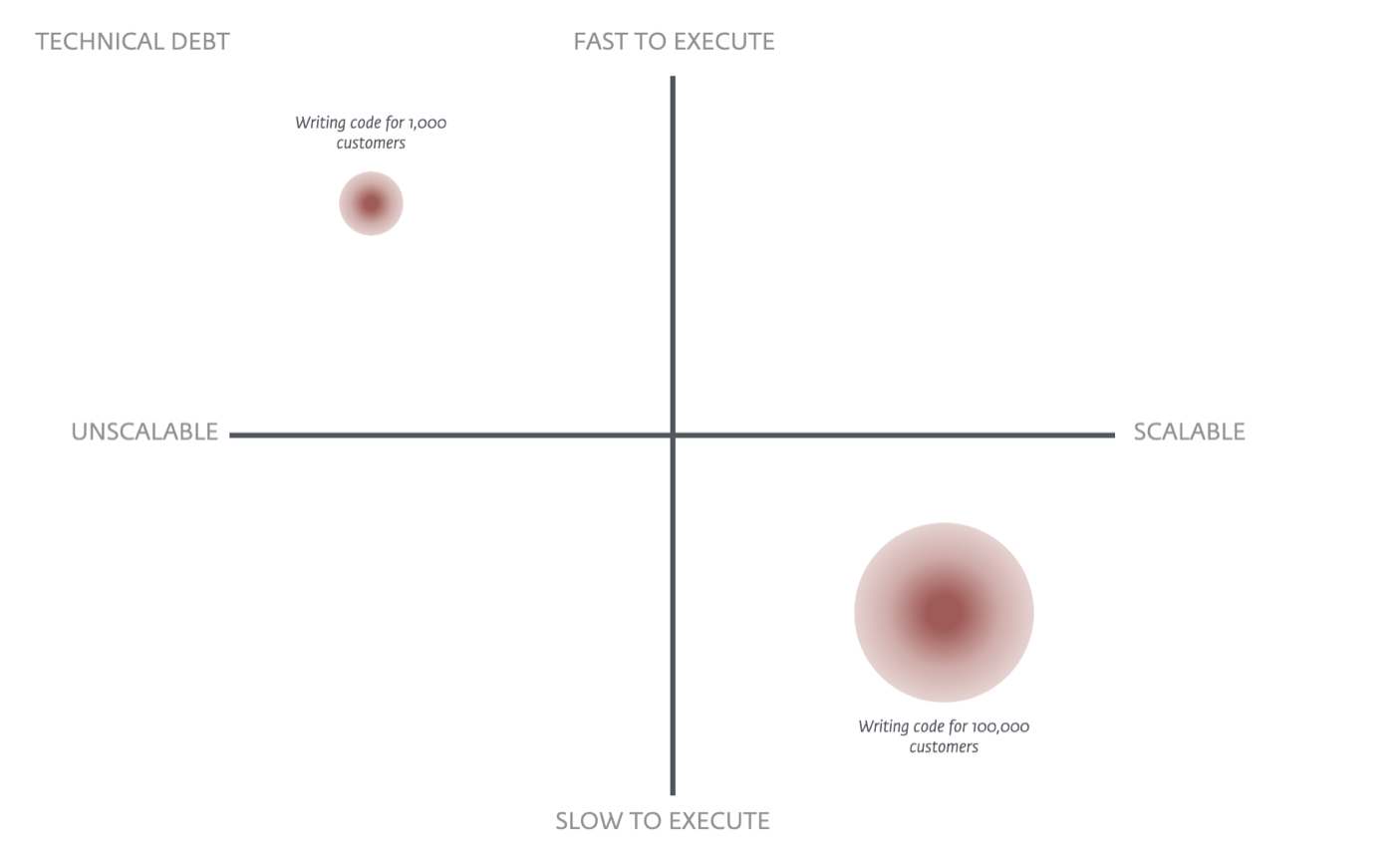
If you’ve ever worked at a fast-growing startup, you’re probably familiar with the concept of “technical debt.” Code is scrappily thrown together so that the product can function. It’s done with the understanding that this debt will accumulate and eventually cause things to break if not addressed down the line.
Something similar can also happen with the human nervous system. We are able to buffer intensely stressful experiences by repressing our emotions in the moment (sometimes subconsciously). We save “feeling our feelings” for a later point when we’re more equipped to deal with them. But if we never unpack what’s there, we can accumulate emotional debt that contributes to burnout and causes issues with our bodies.
This isn’t a solved science, and not all cases of burnout or emotional reactivity are the result of accumulated stress reactions. But this “body keeps the score” model has gained a lot of traction in recent years (see the recent New York Magazine cover story). It has its critics, but in my work coaching founders, I’ve seen firsthand how helpful this framework can be.
With that caveat in mind, let’s explore the concept of emotional debt and how to clear it.
What is emotional debt?
Imagine the following scenario: you’re an employee who’s just been fired from your role (or, if you’re a founder, pretend your company went bankrupt overnight). Upon receiving the news, you’re likely to experience a surge of adrenaline and numbness—feeling disassociated or even dazed—right up until you arrive home and collapse on the couch. At this point, ideally the buffered emotions would surge to the surface to be experienced and processed.
This is what’s known in therapy circles as completing the “mobilization response,” and it’s an evolutionary process that we have hardwired into our nervous systems. Most mammals have an built-in mechanism for paying off this emotional debt.
To illustrate, witness this footage of an impala barely escaping from the jaws of a leopard. Once it realizes that it’s safe, lying on the ground, the impala’s entire body begins to shake—discharging the energy and completing the mobilization response that was triggered by encountering a predator. (These observations come from the work of Dr. Peter Levine, a biophysics and psychology doctorate who wrote one of the seminal texts on trauma processing.)
Unlock the power of AI and learn to create your personal AI chatbot in just 30 days with our cohort-based course.
Here's what you'll learn:
- Master AI fundamentals like GPT-4, ChatGPT, vector databases, and LLM libraries
- Learn to build, code, and ship a versatile AI chatbot
- Enhance your writing, decision-making, and ideation with your AI assistant
What's included:
- Weekly live sessions and expert mentorship
- Access to our thriving AI community
- Hands-on projects and in-depth lessons
- Live Q&A sessions with industry experts
- A step-by-step roadmap to launch your AI assistant
- The chance to launch your chatbot to Every's 85,000 person audience
Over 80% of the seats are now sold, so sign up now to take advantage. Learn to build with AI in just 30 days!
Somewhere along the way, many of us human mammals have forgotten how to complete these physiological stress cycles. Research has shown that this accumulated emotional debt wreaks havoc on our nervous systems—often leaving us stuck in hyper-aroused (anxious) or disassociated (shut-down) states. Most of the scientific literature focuses on people with extreme cases of PTSD, but I’ve seen these patterns play out with clients from a range of backgrounds.
In the short term, there are times when building up emotional debt is essential to survival. We have this biological wiring for an important reason: it allowed our ancestors to get through intensely stressful experiences and only process them once safety had been reached.
However, if left unaddressed—especially in a world filled with ambient sources of stress—these buffered experiences accumulate and contribute to various health conditions or burnout.
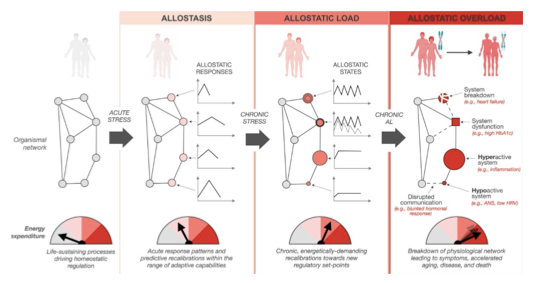
In the neuroscience literature, this emotional debt is labeled “allostatic overload.” It typically presents with what’s known as a “fluctuating or heightened neuroendocrine response”—which is the technical way of saying adrenaline floods our system.
Allostatic overload has a range of downstream consequences, like significantly accelerated cellular aging, increased mortality, and chronic health conditions. This is from where phrases like “the body keeps the score” and “the issues are in the tissues” arise.
One recent study found that allostatic overload causes a 60% increase in energy expenditure. This is energy produced by the body that is essentially wasted, like pressing your foot on the gas pedal without first removing the emergency brake. You may see it manifest in your body as anxiety or agitation.
For individuals with a higher degree of emotional debt, their nervous systems will be prone to greater fragility and reactivity in relationships. They may be more liable to shut down in high-pressure situations. This can become a vicious cycle, leading to the loss of support nets of friends or romantic partners, causing even more stress to the system.
Here’s an example from my time working as a venture-backed startup founder. There were some co-workers whose critical feedback elicited a disproportionate response in me—I’d get triggered. The resulting spike in shame, anxiety, or anger would severely diminish my capacity to act rationally in that moment or empathize with myself or others. My feelings usually didn’t match the scale of the situation—they were residual, repressed emotions from the past, trying to claw their way to the surface.
Perhaps you can relate? This is a sign of emotional debt at play.
My collaborator Jan Chipchase and I sought to explore the long-term consequences of accumulating this physiological debt. We surveyed 261 leaders from 43 countries about their experiences with burnout. We presented our findings in the Emotional Resilience in Leadership Report, hearing firsthand what happens when emotional debt accumulates beyond our capacity.
One San Francisco-based participant described his “breaking point”: “I remember…getting off a call with my client at the time during an extremely stressful project phase. My brain went completely blank like it was frozen or something, and then tears just streamed down my face. I wasn't able to make any decisions or have a conversation, and I had to just go home and try to rest.”
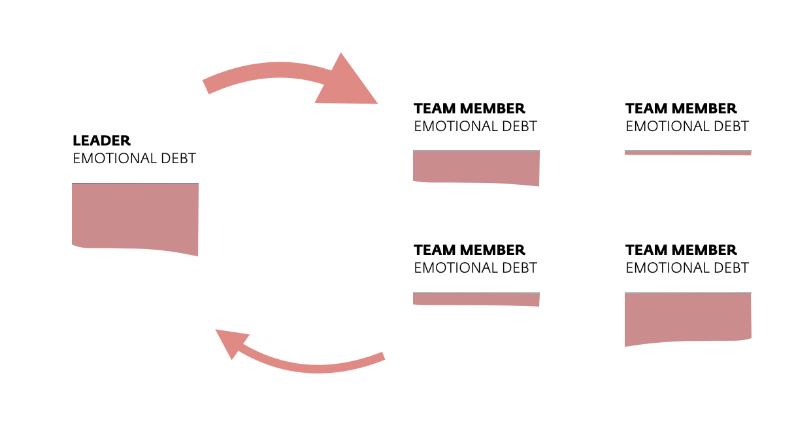
If you are in a leadership position, your emotional debt will have an outsized impact on your team and the company culture. “Emotional contagion” occurs when the moods and feelings from one person are passed to others. Research has shown that because of their role, leaders are particularly contagious. I’ve seen up close how calm managers impart serenity to their team, and highly anxious managers add to their reports’ stress. (My previous piece has more on this topic.)
How to release emotional debt
In my work as a founder coach and facilitated breath repatterning (FBR) practitioner, I’ve guided hundreds of people through processing all manner of stored emotions—from reliving the fear of a near-death drowning, to fully grieving the loss of a loved one, to recovering from burnout.
Time and time again, I’ve seen my clients develop emotional mastery in a counterintuitive way: by releasing control and allowing their feelings to flow freely. When we welcome emotions as they come and experience them without judgment, we can keep ourselves from building up “emotional debt” in the first place.
Present emotions can serve as a portal to the past, and processing a current situation sometimes releases stored "emotional debt" from previous experiences. When founders I work with grasp this, they often find it freeing to witness internal sensations arising and passing without needing to intellectualize what it means or why they’re here.
Of course, it’s easier said than done, and it’s counterintuitive from traditional Western methods of processing emotions (namely, by intellectualizing them). In my previous piece, we touched on one approach to “feeling your feelings” via a journaling prompt. Now, let’s go a little deeper on the subject via an embodiment technique called somatic surfing—a practice of connecting with physical sensations that arise with emotions.
The practice of somatic surfing
1. Create embodied safety
Decide in advance where you’ll go to process vulnerable feelings when they come up.
The degree to which we express emotions depends on our perceived sense of internal and external safety. In a one-on-one therapy or somatic session, a practitioner may not even need to say anything before the client’s emotion rises to the surface—the sense of embodied safety does 80% of the work. (Perhaps you’ve experienced something similar with a trusted friend or family member.) Being in a low-arousal environment—soft surfaces, warm lighting, plants or nature in view, etc.—can also make a substantial difference.
Reflect on what “safe” conditions look like for you and create a plan. Perhaps you’ll draw a solitary bath with candles when you get home from work, or you’ll snuggle under a blanket with your partner. Maybe you’ll drive to a secluded park near the office, or straight to your sister’s house. The best conditions for genuine emotional expression will differ for everyone. You’ll need to turn inward for this practice, so if you prefer not to be alone, set expectations accordingly with your trusted person (e.g., warn them you won’t necessarily be talking).
2. Get out of your head
Once you’ve established a safe setting, acknowledge to yourself that there is an emotion present. Then invite your awareness to shift away from any story or thoughts—although they will likely still be there—and move the spotlight of your attention to sensations in your body. Perhaps you feel queasiness in your lower belly, or tightness in the band around your diaphragm (below your rib cage). Maybe you sense tingling in your chest, neck, and throat area. Focus on an area that feels like it has the most aliveness or contraction.
3. Get curious
From here, give yourself explicit permission to soften into this place and feel what may be there. Invite curious awareness and try to breathe into the space. Explore the contours and texture of the sensation (e.g., rough, tight, numb, cold). If you can, visualize walking into the epicenter of this sensation.
4. Play with what you find
It’s common for resistance to arise, so try to welcome everything that comes up. You may ask yourself: what does this sensation want to express? If it feels overwhelming, bring the spotlight of your attention to a more neutral area—perhaps your feet on the ground or the palms of your hands. From here, see if you can hold awareness of the neutral and intense areas simultaneously.
5. Follow the changes
You will likely find that the sensation begins to shift or move. If it does then gently track or “surf” it, staying present with the emergent feelings. They may eventually release via a sigh, a yawn, tears, giggles, or a tangible sense of letting go. Allow it all to unfold. On the other side, it’s common to experience lightness, clarity, and relief.
6. Decompress afterward
If you do experience release, aim to give yourself time afterward to drop into a state of relaxation—perhaps listening to an NSDR or relaxing music—since this is when your nervous system will be rewiring new neural pathways and integrating whatever surfaced.
Collaborate with a somatic practitioner
If you’ve built up a lot of emotional debt, it can be challenging to tap into your body’s experience on your own. I recommend working in person with a practitioner who is trained in a somatic modality. Having a guide helps for two primary reasons: first, they contribute to a sense of embodied safety that allows these incomplete reflexes to surface. Secondly, they’ll ensure you don’t bypass challenging emotions or get stuck in mental story loops.
That said, it can be challenging to find a skilled practitioner. My recommendation would be to begin by searching for someone who is trained in either “somatic experiencing,” “Hakomi” or “conscious connected breathwork.” All three of these approaches utilize similar techniques for accessing the repository of emotional debt stored in the nervous system and releasing it.
There are many other modalities out there, but these tend to be the most reliably effective that I’ve come across. In terms of choosing someone to work with, ideally, look for someone with a minimum of five years of experience around whom you feel comfortable and safe.
I’m building an open-source project called Soma List. The intention is to crowdsource a directory of world-class practitioners trained in these emotionally-attuned modalities. Feel free to explore the directory (and recommend practitioners for inclusion!). Alternatively, a more affordable or accessible option is to take an online course.
Whatever you do, you’ll be better equipped to navigate stressful experiences, process your emotions, and avoid burnout—at work and in the rest of your life.
Jonny Miller hosts the Curious Humans podcast and Nervous System Mastery, a cohort-based course that shares evidence-based protocols for cultivating calm and resilience. If you’re interested in learning how to pay off emotional debt and regulate your emotional state, he is accepting applications for the fall cohort of his course. Every subscribers receive $250 off enrollment with the code EVERY. Apply here.