AI is going to make mathematicians much more productive. This sounds like an unambiguously good thing, but in the publish or perish world of academia, there will be significant unintended consequences.
I finished my PhD in dynamical systems in June 2025, when LLMs were becoming quite good in general but the ones I could access were still terrible at the kind of pure math research I cared about. People in my department were getting slightly nervous, but the general feeling was that these tools could help with routine work and maybe explain things, but they wouldn’t be able to create new mathematics any time soon. That was just over one year ago.
In August 2026, OpenAI announced ten AI generated results, including the first known construction of a non-sofic group. The longstanding question of whether every countable group is sofic had been open for more than 25 years and is closely tied to my own area of dynamics. In September Anthropic released a 13 million line formalization of Fermat’s Last Theorem that it says Claude largely produced in 11 days. This was not a new mathematical argument, but it is a pretty ridiculous demonstration of how quickly AI assisted formalization is improving.
And now, literally as I am writing this, OpenAI has released a solution to the Navier–Stokes Millennium Prize Problem. OpenAI says a system involving on the order of 10,000 concurrent agents produced a finite-time blowup construction for smoothly forced three-dimensional Navier–Stokes in 88 hours, with the Lean formalization taking another 17. OpenAI says this establishes alternatives C and D in the official Clay formulation, which explicitly allow a smooth external force. The paper is 165 pages, the Lean repository labels its review self-assessed and both were released today, so I am not going to pretend the mathematical community has already digested it. If it holds up, this is an enormous result, and the future this essay is worried about is not very far away.
There are plenty of caveats here. Some of these runs use substantial compute, the amount of human scaffolding varies and failed attempts aren’t advertised as loudly as successful ones. But I think the question of whether AI can do novel research mathematics now has a definitive answer: yes, and it will almost certainly get better.
Terence Tao recently described a possible transition from proof scarcity to proof abundance. His basic answer is that mathematicians will need to spend more time verifying, explaining and digesting proofs instead of just producing them. He also points out that journals, hiring, promotion and prizes were designed around proof scarcity and may behave badly when proofs become cheap. David Bessis makes a related point in The fall of the theorem economy: academia tends to reward the theorem because it is easier to point to than the understanding that came with it.
I think this is right, but saying what mathematicians should do doesn’t make it what they will be rewarded for doing. The field may desperately need more understanding, but that doesn’t help the individual mathematician who is still rewarded for producing the next theorem.
The general version of this argument is not new. People have been complaining about publish or perish forever, and Beth Bechky and Gerald Davis have already made a broader version of this argument about scholarly craft: AI may let researchers skip some of the hands-on work that teaches them how to do research.
The version I care about in mathematics is unusually direct. Mathematical research has usually produced two things at once: a theorem and a mathematician who understands the subject better than they did before. Only the first one goes on your CV. Until now, getting the theorem usually meant someone had to spend a lot of time playing with examples, getting stuck and slowly building taste. AI may let us get the theorem without most of that.
AI can produce mathematics faster than humans can understand it, and publish or perish forces mathematicians to keep adding to the pile even if they would rather understand what is already there. The slow work getting squeezed out is also part of how people learn which results matter in the first place.
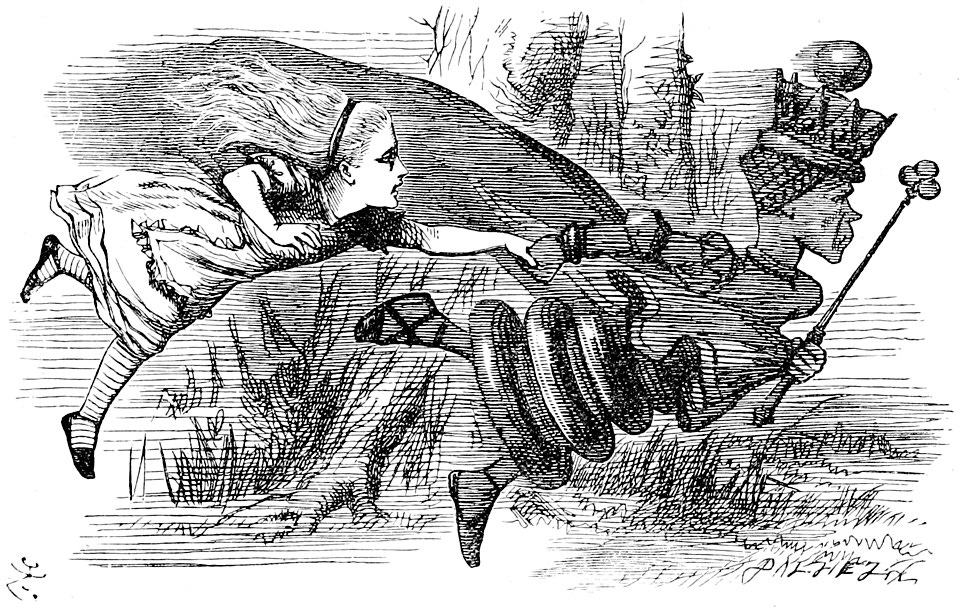
In Through the Looking-Glass, the Red Queen explains to Alice that she has to run as fast as she can just to stay in the same place.
Suppose a good AI research assistant makes a mathematician ten times as productive. One version of this story is that the mathematician now produces the same amount of work in one tenth the time and spends the rest of the year thinking deeply, teaching, going on walks or doing whatever else mathematicians do.
This mechanism may already be showing up elsewhere in academia. An April 2026 report from *Organization Science*’s AI Task Force found that submissions to the journal rose 42 percent following ChatGPT’s release, with nearly all of the growth coming from submissions whose abstracts an AI detector flagged as AI assisted or generated. The increase was larger at schools where researchers had historically responded more strongly to journal rankings.
This is one management journal and an AI detector is not ground truth. Responding to journal rankings is also obviously not a perfect measure of publish or perish. It is evidence about AI assisted writing, not AI doing the underlying research. Still, it points in exactly the direction you would expect. The authors describe the result at their journal as “more rather than better” research.
The first mathematician with that tool has an enormous advantage. They can search more literature, test more conjectures and explore more proof strategies. Of course everyone else can use the same tool. Once they do, it stops being an advantage and becomes something you need to keep up. Soon ten papers, or one much more ambitious paper, becomes what everyone expects. The tool may save time, but all of that saved time gets turned into an expectation that you publish more; that you do more mathematics.
Academia doesn’t literally rank mathematicians by sorting a spreadsheet by theorem count. Quality, importance, letters and the judgment of other mathematicians all matter. Maybe cheap proofs become less impressive and committees simply raise the bar for quality and depth of understanding. I hope they do.
The problem is that papers and theorems are unusually easy to see. You can list them and point to a solved problem. It is much harder to put “spent four months understanding why all of my ideas were bad and now has excellent intuition” in a tenure packet. AI will inevitably change research faster than the institutions evaluating it, and people with too much to read may rely even more on shortcuts. I can see a future in which every PhD candidate needs what used to be half a career’s worth of work just for their dissertation.
Eventually you aren’t using AI to get ahead, you are using it because refusing means falling behind. That’s unfortunate on its own, but the more important issue is what gets removed from research in order to keep up.
Play and Mathematical Taste
Tao argues that in an era of proof abundance a lot of the important work in mathematics will be digesting proofs: figuring out which results matter, how they fit together and how to turn them into mathematics other people can actually understand. Doing that well requires mathematical taste, which is a slightly pretentious word for the vague sense that one direction is promising and another is not before you can fully explain why. I don’t think taste is magic or simply a thing smart people have. You build it by doing a lot of mathematics and learning from all the parts that go nowhere. Mathematicians usually call this play.
I have heard numerous tenured professors remark that they are amazed they get paid to play silly abstract games for a living. The play is fun, obviously, but it is also how mathematicians learn. You try easy examples, then weird ones, then spend a week proving something that turns out to be false. Examples teach you which cases matter and broken proofs show you where the difficulty is. Eventually you get a feeling that a statement is true or a direction is going nowhere before you can explain why.
Commonly, after six months of play, the only thing you can put on your CV may be one theorem. You have also spent six months getting much better at the subject, but that part is hard to count. The theorem is the visible output. The better mathematician is not.
I’m not arguing that we should preserve every annoying part of mathematical work because suffering builds character. During grad school I spent months diving into and finding the right sources on Choquet theory, including getting an old book loaned from another university. Today I could cover more ground in an afternoon with ChatGPT. I don’t want future students repeating my library search for the spiritual benefits of waiting for interlibrary loan.
The problem is that AI can remove both the library search and the actual mathematical exploration. An agent can try 50 proof strategies and hand you the one that works. You can go through the other 49 and probably learn a lot, but that is slow. The person who turns the successful proof into a paper and moves on now has another paper. That paper goes on this year’s CV. Whatever taste you might build by understanding the other 49 may pay off years later, and no committee can see it happening. In a publish or perish environment, when everyone is faster you can’t afford to be slow and play even if it has long term benefits. That is how the time that builds taste gets squeezed out even if everyone knows play is important.
The first generation of AI assisted mathematicians may make this look fine. Most established mathematicians trained for years without these tools. They got stuck, tried stupid ideas and built their intuition the slow way. Now they can hand work to an AI and use all of that experience to tell whether the answer is promising or stupid. I do this myself on a much smaller scale. Whatever taste I have came from years of problem sets, failed arguments, seminars I barely understood and a PhD where I had to figure out which ideas went nowhere. When I ask an AI to work on something now, I’m bringing all of that with me. This tells us very little about someone who starts college with an extremely capable mathematical agent and never has to get stuck in the same way.
The standard analogy here is calculators. We no longer make researchers do long division and mathematics survived just fine. This is an annoying example for me because I actually had to relearn long division by hand in order to understand the division algorithm in my rings and fields class. I didn’t need long division for day to day calculation, but playing with the algorithm gave me the intuition for how division might work in a more general setting. I needed that intuition to understand rings and fields well enough to pass my prelims. I still don’t do long division now and I don’t think everyone should keep doing routine arithmetic forever. I did need to do it long enough to understand what the algorithm was doing.
Maybe students will build taste by arguing with an AI. Maybe directing agents will become its own kind of mathematical play, and maybe an AI tutor will force students to think better than a human advisor with 15 other things to do. I hope so. But the senior mathematicians using these tools already spent decades doing mathematics the slow way. Their success tells us almost nothing about students who never have to.
If these systems produce as much mathematics as it looks like they will, we are going to need a lot of people who are good at deciding what matters. I don’t know when they are supposed to learn that if keeping up means handing more of the work to AI.
A Very Productive Dark Age
Knowing a theorem is true doesn’t mean you know why it is true, why anyone should care or what to do with it next. Lean does one very important thing: it can check that a formal statement follows from the definitions, axioms and imported results being used. It cannot tell us whether the statement captures what the humans meant or whether the proof contains an idea worth remembering.
We already have a small example of this gap. Lech Mazur used an AI system through ProofAtlas to produce a roughly 90,000 line Lean verified proof of Sendov’s conjecture. Tao wrote that it had not yet been digested into a publication ready human explanation, so he spent several days, with heavy AI assistance, connecting the proof to the literature and making the main ideas visible. Using another AI agent, he produced a roughly 15,000 line formalization.
This is a good outcome. The AI produced a proof and an expert turned it into something other mathematicians could use. The problem is what happens when there are 10,000 proofs waiting for the same treatment. Someone still has to decide which ones are versions of the same idea, which contain something useful and which are technically new but basically clutter.
There is also a basic mismatch in who gets the benefit. Proving theorem 10,001 gives you a paper with your name on it. Spending six months making the first 10,000 intelligible may improve an entire area, but a lot of that value shows up later in other people’s work. Sometimes it becomes a great expository paper or book. A lot of the time it is seminar talks, conversations and the general fact that everyone now understands the subject better.
That is wonderful for mathematics and much harder to turn into the next job or grant. A paper helps right now. Taste may help for the rest of your career, but it takes years to build and is very hard for anyone else to see. So even if the field desperately needs people to digest proofs, the same pressure creating the pile makes producing the next theorem a better use of six months for the individual mathematician. That is the part I don’t think the usual “humans will do the understanding” answer deals with.
The obvious response is to tell mathematicians to slow down and understand their own work. This is nice advice and doesn’t solve the problem. A mathematician can spend six months deeply understanding one problem, but they can’t decide what a hiring committee will reward. Telling someone early in their career to publish less for the health of mathematics is basically telling them to make it harder to get a job. Tenure makes opting out easier, but grants, students, invitations, and status do not suddenly disappear. This outcome doesn’t come from people wanting this future. It comes from basic incentives and people acting rationally within them.
The next answer is that academia should reward understanding instead of counting papers. Sure. People across basically every scientific field have been complaining about publish or perish and bad metrics for decades, and we have mostly failed to fix them. Hiring and grant committees have too many applications, limited time and no reliable way to measure taste, so they fall back on things they can see.
Giving more credit for exposition and asking people to defend a few contributions instead of waving at the length of their CV would probably help. So would protecting parts of mathematical training from immediate delegation to AI. But the reproducibility crisis is a pretty good reason not to trust academia to solve this just by agreeing that something is important. If exposition becomes valuable, AI can produce much more exposition. A department that deliberately trains students more slowly may just make them less competitive. There is no single institution that gets to decide everyone will stop running at once.
Maybe proofs become so cheap that everyone stops caring about theorem count. Maybe AI becomes as good at choosing important questions and explaining the answers as it is at producing proofs. If that happens, this particular problem changes. But even a few years of proofs arriving much faster than anyone can understand them could create a serious mess.
Suppose that period lasts. Formal libraries grow at a ridiculous rate. Every day thousands of statements are proved and verified. Papers cite work generated a month earlier and agents build on results no person has read. Every theorem people have not digested can immediately become input for more theorems. The pile keeps growing and there is no obvious point where the field gets to stop and catch up. At the same time, the pressure to keep producing has squeezed out the play that would train more people to make sense of it.
This is different from ordinary specialization. No one understands all of modern mathematics now. The important thing is that results are understood inside active communities. People explain them, simplify proofs, write books, teach students and eventually turn a collection of theorems into a coherent piece of mathematics. The dark future is one where this local chain of understanding starts to break.
We could know more true mathematical facts than ever and be less able to say what any of them mean. The field would still be moving incredibly quickly. That is the very productive dark age I am worried about.
Why I’m Still Excited
That being said, the same tool looks very different outside those incentives. A professional mathematician may have to turn every hour AI saves into another result. If you are doing mathematics because you want to know the answer, you can use that hour to ask another question instead. No committee is waiting to tell you otherwise.
I regularly use ChatGPT to answer whatever curiosity driven math question is bothering me, and sometimes that requires it to produce a novel proof. This is not hypothetical: I just posted a paper on arXiv whose proof was produced entirely by GPT-5.6 Sol. I am already using these tools to do new mathematics for fun. I can ask more questions, move between fields more easily and test an idea without spending a week learning enough notation to discover it was obviously impossible. It may not build taste in exactly the same way as spending a week stuck, but it is still incredible. Give everyone a superpowered math brain they can just talk to and people are going to learn stuff. For the curious amateur in particular, we may be entering a genuine golden age.
AI does not have to produce the proof itself for this to be exciting. A few weeks ago Retraction Watch wrote about Brandon Yates, a composer with no formal physics training who taught himself general relativity and published a peer reviewed paper as an independent researcher. Yates says AI helped with phrasing, typesetting and a verification script, not the mathematical claims. The result was apparently not especially novel, which is part of why I like it. An amateur followed his curiosity far enough to do a legitimate piece of work in a subject he loves. That is extremely cool.
Niche fields should also have a heyday. Famous open problems are probably going to be saturated with people and agents sprinting to get there first, but obscure questions with three interested people are different. Suddenly those three people have the literature, computational help and something close to a collaborator sitting on their laptops. People working for fun do not have to turn every saved hour into more papers, so a huge amount of mathematics that was never practical to explore may become practical simply because someone wants to know.
This does not fix the professional problem. The darkest version of it comes from the incentives around the tool, not from the tool alone. I’m deeply worried about what AI will do inside academic mathematics and extremely excited that more people will get to ask questions they could never reasonably answer before. I plan to be one of them.