Ethereum roadmap | ⁦ethereum.org⁩

5 min read Original article ↗

The path to more scalability, security and sustainability for Ethereum.

What changes are coming to Ethereum?

Ethereum is already a powerful platform, but it is still being improved. An ambitious set of improvements will upgrade Ethereum from its current form into a fully scaled, maximally resilient platform.

Cheaper transactions

Rollups are too expensive and rely on centralized components, causing users to place too much trust in their operators. The roadmap includes fixes for both of these problems.

More on reducing fees

Extra security

Ethereum is already very secure but it can be made even stronger, ready to withstand all kinds of attack far into the future.

More on security

Better user experience

More support for smart contract wallets and light-weight nodes will make using Ethereum simpler and safer.

More on user experience

Future-proofing

Ethereum researchers and developers are solving tomorrow's problems today, readying the network for future generations.

More on future-proofing

Why does Ethereum need a roadmap?

Ethereum gets regular upgrades that enhance its scalability, security, or sustainability. One of Ethereum's core strengths is adapting as new ideas emerge from research and development. Adaptability gives Ethereum the flexibility to tackle emerging challenges and keep up with the most advanced technological breakthroughs.

How the roadmap is defined

The roadmap is mostly the result of years of work by researchers and developers - because the protocol is very technical - but any motivated person can participate.

Ideas usually start off as discussions on a forum such as ethresear.ch (opens in a new tab), Ethereum Magicians (opens in a new tab) or the Eth R&D discord server. They may be responses to new vulnerabilities that are discovered, suggestions from organizations working in the application layer (such as dapps and exchanges) or from known frictions for end users (such as costs or transaction speeds).

When these ideas mature, they can be proposed as Ethereum Improvement Proposals (opens in a new tab). This is all done in public so that anyone from the community can weigh in at any time.

More on Ethereum governance

Ethereum roadmap

What technical upgrades are coming to Ethereum?
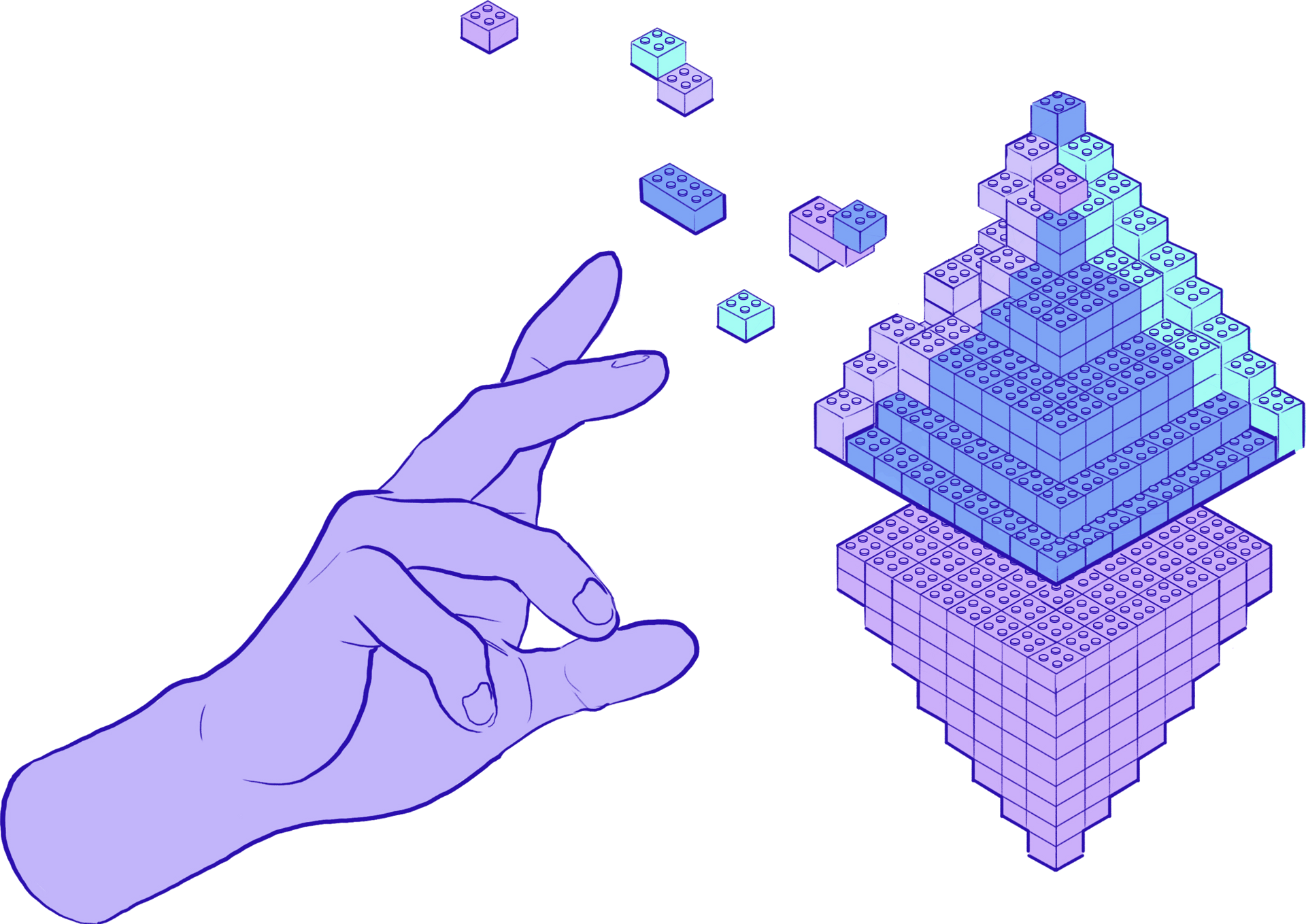
Danksharding

Danksharding makes L2 rollups much cheaper for users by adding "blobs" of data to Ethereum blocks.

Learn more

Single slot finality

Instead of waiting for fifteen minutes, blocks could get proposed and finalized in the same slot. This is more convenient for apps and difficult to attack.

Learn more

Account abstraction

Account abstraction is a class of upgrades that support smart contract wallets natively on Ethereum, rather than having to use complex middleware.

Learn more

Statelessness

Stateless clients will be able to verify new blocks without having to store large amounts of data. This will provide all the benefits of running a node with only a tiny fraction of today's costs.

Learn more

zkEVM

Zero-knowledge proofs could allow validators to verify Ethereum blocks without re-executing transactions, enabling higher gas limits without raising hardware requirements.

Learn more

Ethereum blocks

What is the timeline for these upgrades?

Yes—almost definitely. The roadmap is the current plan for upgrading Ethereum, covering both near-term and future plans. We expect the roadmap to change as new information and technology become available.

Think of Ethereum's roadmap as a set of intentions for improving Ethereum; it is the core researchers' and developers' best hypothesis of Ethereum's most optimal path forward.

Some upgrades are lower priority and likely not to be implemented for the next 5-10 years (e.g. quantum resistance). Giving precise timing of each upgrade is complicated to predict as many roadmap items are worked on in parallel and developed at different speeds. The urgency of an upgrade can also change over time depending on external factors (e.g. a sudden leap in the performance and availability of quantum computers may make quantum-resistant cryptography more urgent).

One way to think about Ethereum development is by analogy to biological evolution. A network that is able to adapt to new challenges and maintain fitness is more likely to succeed than one that is resistant to change, although as the network becomes more and more performant, scalable and secure fewer changes to the protocol will be required.

Upgrades tend not to impact end-users except by providing better user-experiences and a more secure protocol and perhaps more options for how to interact with Ethereum. Regular users are not required to actively participate in an upgrade, nor are they required to do anything** to secure their assets. Node operators will need to update their clients to prepare for an upgrade. Some upgrades may lead to changes for application developers. For example, history expiry upgrades may lead application developers to grab historical data from new sources.

Sharding is splitting up the Ethereum blockchain so that subsets of validators are only responsible for a fraction of the total data. This was originally intended to be the way for Ethereum to scale. However, layer 2 rollups have developed much faster than expected and have provided a lot of scaling already, and will provide much more after Proto-Danksharding is implemented. This means "shard chains" are no longer needed and have been dropped from the roadmap.