The best way I’ve found to get a room full of scientists to think creatively is to tell them we’re going to terraform Mars.
Scientific progress is famously dependent on luck, which makes attempts to “go faster” hard. One reliable way to tilt the odds is to begin with a familiar problem and impose genuinely new constraints. Doing that has a way of stripping away the comfortable defaults, and forcing you to ask different questions than you have before. In that vein, my former academic lab set out with an extremely nonstandard constraint—the goal of terraforming Mars—and, in trying to make that goal concrete, we ran into a technical blocker that pushed us into a new approach to enzyme engineering. The result was a paper on engineering halogenase enzymes and their application to making therapeutics, now out in Nature Communications. The toolchain we created turned out to be useful for nearer-term applications on Earth, a small but vivid example of how “weird” constraints can produce practical innovations.
To terraform Mars, the fundamental challenge is to heat the planet up enough that liquid surface water doesn’t immediately freeze or evaporate. Despite what Elon says, you need to do much more than simply liberate the CO2 in Mars’s Northern ice cap1. One proposal is to use a mixture of super greenhouse gases that would be sufficient to keep Mars warm. This could work… if it were possible to manufacture such gases at scale. This leads us to a problem statement: can we interact with super-greenhouse gases — produce and degrade them — at scale with biology?
When I started my academic lab in 2022, I created a program called ‘Focus Areas’ that guided students all the way through the process of learning about a completely new topic area to pitching actionable projects over a period of four weeks2. A group of four people in my lab went from never having thought about the intersection of greenhouse gases and biology to pitching projects on the topic!
What did we learn? Powerful greenhouse gases often have exotic atoms in them like Fluorine, Chlorine, and Bromine, which are from the second-to-the-right-most column of the period table and are all referred to as “halogens”. You may have heard of CFCs, or chloro-fluoro-carbons (meaning they contain both chlorine and fluorine), the classic uber-greenhouse gas that is 10,000x more powerful than CO2 per weight. CFCs were common in spray aerosols because they are stable, nontoxic, and nonflammable, but they were banned and phased out in the 70’s and 80’s after it was discovered they deplete ozone. Enzymes that can move around the chemical bonds attached to a halogen atom are called “halogenases” and are the type of enzyme that would be needed to produce or degrade these compounds.
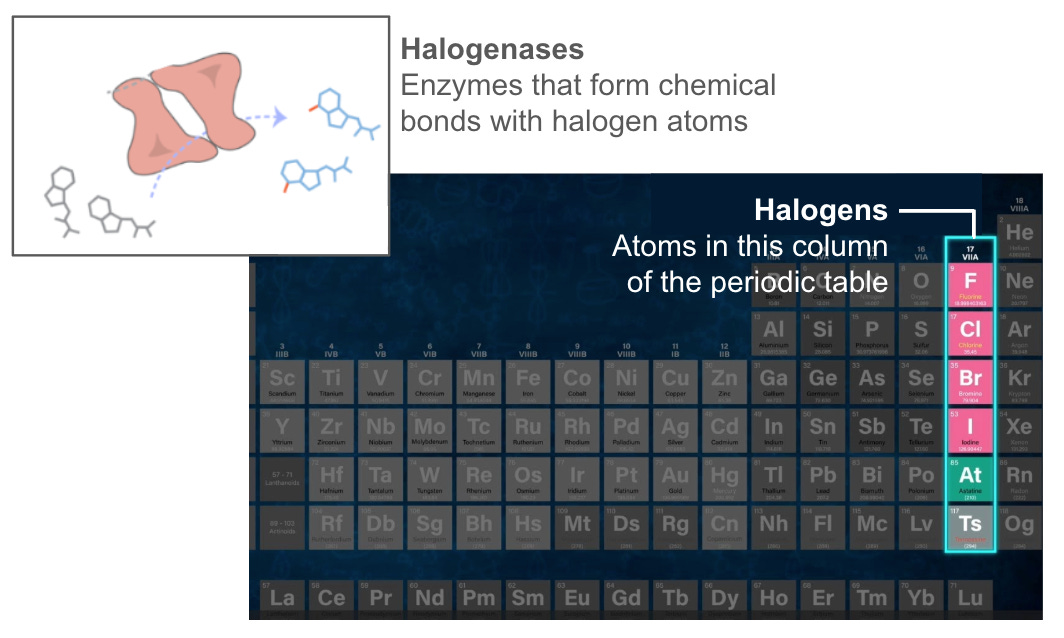
What is it about halogenated compounds that causes them to have such unusual properties? A key moment I remember during brainstorming was when Osaid Ather, a practicing physician who worked part-time in my lab on therapeutics manufacturing with synthetic biology, realized that half the drugs he prescribes are halogenated. Halogen-carbon bonds are extremely stable, which makes the resulting molecules less reactive and thus difficult to degrade in your body! Indeed, nature does create halogenated compounds, but rarely, and mostly as toxins, which makes sense: toxins also benefit from being hard to degrade, just like therapeutics. In general, there’s a very wide variety of useful halogenated compounds we interact with in everyday life including pharmaceuticals, pigments, and coatings, and today they’re manufactured chemically with expensive processes that often involve toxic byproducts. Creating halogenated compounds using low-cost, non-toxic biomanufacturing methods could be hugely beneficial for lots of applications, and not just terraforming!
So why don’t we already manufacture halogenated compounds with biology? Unfortunately, the existing known natural halogenases don’t work very well. They are low-activity, sensitive to temperature, and very insoluble, which makes them tough to work with in an industrial setting. Before you can get to assembling large pathways to make useful specific halogenated compounds, you just need better enzymes. Where do you look for them, and how do you measure them? We don’t even have good biosensors for detecting whether or not halogenase enzymes are working in cells! These were some of the key bottlenecks we came up with.
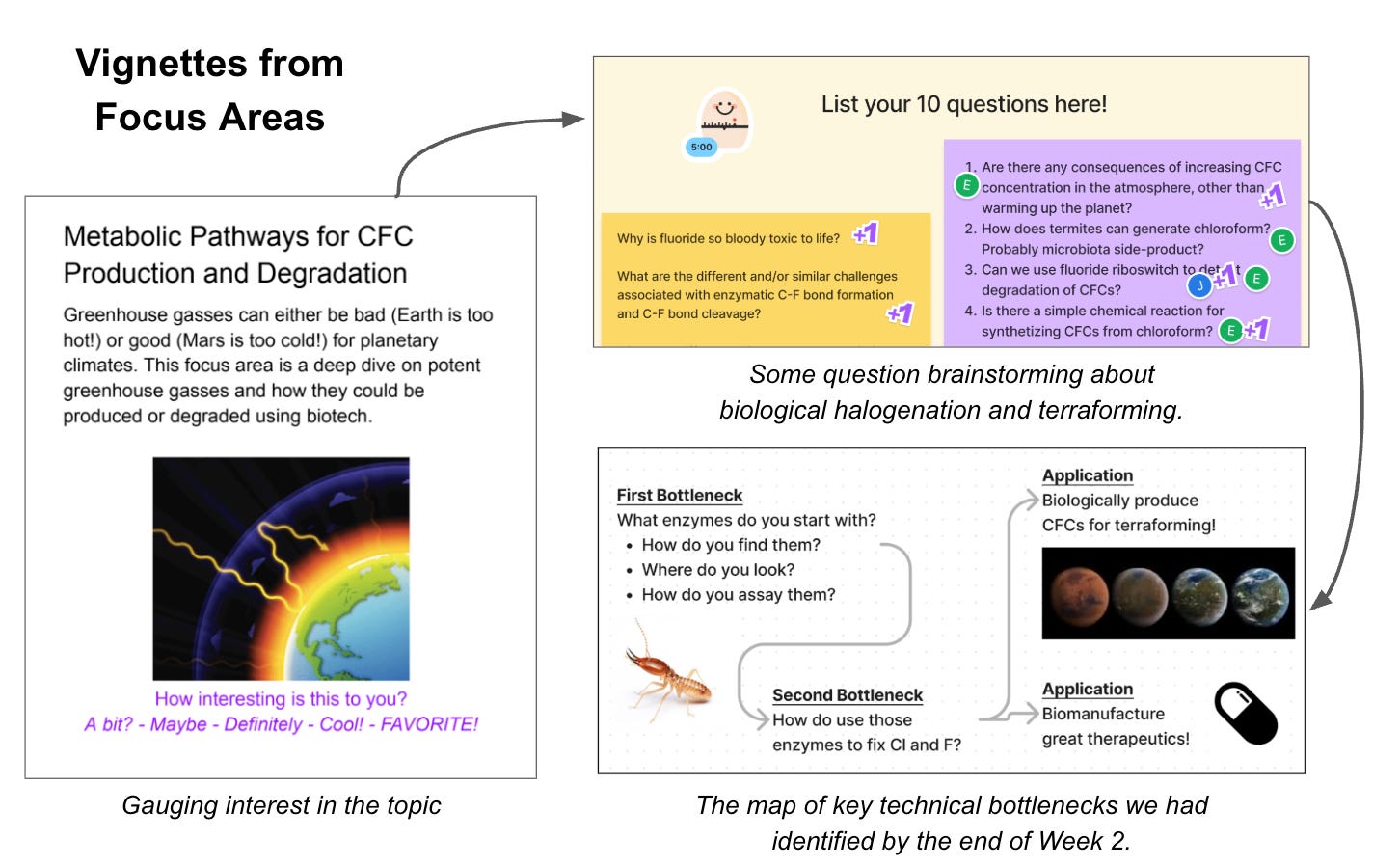
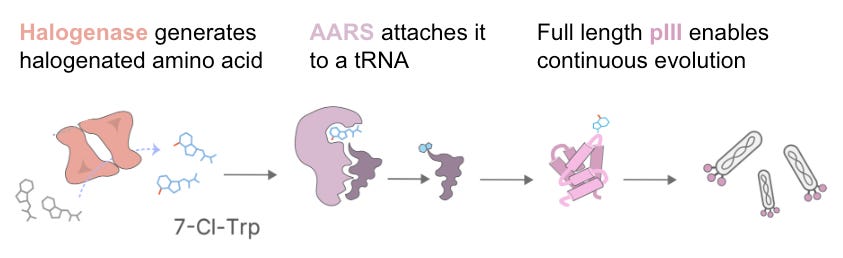
As a result of Focus Areas, Andre Pulschen, an amazing postdoc in my lab with a background in biochemistry and nonmodel microbes, pitched a project concept that seemed quite promising. It tackled both key problems: 1) better biosensors for measuring whether halogenation is happening efficiently in cells3 and 2) better enzymes that work well in cells. His idea was to evolve better halogenase enzymes with continuous evolution by using a new type of biosensor — an aminoacyl tRNA synthetase (AARS)4 — to detect halogenated compounds inside of cells.
AARSs are one of the most ancient protein families, responsible for making sure the genetic code correctly translates DNA into proteins. They work by attaching the ‘right’ amino acids onto the top of tRNAs. If an AARS attaches the wrong amino acid, then a protein gets made wrong, and as a result AARSs are exquisitely sensitive to small chemical changes in amino acids — the perfect biosensor to detect subtle differences like halogenation! They’re also easily coupled to protein expression, which is important in a protein engineering context for creating a readout like fluorescence, or in our case, production of a protein called “pIII” that enables continuous evolution.
We made a tiny molecular Rube Goldberg machine that went like this: the halogenase enzyme attaches a chlorine or bromine to an amino acid, that halogenated amino acid is attached to a tRNA by the special AARS, that tRNA enables production of pIII, and thus continuous evolution is achieved! It’s a pretty cool trick!
Andre teamed up with Justin Booth, an undergraduate student in the lab, and together they evolved and characterized improved halogenases, culminating in RebHEvo4, an evolved 12-mutant that is ~40x higher activity than the natural starting point, and very soluble. Win!
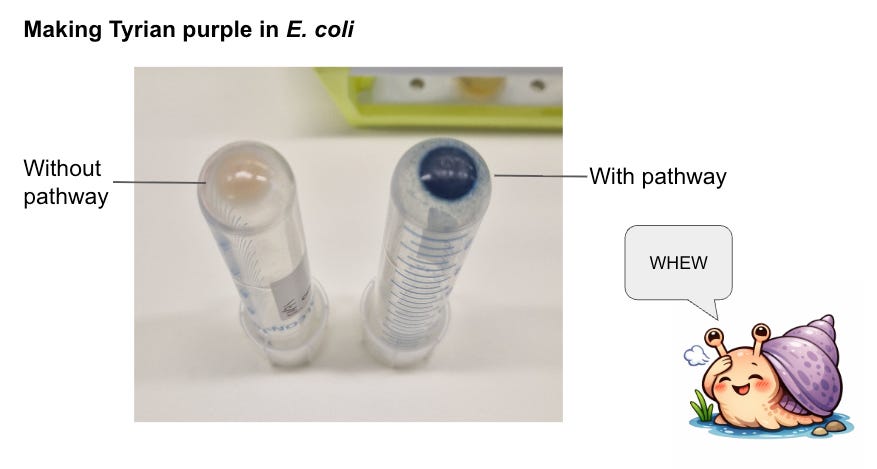
Justin and Andre also explored several example applications of these improved enzymes that are shorter-term and more tangible than terraforming. There are a number of high-value halogenated pigments, like Tyrian purple, that since ancient times have been produced by grinding up sea snails. It’s an expensive, gross, and not-very-vegan process that could be replaced by direct biomanufacturing of the compound in bacteria. We got the tyrian purple pathway working, and even collaborated with Colorifix, a UK-based synthetic biology pigments company, to explore whether the evolved halogenases would improve yields. Ultimately some of the other applications ended up working better faster, so we didn’t push this far enough for it to make it into the paper5. But it’s only a matter of time before engineered halogenases become the commonplace way to produce this and other pigments.
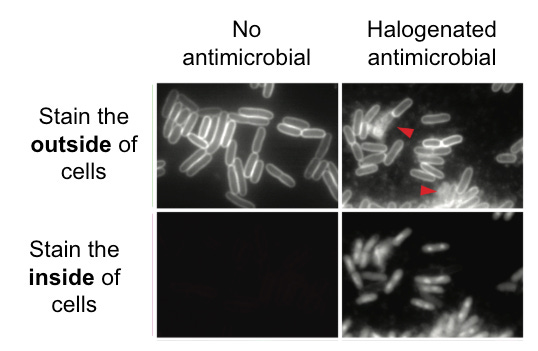
Instead, we used our evolved halogenase to make halogenated antimicrobial peptides, and this is the application that made it into the paper. Your immune system already makes short proteins that kill bacteria by punching holes in their membranes. These antimicrobial peptides are exciting because bacteria have a much harder time evolving resistance to something that destroys their membrane wholesale, compared to conventional antibiotics that target a single protein. Halogenation makes them better: the carbon-halogen bond makes the peptide more hydrophobic, so it inserts into bacterial membranes more aggressively, and harder to degrade, for the same reason that halogenated drugs last longer in your body. The problem is manufacturing. Chemically synthesizing halogenated peptides is expensive and toxic, so we used our evolved halogenase to do it biologically. And lo and behold, when you add these halogenated antimicrobials to bacteria, they damage the membrane, causing them to pop open, spill their guts, and die.
The irony is that during the three years between identifying this project concept (early 2023), executing on it (finishing mid 2025), and publishing it (early 2026), terraforming research advanced so much that we now know that you don’t need CFCs to terraform Mars after all! In 2024, Edwin Kite and colleagues proposed a different strategy to warm Mars with metallic ‘glitter’ particles that would reflect heat back toward the surface. This glitter is 10,000x more mass-efficient than CFCs, and sidesteps an enormous number of other possibly fatal problems with the CFC approach6. And yet, the insane prompt of “how do we interact with CFCs on Mars with biology” was the right one to generate creative thinking that led to a lot of value, including 1) a new enzyme engineering approach that may be broadly useful for others (using AARSs as biosensors), 2) RebHEvo4, an evolved halogenase that kicks ass! and 3) proof of concept terrestrial applications of the evolved enzyme to two key areas: therapeutics discovery & production, and green bioproduction of halogenated compounds. Regardless of whether or not it ends up being used to terraform Mars, the project was a good one, and worth doing!
I believe this is a reliable way to foster scientific creativity: give someone a familiar problem in an unfamiliar context, and invite genuinely new solutions. The challenge is that most people are uncomfortable with ambiguity. Many scientists shy away from brainstorming outside of their chosen niche topic area, and this is especially true once they’ve had the experience of actually being a world-expert in something! Creating the conditions for that kind of exploration requires prompts that strike the right balance of novel and familiar, and a setting that blends structure with enough freeform space for people to unclench. “Focus Areas” was one attempt at this and it worked reasonably well. In biological engineering, I’ve found repeatedly that space science to be a particularly strong prompt for revisiting standard challenges (“can we do X, but in space?”). It’s a specific vision of what better biological engineering could enable, and it repeatedly reframes familiar problems in ways that make them feel new again. This is why I like terraforming Mars as a north star: it’s a bold goal in its own right, and along the way it will help us discover many delightful inventions closer to home. 🚀
Read the paper, now out in Nature Communications. If you want to build on our work we’ve tried to make it easy. The table in Supplemental Information lists every plasmid that was used to create every subfigure. Many are available on Addgene and we provide annotated plasmid maps in .gb file format for the rest. The vector image files in .ai format of all the lovely figures are also provided7, hopefully this saves someone spending a lot of time making a cartoon enzyme yet again! Huge congrats to Andre and Justin!
The halogenase project is finished, but the terraforming prompt just keeps generating new ideas. If you’re interested to hear more about how to terraform Mars without CFCs, sign up for Pioneer Lab’s substack, where we post technical essays about recent results as we engineer organisms to make Mars more habitable.
Thanks to Sam Rodriques, Michalea Hinks, and Devon Stork for feedback and edits on this essay.