At the end of 2025, there was so much talk of an AI bubble that I’m convinced the bigger bubble was the conversation itself: Is there a bubble? Will it pop? When? How much of the economy will get dragged down along with it?
Now, I think the AI “bubble talk” bubble has popped or at least deflated. I’m seeing less chatter around a bubble, but the underlying forces haven’t changed. Assuming an AI correction occurs, I’m left wondering who will win and who will lose.
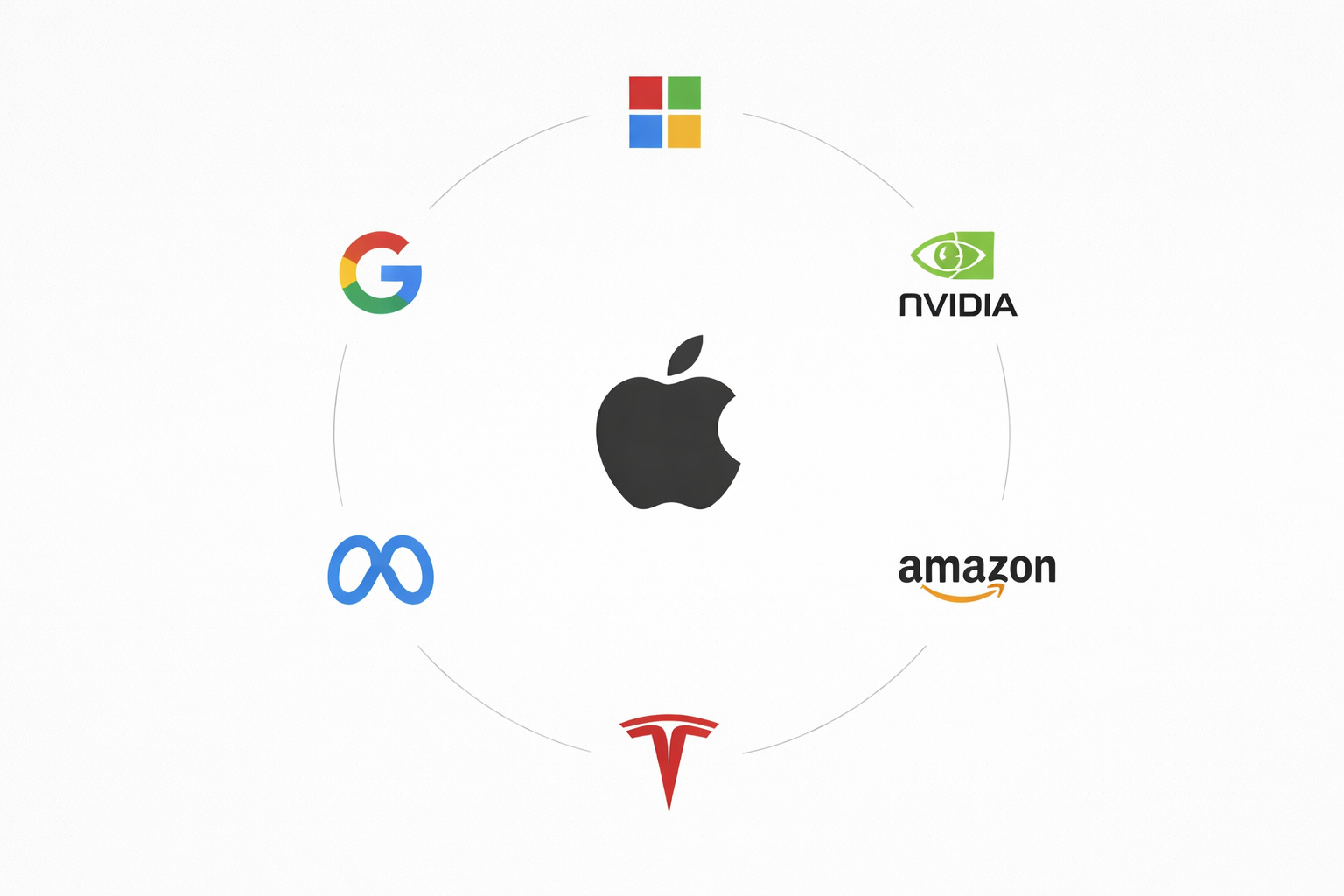
My hunch is that Apple will be better off after a correction than the rest of the Mag 7.
Apple’s 2025 return (8.6%) lagged behind the S&P (18%). Over the last year, Apple’s been beat up over what’s seen as a weak or non-existent AI strategy.
In March 2025, Apple announced that they were delaying updates to Siri until 2026. Apple’s 2025 capex spend was relatively small at around $13 billion compared to Meta, Microsoft, and Google, which were collectively spending hundreds of billions on AI data center buildouts.
Historically, Apple has been known for its ability to dominate its supply chain. Now, TSMC and Foxconn are increasingly prioritizing AI data centers over Apple’s needs. A weakening supply chain could put pressure on Apple’s margins.
At the time of this writing, Apple is down nearly 6% year-to-date, while the S&P is up 1%.
All of this might point to rough sledding for Apple, but my bet is that a bearish Apple narrative misses the mark.
Apple sells hardware built around an extremely durable ecosystem. People love Apple products, and even when they don’t love them, they buy them for other reasons. The AI features of a Google Pixel and the foldability of Samsung phones are not enough to make a meaningful dent in Apple’s market share. People will not switch from Apple en masse for AI features alone.
For these reasons, I don’t believe Apple needs to build powerful AI features, at least not in the short term. They just need to keep selling phones.
Frontier AI labs will continue to churn out better models. Meanwhile, Apple will be well positioned to distribute AI, just as they’ve distributed every other software company’s products for decades.
While I don’t believe AI presents an existential threat to Apple, there are some ways I could end up eating my words.
First, a couple of moderate risks:
The supply-chain issues mentioned above could make a dent in Apple’s profitability. I believe this could impact Apple’s stock price in the short term, but not its long-term value.
A weak economy could lead to people having less money in their pockets, and less appetite for expensive electronics. People might choose to hang on to their phones longer. Again, I don’t see this as a long-term threat to Apple’s valuation though it is a risk.
The most catastrophic risk to Apple is a total reset of mobile computing driven by AI and/or new types of devices. OpenAI, for example, could build a device that works like a smartphone but is just a delivery vehicle for OpenAI models. Another option is an entirely new form factor, like smart glasses. Despite Meta’s best efforts, though, I don’t see Meta Ray-Ban overtaking smartphones as our primary personal computing device just yet. For another device to win out, it needs to:
provide a superior experience
convince millions of people to switch
do this all before Apple builds a similar product
Nothing points to that level of disruption at the moment.
In the short term, I believe Apple may continue to underperform as the AI hype-train continues. That dynamic changes if the narrative loses momentum.
Don’t be surprised if at some point in 2026, CEOs of big companies start admitting that AI isn’t having much impact on their earnings, if at all. If and when that happens, there could be a correction on companies like NVIDIA and Alphabet, and any other company priced on AI optimism.
On the other hand, Apple is priced on its durable market position and earnings: its core business doesn’t depend on AI.
If AI lives up to the hype, every major company, including Apple, should benefit.
This is why I think Apple is still a great company for the long term, regardless of how “behind” on AI it looks.