I don’t know why I started to put this together. These machines fascinate me, because so much of early computing/hacker type culture happened on them. I started writing a table, but realised a timeline would be more intuitive. In this graph, the price is for a minimal configuration and adjusted for inflation. The time is the memory cycle time, a decent proxy for speed.
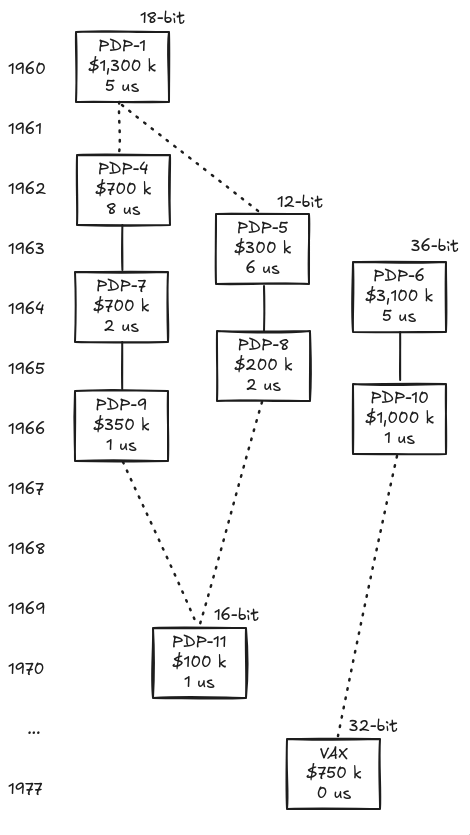
Some notes:
- The pdp-1 was created mostly as an experiment. At the time, industrial control systems used either humans or complicated contraptions of logic boards to make decisions. Some engineers at dec wanted to see if there was a customer base willing to use general-purpose computers instead.1 But it wasn’t called a computer then, because the word “computer” back then meant big mainframe systems that ran batch calculations.
- The pdp-4 was a variant of pdp-1 that was a little slower and much cheaper. It was not compatible with the pdp-1. The pdp-4 was upgraded with new chip technology and became the pdp-7, which was then optimised further for cost and speed and became the pdp-9.
- The pdp-5 was created when they realised the pdp-1 and pdp-4 machines were overkill for industrial control systems. By being smaller, it could be much cheaper, at the cost of compatibility with pdp-1 and pdp-4. It was still intended for roughly the same market. The chip upgrade turned it into the pdp-8.
- The pdp-6 was a completely different beast, aimed at a different market. It supported having tonnes of directly-addressable memory, as well as memory protection, so it could be used as a time-sharing system. The amount of memory made it run Lisp well.2 The smaller machines could also run Lisp, but not large Lisp programs. With the chip upgrade, it became the pdp-10.
- The pdp-11 was a new architecture again, intended to subsume all the previous models, to avoid running three incompatible lines in parallel. There were many variants of the pdp-11, with various performance characteristics and corresponding price points. However, even its most powerful configuration wasn’t powerful enough to attract many pdp-10 users.
- The vax came much later, but it’s included in the table anyway because it is what eventually subsumed the pdp-10. The vax was somewhat compatible with the pdp-11, but they served different markets.
There is a noticeable split in the hacker culture between users of the smaller (18 bit and less) and larger (32 bits and more) computers, exemplified by the contrast between Unix and Emacs. Unix was first created on pdp-7, then ported to pdp-11, then distributed to other pdp-11 users. The fact that it needed to run on these smaller machines, and still handle time sharing, shaped much of its implementation and interface. The same thing is true of the C language and standard library. Then we have something like Emacs, which was created on the massive pdp-10, and gained popularity with other pdp-10 users. It had plenty of hardware resources to use, and it did. The same thing is true of many Lisp variants.
What decided whether you became a small-computer hacker or large-computer hacker was what your employer could afford. Unix was created at Bell Labs, a private company that tried to do more with less. Emacs, in contrast, was built at mit, which at the time was flush with darpa money. This is why Richard Gabriel calls it “mit/Stanford style” and “New Jersey approach”.
Some other examples of things that were developed on the pdp-11 includes
Usenet, vi, rsx-11 (another operating system whose lineage continues into
Windows nt), make, the idea of a shell with composable commands, plus tiny
programming languages like awk. Things that were made with the pdp-10
includes Scheme, TeX, Zork, email, and Microsoft basic.
What do I want to say with this? I don’t know.
Several readers have noted that
- This article doesn’t mention the pdp-12, pdp-14, pdp-15, or pdp-16. Those are cool and interesting machines too. The reason they aren’t in this article is that I had a limited time window for reading up on the history of pdp machines, so I arbitrarily cut out anything that was released after 1970. (Except the vax, because it was what ended the pdp-10 lineage.)
- The article also doesn’t mention the tx machines developed at mit, which were the direct inspiration when dec developed the pdp-1. Due to the same time constraints, I had to cut them out on the grounds that they weren’t ever really in a commercial production process. (Similar reasoning lead to the exclusion of the pdp-3, which was only built once by a customer of dec.)
- The vax had more in common with the pdp-11 than the pdp-10. That’s true on a technical level: its architecture was an extension of the pdp-11, and it had some compatibility with it. However, as one can tell from the price point, it was more aimed at the pdp-10 mainframe type market than the pdp-11 smallish computer market.
Sorry I couldn’t explain this better at my first attempt!