The Victory Column is one of the few monuments to Germany’s former power that remained standing after World War II. From its summit, the golden angel that Wim Wenders filmed in Wings of Desire overlooks the city. Below, the statues of the stern Prussian field marshals Roon and Moltke, and that of Chancellor Otto von Bismarck, still stand, a lasting symbol of Germany, or perhaps an anachronism.
It might seem like a monument from another time, from when this country was a power that frightened the world. But that was before the defeat of 1945 and year zero. Before the Cold War. Before 1990 and reunification, the refounding of the Federal Republic as a European power of peace, an economic giant, and a political and military dwarf.
Germany is undergoing another transformation. Russia’s invasion of Ukraine in 2022 and Donald Trump’s return to the White House a year ago have changed everything. Christian Democratic Chancellor Friedrich Merz, leading a coalition with the Social Democrats, has set out to make the Bundeswehr — the federal army — the strongest conventional (i.e., non-nuclear) armed forces in Europe. It is time for rearmament, and as always when this country militarizes, questions arise. Are the ghosts of the past returning? Or is it a blessing that Germany is finally taking its defense seriously?
The response ranges from those who, on the one hand, celebrate that Europe’s largest economy is assuming its responsibilities in the face of the Russian threat and American hostility — a gain for the entire EU — to those who worry that increased defense spending will create an imbalance among the 27 member states and, in the long run, lead to tensions. And there is yet another, more hypothetical and, for many, worrisome scenario: that the far-right Alternative for Germany (AfD) party comes to power and this formidable arsenal falls into its hands.
“What prevails in Europe right now, among our partners, is the hope that Germany will do its duty,” says Nils Schmid, Deputy Defense Minister and Social Democratic MP. He quotes a statement made by the current Polish Foreign Minister, Radoslaw Sikorski, in 2011, during the financial crisis: “I fear German inaction less than German power.” “That remains true,” Schmid tells EL PAÍS. “Since German troops are fully integrated into NATO’s common command and German soldiers are fully committed to Alliance tasks,” he guarantees, “there is no risk of Germany acting independently.”
“German rearmament is necessary for Europe,” says historian Liana Fix, affiliated with the U.S. Council on Foreign Relations think tank, in a telephone interview. “The most difficult question is how to spend the money, now that it’s available, and how to mitigate the power imbalance that German defense spending could create with other countries that can’t match it.”
Fix has opened the discussion in political and academic forums by publishing an article in the journal Foreign Affairs entitled “Europe’s Next Hegemon: The Perils of German Power.” There, she cites, among other precedents, the case of German reunification. At the time, British Prime Minister Margaret Thatcher opposed it, believing that a reunified Germany would pose a threat to European security. French President François Mitterrand also harbored concerns. German Chancellor Helmut Kohl’s response was to abandon the Deutsche Mark in favor of the single currency, the future euro. A possible response now could be joint borrowing for defense spending, which Berlin rejects, or, more ambitiously and for now unlikely, the creation of a European army, which Spain is promoting.
The scale of Germany’s rearmament, as detailed by Fix in her article, is staggering. In 2025, Germany spent more on defense than any other country, in absolute terms. Its military budget is the fourth-largest in the world. By 2029, it will exceed €150 billion ($174 billion) annually, triple the amount spent in 2002. Now, it is preparing to reintroduce conscription, initially voluntary. “If the country continues on this path,” the expert concludes, “it will once again be a major military power before 2030.”
It is true that these figures exist within a context, and that context is far from ideal. With the economy stagnating for years, a rampant industrial crisis due to competition from China, and the specter of the end of prosperity looming, it is difficult to imagine Germany becoming a true hegemon. But the transformation is underway.
The automotive industry, in crisis, is recycling factories. In an industrial district in northern Berlin, near the former site of the Wall, a former automotive parts plant is being prepared to manufacture components for artillery ammunition. “Rheinmetall Out,” reads graffiti on the exterior, alluding to the owning company, a true industrial hegemon.
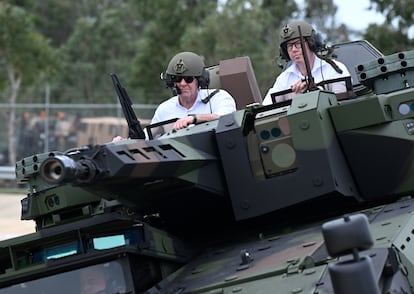
By removing the constitutional debt limit a year ago, Berlin granted itself a margin for arms spending that no other European partner enjoys. This marks a turning point in a Europe where France was the military power and Germany the economic one. The balance has been disrupted, although Paris retains an all-powerful card: the atomic bomb. It is the only EU country that possesses it.
Paul Maurice, head of Franco-German relations at the French Institute of International Relations, explains that “in terms of personnel recruitment, [Germany] is far from having the largest army in Europe.” But he adds: “Financially, yes: the resources dedicated to defense will allow it to purchase equipment like no other European country can. What is somewhat worrying is that it is becoming this great power while others, especially France, are not, due to their financial problems.” And he asks: “What will [Germany’s] 152 billion euros be used for? For the German defense industry? Partly for the U.S. defense industry?”
Mixed feelings in Poland
In Poland, the European partner that spends the most on defense proportionally, already approaching 5% of GDP, pro-Europeans believe that German rearmament is good news for a Europe threatened by Russia. The nationalist right, on the other hand, is stirring up historical fears of German militarism.
“It’s schizophrenic,” observes historian Pawel Machcewicz, “because they accuse Germany of being pro-Russian and, at the same time, when Germany builds a strong army, they say it’s a German attempt to dominate Europe.” “My concern,” he adds, “as a historian and as a Pole, is the AfD. If the AfD comes to power, or enters a coalition government, what would that mean for Germany’s direction? And for the German army?”
“As in other European countries, there is a risk of the far right here,” admits Deputy Defense Minister Schmid, “but reducing military spending in Germany won’t be very convincing because there could be a government led by the far right. It would be tantamount to telling Germans: ‘Do nothing…’”
But the Germans are doing something, and this forces the rest of the world to recalibrate the relationship. “I think that, for our European partners, it is time to examine whether the old demons of history define their view of Germany,” Schmid points out. “Or whether it is the experience of the last few decades that defines it, which has shown that Germany is a stable democracy and a country that looks to Europe.”
Sign up for our weekly newsletter to get more English-language news coverage from EL PAÍS USA Edition