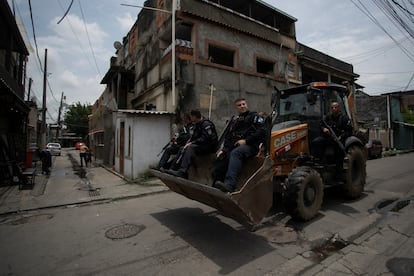
Among the people working in the drug business in Brazil’s favelas, there are those who once dreamed of being an airline pilot, an astronaut, a teacher or a writer but, as they say around here, took the wrong path. Now, their dream is a house of their own and a stable source of income away from crime. A luxury car or motorbike are also on their wish list. We know this thanks to a study based on face-to-face interviews with 3,954 offenders in neighborhoods across the country. X-Ray of Real Life is a detailed portrait of the men and women who operate the retail drug chain in Brazil, examining the lives and dreams of those known mostly from brutal police operations, such as the one in October in Rio de Janeiro.
Respondents range from dealers and their accountants to those who package the marijuana, cocaine, or crack. It also includes the guys who protect the main players and prevent the police from entering neighborhoods which have been turned into drug dens. And then there are the scouts, always on the lookout for the police and members of rival gangs.
“Our aim is not to solve crime, it is to collect data, to understand who these people are, what they believe in... It’s them talking about themselves,” explains Cleo Santana, executive director of Data Favela, a branch of the Central Única das Favelas (CUFA), an organization that works for social inclusion through activities, sports and entrepreneurship. Its field of research is the shantytowns known as favelas, home to 16 million Brazilians.
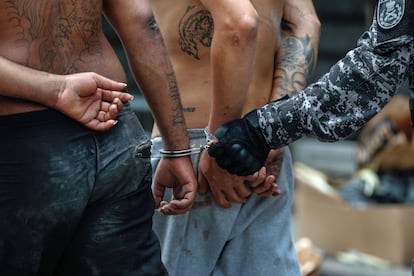
The average profile was no surprise: men (79%), Black or mestizo (74%) and poor – for a third of respondents, the best thing about school was getting lunch. Forty two percent did not finish basic education. Most got into the drug business through economic necessity while a minority did so for street credibility. A third combine drug dealing with legal work. Fifty eight percent would leave their life of crime if they had a guaranteed income to support their family. Many harbor the dream of opening their own business so they can work without having the police on their backs. A number of interviewees confess that fear keeps them in the drug business. Eighty four percent say they would not allow their children to pursue a life of crime.
One 50-year-old woman told the study, “My son dealt, and when he went to prison, I inherited his point of sale.” Women (20% of those interviewed) have been increasingly involved, almost always in an auxiliary capacity and for less money.
For the authors of the study, the interviewees flag up a path that might lead to solving the problem of crime: the promotion of work, employability, entrepreneurship and income. The Central Única das Favelas suggests to the authorities that “a possible strategy would be a broad public program of employment, work and income generation that involves civil society and companies.” The director of Data Favela stresses that these are not short-term solutions, but paths to explore.
How do you get 4,000 people engaged in illegal activities to answer a detailed survey? The secret of Data Favela’s work is that the pollsters are from the favelas too – interviewer and interviewee know each other. Data Favela’s reputation is well established. The official statistics institute (IBGE) asked it to help carry out the last census, to X-ray those peripheral territories neglected by the authorities and hostile to outsiders.
“The people who prevent them from entering are the object of our investigation. They agreed to participate because they recognize our work and the benefits it brings to the favelas,” explains Marcus Athayde, from CUFA.
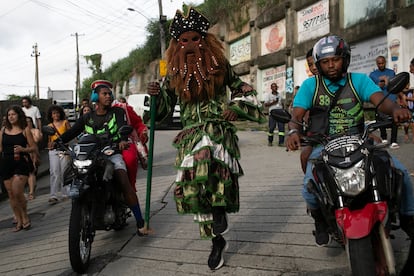
Santana stresses the importance of being listened to, that for once these individuals are given the opportunity to talk about their lives beyond crime. Because they also dream of traveling, especially to Rio de Janeiro, but also to New York, France, the beaches of Ceará, the Vatican or Las Vegas. Seventy percent say they are religious.
Athayde points out that having neighbors carry out the interviews acts as an insurance against lies or exaggerations. “You can’t say you earn R$50,000 if it’s not true because your neighbor, your colleague, they know it.” In those labyrinthine streets, nothing is secret. The survey was conducted between August and September, before the brutal police operation that killed 121 in Rio.
The study undermines the hackneyed promise that working in the drug business leads to riches. Two-thirds earn about 3,000 reais a month ($584). Just 2% earn more than $2,800 a month. Many keep the money in their homes or in the homes of relatives, away from the authorities. The study also contradicts the idea these people lack families. Three out of four were raised with their mother, father or both. Grandmothers and aunts are present in their lives.
More than half of those interviewed are between 13 and 26. Santana says that traffickers offer young people with no prospects low-risk jobs in exchange for what feels like good money. Gradually they become trapped in a life that brings respect and a sense of belonging, but also stress, depression, insomnia, and, for a third, at least one spell behind bars. And since they often live and operate in turf controlled by gangs, many live imprisoned in their favelas because going to the beach or to a football match could well involve crossing paths with rivals.
Their hobbies and dreams differ little from those of Brazilians in general. Most of them are fans of the football clubs Flamengo or Corinthians; they listen to samba or pagode, dream of Apple and Samsung technology, a BMW, a Honda motorbike, and use Omo detergent. Reflecting how young many of them are, their ideal hobby is playing football and their idol is Neymar. They are also asked about their favorite soap opera: many answered Vale tudo (Anything Goes), which deals with corruption and lack of ethics and whose remake was a hit in 2025.
So much data was gathered in the survey that Athayde and his father, Celso, founder and boss of CUFA, have taken advantage of it to write a book entitled Humans, A Provocation that aims to trigger debate on public security and also cover education, income, employment, public transportation and inequality. Because taking one path or another is often not a moral choice but boils down to opportunities.
Sign up for our weekly newsletter to get more English-language news coverage from EL PAÍS USA Edition