Before we get started: this is a low-volume Substack (a bit more than one post per month), but - hopefully - a high-signal one. So it’s a bit unusual to write another post just two days after the previous one. But I want to share with you a paper on AI and jobs that I find extremely important.
Just one more thing: AMLD Intelligence Summit 2026 is coming up soon. This is the yearly AI conference at EPFL that I have the pleasure of co-organizing. Program and more info is here: https://2026.appliedmldays.org/. Come join us for the 10th anniversary edition! 🎉
You’ve probably seen the headlines: AI might be killing jobs for the young. A widely-shared academic paper - the “canaries in the coal mine” paper by Stanford colleagues - found a 16% employment decline for young workers (ages 22-25) in AI-exposed occupations since ChatGPT launched in November 2022. The implication seems clear: AI is already eliminating the first rung of the career ladder, and we’re witnessing the beginning of a massive technological displacement.
It’s a compelling narrative, and it matches our fears. After all, if AI can write code and answer customer queries, why would companies hire junior people to do those things?
But a new paper from the Economic Innovation Group looks more carefully at the data. And when you do, the story becomes a lot less clear. The paper is by Zanna Iscenko (AI & Economy Lead, Chief Economist’s Team), and Fabien Curto Millet (Chief Economist), both at Google.
The first issue is timing. If ChatGPT caused the decline in entry-level hiring, you’d expect the decline to start after ChatGPT launched, or at least around the same time. But that’s not what the data show.
Chart 1 in the paper tracks job postings by AI exposure quintile, and it reveals that postings for the most AI-exposed occupations peaked in Spring 2022, then declined sharply throughout the rest of the year. By the time ChatGPT launched in November, the decline was already six months old.
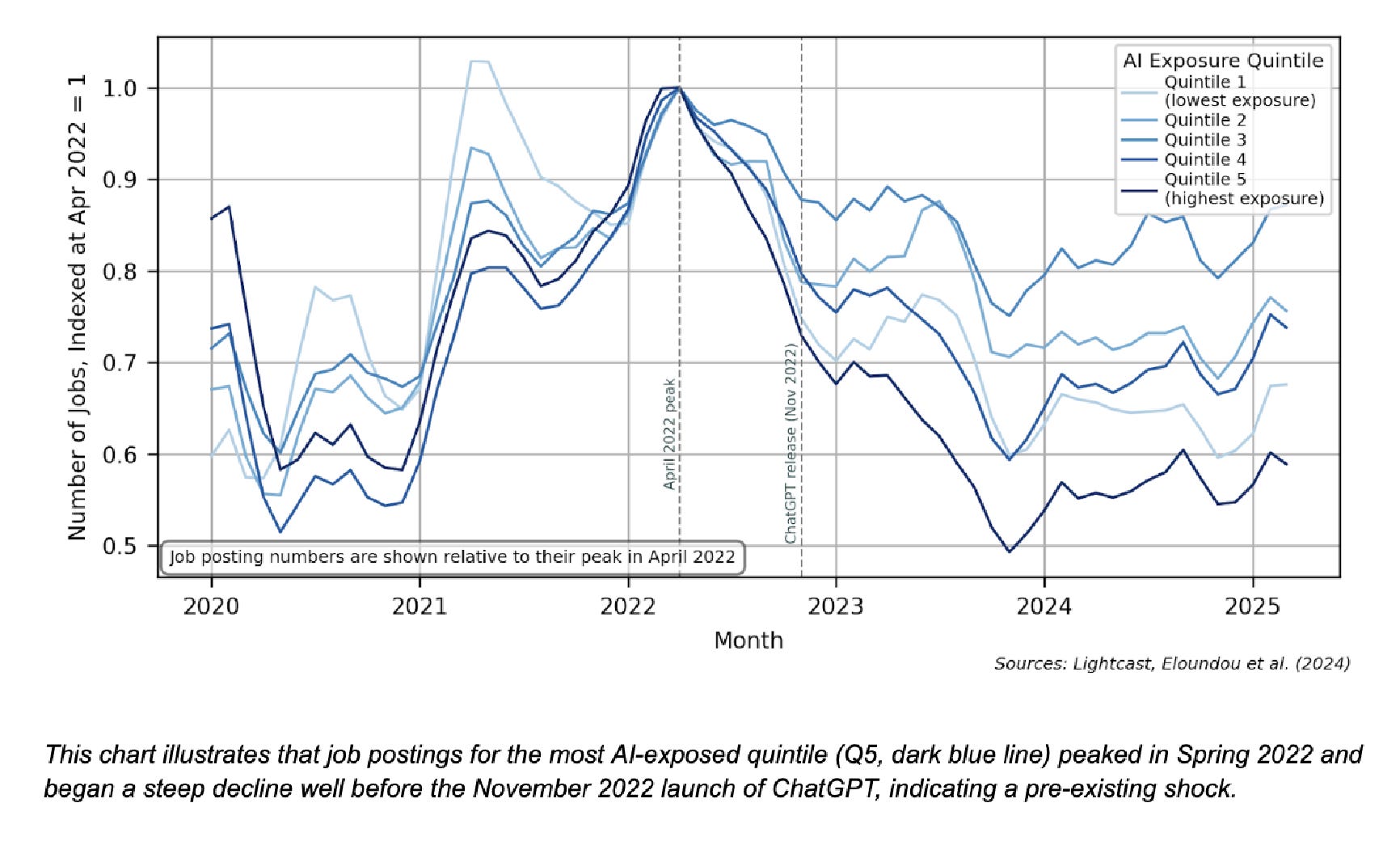
This creates a major problem for the AI explanation. Are we really to believe that companies anticipated ChatGPT’s release and preemptively stopped hiring? That seems unlikely.
So if not AI, what else happened in early 2022?
Chart 3 overlays the Federal Funds rate on the job postings data, and the correlation is extremely strong. In March 2022, the Federal Reserve began raising interest rates, which started the most aggressive monetary tightening cycle in four decades. That’s exactly when job postings for AI-exposed occupations began their decline.
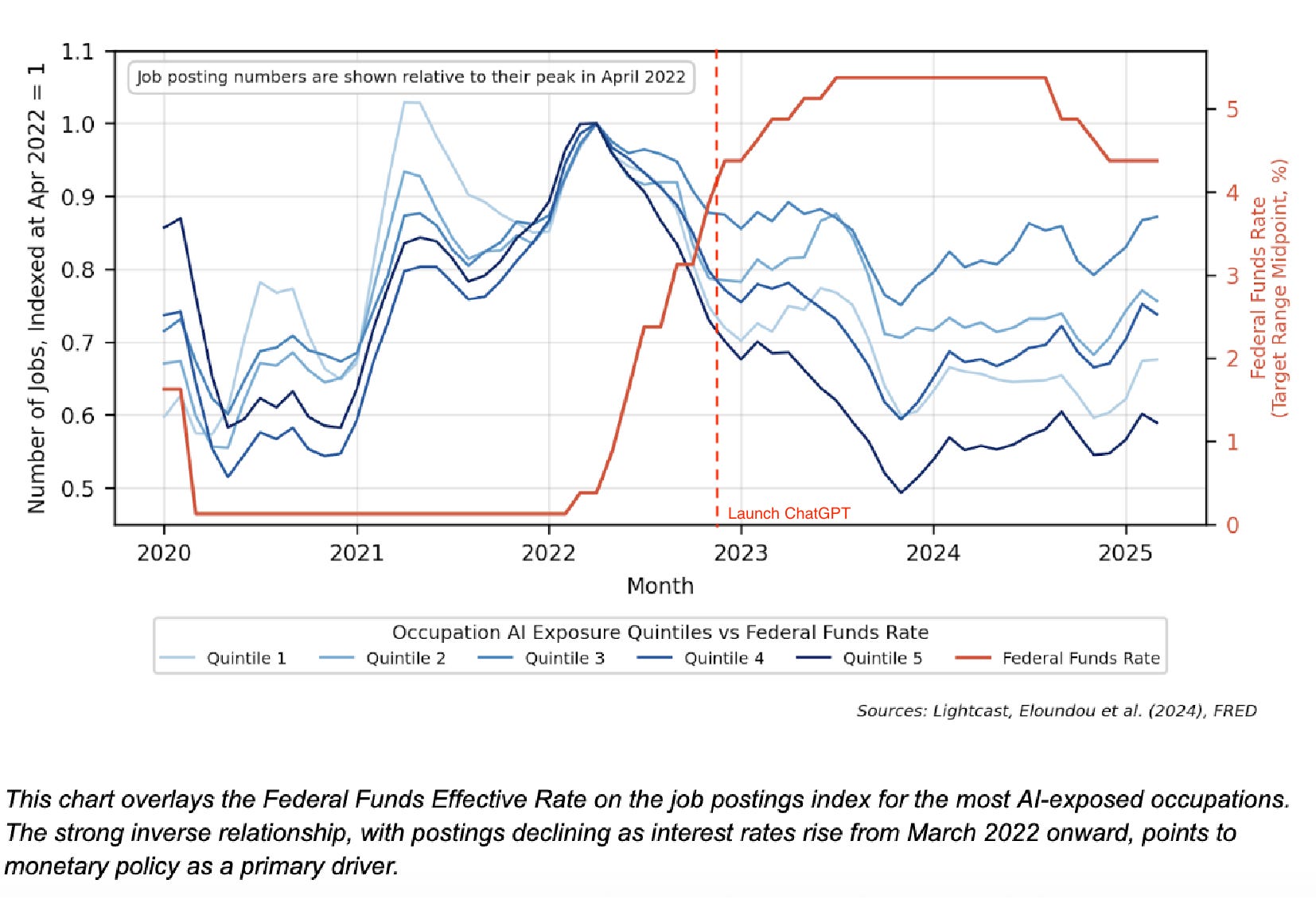
Famously, correlation isn’t causation, and the paper is careful not to overclaim here. But the timeline fits in a way that the AI timeline simply doesn’t.
And there’s a deeper reason why this explanation makes sense. When you look at where “AI-exposed” workers actually work, they’re overwhelmingly concentrated in technology, finance, and professional services (about 38% of them, compared to just 2% in the least AI-exposed occupations). These are precisely the sectors most sensitive to interest rates and capital costs. When money gets expensive, these industries pull back on hiring first.
But a good analysis doesn’t just propose an alternative explanation, it also tests it. The paper offers two compelling checks.
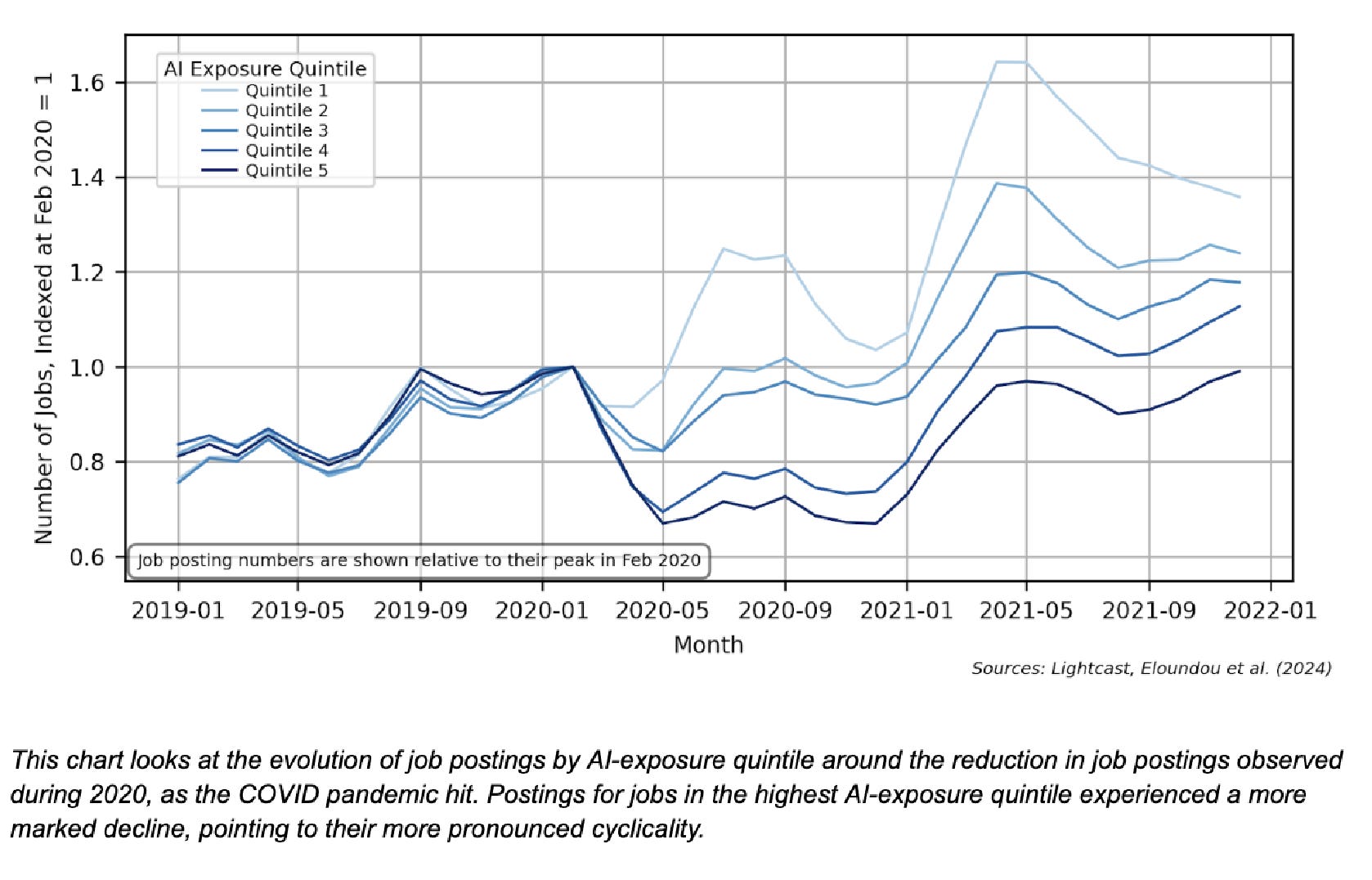
First, Chart 4 looks at what happened during COVID. If AI-exposed occupations are simply more cyclical and more sensitive to economic shocks, we should see them decline more sharply during COVID as well. And that’s exactly what the data show: the most AI-exposed quintile dropped more steeply than others. This obviously can’t be explained by ChatGPT, which didn’t exist yet.
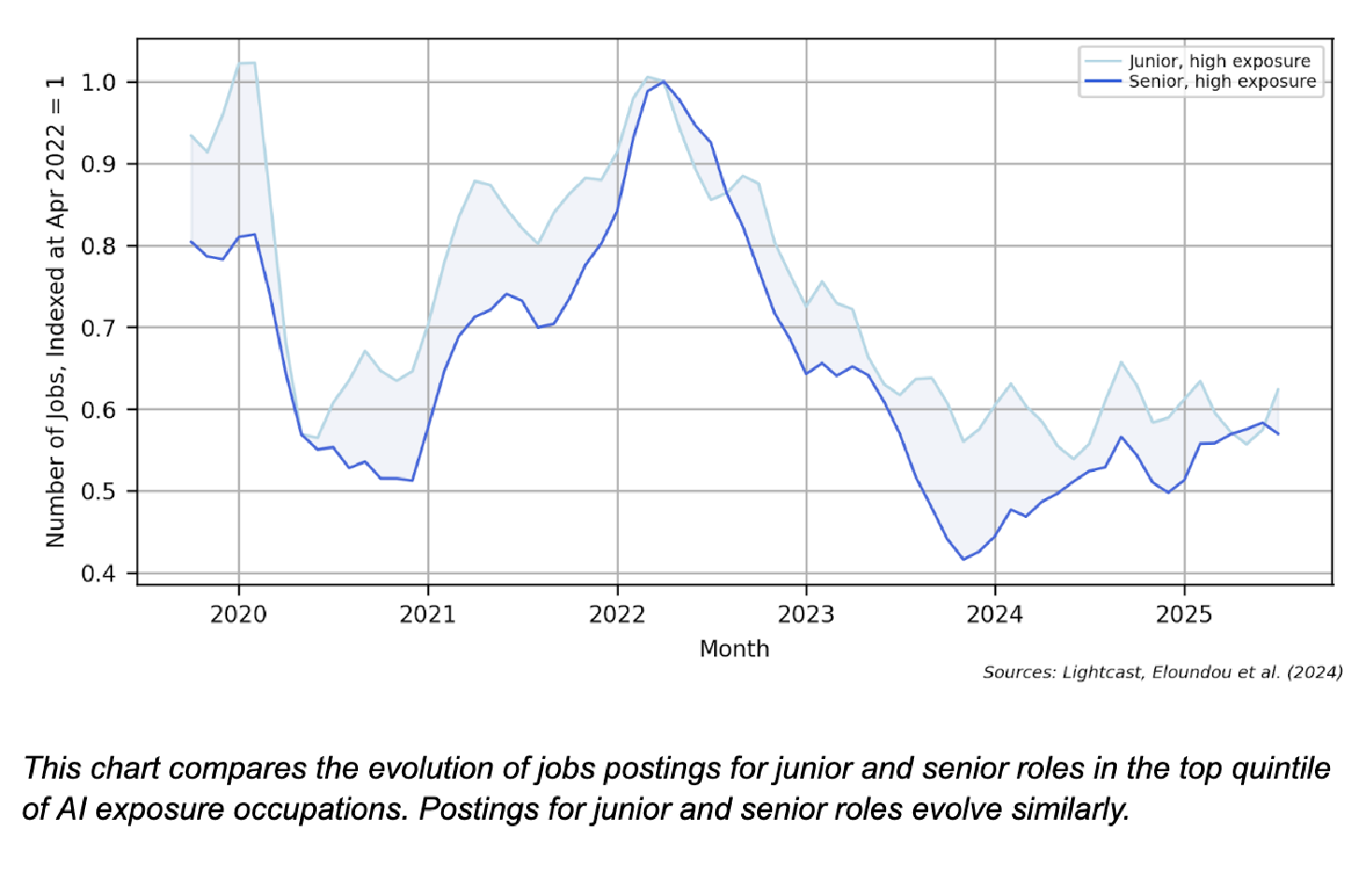
Second, Chart 2 examines whether junior positions declined more than senior positions within AI-exposed occupations. This is a crucial test. If AI specifically replaces entry-level work - the “AI can now do the tasks junior employees used to handle” story - then we’d expect to see junior postings falling faster than senior ones. But they don’t. They decline roughly in parallel.
This doesn't mean young workers aren't struggling. They clearly seem to be. Unemployment rates for recent college graduates are running well above the overall rate, and entry-level hiring remains depressed compared to pre-pandemic levels.
But getting the diagnosis right matters, because different causes call for different remedies. The paper’s authors put it well: viewing the challenges of early-career workers “through the narrow aperture of AI impacts alone could cause us to miss important contributing factors and likely lead to overly narrow and inappropriate remedies.”
I want to be clear about what this paper does and doesn’t say. It doesn’t claim that AI will never affect entry-level employment. That would obviously be a foolish prediction to make about a technology that’s evolving this rapidly. It simply argues that the evidence for AI displacement so far is much weaker than the headlines suggest.
The authors call for “attentive vigilance,” and I think that’s the right framing. We should monitor job postings and employment, track wages alongside quantities, use multiple measures of AI exposure, and pay attention to how tasks within occupations are actually changing. In this context, the recent report by Anthropic, which suggests to monitor API usage as a proxy for automation, seems quite relevant.
But we should resist the urge to see AI’s fingerprints everywhere before the evidence supports it. Sometimes a downturn is just a downturn.
This is a newsletter with two subscription types. I highly recommend to switch to the paid version. While all content will remain free, all financial support directly funds EPFL AI Center-related activities.
To stay in touch, here are other ways to find me:
Social: I’m mainly on LinkedIn these days.
Podcasting: I’m hosting an AI podcast at the EPFL AI Center called “Inside AI” (Apple Podcasts, Spotify, YouTube), where I have the privilege to talk to people who are much smarter than me.