This is a dynamic list and may never be able to satisfy particular standards for completeness. You can help by editing the page to add missing items, with references to reliable sources.
Many mathematical problems have been stated but not yet solved. These problems come from many areas of mathematics, such as theoretical physics, computer science, algebra, analysis, combinatorics, algebraic, differential, discrete and Euclidean geometries, graph theory, group theory, mathematical logic, number theory, set theory, Ramsey theory, dynamical systems, and partial differential equations. Some problems belong to more than one discipline and are studied using techniques from different areas. Prizes are often awarded for the solution to a long-standing problem, and some lists of unsolved problems, such as the Millennium Prize Problems, receive considerable attention.
This list is a composite of notable unsolved problems mentioned in previously published lists, including but not limited to lists considered authoritative, and the problems listed here vary widely in both difficulty and importance.
For over a century, various mathematicians and organizations have published and promoted lists of unsolved mathematical problems. In some cases, the lists have been associated with prizes for the discoverers of solutions, with the Millennium Prize Problems each containing a reward of one million dollars.
| List | Number of problems | Number unsolved or incompletely solved | Proposed by | Proposed in |
|---|---|---|---|---|
| Hilbert's problems[1] | 23 | 13 | David Hilbert | 1900 |
| Landau's problems[2] | 4 | 4 | Edmund Landau | 1912 |
| Taniyama's problems[3] | 36 | – | Yutaka Taniyama | 1955 |
| Thurston's 24 questions[4][5] | 24 | 2 | William Thurston | 1982 |
| Smale's problems | 18 | 14 | Stephen Smale | 1998 |
| Millennium Prize Problems | 7 | 6[6] | Clay Mathematics Institute | 2000 |
| Simon problems | 15 | 12[7][8] | Barry Simon | 2000 |
| DARPA's math challenges[9][10] | 23 | – | DARPA | 2007 |
| Erdős's problems[11] | > 1220 | 634 | Paul Erdős | Over six decades of Erdős' career, from the 1930s to 1990s |

Of the original seven Millennium Prize Problems listed by the Clay Mathematics Institute in 2000, six remain unsolved to date:[6]
- Birch and Swinnerton-Dyer conjecture
- Hodge conjecture
- Navier–Stokes existence and smoothness
- P versus NP
- Riemann hypothesis
- Yang–Mills existence and mass gap
The seventh problem, the Poincaré conjecture, was solved by Grigori Perelman in 2003.[13] However, a generalization called the smooth four-dimensional Poincaré conjecture—that is, whether a four-dimensional topological sphere can have two or more inequivalent smooth structures—is unsolved.[14]
- The Kourovka Notebook (Russian: Коуровская тетрадь) is a collection of unsolved problems in group theory, first published in 1965 and updated many times since.[15]
- The Sverdlovsk Notebook (Russian: Свердловская тетрадь) is a collection of unsolved problems in semigroup theory, first published in 1965 and updated every 2 to 4 years since.[16][17][18]
- The Dniester Notebook (Russian: Днестровская тетрадь) lists several hundred unsolved problems in algebra, particularly ring theory and modulus theory.[19][20]
- The Erlagol Notebook (Russian: Эрлагольская тетрадь) lists unsolved problems in algebra and model theory.[21]

- Birch–Tate conjecture on the relation between the order of the center of the Steinberg group of the ring of integers of a number field to the field's Dedekind zeta function.
- Casas-Alvero conjecture: if a polynomial of degree defined over a field of characteristic has a factor in common with its first through -th derivative, then must be the -th power of a linear polynomial?
- Connes embedding problem in Von Neumann algebra theory
- Crouzeix's conjecture: the matrix norm of a complex function applied to a complex matrix is at most twice the supremum of over the field of values of .
- Determinantal conjecture on the determinant of the sum of two normal matrices.
- Eilenberg–Ganea conjecture: a group with cohomological dimension 2 also has a 2-dimensional Eilenberg–MacLane space .
- Farrell–Jones conjecture on whether certain assembly maps are isomorphisms.
- Bost conjecture: a specific case of the Farrell–Jones conjecture
- Finite lattice representation problem: is every finite lattice isomorphic to the congruence lattice of some finite algebra?[22]
- Goncharov conjecture on the cohomology of certain motivic complexes.
- Green's conjecture: the Clifford index of a non-hyperelliptic curve is determined by the extent to which it, as a canonical curve, has linear syzygies.
- Grothendieck–Katz p-curvature conjecture: a conjectured local–global principle for linear ordinary differential equations.
- Hadamard conjecture: for every positive integer , a Hadamard matrix of order exists.
- Hadamard's maximal determinant problem: what is the largest determinant of a matrix with entries all equal to 1 or −1?
- Hilbert's fifteenth problem: put Schubert calculus on a rigorous foundation.
- Hilbert's sixteenth problem: what are the possible configurations of the connected components of M-curves?
- Homological conjectures in commutative algebra
- Jacobson's conjecture: the intersection of all powers of the Jacobson radical of a left-and-right Noetherian ring is precisely 0.
- Kaplansky's conjectures
- Köthe conjecture: if a ring has no nil ideal other than , then it has no nil one-sided ideal other than .
- Monomial conjecture on Noetherian local rings
- Existence of perfect cuboids and associated cuboid conjectures
- Pierce–Birkhoff conjecture: every piecewise-polynomial is the maximum of a finite set of minimums of finite collections of polynomials.
- Rota's basis conjecture: for matroids of rank with disjoint bases , it is possible to create an matrix whose rows are and whose columns are also bases.
- Serre's conjecture II: if is a simply connected semisimple algebraic group over a perfect field of cohomological dimension at most , then the Galois cohomology set is zero.
- Serre's positivity conjecture that if is a commutative regular local ring, and are prime ideals of , then implies .
- Uniform boundedness conjecture for rational points: do algebraic curves of genus over number fields have at most some bounded number of -rational points?
- Wild problems: problems involving classification of pairs of matrices under simultaneous conjugation.
- Zariski–Lipman conjecture: for a complex algebraic variety with coordinate ring , if the derivations of are a free module over , then is smooth.
- Zauner's conjecture: do SIC-POVMs exist in all dimensions?






- Sudoku:
- Tic-tac-toe variants:
- Given the width of a tic-tac-toe board, what is the smallest dimension such that X is guaranteed to have a winning strategy? (See also Hales–Jewett theorem and nd game)[43]
- Chess:
- What is the outcome of a perfectly played game of chess? (See also first-move advantage in chess)
- Go:
- What is the perfect value of Komi?
- Set:
- Are the nim-sequences of all finite octal games eventually periodic?
- Is the nim-sequence of Grundy's game eventually periodic?
- Abundance conjecture: if the canonical bundle of a projective variety with Kawamata log terminal singularities is nef, then it is semiample.
- Bass conjecture on the finite generation of certain algebraic K-groups.
- Bass–Quillen conjecture relating vector bundles over a regular Noetherian ring and over the polynomial ring .
- Deligne conjecture: any one of numerous named for Pierre Deligne.
- Deligne's conjecture on Hochschild cohomology about the operadic structure on Hochschild cochain complex.
- Dixmier conjecture: any endomorphism of the Weyl algebras and is an automorphism.
- Fröberg conjecture on the Hilbert functions of a set of forms.
- Fujita conjecture regarding the line bundle constructed from a positive holomorphic line bundle on a compact complex manifold and the canonical line bundle of
- General elephant problem: do general elephants have at most Du Val singularities?
- Hartshorne's conjectures[45]
- In spherical or hyperbolic geometry, must polyhedra with the same volume and Dehn invariant be scissors-congruent?[46]
- Jacobian conjecture for two-dimensional spaces: if a two-dimensional polynomial mapping over a characteristic-0 field has a constant nonzero Jacobian determinant, then does it have a regular (i.e. with polynomial components) inverse function?
- Maulik–Nekrasov–Okounkov–Pandharipande conjecture on an equivalence between Gromov–Witten theory and Donaldson–Thomas theory[47]
- Nagata's conjecture on curves, specifically the minimal degree required for a plane algebraic curve to pass through a collection of very general points with prescribed multiplicities.
- Nagata–Biran conjecture that if is a smooth algebraic surface and is an ample line bundle on of degree , then for sufficiently large , the Seshadri constant satisfies .
- Nakai conjecture: if a complex algebraic variety has a ring of differential operators generated by its contained derivations, then it must be smooth.
- Parshin's conjecture: the higher algebraic K-groups of any smooth projective variety defined over a finite field must vanish up to torsion.
- Section conjecture on splittings of group homomorphisms from fundamental groups of complete smooth curves over finitely-generated fields to the Galois group of .
- Standard conjectures on algebraic cycles
- Tate conjecture on the connection between algebraic cycles on algebraic varieties and Galois representations on étale cohomology groups.
- Virasoro conjecture: a certain generating function encoding the Gromov–Witten invariants of a smooth projective variety is fixed by an action of half of the Virasoro algebra.
- Zariski multiplicity conjecture on the topological equisingularity and equimultiplicity of varieties at singular points[48]
- Are infinite sequences of flips possible in dimensions greater than 3?
- Resolution of singularities in characteristic
![{\displaystyle A[t_{1},\ldots ,t_{n}]}](https://wikimedia.org/api/rest_v1/media/math/render/svg/6db7c2e068068f81d1be4e7ed8f140f0f69fea50)




- Borsuk's problem on upper and lower bounds for the number of smaller-diameter subsets needed to cover a bounded n-dimensional set.
- The covering problem of Rado: if the union of finitely many axis-parallel squares has unit area, how small can the largest area covered by a disjoint subset of squares be?[49]
- The Erdős–Oler conjecture: when is a triangular number, packing circles in an equilateral triangle requires a triangle of the same size as packing circles.[50]
- The disk covering problem about finding the smallest real number such that disks of radius can be arranged in such a way as to cover the unit disk.
- The kissing number problem for dimensions other than 1, 2, 3, 4, 8 and 24[51]
- Reinhardt's conjecture: the smoothed octagon has the lowest maximum packing density of all centrally-symmetric convex plane sets[52]
- Sphere packing problems, including the density of the densest packing in dimensions other than 1, 2, 3, 8 and 24, and its asymptotic behavior for high dimensions.
- Square packing in a square: what is the asymptotic growth rate of wasted space?[53]
- Ulam's packing conjecture about the identity of the worst-packing convex solid[54]
- The Tammes problem for numbers of nodes greater than 14 (except 24).[55]


- Are the two Meissner tetrahedra the minimum-volume three-dimensional shapes of constant width?[85]
- Moser's worm problem – what is the smallest area of a shape that can cover every unit-length curve in the plane?[86]
- The moving sofa problem – what is the largest area of a shape that can be maneuvered through a unit-width L-shaped corridor?[87]
- In parallelohedron:
- Can every spherical non-convex polyhedron that tiles space by translation have its faces grouped into patches with the same combinatorial structure as a parallelohedron?[88]
- Does every higher-dimensional tiling by translations of convex polytope tiles have an affine transformation taking it to a Voronoi diagram?[89]
- Ropelength problems:
- Does every convex polyhedron have Rupert's property?[90][91][a]
- Shephard's problem (a.k.a. Dürer's conjecture) – does every convex polyhedron have a net, or simple edge-unfolding?[93][94]
- Is there a non-convex polyhedron without self-intersections with more than seven faces, all of which share an edge with each other?
- The Thomson problem – what is the minimum energy configuration of mutually-repelling particles on a unit sphere?[95]
- Convex uniform 5-polytopes – find and classify the complete set of these shapes[96]
- Hilbert's third problem for non-Euclidean geometries: in spherical or hyperbolic geometry, must polyhedra with the same volume and Dehn invariant be scissors-congruent?
- Babai's problem: which groups are Babai invariant groups?
- Brouwer's conjecture on upper bounds for sums of eigenvalues of Laplacians of graphs in terms of their number of edges

- The Albertson conjecture: the crossing number can be lower-bounded by the crossing number of a complete graph with the same chromatic number[111]
- Conway's thrackle conjecture[112] that thrackles cannot have more edges than vertices
- The GNRS conjecture on whether minor-closed graph families have embeddings with bounded distortion[113]
- Harborth's conjecture: every planar graph can be drawn with integer edge lengths[114]
- Negami's conjecture on projective-plane embeddings of graphs with planar covers[115]
- The strong Papadimitriou–Ratajczak conjecture: every polyhedral graph has a convex greedy embedding[116]
- Turán's brick factory problem – Is there a drawing of any complete bipartite graph with fewer crossings than the number given by Zarankiewicz?[117]
- Guy's conjecture on the crossing number for complete graphs – Is there a drawing of any complete graph with fewer crossings than the number given by his upper bound?[118]
- Universal point sets of subquadratic size for planar graphs[119]

- Does there exist a conference graph for every number of vertices where and is an odd sum of two squares?[120]
- Conway's 99-graph problem: does there exist a strongly regular graph with parameters ?[121]
- Degree diameter problem: given two positive integers , what is the largest graph of diameter such that all vertices have degrees at most ?
- Jørgensen's conjecture that every 6-vertex-connected -minor-free graph is an apex graph[122]
- Does a Moore graph with girth 5 and degree 57 exist?[123]
- Do there exist infinitely many strongly regular geodetic graphs, or any strongly regular geodetic graphs that are not Moore graphs?[124]


- Are there any graphs on n vertices whose representation requires more than floor(n/2) copies of each letter?[142][143][144][145]
- Characterise (non-)word-representable planar graphs[142][143][144][145]
- Characterise word-representable graphs in terms of (induced) forbidden subgraphs.[142][143][144][145]
- Characterise word-representable near-triangulations containing the complete graph K4 (such a characterisation is known for K4-free planar graphs[146])
- Classify graphs with representation number 3, that is, graphs that can be represented using 3 copies of each letter, but cannot be represented using 2 copies of each letter[147]
- Is it true that out of all bipartite graphs, crown graphs require longest word-representants?[148]
- Is the line graph of a non-word-representable graph always non-word-representable?[142][143][144][145]
- Which (hard) problems on graphs can be translated to words representing them and solved on words (efficiently)?[142][143][144][145]
- Delta-conjecture (1978): consider a complete graph each edge of which is colored by one of colors such that there exists a triangle colored in three pairwise distinct colors. Then, in each chromatic component , one can choose a maximal independent vertex-set such that the intersection of the obtained sets is empty.[149][150]
- The imbalance conjecture: If the imbalance for each edge of a graph is at least 1, is the multiset of all edge imbalances always graphic?[151]
- The implicit graph conjecture on the existence of implicit representations for slowly-growing hereditary families of graphs[152]
- Ryser's conjecture relating the maximum matching size and minimum transversal size in hypergraphs
- The second neighborhood problem: does every oriented graph contain a vertex for which there are at least as many other vertices at distance two as at distance one?[153]
- Sidorenko's conjecture on homomorphism densities of graphs in graphons
- Teschner's bondage number conjecture: is the bondage number of a graph always less than or equal to 3/2 times its maximum degree?[154]
- Tutte's conjectures:
- every bridgeless graph has a nowhere-zero 5-flow[155]
- every Petersen-minor-free bridgeless graph has a nowhere-zero 4-flow[156]
- Woodall's conjecture that the minimum number of edges in a dicut of a directed graph is equal to the maximum number of disjoint dijoins.


- The Cherlin–Zilber conjecture: A simple group whose first-order theory is stable in is a simple algebraic group over an algebraically closed field.
- Generalized star height problem: can all regular languages be expressed using generalized regular expressions with limited nesting depths of Kleene stars?
- For which number fields does Hilbert's tenth problem hold?
- Kueker's conjecture[157]
- The main gap conjecture, e.g. for uncountable first order theories, for AECs, and for -saturated models of a countable theory.[158]
- Shelah's categoricity conjecture for : If a sentence is categorical above the Hanf number then it is categorical in all cardinals above the Hanf number.[158]
- Shelah's eventual categoricity conjecture: For every cardinal there exists a cardinal such that if an AEC K with LS(K) is categorical in a cardinal above then it is categorical in all cardinals above .[158][159]
- The stable field conjecture: every infinite field with a stable first-order theory is separably closed.
- The stable forking conjecture for simple theories[160]
- Tarski's exponential function problem: is the theory of the real numbers with the exponential function decidable?
- The universality problem for C-free graphs: For which finite sets C of graphs does the class of C-free countable graphs have a universal member under strong embeddings?[161]
- The universality spectrum problem: Is there a first-order theory whose universality spectrum is minimum?[162]
- Vaught conjecture: the number of countable models of a first-order complete theory in a countable language is either finite, , or .
- Assume K is the class of models of a countable first order theory omitting countably many types. If K has a model of cardinality does it have a model of cardinality continuum?[163]
- Do the Henson graphs have the finite model property?
- Does a finitely presented homogeneous structure for a finite relational language have finitely many reducts?
- Does there exist an o-minimal first order theory with a trans-exponential (rapid growth) function?
- If the class of atomic models of a complete first order theory is categorical in the , is it categorical in every cardinal?[164][165]
- Is every infinite, minimal field of characteristic zero algebraically closed? (Here, "minimal" means that every definable subset of the structure is finite or co-finite.)
- Is the Borel monadic theory of the real order (BMTO) decidable? Is the monadic theory of well-ordering (MTWO) consistently decidable?[166]
- Is the theory of the field of Laurent series over decidable? of the field of polynomials over ?
- Is there a logic L which satisfies both the Beth property and Δ-interpolation, is compact but does not satisfy the interpolation property?[167]
- Determine the structure of Keisler's order.[168][169]
- What is the nature of the proof-theoretic ordinal (the smallest ordinal a theory cannot prove well-founded) for second-order arithmetic, ZFC, or stronger theories?[170]


- Büchi's problem on sufficiently large sequences of square numbers with constant second difference.
- Carmichael's totient function conjecture: do all values of Euler's totient function have multiplicity greater than ?
- Catalan–Dickson conjecture on aliquot sequences: no aliquot sequences are infinite but non-repeating.
- Exponent pair conjecture: for all , is the pair an exponent pair?
- The Gauss circle problem: how far can the number of integer points in a circle centered at the origin be from the area of the circle?
- Grimm's conjecture: each element of a set of consecutive composite numbers can be assigned a distinct prime number that divides it.
- Hall's conjecture: for any , there is some constant such that either or .
- Lehmer's totient problem: if divides , must be prime?
- Magic square of squares: is there a 3x3 magic square composed of distinct perfect squares?
- Mahler's 3/2 problem that no real number has the property that the fractional parts of are less than for all positive integers .
- Newman's conjecture: the partition function satisfies any arbitrary congruence infinitely often.
- Scholz conjecture: the length of the shortest addition chain producing is at most plus the length of the shortest addition chain producing .
- Singmaster's conjecture: is there a finite upper bound on the multiplicities of the entries greater than 1 in Pascal's triangle?[171]
- Sister Beiter conjecture: the maximal coefficient of a ternary cyclotomic polynomial is bounded by of the smallest prime factor of its index.
- Are there infinitely many perfect numbers?
- Do any odd perfect numbers exist?
- Do quasiperfect numbers exist?
- Do any non-power of 2 almost perfect numbers exist?
- Are there 65, 66, or 67 idoneal numbers?
- Are there any pairs of amicable numbers which have opposite parity?
- Are there any pairs of betrothed numbers which have same parity?
- Are there any pairs of relatively prime amicable numbers?
- Are there infinitely many pairs of amicable numbers?
- Are there infinitely many betrothed numbers?
- Are there infinitely many Giuga numbers?
- Do any Lychrel numbers exist in base 10?
- Do any odd noncototients exist?
- Do any odd weird numbers exist?
- Do any (2, 5)-perfect numbers exist?
- Do any Taxicab(5, 2, n) exist for n > 1?
- Is there a covering system with odd distinct moduli?[172]
- Is a normal number (i.e., is each digit 0–9 equally frequent)?[173]
- Are all irrational algebraic numbers normal?
- Is 10 a solitary number?


- Can integer factorization be done in polynomial time?
- Can a discrete logarithm be computed in polynomial time?
- Can a discrete logarithm on a elliptic curve be computed in sub-exponential time?
- Does every rational number with an odd denominator have an odd greedy expansion?
Diophantine approximation and transcendental number theory

- Littlewood conjecture: for any two real numbers , , where is the distance from to the nearest integer.
- Schanuel's conjecture on the transcendence degree of certain field extensions of the rational numbers.[176] In particular: Are and algebraically independent? Which nontrivial combinations of transcendental numbers (such as ) are themselves transcendental?[177][178]
- The four exponentials conjecture: the transcendence of at least one of four exponentials of combinations of irrationals[176]
- Are Euler's constant and Catalan's constant irrational? Are they transcendental? Is Apéry's constant transcendental?[179][180]
- Which transcendental numbers are (exponential) periods?[181]
- How well can non-quadratic irrational numbers be approximated? What is the irrationality measure of specific (suspected) transcendental numbers such as and ?[180]
- Which irrational numbers have simple continued fraction terms whose geometric mean converges to Khinchin's constant?[182]
- Hartmanis–Stearns conjecture




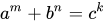
- Beal's conjecture: for all integral solutions to where , all three numbers must share some prime factor.
- Brocard's problem: are there any integer solutions to other than ?
- Congruent number problem (a corollary to Birch and Swinnerton-Dyer conjecture, per Tunnell's theorem): determine precisely what rational numbers are congruent numbers.
- Erdős–Moser problem: is the only solution to the Erdős–Moser equation?
- Erdős–Straus conjecture: for every , there are positive integers such that .
- Fermat–Catalan conjecture: there are finitely many distinct solutions to the equation with being positive coprime integers and being positive integers satisfying .
- Goormaghtigh conjecture on solutions to where and .
- The uniqueness conjecture for Markov numbers[183] that every Markov number is the largest number in exactly one normalized solution to the Markov Diophantine equation.
- Pillai's conjecture: for any , the equation has finitely many solutions when are not both .
- Which integers can be written as the sum of three perfect cubes?[184]
- Can every integer be written as a sum of four perfect cubes?



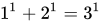













- Agoh–Giuga conjecture on the Bernoulli numbers that is prime if and only if
- Agrawal's conjecture that given coprime positive integers and , if , then either is prime or
- Artin's conjecture on primitive roots that if an integer is neither a perfect square nor , then it is a primitive root modulo infinitely many prime numbers
- Brocard's conjecture: there are always at least prime numbers between consecutive squares of prime numbers, aside from and .
- Bunyakovsky conjecture: if an integer-coefficient polynomial has a positive leading coefficient, is irreducible over the integers, and has no common factors over all where is a positive integer, then is prime infinitely often.
- Catalan's Mersenne conjecture: some Catalan–Mersenne number is composite and thus all Catalan–Mersenne numbers are composite after some point.
- Dickson's conjecture: for a finite set of linear forms with each , there are infinitely many for which all forms are prime, unless there is some congruence condition preventing it.
- Dubner's conjecture: every even number greater than is the sum of two primes which both have a twin.
- Elliott–Halberstam conjecture on the distribution of prime numbers in arithmetic progressions.
- Erdős–Mollin–Walsh conjecture: no three consecutive numbers are all powerful.
- Feit–Thompson conjecture: for all distinct prime numbers and , does not divide
- Fortune's conjecture that no Fortunate number is composite.
- The Gaussian moat problem: is it possible to find an infinite sequence of distinct Gaussian prime numbers such that the difference between consecutive numbers in the sequence is bounded?
- Gillies' conjecture on the distribution of prime divisors of Mersenne numbers.
- Landau's problems
- Problems associated to Linnik's theorem
- New Mersenne conjecture: for any odd natural number , if any two of the three conditions or , is prime, and is prime are true, then the third condition is also true.
- Polignac's conjecture: for all positive even numbers , there are infinitely many prime gaps of size .
- Schinzel's hypothesis H that for every finite collection of nonconstant irreducible polynomials over the integers with positive leading coefficients, either there are infinitely many positive integers for which are all primes, or there is some fixed divisor which, for all , divides some .
- Selfridge's conjecture: is 78,557 the lowest Sierpiński number?
- Does the converse of Wolstenholme's theorem hold for all natural numbers?
- Are all Euclid numbers square-free?
- Are all Fermat numbers square-free?
- Are all Mersenne numbers of prime index square-free?
- Are there any composite c satisfying 2c − 1 ≡ 1 (mod c2)?
- Are there any Wall–Sun–Sun primes?
- Are there any Wieferich primes in base 47?
- Are there infinitely many balanced primes?
- Are there infinitely many cluster primes?
- Are there infinitely many cousin primes?
- Are there infinitely many Cullen primes?
- Are there infinitely many Euclid primes?
- Are there infinitely many Fibonacci primes?
- Are there infinitely many Kummer primes?
- Are there infinitely many Kynea primes?
- Are there infinitely many Lucas primes?
- Are there infinitely many Mersenne primes (Lenstra–Pomerance–Wagstaff conjecture); equivalently, infinitely many even perfect numbers?
- Are there infinitely many Newman–Shanks–Williams primes?
- Are there infinitely many palindromic primes to every base?
- Are there infinitely many Pell primes?
- Are there infinitely many Pierpont primes?
- Are there infinitely many prime quadruplets?
- Are there infinitely many prime triplets?
- Siegel's conjecture: are there infinitely many regular primes, and if so is their natural density as a subset of all primes ?
- Are there infinitely many sexy primes?
- Are there infinitely many safe and Sophie Germain primes?
- Are there infinitely many Wagstaff primes?
- Are there infinitely many Wieferich primes?
- Are there infinitely many Wilson primes?
- Are there infinitely many Wolstenholme primes?
- Are there infinitely many Woodall primes?
- Can a prime p satisfy and simultaneously?[185]
- Does every prime number appear in the Euclid–Mullin sequence?
- What is the smallest Skewes's number?
- For any given integer a > 0, are there infinitely many Lucas–Wieferich primes associated with the pair (a, −1)? (Specially, when a = 1, this is the Fibonacci-Wieferich primes, and when a = 2, this is the Pell-Wieferich primes)
- For any given integer a > 0, are there infinitely many primes p such that ap − 1 ≡ 1 (mod p2)?[186]
- For any given integer b which is not a perfect power and not of the form −4k4 for integer k, are there infinitely many repunit primes to base b?
- For any given integers , with gcd(k, c) = 1 and gcd(b, c) = 1, are there infinitely many primes of the form with integer n ≥ 1?
- Is every Fermat number composite for ?
- Is 509,203 the lowest Riesel number?




















The following conjectures are expressed in the first-order language of axiomatic set theory and, unless stated otherwise, are here taken to be over Zermelo-Frankel set theory, possibly with Choice. In particular, the conjecture's independence may not be open in set theories with a wider or conflicting class of models, such as the various constructive resp. non-wellfounded set theories, etc.


- Jacobian conjecture for more than 2 dimensions (Levent Alpöge, 2026 using Claude Fable 5).[191][192][193]
- Dixmier conjecture for , stably equivalent to the Jacobian conjecture.
- Mazur's conjecture B (Vessilin Dimitrov, Ziyang Gao, and Philipp Habegger, 2020).[194]
- Suita conjecture (Qi'an Guan and Xiangyu Zhou, 2015).[195]

- Sendov's conjecture and Phelps–Rodriguez conjecture (Lech Mazur using GPT-5.6 Pro, 2026).[198][199]
- Heil–Ramanathan–Topiwala conjecture (Markus Faulhuber, Philipp Petersen, Jordy Timo van Velthoven, Felix Voigtlaender using GPT-5.6 Pro, 2026).[200]
- Mizohata–Takeuchi conjecture (Hannah Cairo, 2025).[201][202]
- Erdős unit distance conjecture (published in an anonymized paper by OpenAI, 2026).[203][204]
- Bunkbed conjecture (Nikita Gladkov, Igor Pak, Alexander Zimin, 2025).[205]
- Erdős sumset conjecture (Joel Moreira, Florian Richter, Donald Robertson, 2018).[206]
- McMullen's g-conjecture on the possible numbers of faces of different dimensions in a simplicial sphere (also Grünbaum conjecture, several conjectures of Kühnel). (Karim Adiprasito, 2018).[207][208]
- Upper bound for the cap set problem (Jordan Ellenberg, Dion Gijswijt, 2016).[209]
- Erdős discrepancy problem (Terence Tao, 2015)[210]
- Eremenko's conjecture: every component of the escaping set of an entire transcendental function is unbounded. (David Martí-Pete, Lasse Rempe, and James Waterman, 2025).[211]
- Zimmer's conjecture (Aaron Brown, David Fisher, and Sebastián Hurtado-Salazar, 2017).[212]
- Existence of a non-terminating game of beggar-my-neighbour (Brayden Casella, 2024).[213][214]
- Talagrand's convexity conjecture (Dongming Hua, Antoine Song, Stefan Tudose using GPT-5.5 Pro, 2026).[215][216]
- Carathéodory conjecture for surfaces of smoothness (Brendan Guilfoyle and Wilhelm Klingenberg, 2025).[217]
- Einstein problem (David Smith, Joseph Samuel Myers, Craig S. Kaplan, Chaim Goodman-Strauss, 2024).[218]
- Egan conjecture (Sergei Drozdov, 2023).[219]
- Existence of a complex structure on (Levent Alpöge, 2026 using Claude Fable 5).[220][221][222]
- Keller's conjecture (Joshua Brakensiek, Marijn Heule, John Mackey, David Narvaez, 2019).[223]
- Maximal rank conjecture (Eric Larson, 2018).[224]
- Weibel's conjecture (Moritz Kerz, Florian Strunk, and Georg Tamme, 2018).[225]
- Yau's conjecture (Antoine Song, 2018).[226][227]
- Pentagonal tiling (Michaël Rao, 2017).[228]


- Dinitz–Garg–Goemans conjecture (Dmitry Rybin using GPT-5.6 Pro, 2026).[229]
- Kahn–Kalai conjecture (Jinyoung Park and Huy Tuan Pham, 2022).[230]
- Blankenship–Oporowski conjecture on the book thickness of subdivisions (Vida Dujmović, David Eppstein, Robert Hickingbotham, Pat Morin, and David Wood, 2021).[231]
- Ringel's conjecture that the complete graph can be decomposed into copies of any tree with edges (Richard Montgomery, Benny Sudakov, Alexey Pokrovskiy, 2020).[232][233]
- Disproof of Hedetniemi's conjecture on the chromatic number of tensor products of graphs (Yaroslav Shitov, 2019).[234]
- Kelmans–Seymour conjecture (Dawei He, Yan Wang, and Xingxing Yu, 2020).[235][236][237][238]
- Goldberg–Seymour conjecture (Guantao Chen, Guangming Jing, and Wenan Zang, 2019).[239]
- Babai's problem (Alireza Abdollahi, Maysam Zallaghi, 2015).[240]


- André–Oort conjecture (Jonathan Pila, Ananth Shankar, Jacob Tsimerman, 2021).[241]
- Duffin–Schaeffer theorem (Dimitris Koukoulopoulos, James Maynard, 2019).[242]
- Main conjecture in Vinogradov's mean-value theorem (Jean Bourgain, Ciprian Demeter, Larry Guth, 2015).[243]
- Burr–Erdős conjecture (Choongbum Lee, 2017).[244]
- Boolean Pythagorean triples problem (Marijn Heule, Oliver Kullmann, Victor W. Marek, 2016).[245][246]
- Sensitivity conjecture for Boolean functions (Hao Huang, 2019).[247]
- Deciding whether the Conway knot is a slice knot (Lisa Piccirillo, 2020).[248][249]
- ↑ Thiele, Rüdiger (2005). "On Hilbert and his twenty-four problems". In Van Brummelen, Glen (ed.). Mathematics and the historian's craft. The Kenneth O. May Lectures. CMS Books in Mathematics/Ouvrages de Mathématiques de la SMC. Vol. 21. pp. 243–295. ISBN 978-0-387-25284-1.
- ↑ Guy, Richard (1994). Unsolved Problems in Number Theory (2nd ed.). Springer. p. vii. ISBN 978-1-4899-3585-4. Archived from the original on 2019-03-23. Retrieved 2016-09-22..
- ↑ Shimura, G. (1989). "Yutaka Taniyama and his time". Bulletin of the London Mathematical Society. 21 (2): 186–196. doi:10.1112/blms/21.2.186.
- ↑ Friedl, Stefan (2014). "Thurston's vision and the virtual fibering theorem for 3-manifolds". Jahresbericht der Deutschen Mathematiker-Vereinigung. 116 (4): 223–241. doi:10.1365/s13291-014-0102-x. MR 3280572. S2CID 56322745.
- ↑ Thurston, William P. (1982). "Three-dimensional manifolds, Kleinian groups and hyperbolic geometry". Bulletin of the American Mathematical Society. New Series. 6 (3): 357–381. doi:10.1090/S0273-0979-1982-15003-0. MR 0648524.
- 1 2 "Millennium Problems". claymath.org. Archived from the original on 2017-06-06. Retrieved 2015-01-20.
- ↑ "Fields Medal awarded to Artur Avila". Centre national de la recherche scientifique. 2014-08-13. Archived from the original on 2018-07-10. Retrieved 2018-07-07.
- ↑ Bellos, Alex (2014-08-13). "Fields Medals 2014: the maths of Avila, Bhargava, Hairer and Mirzakhani explained". The Guardian. Archived from the original on 2016-10-21. Retrieved 2018-07-07.
- ↑ "DARPA invests in math". CNN. 2008-10-14. Archived from the original on 2009-03-04. Retrieved 2013-01-14.
- ↑ "Broad Agency Announcement (BAA 07-68) for Defense Sciences Office (DSO)". DARPA. 2007-09-10. Archived from the original on 2012-10-01. Retrieved 2013-06-25.
- ↑ Bloom, Thomas. "Erdős Problems". Retrieved 2026-05-09.
- ↑ "Math Problems Guide: From Simple to Hardest Math Problems Tips & Examples". blendedlearningmath. Retrieved 2024-11-28.
- ↑ "Poincaré Conjecture". Clay Mathematics Institute. Archived from the original on 2013-12-15.
- ↑ rybu (November 7, 2009). "Smooth 4-dimensional Poincare conjecture". Open Problem Garden. Archived from the original on 2018-01-25. Retrieved 2019-08-06.
- ↑ Khukhro, Evgeny I.; Mazurov, Victor D. (2019). Unsolved Problems in Group Theory. The Kourovka Notebook. arXiv:1401.0300v16.
- ↑ RSFSR, MV i SSO; Russie), Uralʹskij gosudarstvennyj universitet im A. M. Gorʹkogo (Ekaterinbourg (1969). Свердловская тетрадь: нерешенные задачи теории подгрупп (in Russian). S. l.
- ↑ Свердловская тетрадь: Сб. нерешённых задач по теории полугрупп. Свердловск: Уральский государственный университет. 1979.
- ↑ Свердловская тетрадь: Сб. нерешённых задач по теории полугрупп. Свердловск: Уральский государственный университет. 1989.
- ↑ ДНЕСТРОВСКАЯ ТЕТРАДЬ [DNIESTER NOTEBOOK] (PDF) (in Russian). The Russian Academy of Sciences. 1993.
- ↑ "DNIESTER NOTEBOOK: Unsolved Problems in the Theory of Rings and Modules" (PDF). University of Saskatchewan. Retrieved 2019-08-15.
- ↑ Эрлагольская тетрадь [Erlagol notebook] (PDF) (in Russian). The Novosibirsk State University. 2018.
- ↑ Dowling, T. A. (February 1973). "A class of geometric lattices based on finite groups". Journal of Combinatorial Theory. Series B. 14 (1): 61–86. doi:10.1016/S0095-8956(73)80007-3.
- ↑ Schmidt, Kai-Uwe; Willms, Jürgen (2016). "Barker sequences of odd length". Designs, Codes and Cryptography. 80 (2): 409–414. doi:10.1007/s10623-015-0104-4.
- ↑ Aschbacher, Michael (1990). "On Conjectures of Guralnick and Thompson". Journal of Algebra. 135 (2): 277–343. doi:10.1016/0021-8693(90)90292-V.
- ↑ Kung, H. T.; Traub, Joseph Frederick (1974). "Optimal order of one-point and multipoint iteration". Journal of the ACM. 21 (4): 643–651. doi:10.1145/321850.321860. S2CID 74921.
- ↑ Smyth, Chris (2008). "The Mahler measure of algebraic numbers: a survey". In McKee, James; Smyth, Chris (eds.). Number Theory and Polynomials. London Mathematical Society Lecture Note Series. Vol. 352. Cambridge University Press. pp. 322–349. ISBN 978-0-521-71467-9.
- ↑ Berenstein, Carlos A. (2001) [1994]. "Pompeiu problem". Encyclopedia of Mathematics. EMS Press.
- ↑ Csordas, George; Smith, Wayne; Varga, Richard S. (1994). "Lehmer pairs of zeros, the de Bruijn-Newman constant Λ, and the Riemann hypothesis". Constructive Approximation. 10 (1): 107–129. doi:10.1007/BF01205170. MR 1260363. S2CID 122664556.
- ↑ Brightwell, Graham R.; Felsner, Stefan; Trotter, William T. (1995). "Balancing pairs and the cross product conjecture". Order. 12 (4): 327–349. doi:10.1007/BF01110378. MR 1368815. S2CID 14793475..
- ↑ Tao, Terence (2018). "Some remarks on the lonely runner conjecture". Contributions to Discrete Mathematics. 13 (2): 1–31. arXiv:1701.02048. doi:10.11575/cdm.v13i2.62728.
- ↑ González-Jiménez, Enrique; Xarles, Xavier (2014). "On a conjecture of Rudin on squares in arithmetic progressions". LMS Journal of Computation and Mathematics. 17 (1): 58–76. arXiv:1301.5122. doi:10.1112/S1461157013000259. S2CID 11615385.
- ↑ Bruhn, Henning; Schaudt, Oliver (2015). "The journey of the union-closed sets conjecture" (PDF). Graphs and Combinatorics. 31 (6): 2043–2074. arXiv:1309.3297. doi:10.1007/s00373-014-1515-0. MR 3417215. S2CID 17531822. Archived (PDF) from the original on 2017-08-08. Retrieved 2017-07-18.
- ↑ Murnaghan, F. D. (1938). "The Analysis of the Direct Product of Irreducible Representations of the Symmetric Groups". American Journal of Mathematics. 60 (1): 44–65. doi:10.2307/2371542. JSTOR 2371542. MR 1507301. PMC 1076971. PMID 16577800.
- ↑ "Dedekind Numbers and Related Sequences" (PDF). Archived from the original (PDF) on 2015-03-15. Retrieved 2020-04-30.
- ↑ Liśkiewicz, Maciej; Ogihara, Mitsunori; Toda, Seinosuke (2003-07-28). "The complexity of counting self-avoiding walks in subgraphs of two-dimensional grids and hypercubes". Theoretical Computer Science. 304 (1): 129–156. doi:10.1016/S0304-3975(03)00080-X. S2CID 33806100.
- ↑ S. M. Ulam, Problems in Modern Mathematics. Science Editions John Wiley & Sons, Inc., New York, 1964, page 76.
- ↑ Kaloshin, Vadim; Sorrentino, Alfonso (2018). "On the local Birkhoff conjecture for convex billiards". Annals of Mathematics. 188 (1): 315–380. arXiv:1612.09194. doi:10.4007/annals.2018.188.1.6. S2CID 119171182.
- ↑ Sarnak, Peter (2011). "Recent progress on the quantum unique ergodicity conjecture". Bulletin of the American Mathematical Society. 48 (2): 211–228. doi:10.1090/S0273-0979-2011-01323-4. MR 2774090.
- ↑ Paul Halmos, Ergodic theory. Chelsea, New York, 1956.
- ↑ Bowman, Joshua (2015). "The way the billiard ball bounces". Math Horizons. 22 (3): 18–22. doi:10.4169/mathhorizons.22.3.18. JSTOR 10.4169/mathhorizons.22.3.18. MR 3313808.
- ↑ Kari, Jarkko (2009). "Structure of reversible cellular automata". Structure of Reversible Cellular Automata. International Conference on Unconventional Computation. Lecture Notes in Computer Science. Vol. 5715. Springer. p. 6. Bibcode:2009LNCS.5715....6K. doi:10.1007/978-3-642-03745-0_5. ISBN 978-3-642-03744-3.
- 1 2 3 "Open Q – Solving and rating of hard Sudoku". english.log-it-ex.com. Archived from the original on 10 November 2017.
- ↑ "Higher-Dimensional Tic-Tac-Toe". PBS Infinite Series. YouTube. 2017-09-21. Archived from the original on 2017-10-11. Retrieved 2018-07-29.
- ↑ Austin, David (August 2016). "Game. SET. Polynomial". Feature column. American Mathematical Society..
- ↑ Barlet, Daniel; Peternell, Thomas; Schneider, Michael (1990). "On two conjectures of Hartshorne's". Mathematische Annalen. 286 (1–3): 13–25. doi:10.1007/BF01453563. S2CID 122151259.
- ↑ Dupont, Johan L. (2001). Scissors congruences, group homology and characteristic classes. Nankai Tracts in Mathematics. Vol. 1. World Scientific Publishing Co., Inc., River Edge, NJ. p. 6. doi:10.1142/9789812810335. ISBN 978-981-02-4507-8. MR 1832859. Archived from the original on 2016-04-29..
- ↑ Maulik, Davesh; Nekrasov, Nikita; Okounov, Andrei; Pandharipande, Rahul (2004-06-05). Gromov–Witten theory and Donaldson–Thomas theory, I. arXiv:math/0312059. Bibcode:2003math.....12059M.
- ↑ Zariski, Oscar (1971). "Some open questions in the theory of singularities". Bulletin of the American Mathematical Society. 77 (4): 481–491. doi:10.1090/S0002-9904-1971-12729-5. MR 0277533.
- ↑ Bereg, Sergey; Dumitrescu, Adrian; Jiang, Minghui (2010). "On covering problems of Rado". Algorithmica. 57 (3): 538–561. doi:10.1007/s00453-009-9298-z. MR 2609053. S2CID 6511998.
- ↑ Melissen, Hans (1993). "Densest packings of congruent circles in an equilateral triangle". American Mathematical Monthly. 100 (10): 916–925. doi:10.2307/2324212. JSTOR 2324212. MR 1252928.
- ↑ Conway, John H.; Neil J.A. Sloane (1999). Sphere Packings, Lattices and Groups (3rd ed.). New York: Springer-Verlag. pp. 21–22. ISBN 978-0-387-98585-5.
- ↑ Hales, Thomas (2017). The Reinhardt conjecture as an optimal control problem. arXiv:1703.01352.
- ↑ Brass, Peter; Moser, William; Pach, János (2005). Research Problems in Discrete Geometry. New York: Springer. p. 45. ISBN 978-0387-23815-9. MR 2163782.
- ↑ Gardner, Martin (1995). New Mathematical Diversions (Revised Edition). Washington: Mathematical Association of America. p. 251.
- ↑ Musin, Oleg R.; Tarasov, Alexey S. (2015). "The Tammes Problem for N = 14". Experimental Mathematics. 24 (4): 460–468. doi:10.1080/10586458.2015.1022842. S2CID 39429109.
- ↑ Barros, Manuel (1997). "General Helices and a Theorem of Lancret". Proceedings of the American Mathematical Society. 125 (5): 1503–1509. doi:10.1090/S0002-9939-97-03692-7. JSTOR 2162098.
- ↑ Katz, Mikhail G. (2007). Systolic geometry and topology. Mathematical Surveys and Monographs. Vol. 137. American Mathematical Society, Providence, RI. p. 57. doi:10.1090/surv/137. ISBN 978-0-8218-4177-8. MR 2292367.
- ↑ Rosenberg, Steven (1997). The Laplacian on a Riemannian Manifold: An introduction to analysis on manifolds. London Mathematical Society Student Texts. Vol. 31. Cambridge: Cambridge University Press. pp. 62–63. doi:10.1017/CBO9780511623783. ISBN 978-0-521-46300-3. MR 1462892.
- ↑ Nikolayevsky, Y. (2003). "Two theorems on Osserman manifolds". Differential Geometry and Its Applications. 18 (3): 239–253. doi:10.1016/S0926-2245(02)00160-2.
- ↑ Ghosh, Subir Kumar; Goswami, Partha P. (2013). "Unsolved problems in visibility graphs of points, segments, and polygons". ACM Computing Surveys. 46 (2): 22:1–22:29. arXiv:1012.5187. doi:10.1145/2543581.2543589. S2CID 8747335.
- ↑ Brass, Peter; Moser, William; Pach, János (2005). Research problems in discrete geometry. Berlin: Springer. ISBN 0-387-23815-8.
- ↑ Boltjansky, V.; Gohberg, I. (1985). "11. Hadwiger's Conjecture". Results and Problems in Combinatorial Geometry. Cambridge University Press. pp. 44–46..
- ↑ Morris, Walter D.; Soltan, Valeriu (2000). "The Erdős-Szekeres problem on points in convex position—a survey". Bull. Amer. Math. Soc. 37 (4): 437–458. doi:10.1090/S0273-0979-00-00877-6. MR 1779413.; Suk, Andrew (2016). "On the Erdős–Szekeres convex polygon problem". J. Amer. Math. Soc. 30 (4): 1047–1053. arXiv:1604.08657. doi:10.1090/jams/869. S2CID 15732134.
- ↑ Kalai, Gil (1989). "The number of faces of centrally-symmetric polytopes". Graphs and Combinatorics. 5 (1): 389–391. doi:10.1007/BF01788696. MR 1554357. S2CID 8917264..
- ↑ Moreno, José Pedro; Prieto-Martínez, Luis Felipe (2021). "El problema de los triángulos de Kobon" [The Kobon triangles problem]. La Gaceta de la Real Sociedad Matemática Española (in Spanish). 24 (1): 111–130. hdl:10486/705416. MR 4225268.
- ↑ Guy, Richard K. (1983). "An olla-podrida of open problems, often oddly posed". American Mathematical Monthly. 90 (3): 196–200. doi:10.2307/2975549. JSTOR 2975549. MR 1540158.
- ↑ Matoušek, Jiří (2002). Lectures on discrete geometry. Graduate Texts in Mathematics. Vol. 212. Springer-Verlag, New York. p. 206. doi:10.1007/978-1-4613-0039-7. ISBN 978-0-387-95373-1. MR 1899299.
- ↑ Burr, S. A.; Grünbaum, B.; Sloane, N. J. A. (1974). "The Orchard problem". Geometriae Dedicata. 2 (4): 397–424. doi:10.1007/BF00147569. S2CID 120906839.
- ↑ Brass, Peter; Moser, William; Pach, János (2005). "5.1 The Maximum Number of Unit Distances in the Plane". Research problems in discrete geometry. Springer, New York. pp. 183–190. ISBN 978-0-387-23815-9. MR 2163782.
- ↑ Dey, Tamal K. (1998). "Improved bounds for planar k-sets and related problems". Discrete & Computational Geometry. 19 (3): 373–382. doi:10.1007/PL00009354. MR 1608878.; Tóth, Gábor (2001). "Point sets with many k-sets". Discrete & Computational Geometry. 26 (2): 187–194. doi:10.1007/s004540010022. MR 1843435..
- ↑ Aichholzer, Oswin; García, Jesús; Orden, David; Ramos, Pedro (2007). "New Lower Bounds for the Number of (≤ k)-Edges and the Rectilinear Crossing Number of Kn" (PDF). Discrete & Computational Geometry. 38 (1): 1–14. doi:10.1007/s00454-007-1325-8. Retrieved 22 July 2025.
- ↑ Aronov, Boris; Dujmović, Vida; Morin, Pat; Ooms, Aurélien; Schultz Xavier da Silveira, Luís Fernando (2019). "More Turán-type theorems for triangles in convex point sets". Electronic Journal of Combinatorics. 26 (1): 1.8. arXiv:1706.10193. Bibcode:2017arXiv170610193A. doi:10.37236/7224. Archived from the original on 2019-02-18. Retrieved 2019-02-18.
- ↑ Atiyah, Michael (2001). "Configurations of points". Philosophical Transactions of the Royal Society of London. Series A: Mathematical, Physical and Engineering Sciences. 359 (1784): 1375–1387. Bibcode:2001RSPTA.359.1375A. doi:10.1098/rsta.2001.0840. ISSN 1364-503X. MR 1853626. S2CID 55833332.
- ↑ Finch, S. R.; Wetzel, J. E. (2004). "Lost in a forest". American Mathematical Monthly. 11 (8): 645–654. doi:10.2307/4145038. JSTOR 4145038. MR 2091541.
- ↑ Howards, Hugh Nelson (2013). "Forming the Borromean rings out of arbitrary polygonal unknots". Journal of Knot Theory and Its Ramifications. 22 (14): 1350083, 15. arXiv:1406.3370. doi:10.1142/S0218216513500831. MR 3190121. S2CID 119674622.
- ↑ Miller, Ezra; Pak, Igor (2008). "Metric combinatorics of convex polyhedra: Cut loci and nonoverlapping unfoldings". Discrete & Computational Geometry. 39 (1–3): 339–388. doi:10.1007/s00454-008-9052-3. MR 2383765.. Announced in 2003.
- ↑ Solomon, Yaar; Weiss, Barak (2016). "Dense forests and Danzer sets". Annales Scientifiques de l'École Normale Supérieure. 49 (5): 1053–1074. arXiv:1406.3807. doi:10.24033/asens.2303. MR 3581810. S2CID 672315.; Conway, John H. Five $1,000 Problems (Update 2017) (PDF). On-Line Encyclopedia of Integer Sequences. Archived (PDF) from the original on 2019-02-13. Retrieved 2019-02-12.
- ↑ Brandts, Jan; Korotov, Sergey; Křížek, Michal; Šolc, Jakub (2009). "On nonobtuse simplicial partitions" (PDF). SIAM Review. 51 (2): 317–335. Bibcode:2009SIAMR..51..317B. doi:10.1137/060669073. MR 2505583. S2CID 216078793. Archived (PDF) from the original on 2018-11-04. Retrieved 2018-11-22.. See in particular Conjecture 23, p. 327.
- ↑ Arutyunyants, G.; Iosevich, A. (2004). "Falconer conjecture, spherical averages and discrete analogs". In Pach, János (ed.). Towards a Theory of Geometric Graphs. Contemp. Math. Vol. 342. Amer. Math. Soc., Providence, RI. pp. 15–24. doi:10.1090/conm/342/06127. ISBN 978-0-8218-3484-8. MR 2065249.
- ↑ Matschke, Benjamin (2014). "A survey on the square peg problem". Notices of the American Mathematical Society. 61 (4): 346–352. doi:10.1090/noti1100.
- ↑ Katz, Nets; Tao, Terence (2002). "Recent progress on the Kakeya conjecture". Proceedings of the 6th International Conference on Harmonic Analysis and Partial Differential Equations (El Escorial, 2000). Publicacions Matemàtiques. pp. 161–179. doi:10.5565/PUBLMAT_Esco02_07. MR 1964819. S2CID 77088.
- ↑ Weaire, Denis, ed. (1997). The Kelvin Problem. CRC Press. p. 1. ISBN 978-0-7484-0632-6.
- ↑ Brass, Peter; Moser, William; Pach, János (2005). Research problems in discrete geometry. New York: Springer. p. 457. ISBN 978-0-387-29929-7. MR 2163782.
- ↑ Mahler, Kurt (1939). "Ein Minimalproblem für konvexe Polygone". Mathematica (Zutphen) B: 118–127.
- ↑ Kawohl, Bernd; Weber, Christof (2011). "Meissner's Mysterious Bodies" (PDF). Mathematical Intelligencer. 33 (3): 94–101. doi:10.1007/s00283-011-9239-y. S2CID 120570093..
- ↑ Norwood, Rick; Poole, George; Laidacker, Michael (1992). "The worm problem of Leo Moser". Discrete & Computational Geometry. 7 (2): 153–162. doi:10.1007/BF02187832. MR 1139077.
- ↑ Wagner, Neal R. (1976). "The Sofa Problem" (PDF). The American Mathematical Monthly. 83 (3): 188–189. doi:10.2307/2977022. JSTOR 2977022. Archived (PDF) from the original on 2015-04-20. Retrieved 2014-05-14.
- ↑ Senechal, Marjorie; Galiulin, R. V. (1984). "An introduction to the theory of figures: the geometry of E. S. Fedorov". Structural Topology (in English and French) (10): 5–22. hdl:2099/1195. MR 0768703.
- ↑ Grünbaum, Branko; Shephard, G. C. (1980). "Tilings with congruent tiles". Bulletin of the American Mathematical Society. New Series. 3 (3): 951–973. doi:10.1090/S0273-0979-1980-14827-2. MR 0585178.
- ↑ Chai, Ying; Yuan, Liping; Zamfirescu, Tudor (June–July 2018). "Rupert Property of Archimedean Solids". The American Mathematical Monthly. 125 (6): 497–504. doi:10.1080/00029890.2018.1449505. S2CID 125508192.
- ↑ Steininger, Jakob; Yurkevich, Sergey (December 27, 2021). An algorithmic approach to Rupert's problem. arXiv:2112.13754.
- ↑ Steininger, Jakob; Yurkevich, Sergey (2025). A convex polyhedron without Rupert's property. arXiv:2508.18475.
- ↑ Demaine, Erik D.; O'Rourke, Joseph (2007). "Chapter 22. Edge Unfolding of Polyhedra". Geometric Folding Algorithms: Linkages, Origami, Polyhedra. Cambridge University Press. pp. 306–338.
- ↑ Ghomi, Mohammad (2018-01-01). "Dürer's Unfolding Problem for Convex Polyhedra". Notices of the American Mathematical Society. 65 (1): 25–27. doi:10.1090/noti1609. ISSN 0002-9920.
- ↑ Whyte, L. L. (1952). "Unique arrangements of points on a sphere". The American Mathematical Monthly. 59 (9): 606–611. doi:10.2307/2306764. JSTOR 2306764. MR 0050303.
- ↑ ACW (May 24, 2012). "Convex uniform 5-polytopes". Open Problem Garden. Archived from the original on October 5, 2016. Retrieved 2016-10-04..
- ↑ Klostermeyer, W.; Mynhardt, C. (2015). "Protecting a graph with mobile guards". Applicable Analysis and Discrete Mathematics. 10: 21. arXiv:1407.5228. doi:10.2298/aadm151109021k.
- ↑ MacGillivray, Gary; Mynhardt, C. M.; Virgile, Virgélot (2022). "Eternal domination and clique covering". Electronic Journal of Graph Theory and Applications. 10 (2): 603–624. doi:10.5614/ejgta.2022.10.2.19.
- ↑ Pleanmani, Nopparat (2019). "Graham's pebbling conjecture holds for the product of a graph and a sufficiently large complete bipartite graph". Discrete Mathematics, Algorithms and Applications. 11 (6): 1950068, 7. doi:10.1142/s179383091950068x. MR 4044549. S2CID 204207428.
- ↑ Baird, William; Bonato, Anthony (2012). "Meyniel's conjecture on the cop number: a survey". Journal of Combinatorics. 3 (2): 225–238. arXiv:1308.3385. doi:10.4310/JOC.2012.v3.n2.a6. MR 2980752. S2CID 18942362.
- ↑ Zhu, Xuding (1999). "The Game Coloring Number of Planar Graphs". Journal of Combinatorial Theory, Series B. 75 (2): 245–258. doi:10.1006/jctb.1998.1878.
- ↑ Bousquet, Nicolas; Bartier, Valentin (2019). "Linear Transformations Between Colorings in Chordal Graphs". In Bender, Michael A.; Svensson, Ola; Herman, Grzegorz (eds.). 27th Annual European Symposium on Algorithms, ESA 2019, September 9-11, 2019, Munich/Garching, Germany. LIPIcs. Vol. 144. Schloss Dagstuhl – Leibniz-Zentrum für Informatik. pp. 24:1–24:15. doi:10.4230/LIPIcs.ESA.2019.24. ISBN 978-3-95977-124-5. S2CID 195791634.
- ↑ Gethner, Ellen (2018). "To the Moon and beyond". In Gera, Ralucca; Haynes, Teresa W.; Hedetniemi, Stephen T. (eds.). Graph Theory: Favorite Conjectures and Open Problems, II. Problem Books in Mathematics. Springer International Publishing. pp. 115–133. doi:10.1007/978-3-319-97686-0_11. ISBN 978-3-319-97684-6. MR 3930641.
- ↑ Chung, Fan; Graham, Ron (1998). Erdős on Graphs: His Legacy of Unsolved Problems. A K Peters. pp. 97–99..
- ↑ Chudnovsky, Maria; Seymour, Paul (2014). "Extending the Gyárfás-Sumner conjecture". Journal of Combinatorial Theory. Series B. 105: 11–16. doi:10.1016/j.jctb.2013.11.002. MR 3171779.
- ↑ Toft, Bjarne (1996). "A survey of Hadwiger's conjecture". Congressus Numerantium. 115: 249–283. MR 1411244..
- ↑ Croft, Hallard T.; Falconer, Kenneth J.; Guy, Richard K. (1991). Unsolved Problems in Geometry. Springer-Verlag., Problem G10.
- ↑ Hägglund, Jonas; Steffen, Eckhard (2014). "Petersen-colorings and some families of snarks". Ars Mathematica Contemporanea. 7 (1): 161–173. doi:10.26493/1855-3974.288.11a. MR 3047618. Archived from the original on 2016-10-03. Retrieved 2016-09-30..
- ↑ Jensen, Tommy R.; Toft, Bjarne (1995). "12.20 List-Edge-Chromatic Numbers". Graph Coloring Problems. New York: Wiley-Interscience. pp. 201–202. ISBN 978-0-471-02865-9..
- ↑ Molloy, Michael; Reed, Bruce (1998). "A bound on the total chromatic number". Combinatorica. 18 (2): 241–280. doi:10.1007/PL00009820. hdl:1807/9465. MR 1656544. S2CID 9600550..
- ↑ Barát, János; Tóth, Géza (2010). "Towards the Albertson Conjecture". Electronic Journal of Combinatorics. 17 (1): R73. arXiv:0909.0413. Bibcode:2009arXiv0909.0413B. doi:10.37236/345..
- ↑ Fulek, Radoslav; Pach, János (2011). "A computational approach to Conway's thrackle conjecture". Computational Geometry. 44 (6–7): 345–355. arXiv:1002.3904. doi:10.1016/j.comgeo.2011.02.001. MR 2785903..
- ↑ Gupta, Anupam; Newman, Ilan; Rabinovich, Yuri; Sinclair, Alistair (2004). "Cuts, trees and -embeddings of graphs". Combinatorica. 24 (2): 233–269. doi:10.1007/s00493-004-0015-x. MR 2071334. S2CID 46133408.
- ↑ Hartsfield, Nora; Ringel, Gerhard (2013). Pearls in Graph Theory: A Comprehensive Introduction. Dover Books on Mathematics. Courier Dover Publications. p. 247. ISBN 978-0-486-31552-2. MR 2047103..
- ↑ Hliněný, Petr (2010). "20 years of Negami's planar cover conjecture" (PDF). Graphs and Combinatorics. 26 (4): 525–536. doi:10.1007/s00373-010-0934-9. MR 2669457. S2CID 121645. Archived (PDF) from the original on 2016-03-04. Retrieved 2016-10-04..
- ↑ Nöllenburg, Martin; Prutkin, Roman; Rutter, Ignaz (2016). "On self-approaching and increasing-chord drawings of 3-connected planar graphs". Journal of Computational Geometry. 7 (1): 47–69. arXiv:1409.0315. doi:10.20382/jocg.v7i1a3. MR 3463906. S2CID 1500695.
- ↑ Pach, János; Sharir, Micha (2009). "5.1 Crossings—the Brick Factory Problem". Combinatorial Geometry and Its Algorithmic Applications: The Alcalá Lectures. Mathematical Surveys and Monographs. Vol. 152. American Mathematical Society. pp. 126–127..
- ↑ Guy, R. K. (1960). "A combinatorial problem". Nabla (Bulletin of the Malayan Mathematical Society). 7: 68–72.
- ↑ Demaine, E.; O'Rourke, J. (2002–2012). "Problem 45: Smallest Universal Set of Points for Planar Graphs". The Open Problems Project. Archived from the original on 2012-08-14. Retrieved 2013-03-19..
- ↑ Brouwer, Andries E.; Van Maldeghem, Hendrik (2022). "8.2 Conference matrices and conference graphs". Strongly regular graphs (PDF). New Mathematical Monographs. Vol. 41. American Mathematical Society. pp. 189–190. ISBN 978-1-316-51203-6.
- ↑ Conway, John H. Five $1,000 Problems (Update 2017) (PDF). Online Encyclopedia of Integer Sequences. Archived (PDF) from the original on 2019-02-13. Retrieved 2019-02-12.
- ↑ mdevos; Wood, David (December 7, 2019). "Jorgensen's Conjecture". Open Problem Garden. Archived from the original on 2016-11-14. Retrieved 2016-11-13..
- ↑ Ducey, Joshua E. (2017). "On the critical group of the missing Moore graph". Discrete Mathematics. 340 (5): 1104–1109. arXiv:1509.00327. doi:10.1016/j.disc.2016.10.001. MR 3612450. S2CID 28297244.
- ↑ Blokhuis, A.; Brouwer, A. E. (1988). "Geodetic graphs of diameter two". Geometriae Dedicata. 25 (1–3): 527–533. doi:10.1007/BF00191941. MR 0925851. S2CID 189890651.
- ↑ Florek, Jan (2010). "On Barnette's conjecture". Discrete Mathematics. 310 (10–11): 1531–1535. doi:10.1016/j.disc.2010.01.018. MR 2601261..
- ↑ Broersma, Hajo; Patel, Viresh; Pyatkin, Artem (2014). "On toughness and Hamiltonicity of -free graphs" (PDF). Journal of Graph Theory. 75 (3): 244–255. doi:10.1002/jgt.21734. MR 3153119. S2CID 1377980.
- ↑ Jaeger, F. (1985). "A survey of the cycle double cover conjecture". Annals of Discrete Mathematics 27 – Cycles in Graphs. North-Holland Mathematics Studies. Vol. 27. pp. 1–12. doi:10.1016/S0304-0208(08)72993-1. ISBN 978-0-444-87803-8..
- ↑ Heckman, Christopher Carl; Krakovski, Roi (2013). "Erdös-Gyárfás conjecture for cubic planar graphs". Electronic Journal of Combinatorics. 20 (2). P7. doi:10.37236/3252..
- ↑ Chudnovsky, Maria (2014). "The Erdös–Hajnal conjecture—a survey" (PDF). Journal of Graph Theory. 75 (2): 178–190. arXiv:1606.08827. doi:10.1002/jgt.21730. MR 3150572. S2CID 985458. Zbl 1280.05086. Archived (PDF) from the original on 2016-03-04. Retrieved 2016-09-22..
- ↑ Kawarabayashi, Ken-ichi; Niu, Jianbing; Zhang, Cun-Quan (2007). "Chords of longest circuits in locally planar graphs". European Journal of Combinatorics. 28 (1): 315–321. doi:10.1016/j.ejc.2005.07.017. MR 2261821.
- ↑ Akiyama, Jin; Exoo, Geoffrey; Harary, Frank (1981). "Covering and packing in graphs. IV. Linear arboricity". Networks. 11 (1): 69–72. doi:10.1002/net.3230110108. MR 0608921..
- ↑ Babai, László (June 9, 1994). "Automorphism groups, isomorphism, reconstruction". Handbook of Combinatorics. Archived from the original (PostScript) on 13 June 2007.
- ↑ Lenz, Hanfried; Ringel, Gerhard (1991). "A brief review on Egmont Köhler's mathematical work". Discrete Mathematics. 97 (1–3): 3–16. doi:10.1016/0012-365X(91)90416-Y. MR 1140782.
- ↑ Fomin, Fedor V.; Høie, Kjartan (2006). "Pathwidth of cubic graphs and exact algorithms". Information Processing Letters. 97 (5): 191–196. doi:10.1016/j.ipl.2005.10.012. MR 2195217.
- ↑ Schwenk, Allen (2012). Some History on the Reconstruction Conjecture (PDF). Joint Mathematics Meetings. Archived from the original (PDF) on 2015-04-09. Retrieved 2018-11-26.
- ↑ Ramachandran, S. (1981). "On a new digraph reconstruction conjecture". Journal of Combinatorial Theory. Series B. 31 (2): 143–149. doi:10.1016/S0095-8956(81)80019-6. MR 0630977.
- ↑ Kühn, Daniela; Mycroft, Richard; Osthus, Deryk (2011). "A proof of Sumner's universal tournament conjecture for large tournaments". Proceedings of the London Mathematical Society. Third Series. 102 (4): 731–766. arXiv:1010.4430. doi:10.1112/plms/pdq035. MR 2793448. S2CID 119169562. Zbl 1218.05034..
- ↑ Tuza, Zsolt (1990). "A conjecture on triangles of graphs". Graphs and Combinatorics. 6 (4): 373–380. doi:10.1007/BF01787705. MR 1092587. S2CID 38821128.
- ↑ DeVos, Matthew (October 22, 2007). "Unfriendly partitions". Open problem garden.
- ↑ Brešar, Boštjan; Dorbec, Paul; Goddard, Wayne; Hartnell, Bert L.; Henning, Michael A.; Klavžar, Sandi; Rall, Douglas F. (2012). "Vizing's conjecture: a survey and recent results". Journal of Graph Theory. 69 (1): 46–76. doi:10.1002/jgt.20565. MR 2864622. S2CID 9120720..
- ↑ Bailey, R. F.; Stevens, B. (2010). "Hamiltonian decompositions of complete $k$-uniform hypergraphs". Discrete Mathematics. 310 (22): 3088–3095. doi:10.1016/j.disc.2009.03.047. ISSN 0012-365X.
- 1 2 3 4 5 Kitaev, Sergey; Lozin, Vadim (2015). Words and Graphs. Monographs in Theoretical Computer Science. An EATCS Series. doi:10.1007/978-3-319-25859-1. ISBN 978-3-319-25857-7. S2CID 7727433 – via link.springer.com.
- 1 2 3 4 5 Kitaev, Sergey (2017-05-16). A Comprehensive Introduction to the Theory of Word-Representable Graphs. International Conference on Developments in Language Theory. arXiv:1705.05924v1. doi:10.1007/978-3-319-62809-7_2.
- 1 2 3 4 5 Kitaev, S. V.; Pyatkin, A. V. (April 1, 2018). "Word-Representable Graphs: a Survey". Journal of Applied and Industrial Mathematics. 12 (2): 278–296. doi:10.1134/S1990478918020084. S2CID 125814097 – via Springer Link.
- 1 2 3 4 5 Kitaev, Sergey V.; Pyatkin, Artem V. (2018). "Графы, представимые в виде слов. Обзор результатов" [Word-representable graphs: A survey]. Дискретн. Анализ И Исслед. Опер. (in Russian). 25 (2): 19–53. doi:10.17377/daio.2018.25.588.
- ↑ Marc Elliot Glen (2016). "Colourability and word-representability of near-triangulations". arXiv:1605.01688 [math.CO].
- ↑ Kitaev, Sergey (2014-03-06). "On graphs with representation number 3". arXiv:1403.1616v1 [math.CO].
- ↑ Glen, Marc; Kitaev, Sergey; Pyatkin, Artem (2018). "On the representation number of a crown graph". Discrete Applied Mathematics. 244: 89–93. arXiv:1609.00674. doi:10.1016/j.dam.2018.03.013. S2CID 46925617.
- ↑ Gurvich, V. (2011). "On exact blockers and anti-blockers, -conjecture, and related problems". Discrete Applied Mathematics. 159 (5): 311–321. doi:10.1016/j.dam.2010.11.014.
- ↑ Andrade, Diogo V.; Boros, Endre; Gurvich, Vladimir (2018). Goldengorin, Boris (ed.). Optimization Problems in Graph Theory: In Honor of Gregory Z. Gutin's 60th Birthday. Springer Optimization and Its Applications 139. pp. 3–64.
- ↑ Kozerenko, Sergiy; Skochko, Volodymyr (2014). "On graphs with graphic imbalance sequences". Algebra and Discrete Mathematics. 18 (1): 97–108.
- ↑ Spinrad, Jeremy P. (2003). "2. Implicit graph representation". Efficient Graph Representations. American Mathematical Soc. pp. 17–30. ISBN 978-0-8218-2815-1..
- ↑ "Seymour's 2nd Neighborhood Conjecture". faculty.math.illinois.edu. Archived from the original on 11 January 2019. Retrieved 17 August 2022.
- ↑ Teschner, Ulrich (1997). "New results about the bondage number of a graph". Discrete Mathematics. 171 (1–3): 249–259. doi:10.1016/S0012-365X(96)00007-6.
- ↑ mdevos (May 4, 2007). "5-flow conjecture". Open Problem Garden. Archived from the original on November 26, 2018.
- ↑ mdevos (March 31, 2010). "4-flow conjecture". Open Problem Garden. Archived from the original on November 26, 2018.
- ↑ Hrushovski, Ehud (1989). "Kueker's conjecture for stable theories". Journal of Symbolic Logic. 54 (1): 207–220. doi:10.2307/2275025. JSTOR 2275025. S2CID 41940041.
- 1 2 3 Shelah S (1990). Classification Theory. North-Holland.
- ↑ Shelah, Saharon (2009). Classification theory for abstract elementary classes. College Publications. ISBN 978-1-904987-71-0.
- ↑ Peretz, Assaf (2006). "Geometry of forking in simple theories". Journal of Symbolic Logic. 71 (1): 347–359. arXiv:math/0412356. doi:10.2178/jsl/1140641179. S2CID 9380215.
- ↑ Cherlin, Gregory; Shelah, Saharon (May 2007). "Universal graphs with a forbidden subtree". Journal of Combinatorial Theory. Series B. 97 (3): 293–333. arXiv:math/0512218. doi:10.1016/j.jctb.2006.05.008. S2CID 10425739.
- ↑ Džamonja, Mirna, "Club guessing and the universal models." On PCF, ed. M. Foreman, (Banff, Alberta, 2004).
- ↑ Shelah, Saharon (1999). "Borel sets with large squares". Fundamenta Mathematicae. 159 (1): 1–50. arXiv:math/9802134. Bibcode:1998math......2134S. doi:10.4064/fm-159-1-1-50. S2CID 8846429.
- ↑ Baldwin, John T. (July 24, 2009). Categoricity (PDF). American Mathematical Society. ISBN 978-0-8218-4893-7. Archived (PDF) from the original on July 29, 2010. Retrieved February 20, 2014.
- ↑ Shelah, Saharon (2009). "Introduction to classification theory for abstract elementary classes". arXiv:0903.3428 [math.LO].
- ↑ Gurevich, Yuri, "Monadic Second-Order Theories," in J. Barwise, S. Feferman, eds., Model-Theoretic Logics (New York: Springer-Verlag, 1985), 479–506.
- ↑ Makowsky J, "Compactness, embeddings and definability," in Model-Theoretic Logics, eds Barwise and Feferman, Springer 1985 pps. 645–715.
- ↑ Keisler, HJ (1967). "Ultraproducts which are not saturated". J. Symb. Log. 32 (1): 23–46. doi:10.2307/2271240. JSTOR 2271240. S2CID 250345806.
- ↑ Malliaris, Maryanthe; Shelah, Saharon (20 December 2013). "A dividing line within simple unstable theories". Advances in Mathematics. 249: 250–288. arXiv:1208.2140. doi:10.1016/j.aim.2013.08.027.
- ↑ Rathjen, Michael (2023-08-01). "The Art of Measuring the Strength of Theories" (PDF). Notices of the American Mathematical Society. 70 (7): 1071–1079. doi:10.1090/noti2733. ISSN 0002-9920.
- ↑ Singmaster, David (1971). "Research Problems: How often does an integer occur as a binomial coefficient?". American Mathematical Monthly. 78 (4): 385–386. doi:10.2307/2316907. JSTOR 2316907. MR 1536288..
- ↑ Guo, Song; Sun, Zhi-Wei (2005). "On odd covering systems with distinct moduli". Advances in Applied Mathematics. 35 (2): 182–187. arXiv:math/0412217. doi:10.1016/j.aam.2005.01.004. MR 2152886. S2CID 835158.
- ↑ "Are the Digits of Pi Random? Berkeley Lab Researcher May Hold Key". Archived from the original on 2016-03-27. Retrieved 2016-03-18.
- ↑ Conrey, Brian (2016). "Lectures on the Riemann zeta function (book review)". Bulletin of the American Mathematical Society. 53 (3): 507–512. doi:10.1090/bull/1525.
- ↑ Guy, Richard K. (1991). Unsolved Problems in Number Theory. Problem Books in Mathematics. Vol. 1 (2nd ed.). Springer-Verlag. pp. 181–185. doi:10.1007/978-1-4899-3585-4. ISBN 978-1-4899-3587-8.
- 1 2 Waldschmidt, Michel (2013). Diophantine Approximation on Linear Algebraic Groups: Transcendence Properties of the Exponential Function in Several Variables. Springer. pp. 14, 16. ISBN 978-3-662-11569-5.
- ↑ Waldschmidt, Michel (2008). An introduction to irrationality and transcendence methods (PDF). 2008 Arizona Winter School. Archived from the original (PDF) on 16 December 2014. Retrieved 15 December 2014.
- ↑ Albert, John. Some unsolved problems in number theory (PDF). Archived from the original (PDF) on 17 January 2014. Retrieved 15 December 2014.
- ↑ For some background on the numbers in this problem, see articles by Eric W. Weisstein at Wolfram MathWorld (all articles accessed 22 August 2024):
- Euler's Constant
- Catalan's Constant
- Apéry's Constant
- irrational numbers (Archived 2015-03-27 at the Wayback Machine)
- transcendental numbers (Archived 2014-11-13 at the Wayback Machine)
- irrationality measures (Archived 2015-04-21 at the Wayback Machine)
- 1 2 Waldschmidt, Michel (2003-12-24). "Open Diophantine Problems". arXiv:math/0312440.
- ↑ Kontsevich, Maxim; Zagier, Don (2001). "Periods". In Engquist, Björn; Schmid, Wilfried (eds.). Mathematics Unlimited — 2001 and Beyond. Berlin, Heidelberg: Springer. pp. 771–808. doi:10.1007/978-3-642-56478-9_39. ISBN 978-3-642-56478-9. Retrieved 2024-08-22.
- ↑ Weisstein, Eric W. "Khinchin's Constant". mathworld.wolfram.com. Retrieved 2024-09-22.
- ↑ Aigner, Martin (2013). Markov's theorem and 100 years of the uniqueness conjecture. Cham: Springer. doi:10.1007/978-3-319-00888-2. ISBN 978-3-319-00887-5. MR 3098784.
- ↑ Huisman, Sander G. (2016). "Newer sums of three cubes". arXiv:1604.07746 [math.NT].
- ↑ Dobson, John Blythe (1 April 2017). "On Lerch's formula for the Fermat quotient". p. 23. arXiv:1103.3907v6 [math.NT].
- ↑ Ribenboim, P. (2006). Die Welt der Primzahlen. Springer-Lehrbuch (in German) (2nd ed.). Springer. pp. 242–243. doi:10.1007/978-3-642-18079-8. ISBN 978-3-642-18078-1.
- ↑ Mazur, Barry (1992). "The topology of rational points". Experimental Mathematics. 1 (1): 35–45. doi:10.1080/10586458.1992.10504244. S2CID 17372107. Archived from the original on 2019-04-07. Retrieved 2019-04-07.
- ↑ Kuperberg, Greg (1994). "Quadrisecants of knots and links". Journal of Knot Theory and Its Ramifications. 3: 41–50. arXiv:math/9712205. doi:10.1142/S021821659400006X. MR 1265452. S2CID 6103528.
- ↑ Burklund, Robert; Hahn, Jeremy; Levy, Ishan; Schlank, Tomer (2023). "K-theoretic counterexamples to Ravenel's telescope conjecture". arXiv:2310.17459 [math.AT].
- ↑ "Celebratio Mathematica — Eliashberg — Generating functions". Celebratio.org. Retrieved June 16, 2026.
- ↑ Matthew Sparkes (July 20, 2026). "AI's solution to 87-year-old riddle takes mathematicians by surprise". New Scientist.
- ↑ @__alpoge__ (July 20, 2026). "hello there the jacobian conjecture is false" (Tweet) – via X (formerly Twitter).
- ↑ Weisstein, Eric W. "Jacobian Conjecture". MathWorld.
- ↑ Dimitrov, Vessilin; Gao, Ziyang; Habegger, Philipp (2021). "Uniformity in Mordell–Lang for curves" (PDF). Annals of Mathematics. 194: 237–298. arXiv:2001.10276. doi:10.4007/annals.2021.194.1.4. S2CID 210932420.
- ↑ Guan, Qi'an; Zhou, Xiangyu (2015). "A solution of an extension problem with optimal estimate and applications". Annals of Mathematics. 181 (3): 1139–1208. arXiv:1310.7169. doi:10.4007/annals.2015.181.3.6. JSTOR 24523356. S2CID 56205818.
- ↑ "Ten advances in mathematics and theoretical computer science". OpenAI. 2026-07-29. Retrieved 2026-08-01.
- ↑ Duncan, John F. R.; Griffin, Michael J.; Ono, Ken (1 December 2015). "Proof of the umbral moonshine conjecture". Research in the Mathematical Sciences. 2 (1): 26. arXiv:1503.01472. Bibcode:2015arXiv150301472D. doi:10.1186/s40687-015-0044-7. S2CID 43589605.
- ↑ "A Computer-Assisted Proof of Sendov's Conjecture" (PDF). Proofatlas.ai. Retrieved 2026-08-28.
- ↑ "A digestion of the proof of Sendov's conjecture". Terrence Tao's Blog. 2026-08-12. Retrieved 2026-08-20.
- ↑ "A partial digestion of the HRT counterexample". Terrence Tao's Blog. 2026-08-06. Retrieved 2026-08-20.
- ↑ Hartnett, Kevin (2025-08-01). "At 17, Hannah Cairo Solved a Major Math Mystery". Quanta Magazine. Retrieved 2025-08-08.
- ↑ Cairo, Hannah (2025). "A Counterexample to the Mizohata-Takeuchi Conjecture". arXiv:2502.06137 [math.CA].
- ↑ "OpenAI disproves Erdős unit distance conjecture". Wolfram Community.
- ↑ "Planar Point Sets with Many Unit Distances" (PDF). OpenAI.
- ↑ Gladkov, Nikita; Pak, Igor; Zimin, Aleksandr (2025-06-17). "The bunkbed conjecture is false". Proceedings of the National Academy of Sciences. 122 (24) e2420725122. arXiv:2410.02545. Bibcode:2025PNAS..12220725G. doi:10.1073/pnas.2420725122. PMC 12184427. PMID 40512791.
- ↑ Moreira, Joel; Richter, Florian K.; Robertson, Donald (2019). "A proof of a sumset conjecture of Erdős". Annals of Mathematics. 189 (2): 605–652. arXiv:1803.00498. doi:10.4007/annals.2019.189.2.4. S2CID 119158401.
- ↑ Bisztriczky, Tibor; McMullen, Peter; Schneider, Rolf; Weiss, Asia Ivic; Stanley, Richard P. (2012-12-06). "A survey of Eulerian posets". Polytopes: Abstract, Convex and Computational. Springer Science & Business Media. pp. 301–333. ISBN 978-94-011-0924-6.
- ↑ Kalai, Gil (2018-12-25). "Amazing: Karim Adiprasito proved the g-conjecture for spheres!". Archived from the original on 2019-02-16. Retrieved 2019-02-15.
- ↑ Ellenberg, Jordan S.; Gijswijt, Dion (2017). "On large subsets of with no three-term arithmetic progression". Annals of Mathematics. 185 (1): 339–343. doi:10.4007/annals.2017.185.1.8. MR 3583358. Zbl 06686590.
{{cite journal}}: CS1 maint: Zbl (link) - ↑ Tao, Terence (2015). "The Erdős discrepancy problem". arXiv:1509.05363v5 [math.CO].
- ↑ Martí-Pete, David; Rempe, Lasse; Waterman, James (2025). "Eremenko's conjecture, wandering Lakes of Wada, and maverick points". Journal of the American Mathematical Society. 38 (4): 877–918. arXiv:2108.10256. doi:10.1090/jams/1049.
- ↑ Brown, Aaron; Fisher, David; Hurtado, Sebastian (2017-10-07). "Zimmer's conjecture for actions of SL(𝑚,ℤ)". arXiv:1710.02735 [math.DS].
- ↑ Richard P Mann. "Known Historical Beggar-My-Neighbour Records". Retrieved 2024-02-10.
- ↑ Casella, Brayden; Anderson, Philip M.; Kleber, Michael; Mann, Richard P.; Nessler, Reed; Rucklidge, William; Williams, Samuel G.; Wu, Nicolas (2025-11-26). "A Non-Terminating Game of Beggar-My-Neighbor". The American Mathematical Monthly. 132 (10): 978–994. doi:10.1080/00029890.2025.2558484. ISSN 0002-9890.
- ↑ Kasal, Krystal (24 May 2026). Clark, Gaby; Egan, Robert (eds.). "Mathematicians solve decades-old mystery about the hidden order in high-dimensional randomness". Phys.org.
- ↑ Howlett, Joseph (19 May 2026). Billings, Lee (ed.). "'Sensational' proof topples decades-old geometry problem". Scientific American.
- ↑ Guilfoyle, B.; Klingenberg, W. (2025). "The three obdurate conjectures of differential geometry". Math. Proc. R. Ir. Acad. 125A: 9–17. arXiv:2502.11716. doi:10.1353/mpr.2025.a968272.
- ↑ Smith, David; Myers, Joseph Samuel; Kaplan, Craig S.; Goodman-Strauss, Chaim (2024). "An aperiodic monotile". Combinatorial Theory. 4 (1). doi:10.5070/C64163843. ISSN 2766-1334.
- ↑ Drozdov, Sergei (2025-12-31). "Egan conjecture holds". Discrete Applied Mathematics. 377: 562–572. arXiv:2310.10816. doi:10.1016/j.dam.2025.08.034. S2CID 264172309.
- ↑ https://alpo.ge/s6.pdf
- ↑ https://philip-engel.github.io/S6.pdf
- ↑ "Plby/HopfProblem". GitHub.
- ↑ Brakensiek, Joshua; Heule, Marijn; Mackey, John; Narváez, David (2020). Peltier, Nicolas; Sofronie-Stokkermans, Viorica (eds.). "The Resolution of Keller's Conjecture". Automated Reasoning. 12166. Cham: Springer International Publishing: 48–65. arXiv:1910.03740. doi:10.1007/978-3-030-51074-9_4. ISBN 978-3-030-51073-2. PMC 7324133. S2CID 203951899.
{{citation}}: CS1 maint: work parameter with ISBN (link) - ↑ Larson, Eric (2017). "The Maximal Rank Conjecture". arXiv:1711.04906 [math.AG].
- ↑ Kerz, Moritz; Strunk, Florian; Tamme, Georg (2018). "Algebraic K-theory and descent for blow-ups". Inventiones Mathematicae. 211 (2): 523–577. arXiv:1611.08466. Bibcode:2018InMat.211..523K. doi:10.1007/s00222-017-0752-2. MR 3748313. S2CID 253741858.
- ↑ Song, Antoine. "Existence of infinitely many minimal hypersurfaces in closed manifolds" (PDF). www.ams.org. Retrieved 19 June 2021.
..I will present a solution of the conjecture, which builds on min-max methods developed by F. C. Marques and A. Neves..
- ↑ "Antoine Song | Clay Mathematics Institute".
...Building on work of Codá Marques and Neves, in 2018 Song proved Yau's conjecture in complete generality
- ↑ Wolchover, Natalie (July 11, 2017). "Pentagon Tiling Proof Solves Century-Old Math Problem". Quanta Magazine. Archived from the original on August 6, 2017. Retrieved July 18, 2017.
- ↑ Sparkes, Matthew (23 July 2026). "Extremely basic AI prompt cracks decades-old maths problem". New Scientist.
- ↑ Park, Jinyoung; Pham, Huy Tuan (2024). "A Proof of the Kahn-Kalai Conjecture". Journal of the American Mathematical Society. 37: 235–243. arXiv:2203.17207. doi:10.1090/jams/1028.
- ↑ Dujmović, Vida; Eppstein, David; Hickingbotham, Robert; Morin, Pat; Wood, David R. (August 2021). "Stack-number is not bounded by queue-number". Combinatorica. 42 (2): 151–164. arXiv:2011.04195. doi:10.1007/s00493-021-4585-7. S2CID 226281691.
- ↑ Huang, C.; Kotzig, A.; Rosa, A. (1982). "Further results on tree labellings". Utilitas Mathematica. 21: 31–48. MR 0668845..
- ↑ Hartnett, Kevin (19 February 2020). "Rainbow Proof Shows Graphs Have Uniform Parts". Quanta Magazine. Retrieved 2020-02-29.
- ↑ Shitov, Yaroslav (1 September 2019). "Counterexamples to Hedetniemi's conjecture". Annals of Mathematics. 190 (2): 663–667. arXiv:1905.02167. doi:10.4007/annals.2019.190.2.6. JSTOR 10.4007/annals.2019.190.2.6. MR 3997132. S2CID 146120733. Zbl 1451.05087. Retrieved 19 July 2021.
- ↑ He, Dawei; Wang, Yan; Yu, Xingxing (2019-12-11). "The Kelmans-Seymour conjecture I: Special separations". Journal of Combinatorial Theory, Series B. 144: 197–224. arXiv:1511.05020. doi:10.1016/j.jctb.2019.11.008. ISSN 0095-8956. S2CID 29791394.
- ↑ He, Dawei; Wang, Yan; Yu, Xingxing (2019-12-11). "The Kelmans-Seymour conjecture II: 2-Vertices in K4−". Journal of Combinatorial Theory, Series B. 144: 225–264. arXiv:1602.07557. doi:10.1016/j.jctb.2019.11.007. ISSN 0095-8956. S2CID 220369443.
- ↑ He, Dawei; Wang, Yan; Yu, Xingxing (2019-12-09). "The Kelmans-Seymour conjecture III: 3-vertices in K4−". Journal of Combinatorial Theory, Series B. 144: 265–308. arXiv:1609.05747. doi:10.1016/j.jctb.2019.11.006. ISSN 0095-8956. S2CID 119625722.
- ↑ He, Dawei; Wang, Yan; Yu, Xingxing (2019-12-19). "The Kelmans-Seymour conjecture IV: A proof". Journal of Combinatorial Theory, Series B. 144: 309–358. arXiv:1612.07189. doi:10.1016/j.jctb.2019.12.002. ISSN 0095-8956. S2CID 119175309.
- ↑ Zang, Wenan; Jing, Guangming; Chen, Guantao (2019-01-29). "Proof of the Goldberg–Seymour Conjecture on Edge-Colorings of Multigraphs". arXiv:1901.10316v1 [math.CO].
- ↑ Abdollahi A., Zallaghi M. (2015). "Character sums for Cayley graphs". Communications in Algebra. 43 (12): 5159–5167. doi:10.1080/00927872.2014.967398. S2CID 117651702.
- ↑ Pila, Jonathan; Shankar, Ananth; Tsimerman, Jacob; Esnault, Hélène; Groechenig, Michael (2021-09-17). "Canonical Heights on Shimura Varieties and the André-Oort Conjecture". arXiv:2109.08788 [math.NT].
- ↑ Koukoulopoulos, Dimitris; Maynard, James (2020-07-01). "On the Duffin-Schaeffer conjecture". Annals of Mathematics. 192 (1): 251–307. arXiv:1907.04594. doi:10.4007/annals.2020.192.1.5. JSTOR 10.4007/annals.2020.192.1.5. S2CID 195874052.
- ↑ Bourgain, Jean; Ciprian, Demeter; Larry, Guth (2015). "Proof of the main conjecture in Vinogradov's Mean Value Theorem for degrees higher than three". Annals of Mathematics. 184 (2): 633–682. arXiv:1512.01565. Bibcode:2015arXiv151201565B. doi:10.4007/annals.2016.184.2.7. hdl:1721.1/115568. S2CID 43929329.
- ↑ Lee, Choongbum (2017). "Ramsey numbers of degenerate graphs". Annals of Mathematics. 185 (3): 791–829. arXiv:1505.04773. doi:10.4007/annals.2017.185.3.2. S2CID 7974973.
- ↑ Lamb, Evelyn (26 May 2016). "Two-hundred-terabyte maths proof is largest ever". Nature. 534 (7605): 17–18. Bibcode:2016Natur.534...17L. doi:10.1038/nature.2016.19990. PMID 27251254.
- ↑ Heule, Marijn J. H.; Kullmann, Oliver; Marek, Victor W. (2016). "Solving and Verifying the Boolean Pythagorean Triples Problem via Cube-and-Conquer". In Creignou, N.; Le Berre, D. (eds.). Theory and Applications of Satisfiability Testing – SAT 2016. Lecture Notes in Computer Science. Vol. 9710. Springer, [Cham]. pp. 228–245. arXiv:1605.00723. doi:10.1007/978-3-319-40970-2_15. ISBN 978-3-319-40969-6. MR 3534782. S2CID 7912943.
- ↑ Linkletter, David (27 December 2019). "The 10 Biggest Math Breakthroughs of 2019". Popular Mechanics. Retrieved 20 June 2021.
- ↑ Piccirillo, Lisa (2020). "The Conway knot is not slice". Annals of Mathematics. 191 (2): 581–591. doi:10.4007/annals.2020.191.2.5. S2CID 52398890.
- ↑ Klarreich, Erica (2020-05-19). "Graduate Student Solves Decades-Old Conway Knot Problem". Quanta Magazine. Retrieved 2022-08-17.


Books discussing problems solved since 1995
- Singh, Simon (2002). Fermat's Last Theorem. Fourth Estate. ISBN 978-1-84115-791-7.
- O'Shea, Donal (2007). The Poincaré Conjecture. Penguin. ISBN 978-1-84614-012-9.
- Szpiro, George G. (2003). Kepler's Conjecture. Wiley. ISBN 978-0-471-08601-7.
- Ronan, Mark (2006). Symmetry and the Monster. Oxford. ISBN 978-0-19-280722-9.
- Chung, Fan; Graham, Ron (1999). Erdös on Graphs: His Legacy of Unsolved Problems. AK Peters. ISBN 978-1-56881-111-6.
- Croft, Hallard T.; Falconer, Kenneth J.; Guy, Richard K. (1994). Unsolved Problems in Geometry. Springer. ISBN 978-0-387-97506-1.
- Guy, Richard K. (2004). Unsolved Problems in Number Theory. Springer. ISBN 978-0-387-20860-2.
- Klee, Victor; Wagon, Stan (1996). Old and New Unsolved Problems in Plane Geometry and Number Theory. The Mathematical Association of America. ISBN 978-0-88385-315-3.
- du Sautoy, Marcus (2003). The Music of the Primes: Searching to Solve the Greatest Mystery in Mathematics. Harper Collins. ISBN 978-0-06-093558-0.
- Derbyshire, John (2003). Prime Obsession: Bernhard Riemann and the Greatest Unsolved Problem in Mathematics. Joseph Henry Press. ISBN 978-0-309-08549-6.
- Devlin, Keith (2006). The Millennium Problems – The Seven Greatest Unsolved* Mathematical Puzzles Of Our Time. Barnes & Noble. ISBN 978-0-7607-8659-8.
- Blondel, Vincent D.; Megrestski, Alexandre (2004). Unsolved problems in mathematical systems and control theory. Princeton University Press. ISBN 978-0-691-11748-5.
- Ji, Lizhen; Poon, Yat-Sun; Yau, Shing-Tung (2013). Open Problems and Surveys of Contemporary Mathematics (volume 6 in the Surveys in Modern Mathematics series) (Surveys of Modern Mathematics). International Press of Boston. ISBN 978-1-57146-278-7.
- Waldschmidt, Michel (2004). "Open Diophantine Problems" (PDF). Moscow Mathematical Journal. 4 (1): 245–305. arXiv:math/0312440. doi:10.17323/1609-4514-2004-4-1-245-305 (inactive 31 August 2026). ISSN 1609-3321. S2CID 11845578. Zbl 1066.11030.
{{cite journal}}: CS1 maint: DOI inactive as of August 2026 (link) - Mazurov, V. D.; Khukhro, E. I. (1 Jun 2015). "Unsolved Problems in Group Theory. The Kourovka Notebook. No. 18 (English version)". arXiv:1401.0300v6 [math.GR].
- 24 Unsolved Problems and Rewards for them
- List of links to unsolved problems in mathematics, prizes and research
- Open Problem Garden
- AIM Problem Lists
- Formal Conjectures
- Unsolved Problem of the Week Archive. MathPro Press.
- Ball, John M. "Some Open Problems in Elasticity" (PDF).
- Constantin, Peter. "Some open problems and research directions in the mathematical study of fluid dynamics" (PDF).
- Serre, Denis. "Five Open Problems in Compressible Mathematical Fluid Dynamics" (PDF).
- Unsolved Problems in Number Theory, Logic and Cryptography
- 200 open problems in graph theory Archived 2017-05-15 at the Wayback Machine
- Topics in Mathematics of Data Science
- The Open Problems Project (TOPP), discrete and computational geometry problems
- Kirby's list of unsolved problems in low-dimensional topology
- FrontierMath: Open Problems
- Erdős' Problems on Graphs
- Fenn, Roger; Ilyutko, Denis P.; Kauffman, Louis H.; Manturov, Vassily O. (2014-09-09). "Unsolved Problems in Virtual Knot Theory and Combinatorial Knot Theory". arXiv:1409.2823 [math.GT].
- Open problems from the 12th International Conference on Fuzzy Set Theory and Its Applications
- List of open problems in inner model theory
- Open problems in operator algebras
- Aizenman, Michael. "Open Problems in Mathematical Physics".
- Simon, Barry. "15 Problems in Mathematical Physics" (PDF).
- Alexandre Eremenko. Unsolved problems in Function Theory
- Unsolved Problems in OR
- Erdős Problems collection
- Litt Problems
- Green, Ben. "100 OPEN PROBLEMS" (PDF).
- Conjectures.io
- UnsolvedMath: A Benchmark for Mathematical Reasoning
- UnsolvedMath | Mathematics Problem Archive
- Zhi-Wei Sun's conjectures
- Talagrand, Michel. "My favourite problems" (PDF).
- Gowers, Timothy. "Some unsolved problems in additive/combinatorial number theory".
- Baber, Rahil; et al. (2023-10-27). "A collection of open problems in celebration of Imre Leader's 60th birthday". arXiv:2310.18163 [math.CO].
- Gromov, Misha. "101 Questions, Problems and Conjectures around Scalar Curvature" (PDF).
- Some of the conjectures and open problems concerning The Riemann Hypothesis
- Some open problems in Hopf algebras
- Open Problems in Dynamical Systems & Ergodic Theory
- Bielefeld, Ben; et al. (1992-05-09). "Problems in holomorphic dynamics". arXiv:math/9205209.
- Bielefeld, Ben; et al. (1990-01-18). "Conformal dynamics problem list". arXiv:math/9201271.
- Bolsinov, A.; et al. (2020-01-14). "Open Problems, Questions, and Challenges in Finite-Dimensional Integrable Systems". arXiv:1804.03737v2 [math.DS].
- Deift, Percy (2017-03-15). "Some Open Problems in Random Matrix Theory and the Theory of Integrable Systems. II". arXiv:1703.04931 [math-ph].
- Bolsinov, Alexey V.; et al. (2024-10-05). "Research problems on relations between Nijenhuis geometry and integrable systems". arXiv:2410.04276 [math.DG].
- Rosemann, Stefan; Schöbel, Konrad (2025). "Open problems in the theory of finite-dimensional integrable systems and related fields". Journal of Geometry and Physics. 87: 396–414. doi:10.1016/j.geomphys.2014.07.016.
- Lou, Senyue (2024). "Progresses on Some Open Problems Related to Infinitely Many Symmetries". Mathematics. 12 (20) 3224: 1–18. doi:10.3390/math12203224.
- August, M. "2002 MTNS Problem Book" (PDF).
- ResearchGate Unsolved Problems in Mathematical Systems and Control Theory 228698702 Unsolved Problems in Mathematical Systems and Control Theory