From Wikipedia, the free encyclopedia
Mathematical fallacy

In mathematics, the freshman's dream,[1][2][3][4] also known as freshman exponentiation,[4][5] the child's binomial theorem,[6] (rarely) the schoolboy binomial theorem,[7] or the Frobenius identity[3] is the generally-false equation . Beginning students commonly make this error in computing the power of a sum of real numbers, falsely assuming powers distribute over sums.

The correct result is given by the binomial theorem,[5] which has additional terms in the middle when .[1] For example, when , the correct result is x2 + 2xy + y2, which can also be shown by multiplying (x + y)(x + y) by using the distributive property properly, or the FOIL method.


The freshman's dream is actually valid in commutative rings of characteristic p, such as the finite field , where p is a prime number, provided that the exponent n is p or more generally a power of p. Equivalently, the Frobenius map of the ring is an endomorphism. One way to prove this is to show that p divides all the binomial coefficients except for the first and the last, so all the intermediate terms are equal to zero.[1][5] Another way to prove the common special case of this for is to use Fermat's little theorem that ap ≡ a mod p for all integers a.[6] (This can be iterated for powers of p, using the property of exponentiation that taking a power of a power multiplies the exponents, and thereby proven in general using induction.)


The freshman's dream is valid for all n in tropical geometry[2][3] (where multiplication is replaced with addition, so exponentiation becomes multiplication, and addition is replaced with minimum).
The freshman's dream equation is also true in some degenerate cases, such as when n = 1, when and at least one of x and y is zero, and when n is an odd integer and . These are all of the true cases for n ∈ {0, 1, 2, 3}, but when n ≥ 4 or n is negative or non-integer, there are generally additional pairs of complex numbers x, y that satisfy the equation.


Prime characteristic
[edit]
When is a prime number and and are members of a commutative ring of characteristic , then . This can be seen by examining the prime factors of the binomial coefficients: the nth binomial coefficient is



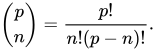
The numerator is p factorial(!), which is divisible by p. However, when 0 < n < p, both n! and (p − n)! are coprime with p since all the factors are less than p and p is prime. Since a binomial coefficient is always an integer, the nth binomial coefficient is divisible by p and hence equal to 0 in the ring. We are left with the zeroth and pth coefficients, which both equal 1, yielding the desired equation.
Thus in characteristic p the freshman's dream is a valid identity. This result demonstrates that exponentiation by p produces an endomorphism, known as the Frobenius endomorphism of the ring.
The demand that the characteristic p be a prime number is central to the truth of the freshman's dream. A related theorem states that a number n is prime if and only if (x + 1)n = xn + 1 in the polynomial ring . This theorem is a key fact in modern primality testing.[6]
![{\displaystyle (\mathbb {Z} /n\mathbb {Z} )[x]}](https://wikimedia.org/api/rest_v1/media/math/render/svg/2fed3d0f77112be60afc5574ac1bcf4074521401)
The history of the term "freshman's dream" is somewhat unclear.
The phrase "freshman's dream" is recorded in non-mathematical contexts since at least the 1840s.[8][9]
On September 6, 1938, The New York Sun published a 16-line poem by Harold Willard Gleason titled «"Dark and Bloody Ground---" (The Freshman's Dream)» that bears some resemblance to this equation. It begins with "In minuends of Algebra / Wild corollaries twine;" and ends with "Or you shall factor cubes, for terms / Of infinite progression!" It mentions "binomial" and "parenthesis" and cautions to "Remove the brackets, radicals [...] with discretion". However, it has no context or explanation to confirm or refute whether it actually refers to this equation. This poem was reproduced by other periodicals over the following two months, including the National Mathematics Magazine published by the Mathematical Association of America (MAA).[10]
On December 30, 1939, Saunders Mac Lane delivered an address to the MAA in Columbus, Ohio, wherein he explained the theorem for fields of prime characteristic, then stated that "As S. C. Kleene has remarked, a knowledge of the case p=2 of this equation would corrupt freshman students of algebra!"[11] This may be the first connection between "freshman" and binomial expansion in fields of positive characteristic.[4] Since then, authors of undergraduate algebra texts took note of the common error.
In 1974, in a textbook about algebra for graduate students, Thomas W. Hungerford published an exercise with a title of "The Freshman's Dream" with a footnote stating, "Terminology due to V[incent] O. McBrien."[12]
- 1 2 3 Bastida, Julio R. (1984). "Chapter 1: Preliminaries on Fields and Polynomials". Field Extensions and Galois Theory. Encyclopedia of Mathematics and its Applications, vol. 22. Cambridge University Press. pp. 1–40 (see p. 8). doi:10.1017/cbo9781107340749.007. ISBN 978-0-521-30242-5. EBSCOhost 589162, 234808e1-8858-3404-80a3-e48607427a55. Retrieved 2025-12-04.
- 1 2 Maclagan, Diane (August 1, 2011). Introduction to Tropical Algebraic Geometry ([class] 1 of 5). ELGA (Escuela Latinoamericana de Geometría Algebraica y Aplicaciones) 2011, by CIMPA, ICTP, UNESCO, MICINN, and Santaló. Buenos Aires: Difusión DM (Departamento de Matemática, Facultad de Ciencias Exactas y Naturales, Universidad de Buenos Aires) (published February 23, 2018). Event occurs at 4m24s–5m23s – via YouTube.
- 1 2 3 Kališnik, Sara (February 2019) [Received: 1 April 2016 / Revised: 6 June 2017 / Accepted: 22 December 2017 / Published online: 30 January 2018]. "Tropical Coordinates on the Space of Persistence Barcodes". Foundations of Computational Mathematics. 19 (1): 101–129 (see p. 103). arXiv:1604.00113. doi:10.1007/s10208-018-9379-y. ISSN 1615-3375. Gale A574342645.
- 1 2 3 Fletcher, Colin R. (October 1978). "[review of]: Selected papers on algebra, edited by Susan Montgomery, Elizabeth W. Ralston and others. Pp xv, 537. 1977. SBN 0 88385 203 9 (Mathematical Association of America)". The Mathematical Gazette. 62 (421): 220–222 (see p. 221). doi:10.2307/3616706. ISSN 0025-5572. JSTOR 3616706.
- 1 2 3 Fraleigh, John B. (1993–1994). A First Course in Abstract Algebra (5th ed.). Reading, Mass.: Addison-Wesley Publishing Company. pp. 283, 453. ISBN 978-0-201-53467-2. LCCN 93-1997. Internet Archive firstcourseinabs0000fral_g1t8. (See alternatively 6th ed. (1998), pp. 262 and 438.)
- 1 2 3 Granville, Andrew (September 30, 2004). "It is easy to determine whether a given integer is prime" (PDF). Bulletin of the American Mathematical Society. New Series. 42 (1): 3–38 (see pp. 8, 12). doi:10.1090/s0273-0979-04-01037-7. ISSN 0273-0979.
- ↑ Clark, Pete L. (April 19, 2018). "Lemma 4.20. ("Schoolboy binomial theorem")". Number Theory: A Contemporary Introduction (PDF). Chapter 4. Quadratic Reciprocity : 7. Proof of the Second Supplement. p. 64. Archived from the original (PDF) on 2024-12-14.
- ↑ "Notices to Correspondents". Editors' Table (pp. 213–216). Nassau Monthly [Nassau Literary Magazine]. Vol. V, no. VI. [Princeton]: [Open Court Publishing Co]. March 1846. pp. 214–216 (see p. 215). Internet Archive sim_nassau-literary-magazine_1846-03_5_6 (canister IA1641630-03, sim_pubid 4839, ark:/13960/t9q36m07x). ProQuest 137473839 (in American Periodicals Series II).
A prose article claiming for itself the dignity of blank verse, entitled, "The Freshman's Dream," and signed "Minnow," next turns up its woful face to notice.
- ↑ "Poetry versus Science, a Freshman's Dream". Bentley's Miscellany. Vol. XXVI. London: Richard Bentley, New Burlington Street. 1849 [February]. pp. 176–184 (see also pp. iii, 651). LCCN 05014033. EBSCOhost 47217143. Gale HNTCQJ330608311, CY0106821297. Google Books dt4RAAAAYAAJ. HathiTrust njp.32101076368255, nyp.33433081753042. Internet Archive bentleysmiscell06cruigoog, sim_bentleys-miscellany_1849-07_26. ProQuest 1310865214. The issues of The Literary Gazette, and Journal of the Belles Lettres, Arts, Sciences, &c. (no. 1697, p. 558), The Athenæum (no. 1135, p. 754), The Spectator ([vol. 22], no. 1100, p. 714), and The Examiner (no. 2165, p. 480) for Saturday 28 July 1849 (available via HathiTrust, Internet Archive, and sometimes elsewhere), as well as various newspapers in England and Scotland through 4 August, contain an advertisement stating that "On Monday will be published, [...] the August Number, [...] of Bentley's Miscellany", followed by a list of contents indicating that this poem is "By the Author of 'The Caliph's Daughter.'"
- ↑ Manuscript in: "Typescript poems 1938–1943". Harold Willard Gleason Papers, Box: 2. Special Collections Research Center, Syracuse University.
First publication: Gleason, Harold Willard (September 6, 1938). ""Dark and Bloody Ground---" (The Freshman's Dream)". The Sun. Vol. CVI, no. 4. New York, N.Y.
Reproduced in:
- The Ottawa Journal. Vol. LIII, no. 229. Ottawa, Ontario, Canada. September 9, 1938. p. 6. Newspapers.com 45993022.
{{cite news}}: Missing or empty|title=(help) - Waterbury Democrat. Waterbury, Connecticut, United States. September 9, 1938. p. 8. NewspaperArchive waterbury-democrat-sep-09-1938-p-8 (library access).
{{cite news}}: Missing or empty|title=(help) - The Bangor Daily News. Bangor, Maine, United States. September 9, 1938. p. 14. Newspapers.com 663268201.
{{cite news}}: Missing or empty|title=(help) - The Moncton Transcript. Vol. LVII, no. 92. Moncton, Moncton Parish, New Brunswick, Canada. September 15, 1938. p. [4]. Newspapers.com 1104615164.
{{cite news}}: Missing or empty|title=(help) - The Boston (Daily) Globe. Vol. CXXXIV, no. 91. Boston, Massachusetts, United States. September 29, 1938. p. 28. Newspapers.com 431880838, 431883159. ProQuest 847896830.
{{cite news}}: Missing or empty|title=(help) - The Reporter. Lansdale, Pennsylvania, United States. October 3, 1938. p. 3. Newspapers.com 992183188.
{{cite news}}: Missing or empty|title=(help) - National Mathematics Magazine. 13 (1): 50. October 1938. ISSN 1539-5588. JSTOR 3028376.
{{cite journal}}: Missing or empty|title=(help)
- The Ottawa Journal. Vol. LIII, no. 229. Ottawa, Ontario, Canada. September 9, 1938. p. 6. Newspapers.com 45993022.
- ↑ Mac Lane, Saunders (May 1940) [An address delivered before the Mathematical Association of America at Columbus, Ohio, December 30, 1939.]. "Modular Fields". The American Mathematical Monthly. 47 (5): 259–274. doi:10.2307/2302685. ISSN 0002-9890. JSTOR 2302685.
- ↑ Hungerford, Thomas W. (1974). Algebra. Holt, Rinehart and Winston. p. 121 (see also pp. ix, 498 for full name). ISBN 978-0-03-086078-2. Google Books KvruAAAAMAAJ. (See alternatively softcover reprint: Hungerford, Thomas W. (2012). Algebra. Graduate Texts in Mathematics (GTM), vol. 73. Springer. pp. xiv, 121, 498. doi:10.1007/978-1-4612-6101-8. ISBN 978-1-4612-6103-2. LCCN 73-15693. SPIN 11013129. Google Books e-YlBQAAQBAJ.) (Also in: Abstract Algebra: An Introduction (2nd ed.). Brooks Cole. July 12, 1996. p. 366.)