
Main Contributions
01
Thin-Shell & Non-Manifold 3D
Leverages multi-chart geometry images to effectively learn thin-shell, non-manifold surfaces — geometry that watertight volumetric models cannot represent.
02
High Fidelity, End-to-End
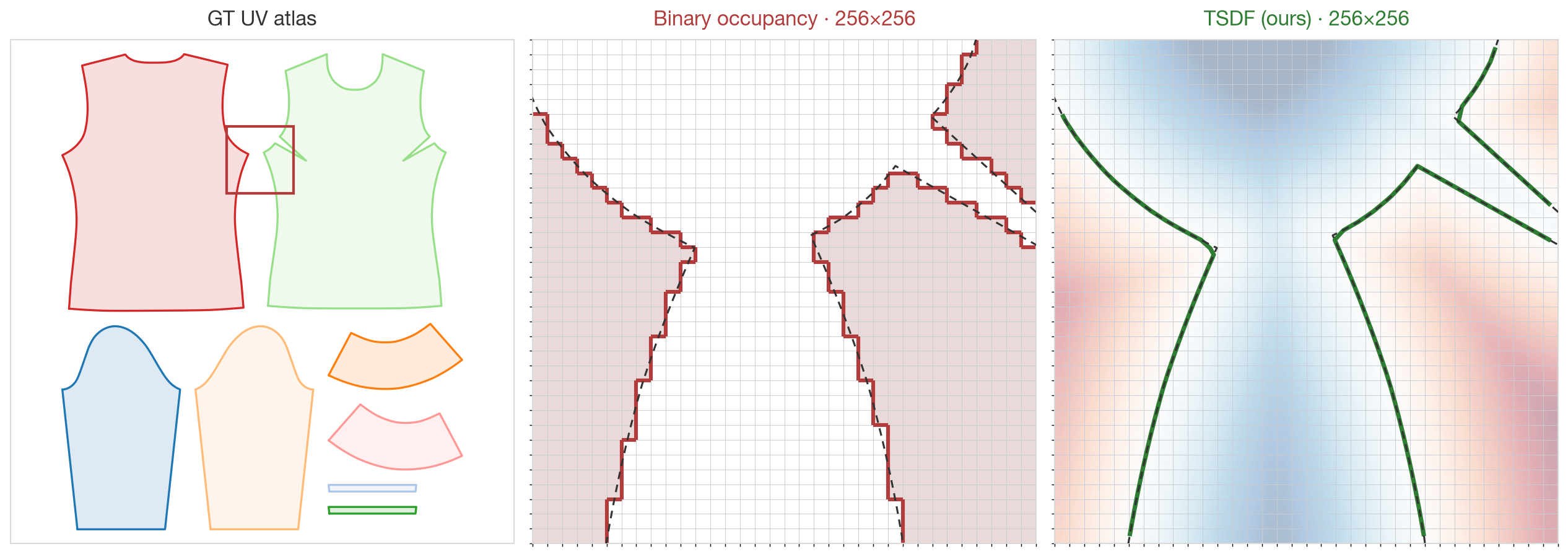
Continuous TSDF + differentiable marching squares backpropagate 3D surface losses end-to-end, yielding subpixel-accurate boundaries.
03
Fast & Lightweight
Diffusion over a compact 32×32 latent generates 3D in ~1.2 s on a consumer GPU — down to CPU-only devices.
DiffGI Pipeline
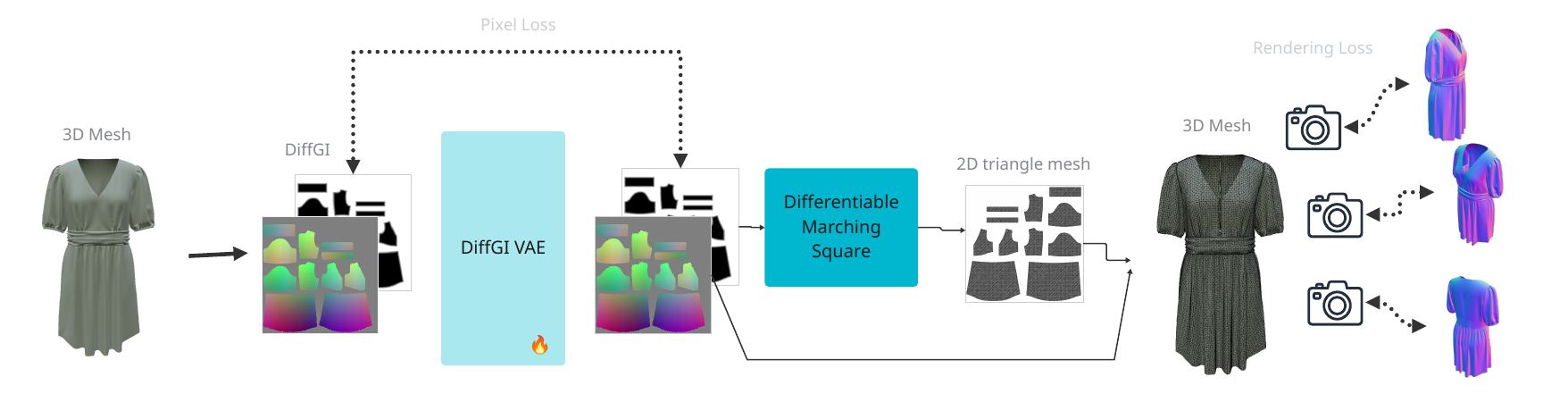
An input 3D mesh is mapped to a 2D TSDF geometry image and compressed by the DiffGI-VAE into a compact 32×32 latent. The decoder reconstructs the TSDF map, and a Differentiable Marching Squares (DMS) module extracts the 3D surface from it. Because DMS is differentiable, pixel-space losses on the TSDF and position maps — together with a geometry-aware normal rendering loss — propagate end-to-end, from the rendered 3D surface all the way back to the 2D latent. A transformer-based latent diffusion model is then trained on this latent space for conditional generation.
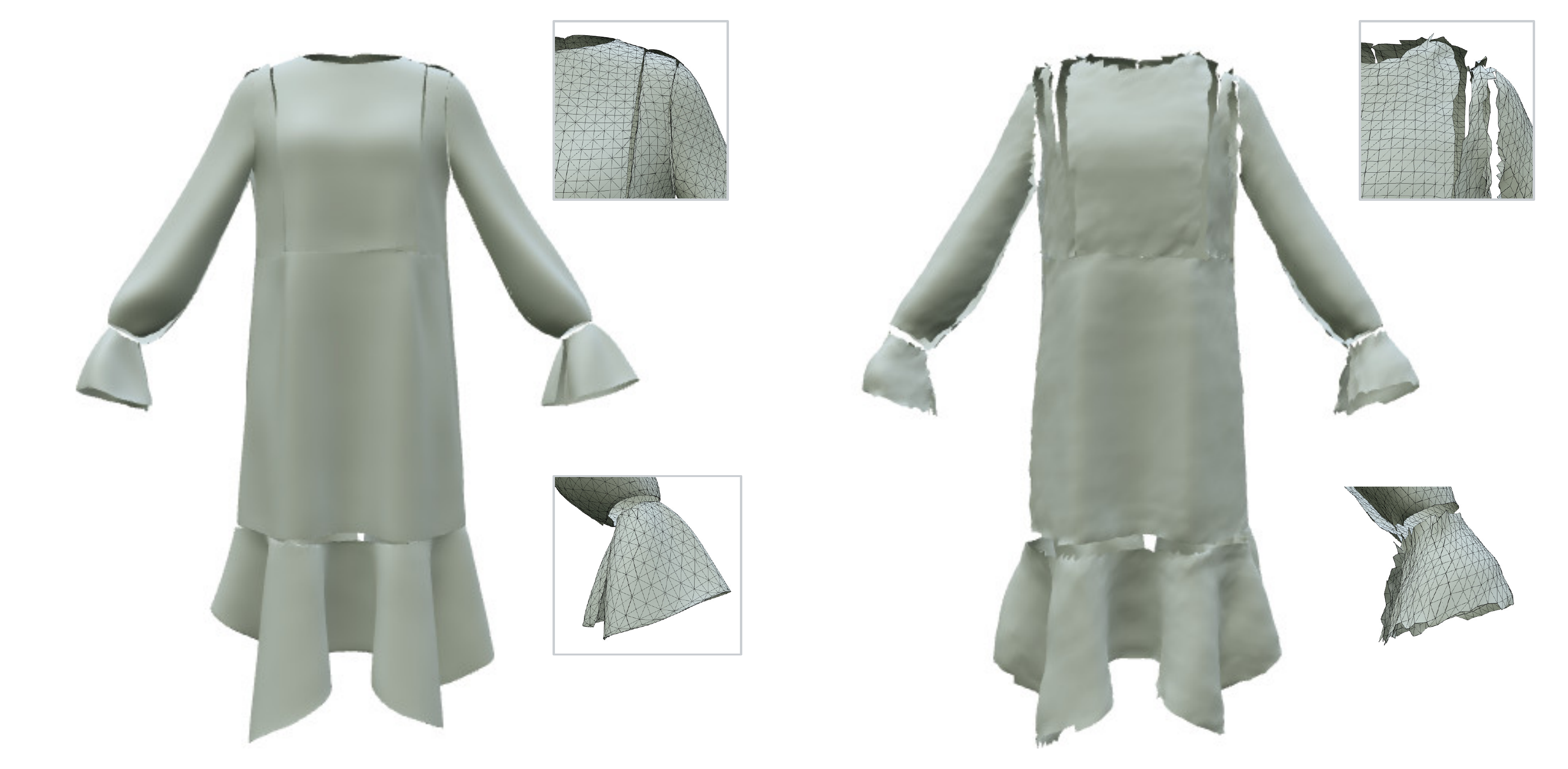
The Effect of Our Representation
DiffGI (ours)
Conventional GI
Results
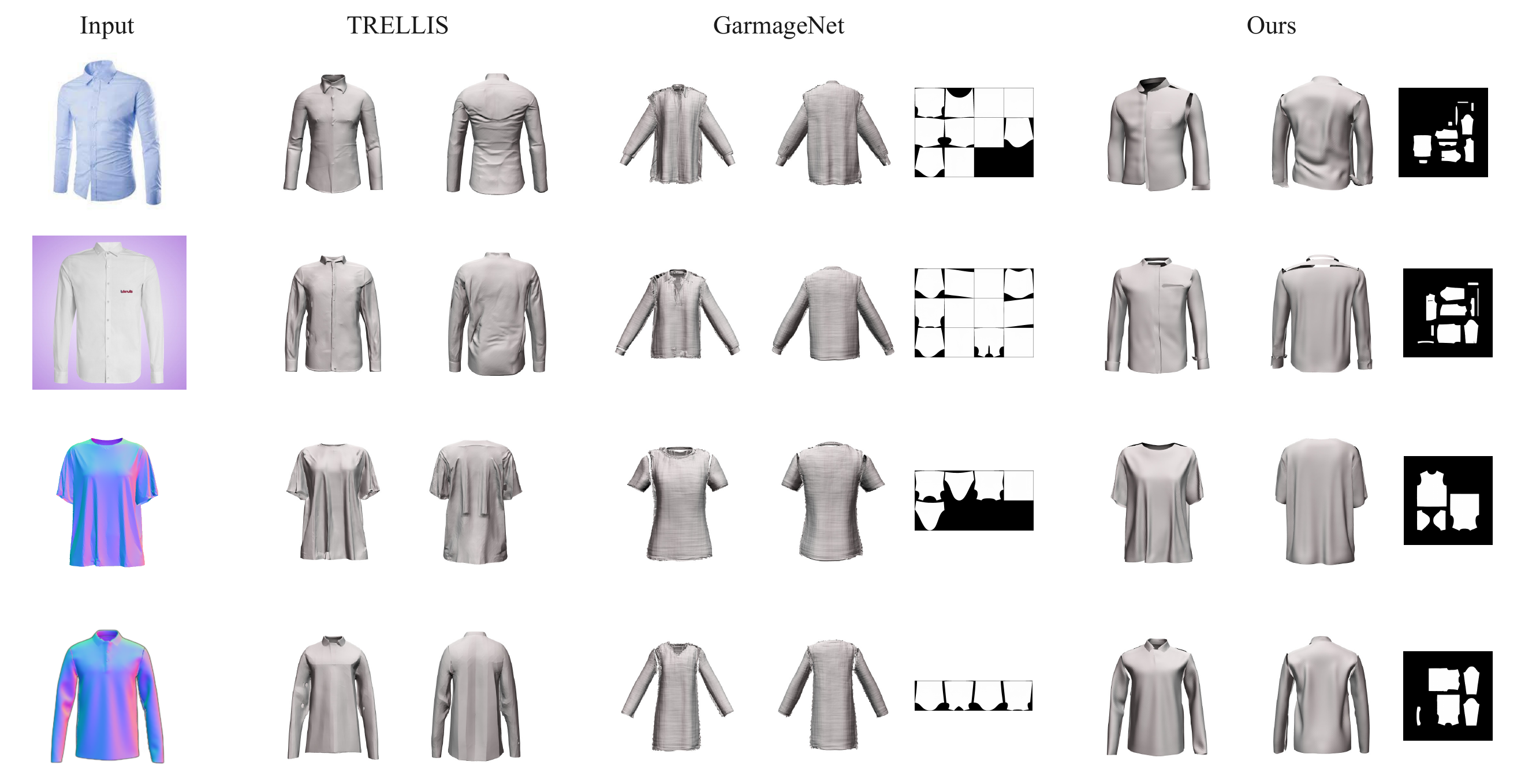
Single-View Image-to-3D
Zero-Shot Generation from In-the-Wild Images
| Method | Avg. Vertices | CD↓ | MD (F1)↑ | dH↓ | BCD↓ |
|---|---|---|---|---|---|
| TRELLIS | 109K | 3.44 | 0.28 | 15.38 | N/A |
| TRELLIS.2 | 380K | 11.01 | 0.27 | 69.70 | 12.44 |
| GarmageNet | 526K | 4.31 | 0.20 | 23.76 | 5.64 |
| Ours (DiffGI) | 23K | 1.35 | 0.48 | 8.42 | 2.91 |
Reconstruction Fidelity (DiffGI-VAE)
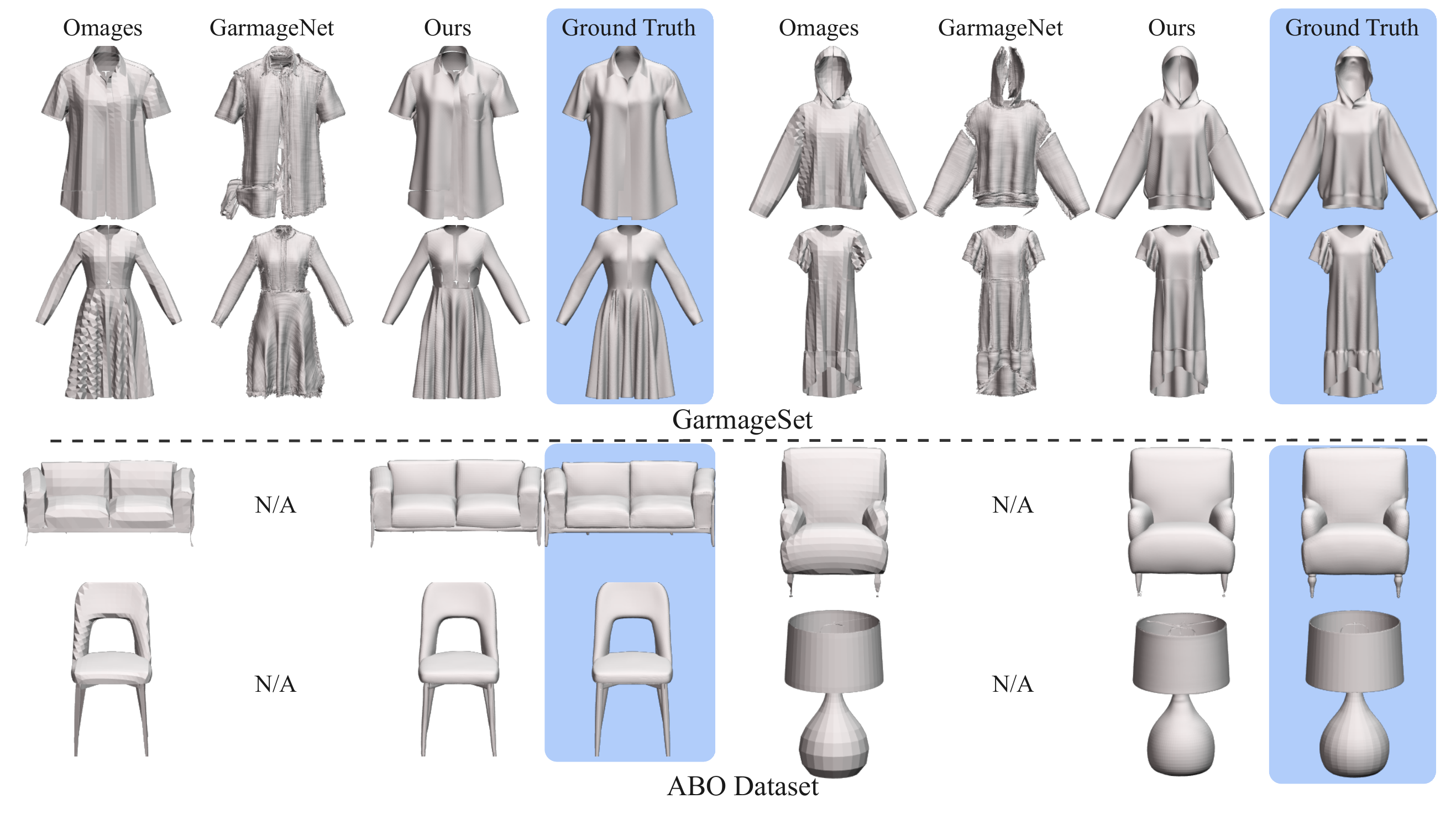
| Method | Rep. Size | ABO CD↓ | ABO EMD↓ | ABO JSD↓ | ABO NC↑ | Garmage CD↓ | Garmage EMD↓ | Garmage JSD↓ | Garmage NC↑ |
|---|---|---|---|---|---|---|---|---|---|
| Omages | 64×64×4 | 0.89 | 0.25 | 0.92 | 0.89 | 1.31 | 0.17 | 1.79 | 0.95 |
| GarmageNet | N×72 | — | — | — | — | 2.19 | 0.21 | 32.61 | 0.94 |
| Ours | 32×32×4 | 0.83 | 0.23 | 0.89 | 0.83 | 0.46 | 0.16 | 1.24 | 0.96 |
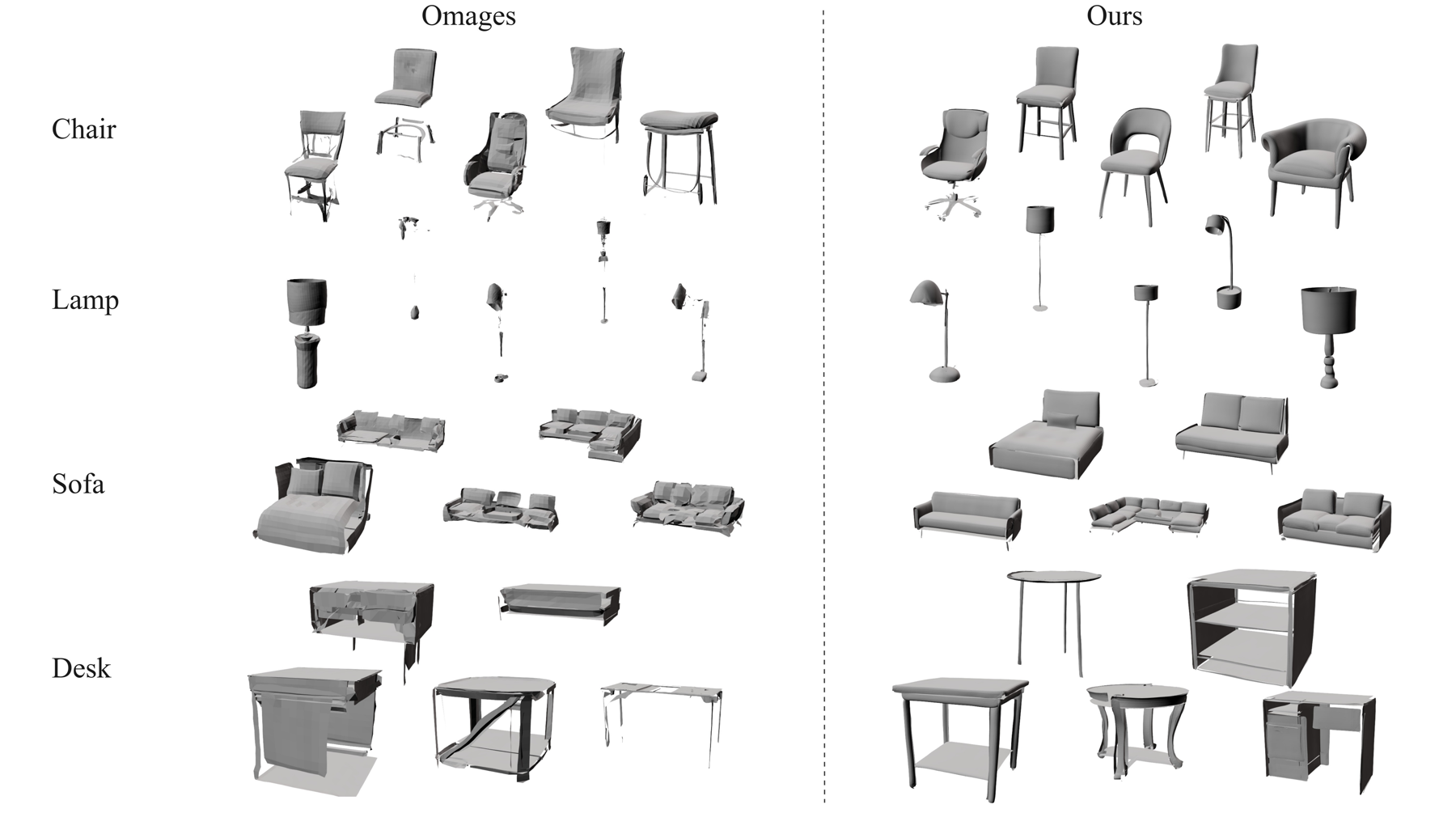
Label-Conditioned Generation (ABO)
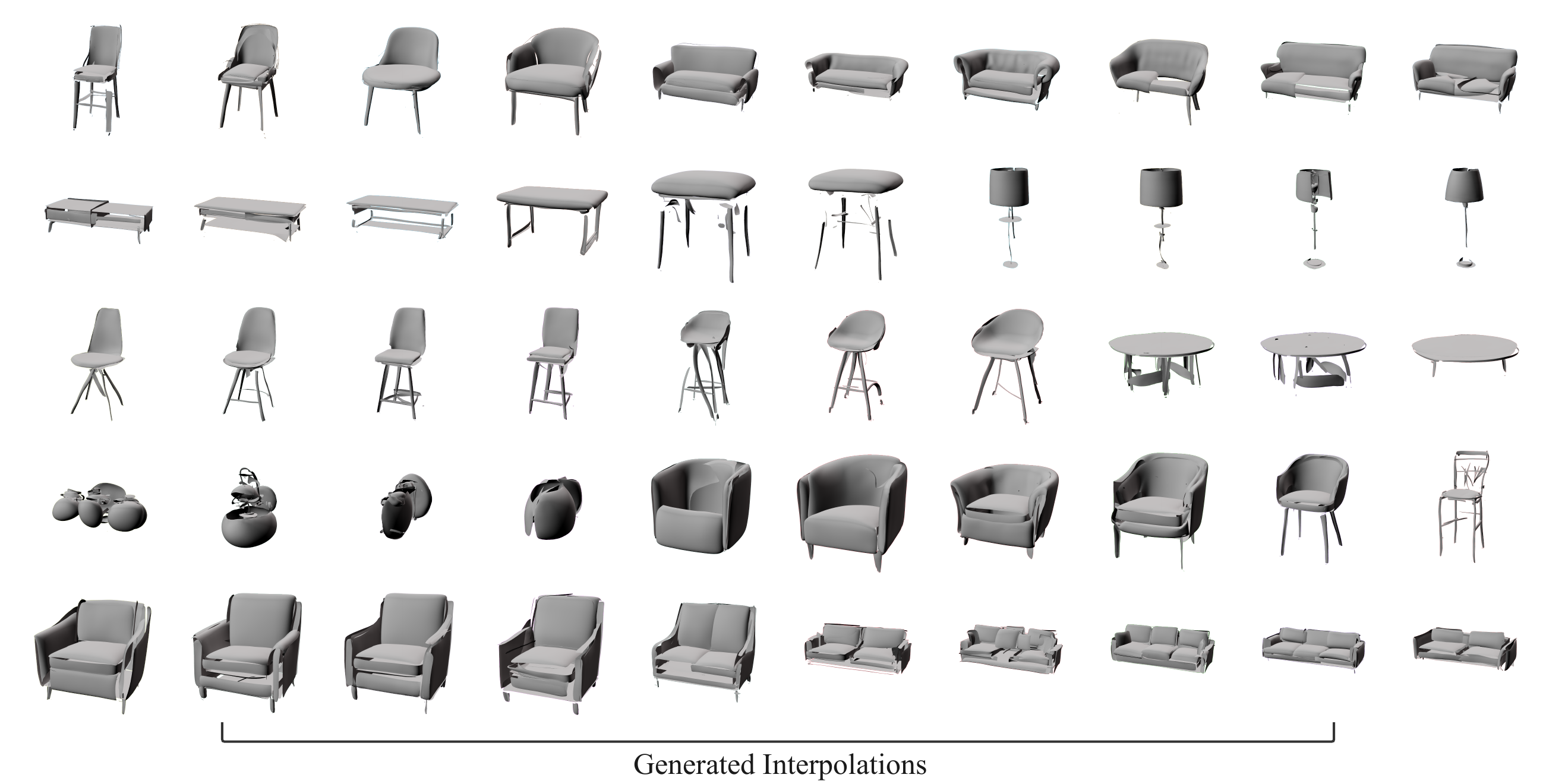
Latent Space Interpolation
Inference Speed
| Method | Hardware | Peak VRAM (GB)↓ | Time (s)↓ |
|---|---|---|---|
| TRELLIS-image | RTX A6000 Ada | 16.28 | 4.52 |
| Omages | RTX A6000 Ada | 2.49 | 52.0 |
| Ours-Image | RTX A6000 Ada | 3.22 | 0.80 |
| Ours-Image | RTX 4070 (12GB) | 3.22 | 1.21 |
| Ours-Image | MacBook M4 (CPU) | — | 8.52 |
Acknowledgements
We thank Hyun Kang, Seungoh Han, Sihun Cha, and Dong-sig Kang for valuable discussions and feedback throughout this work. We are also grateful to CLO Virtual Fashion for providing the research environment and resources that made this work possible.
BibTeX
@inproceedings{shim2026diffgi,
  title     = {DiffGI: Differentiable Geometry Images for High-Fidelity Thin-Shell 3D Generation},
  author    = {Shim, Eungjune and Lee, Hansol and Ju, Eunjung},
  booktitle = {Proceedings of the European Conference on Computer Vision (ECCV)},
  year      = {2026}
}