First off: sorry. I hadn’t meant to leave it quite so long before posting here again. What with the launch of Trade World and a succession of economic stories to cover for Sky News, things have been somewhat busier than expected. But the very first thing I wanted to say was: thank you so much to those of you who bought a copy of Trade World. Thanks to your support, a book about supply chains became an instant bestseller, words I never thought I’d write. Anyway, time for some actual content...
On the surface, it probably seems desperately odd that, all of a sudden, everyone is quite so obsessed with diesel. How is it that a type of fuel (not even the most important fuel for UK or American cars, for heaven’s sake) has become so significant that it’s at the heart of a geopolitical battle - with G7 leaders including Emmanuel Macron holding an emergency meeting, mostly about diesel?
The short answer is that politicians on both sides of the Atlantic are waking up to two very important home truths. The first is that energy matters. The second is that while once upon a time we lived in a world where the economic determined the geopolitics, the world of 2026 is one in which geopolitics is driving the economics. Diesel just so happens to find itself at the heart of these two forces. All of which is why, when you delve into what’s going on here you begin to realise all sorts of things, among them the fact that in a sense, Donald Trump is taking a leaf out of the playbook of both Vladimir Putin and Xi Jinping.
We’ll get to that slightly provocative notion in just a moment but let’s start with the first of those two home truths: that energy is front and centre of the story of geopolitics. In a sense, this has always been the case. As you will know if you’ve read Material World, energy is more or less everything. Our ability to function as a modern civilisation depends on being able to harness sources of energy and turn them into goods and services.
The availability of power determines our ability to run data centres (and in turn AI); the availability of natural gas determines our ability to make the fertilisers we need to grow our crops; every industrial process you care to mention involves the conversion of energy into physical or chemical processes that help us turn ingredients into stuff - and this is before we get to the simple questions of how to heat or power our homes.
None of this is rocket science, of course, but in recent decades many of our politicians deluded themselves into forgetting the importance of this sort of thing. The free and nearly limitless availability of coal, oil and gas from all over the world meant they could forget that this stuff isn’t necessarily always easy to procure. The promise of the energy transition meant they could fool themselves into thinking that within a matter of years all of their energetic needs could come from solar panels and wind turbines. But the inconvenient logic of thermodynamics is that while wind and solar provide an increasing share of British electricity, we still get the vast majority of our energy (75.1% in the latest year for which we have data) from fossil fuels.
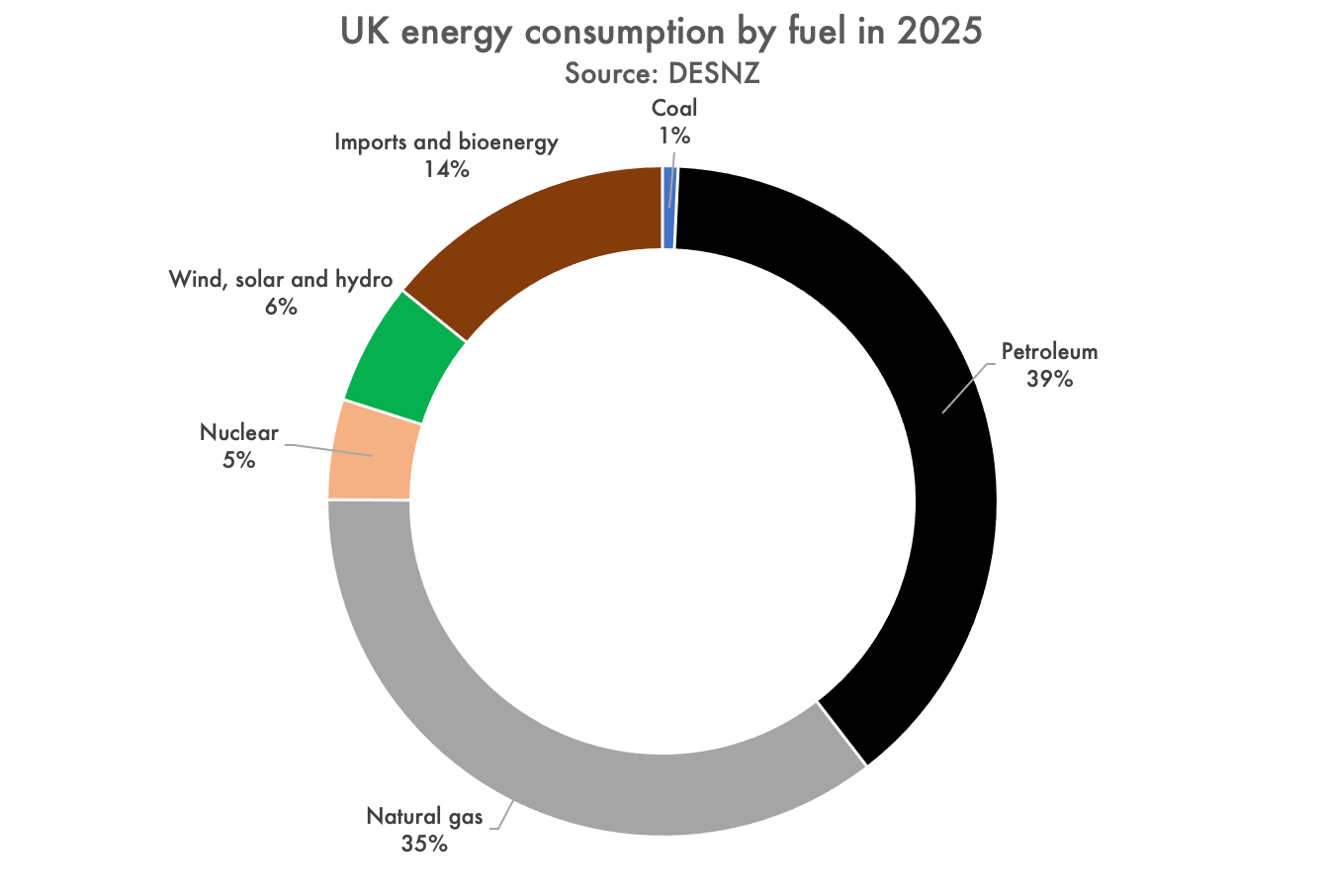
Yes, really. While wind power has come an awfully long way, it and solar still only account for about 6 per cent of total UK energy. If that seems to jar with what you’re often told it’s because many politicians (and, frankly, many journalists) still have yet to work out the difference between electricity and energy.
All of which is to say, at some point in the coming decades we may well have worked out how to fuel heavy trucks and trains with renewable fuels or with batteries but for the time being our ability to move stuff around this country is enormously dependent on fossil fuels, more specifically diesel. Even those who live in London, eating mostly organic food and travelling around mostly on a bike (cards on the table: I am one of these people) still depend on diesel trucks to carry that food into the city for them. Cities are, as you will know if you’ve already read the first chapter of Trade World, essentially glorified food supply chains. No diesel and, very quickly, civilisation as we know it begins to fray.
Britain used to be self-sufficient for diesel - at least statistically. As you see from the chart below, one I’ve used a couple of times on Sky News recently, we used on these shores to produce more diesel than we consumed. There was lots of oil coming out of the North Sea and there were 12 big refineries dotted around the coast taking this oil and cracking the molecules apart into different products: the light stuff went off to become gasoline. Some became the kerosene that went into jet fuel. The heavy stuff was turned into ship fuel and coke - and the stuff in the middle was turned into diesel.
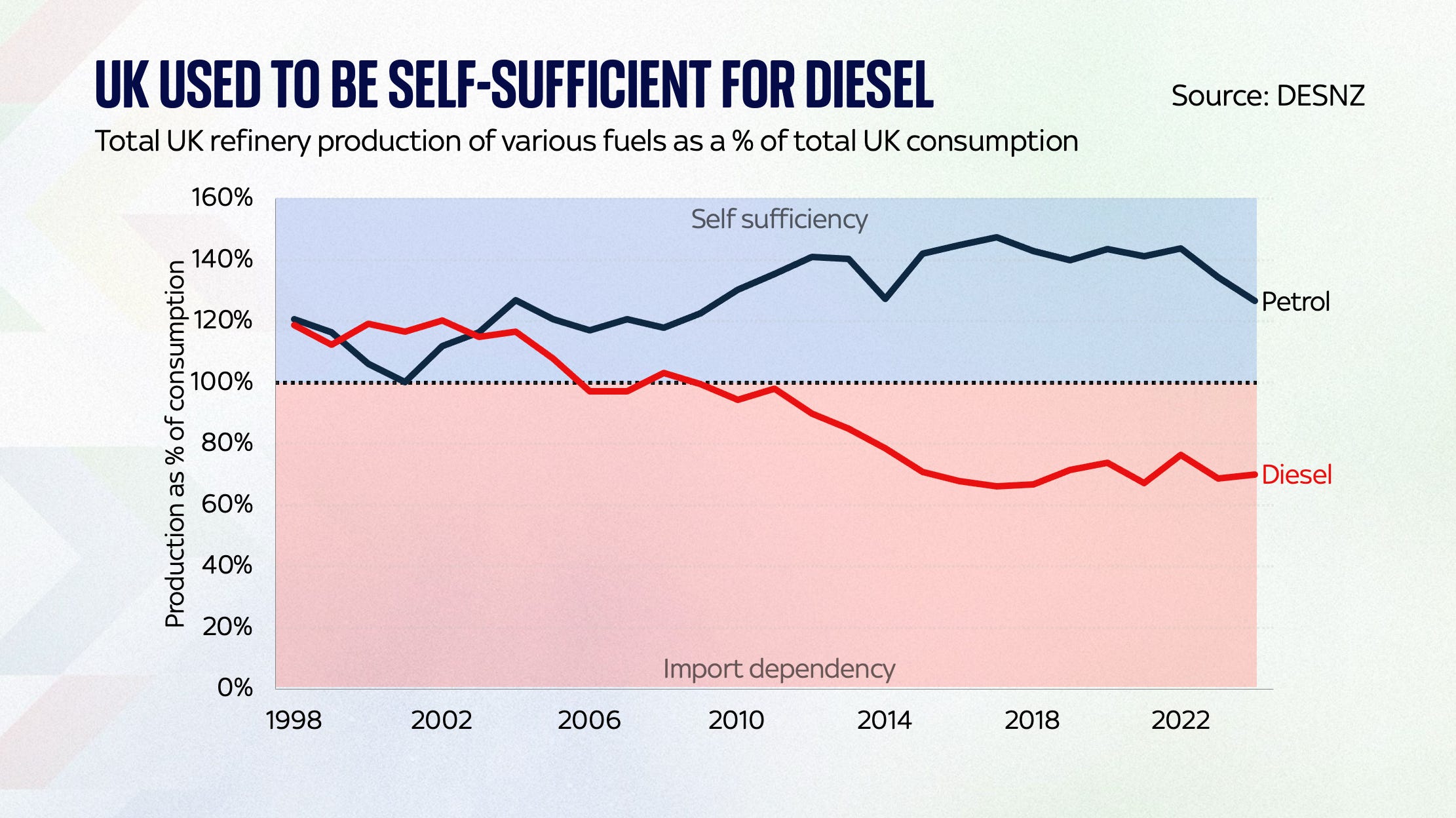
But over time two things have happened. First, we began to consume more diesel. This was partly a function of government policy, of politicians trying to encourage people to buy diesel cars, believing it would be better for the environment (it was certainly better for the carbon emissions figures; however, it was considerably worse for air quality - especially after it transpired Volkswagen was juking the stats). Second, refineries in the UK began to shut down.
At the time, few in Whitehall mourned the fact that Britain went from 12 to four refineries in a couple of decades. The North Sea was in decline and, anyway, fewer refineries meant even lower carbon emissions, and Britain could double down on its claim to be leading the global effort to decarbonise. They reasoned that, to the extent that we would need diesel in the coming years, we may as well just ship it in from other countries who didn’t care quite so much about their emissions. Something similar happened across much of Europe.
Where that diesel came from, shall we say, evolved along with geopolitical events. A decade ago the single biggest provider of it was Russia. Then, when Russia invaded Ukraine, we flipped our dependence to other places, primarily the Middle East, and refiners in Europe and India who also got their oil from the Persian Gulf - but also America, which, since the shale revolution has become one of the world’s preeminent crude and petroleum exporters. Then (you already know where this is heading) when the Strait of Hormuz was closed, stifling how much oil could come out of the Gulf, we flipped our dependence again. Now, it was nearly all about America.
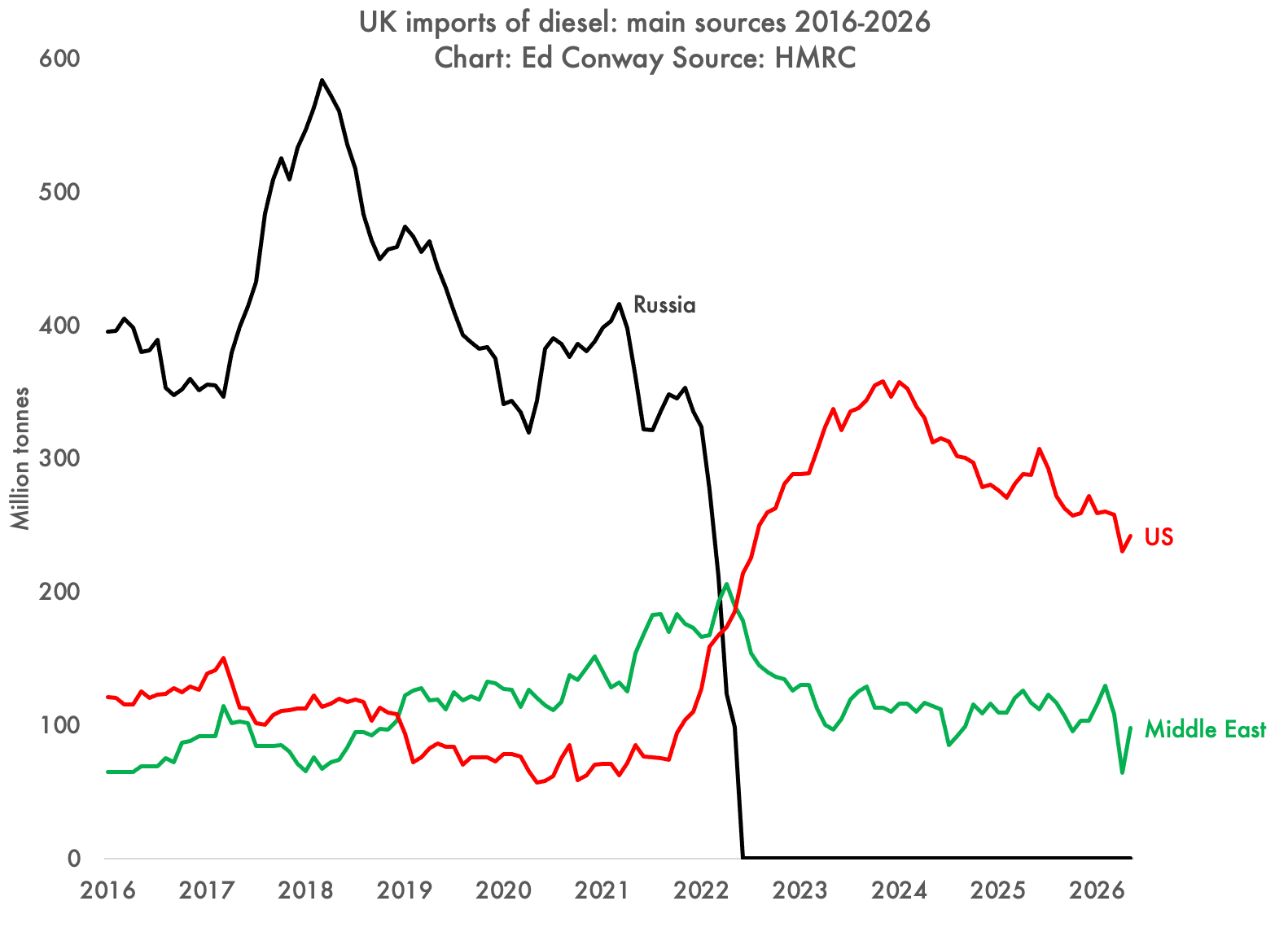
To an extent that is somewhat breathtaking, Europe is now astoundingly dependent on American energy. The main reason this continent has been able to survive the sudden drop in imports from Russia - both for petroleum products and for gas - is largely thanks to a stream of shipments of crude, oil products and liquefied natural gas coming this way from the Gulf of Mexico. American energy saved Europe. For a continent whose leaders have a somewhat antipathetic attitude towards Donald Trump, this is somewhat awkward. But it’s there in the data (and the situation for kerosene is even more stark).
All of which brings us back to where we are now. Diesel and kerosene prices have gone through the roof this year. Partly that’s a consequence of the fact that much less of this stuff is coming out of the Gulf. Partly it’s because of geopolitics (India is wary of refining much Russian crude after Trump imposed secondary tariffs on it). Partly it’s because the Ukrainians have been so successful in attacking Russian refineries, which in turn means even less diesel floating around the high seas (sure, it’s no longer supposed to come to Europe but these are global markets).
That goes for Europe (you have surely seen the news that diesel prices here are at record highs) but it also goes for America. Even though the US produces far more diesel than it actually consumes, this is a global market and as long as American diesel can be sold to desperate buyers in Europe and beyond, American prices will reflect that. So US diesel prices have also hit record highs. This has not gone down well. Consider the chart below, one inspired by a Bloomberg chart I saw (can’t find the link - if anyone else can please post it and I’ll update this).
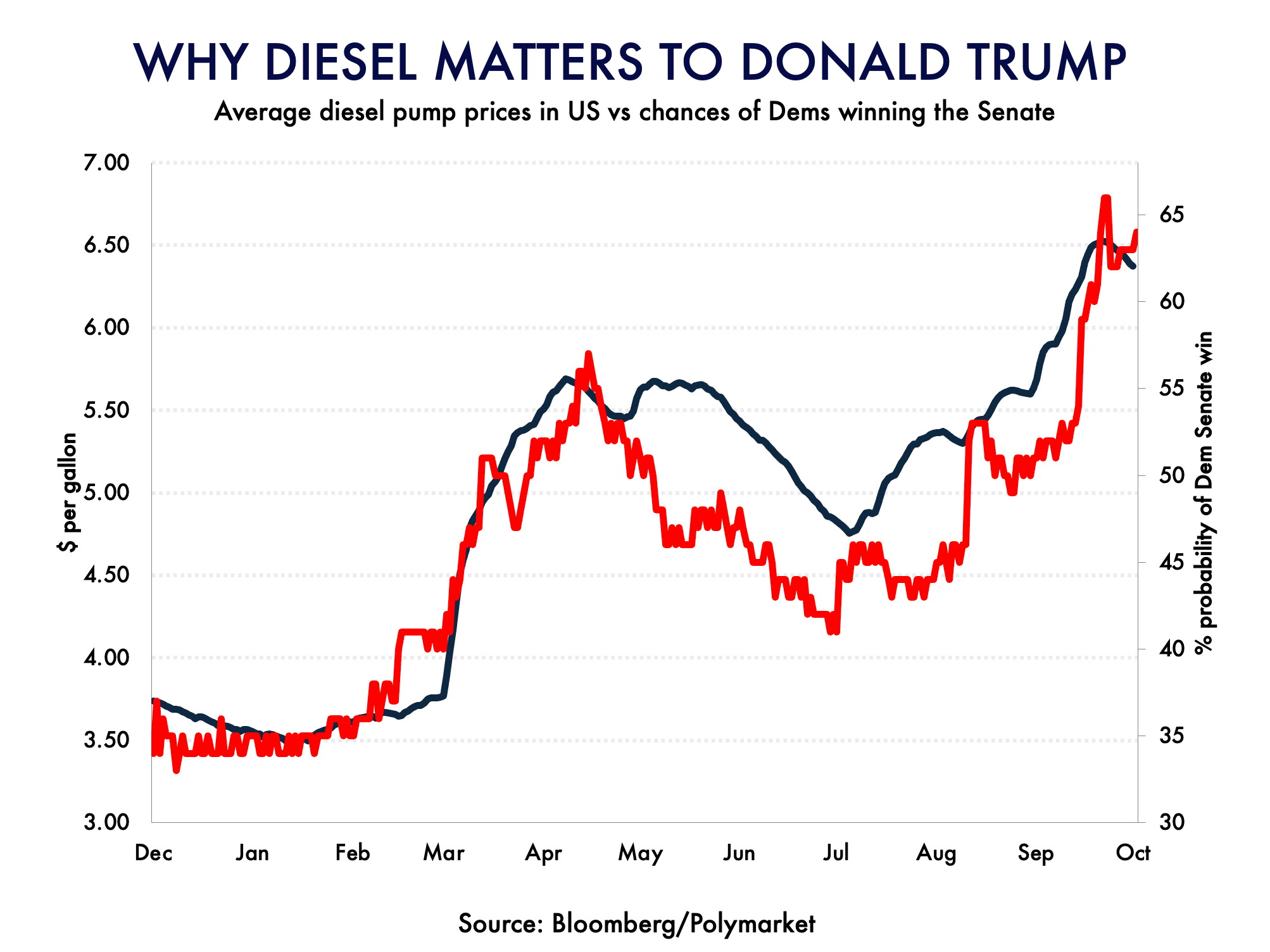
The predicted result of the mid-term elections is strikingly correlated with the price of diesel. When the diesel price goes up, so too do the Democrats’ chances of winning the Senate. When it goes down, the Democrats lose ground. Which is why, in recent weeks, Donald Trump has been pondering a dramatic move, something that has begun to scare the bejesus out of European policymakers: to ban diesel exports altogether.
Now, it’s an open question how much a ban in US exports would actually reduce US diesel prices. As I ran through towards the end of the Sky News screen below, while in theory you might expect it to mean there’s more diesel floating around the US system and hence lower prices, in practice the US diesel market is quite fractured, with the West coast in particular dependent on imports - with the upshot that it might raise prices even as it reduces the price in places like Texas and Louisiana (where many of the refineries are).
Even so, the threat is also somewhat inspired by something else. For a long time, US policymakers have been distinctly irritated by the fact that Europe has been decidedly stingy with their emergency stockpiles of diesel, kerosene and other fuels. Across the continent, there is quite a lot of fuel (round about a billion barrels) sitting in fuel tanks in refineries, terminals and storage locations for precisely an eventuality like this. But the Oval Office was frustrated with the speed at which the EU released its stockpiles earlier this year after the closure of the Strait of Hormuz, and has been asking in recent weeks, couldn’t Europe release some of its own stocks instead of continuing to suck in American imports?
All of which has forced European policymakers to spend the past few weeks spending rather a lot of time getting their heads round how much oil and fuel they actually have in their countries. You might have thought this should be a relatively simple exercise. After all, in theory, what we’re talking about here is quite simple: big tanks of oil, fuel and other related products that sit in refineries and terminals, providing redundancy in the event that a country runs short of a particular fuel. Ever since the oil shocks of the 1970s, western nations have, under the auspices of the International Energy Agency, committed to holding a certain amount of oil back in case of a sudden shortage - roughly 90 days worth of their typical net imports.
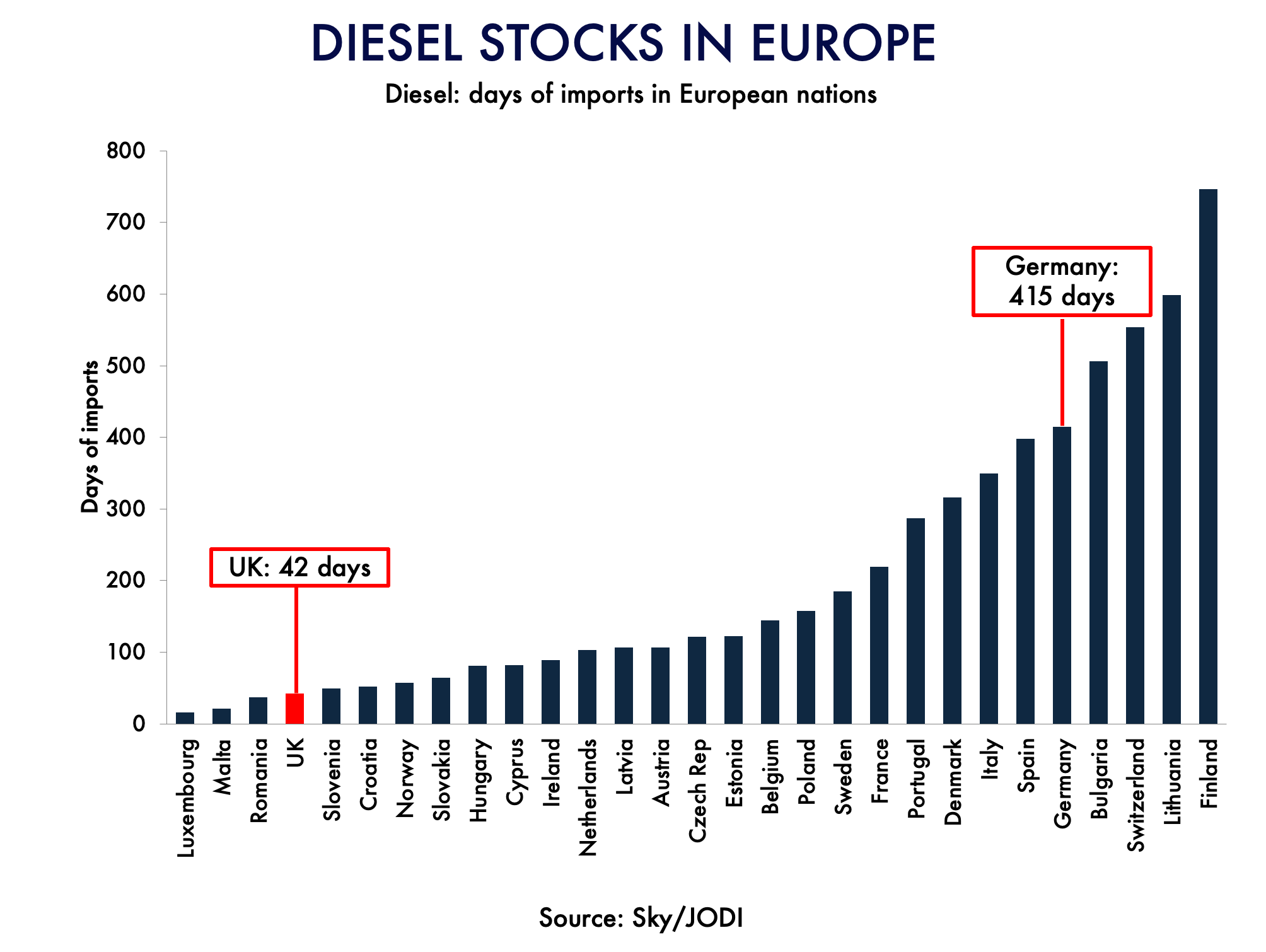
And in some countries it really is that simple. Some oil-poor G7 nations like Germany and Japan have explicit government policies to create large physical stockpiles of fuels. The upshot is Germany has hundreds of days worth of diesel imports in tanks dotted around the country; Japan has over a thousand days of fuel imports set aside. Other countries have a considerably more laissez-faire attitude towards these imports. Consider Australia, one of the world’s biggest diesel importers. It has barely more than 30 days of imports stored in its tanks, in case of a disruption. The UK’s stockpiles are barely much more: about 42 days over the most recent three months, last time I looked at the figures.
But even these figures might be overstating it because the system whereby countries account for their stockpiles is actually far more complex than you might have thought. Under IEA rules, if you can prove that you have a right to a certain amount of oil held in a refinery or terminal in another country, then you can technically count that as a “national” stockpile. These ticketed stocks might be in a nearby terminal, they might be on the other side of the planet, but for the sakes of stockpile accounting, you can count them all the same.
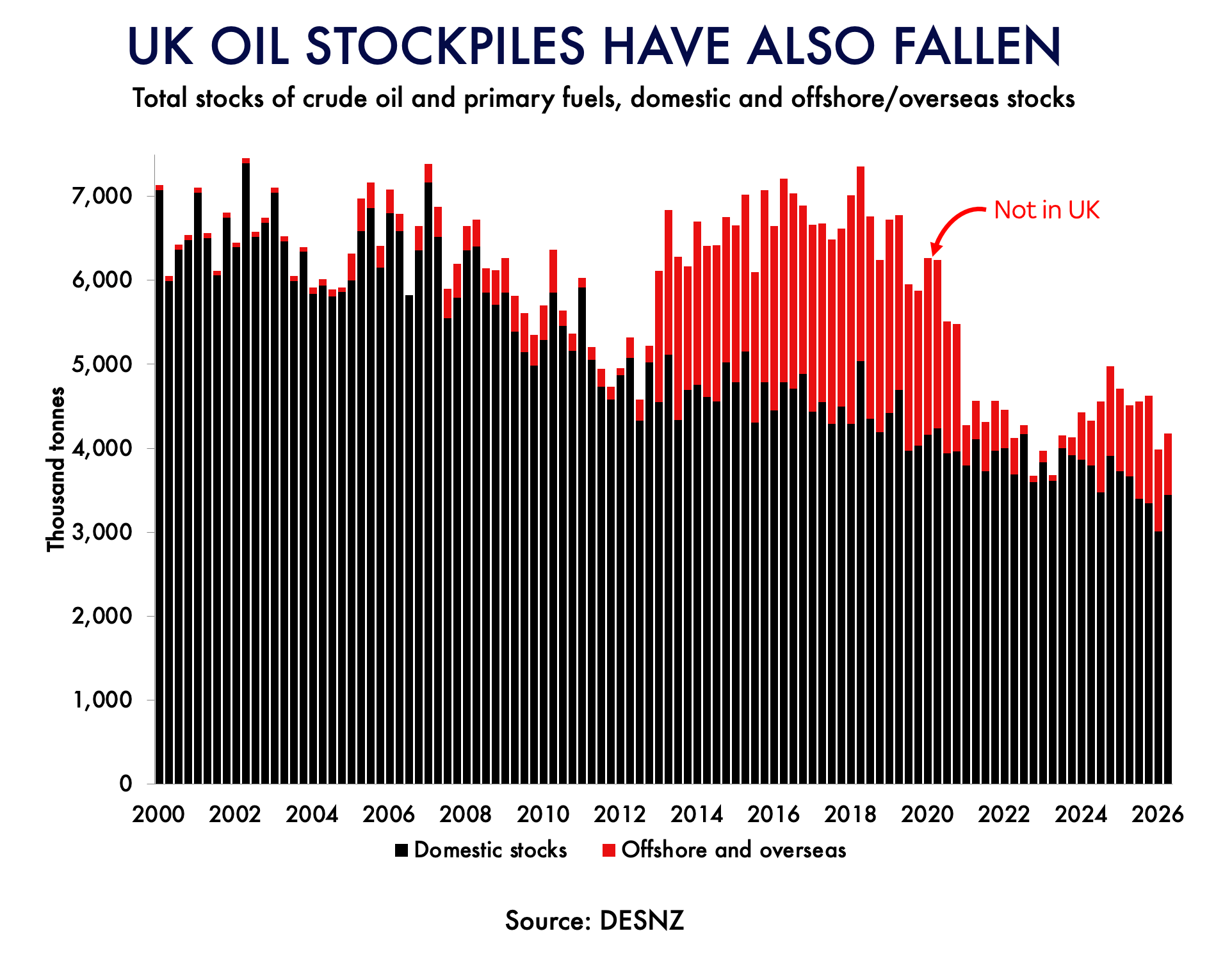
Consider Britain’s stocks of crude oil. Unlike Germany, the UK has no national government-held stock of oil. Instead the Department for Energy Security and Net Zero enforces how much the refineries and terminals around the country have to keep in stocks. Once upon a time this country had roughly 7 million tonnes of crude oil in tanks and refineries around the country. But then refineries began to close. In recent years that stock level has hovered closer to 4 million tonnes. But if you look a little closer you see that roughly a fifth of all that oil isn’t in the UK at all: it’s either offshore or in these overseas stocks that are probably obtainable, but no-one knows how long it will or won’t take.
For most of recent history, no-one paid the slightest bit of attention to all this stuff. For as long as you could assume that crude and diesel tankers would always show up, it seemed to make more sense to allow Britain’s energy infrastructure and redundancy to wither away. That way things would continue to get cheaper and Britain’s domestic carbon emissions would continue to fall. But - and this is sort of the whole point of Trade World - that old world seems to be dissolving very fast, replaced with a new world where it actually matters where stuff comes from.
And if Europe is unable to get American diesel, it is, as you can already divine, in big, big trouble. As I say, a profound shortage would represent civilisational disruption across the continent, which is fed thanks to trucks and trains many of which depend on diesel.
Donald Trump is well aware of this. So his threat to cut off exports is, in a sense, a hybrid of what Vladimir Putin and Xi Jinping have done with trade policy in recent years. And yes, clearly I’m saying that to be a bit provocative but, then again, the more you think about the analogy, the more it holds. Putin has, for years, used Russia’s energy policy to try to affect politics elsewhere. Xi has used Chinese dominance in particular export sectors to win trade wars - consider his decision last year to impose controls on exports of rare earths, something which forced Trump to relent on some of the steepest tariffs on China. Trump is merely doing to Europe what has already been done to him: using his most potent economic lever to try to get his way.
And, as things stand on the day I write this, it looks as if he has succeeded. The G7’s emergency decision to release 100 million barrels worth of oil and fuel stockpiles (my assumption is this mostly means Europe) in the coming months represents a big shift. It might help bring down diesel prices in both Europe and the US. Who knows, it might even help Trump in the mid-term elections. And to Europe’s relief, he seems, for the time being at least, to have decided not to ban those exports. And so, via the vector of diesel, European leaders have found themselves indirectly drawn into a very American political battle.
Perhaps by now you see why this isn’t really just about an obscure topic in the weeds of energy policy. The story of diesel in recent weeks is really a tale about how the world is changing - about how geopolitics is blending into economics and how trade is being used as a weapon even when most people are totally unaware of it. It’s a story of how (once again) Europe’s energy dependence has become an Achilles heel, and of how complacency on both sides of the Channel has allowed us to become especially vulnerable to the vagaries of whether our fuel tankers will ever actually arrive.
One of the reasons I wrote Trade World was that I needed a sort of user’s guide to geopolitics and economics over the coming decade. My suspicion was that, contrary to what many in Europe would like to believe, protectionism and geo-economics (of whatever you want to call it) would not go away after Donald Trump leaves office. Trade World is supposed to provide some answers, or at the very least some explanations or framing mechanisms, to help us all understand and interrogate why the world is the way it is today. If my suspicions are right, we will all have to think more deeply about all this stuff in the coming years, as energy policy and trade policy and politics collide on a frequent basis. This is the new world we inhabit