There have been all sorts of people throughout history who believed they could play God. Some engineers sought to reroute the planet during the era of post-war megaprojects. One of the most ambitious was a Soviet engineer, Petr Mikhailovich Borisov. He became the public face of a plan to pump out the Bering Strait and reroute the currents of the ocean, a scheme that was covered in the June 1956 issue of Popular Mechanics and which he formally developed over the following years. Its aim was not transportation or hydropower generation, but to melt the Arctic, warm Siberia, and alter Earth's climate.
The plan never took off the drawing board. But in a time where geoengineering isn't a far-fetched science fiction concept, Borisov's blueprint seems less like some peculiar science history anecdote and more like an early forecast of a debate we're still engaged in today: what should be the limits of human engineering attempts to modify the planet?
A dam between two continents
At its narrowest point, the Bering Strait is only 82 kilometers (51 miles) wide; it separates Russia from Alaska and connects the Pacific to the Arctic. In Borisov's mind, however, it was a huge climate control valve.
He proposed a huge dam across the strait, with powerful pumping stations moving cold Arctic water into the Pacific. Borisov said that with this water taken away, warmer currents of the Atlantic would be able to penetrate deeper into the Arctic, slowly melting the ice and changing the climate in the North.
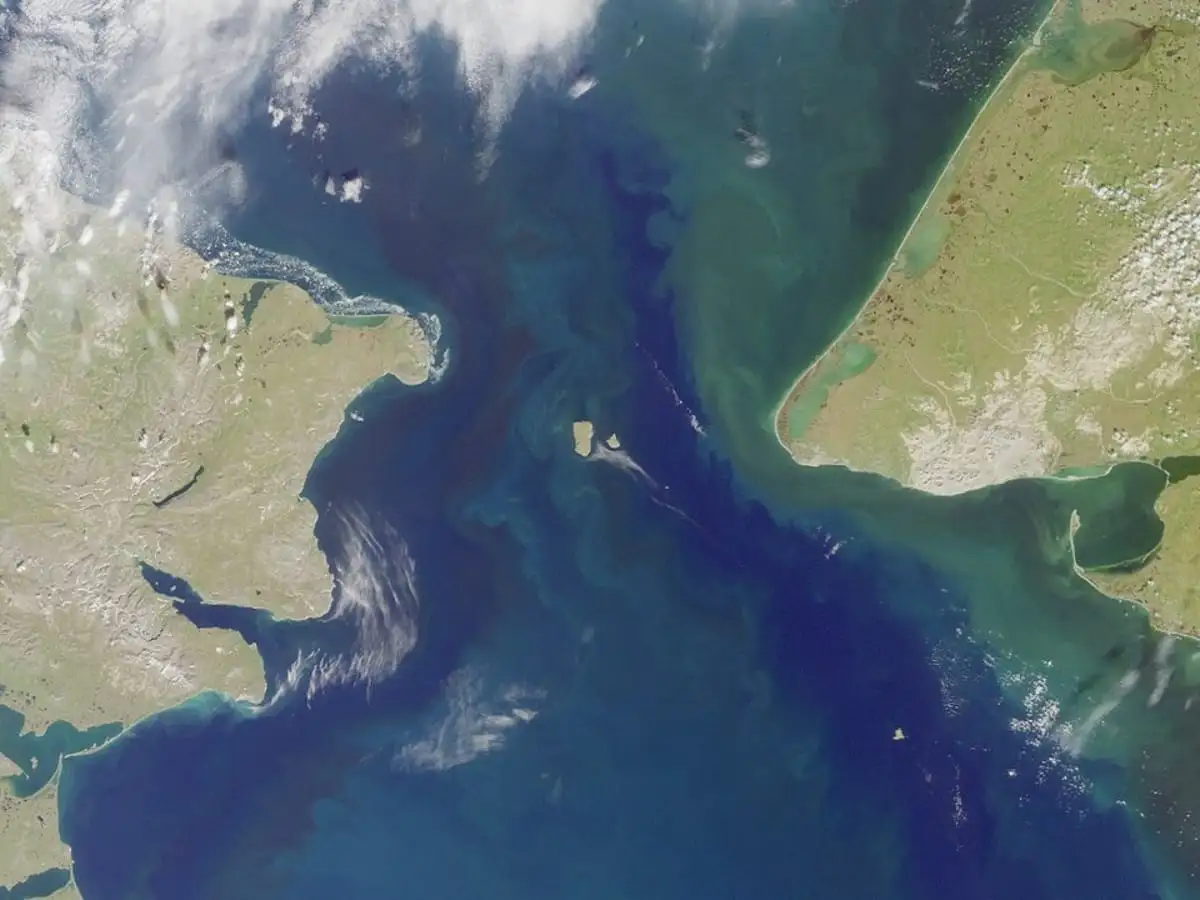
Satellite image of Bering Strait. Image credits: Wikimedia Commons
He thought that this would help 'soften' the harsh winters of Siberia, melt the permafrost, and increase farming acreage, effects he believed would ripple across the wider Northern Hemisphere, with Canada, Denmark, and the United States among the nations whose climates and interests would be directly affected. In his more optimistic predictions, the impacts could extend as far as the Sahara Desert, an ambitious one even by Cold War standards. He insisted that it could alter atmospheric circulation enough to make the Sahara greener and create a milder global climate, as outlined in a 2026 Utrecht University publication. Borisov thought that the new route for warmer Pacific ocean waters into the Arctic would not just melt ice but also open up Russia's agricultural frontier, providing the country with more habitable areas.

Live Events
The Arctic region seems geographically remote. However, environmental changes there can directly influence the weather far beyond the polar region. The Arctic region is the key regulator of global heat exchange. It helps create temperature differences that further become atmospheric circulation patterns. Scientists understand and emphasize the fact that variations in Arctic sea ice can adversely affect ecosystems, oceanic circulation, and climate processes across the Northern Hemisphere. This is the reason that the idea of deliberately modifying Arctic conditions immediately attracted attention from both Borisov’s supporters as well as critics. Any large-scale reduction in the quantum of sea ice would likely have undesirable consequences reaching as far as northern Russia, potentially affecting environmental conditions across Asia, Europe and North America. These reasons bind the central argument why the Arctic is rightfully described as one of the most sensitive climatic regions on Earth.
According to a European Geoscience Union article, the Bering Strait is now carrying about 0.8-1.2 Sverdrups (0.8-1.2 million cubic meters of seawater per second) from the Pacific into the Arctic. Along with heat, this inflow contains freshwater and nutrients that affect the formation of Arctic sea ice, marine ecosystems, and the freshwater budget of the North Atlantic. The strait is involved in these mutual processes, and small variations in exchange in the strait could have climate impacts that go far beyond the polar region.
Peak Cold War, peak confidence
It's important to keep in mind the times: the late 1950s. It was the time of Sputnik, nuclear optimism, and huge infrastructure schemes. On both sides of the Iron Curtain, people believed that technology could solve nearly every problem. There was a possibility of diverting rivers. Mountains were tunneled through. Many thought that even the weather could become an engineering challenge.
The warming of Siberia was not only a scientific curiosity for the Soviet planners, but it had vast economic and geopolitical appeal. Extensive frozen areas with abundant natural resources could become more suitable for human habitation and harvesting, enhancing the Soviet Union's northern border. Climate was not considered an impenetrable natural system, but another force to be explored and influenced.
An issue of the Soviet magazine Soviet Life Today states that Borisov's proposal was also part of a broader Soviet movement, known as the "Great Transformation of Nature," which championed massive engineering projects to reshape ecosystems for economic gain. During the same period, there were plans to reverse the flow of the rivers of Siberia and to change rainfall patterns and reclaim permafrost for agriculture. The idea of having the Bering Strait dammed was thus not a distant dream, but a logical extension of the state ideology that considered nature as a system to be engineered, not adapted to.
Even the scientists had questions
Not all saw this as a positive development. Borisov's idea sparked international interest, in part because it garnered coverage in American newspapers and some proposals to cooperate on the research, but also because it was met with criticism from the scientific community, saying the complexity of Earth's oceans and atmosphere was too much for such simple manipulation.
According to The New York Times, D. A. Drogaytsev in the journal Priroda ridiculed the idea, saying that blocking the Bering Strait would make navigation in the Arctic more difficult by increasing sea ice and freezing north-flowing rivers in Siberia for a longer period.
The opposition was not just theoretical; it extended beyond climate issues. The project, having been floated by the Soviet Union in 1956 as a potential joint American-Soviet endeavor, was ultimately turned down by the American officials on grounds of the project's huge price tag and its implications for the North American Aerospace Defense Command (NORAD). Soviet climatologists were equally skeptical.
Another issue was that the proposal did not take into account the intricacy of global thermohaline circulation. Although the Bering Strait is very narrow, it controls exchanges of freshwater, nutrients and heat between the Pacific and Arctic Oceans, and climate model experiments by Hu and Meehl suggest that changes to or the closure of the strait may impact thermohaline circulation and transport of freshwater to the Arctic. Altering that flow may thus have had cascading impacts on marine life, sea-ice and climate far beyond the Arctic region.
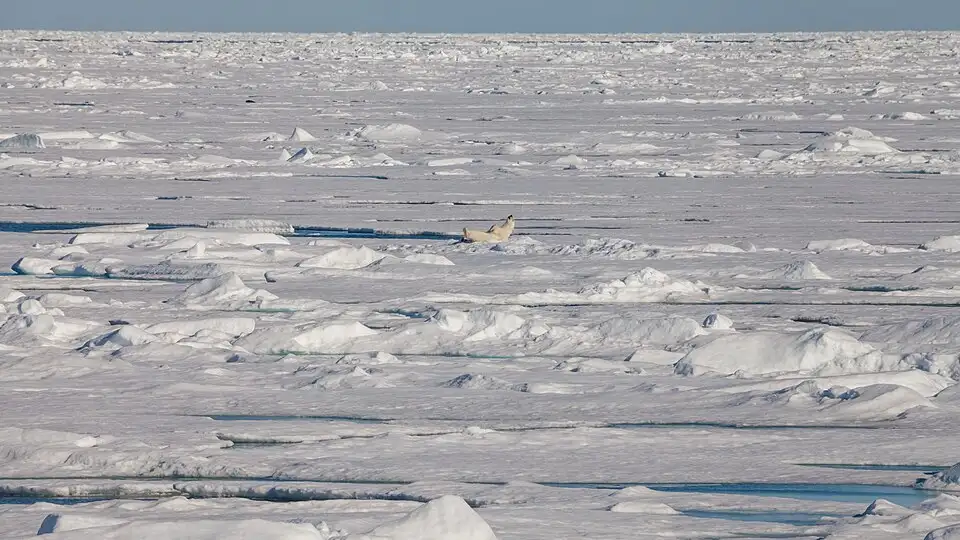
Arctic sea ice: the very system Borisov's plan aimed to melt. Image Credits: Wikimedia Commons
Ocean circulation is not a set of pipes that you can just turn around and reroute, without consequence. Changes in one current could affect other currents and ecosystems, weather patterns, and coastlines thousands of miles from the point of change. Soon, even Soviet publications published detailed critiques challenging the assumptions of Borisov. Looking back on those fears, they were quite ominous, indeed.
The ghost of geoengineering past
Borisov's proposal holds profound significance in the history of climate science because it comes nearly 20 years before the formalization of the term “geoengineering.” According to the study "Soviet and Russian perspectives on geoengineering and climate management" (2023), published in WIREs Climate Change, the term was first coined in the scientific literature between the 1970s and 1980s. However, Borisov's proposal embodied the same core idea decades earlier: deliberate human intervention in Earth's natural systems on a global scale to produce a climatic effect.
In a striking twist, Borisov's proposal now seems remarkably contemporary. Today, it is regarded as one of the earliest examples of large-scale climate engineering, reflecting the technological optimism of the Cold War era and its influence on environmental thinking long before geoengineering became a serious subject of scientific research. Today, scientists are seriously considering types of geoengineering not because they want to change the world, but because climate change has driven scientists to look at interventions that were once thought to be impossible.
In a 2026 article, PhD candidate Jelle Soons at Utrecht University investigated using climate models to find out if closing the Bering Strait could help stabilize the Atlantic Meridional Overturning Circulation (AMOC). Importantly, it wasn't a construction proposal; it was a modelling exercise, and the researchers cautioned against the dire, catastrophic ecological, geopolitical and social impacts. That distinction matters. Most contemporary climate science regards such notions as theoretical, potential worst cases, rather than as alternatives to mitigating greenhouse gas emissions.
A monument to human hubris or human imagination?
Petr M. Borisov's Arctic megadam is an interesting project in its own right. It certainly represents a period of limitless engineering confidence in which people thought they could outsmart nature with sufficient concrete, steel, and electricity. On the other hand, it is an example of making a system that requires planetary-scale operation too simple.
In fact, the Bering Strait dam was never constructed, but its history lives on as a testament to humanity's long history of playing with its surroundings as a thermostat. Whether it's visionary ambition or amazing overconfidence depends on one's point of view. One thing is for sure: if your blueprint is to alter the climate of an entire hemisphere, “measure twice, cut once” is the understatement of the century!