Phoenix is one of the hottest cities in the United States, so in 2020 the city tried a new way to cool things down. Rather than plain black asphalt, the city painted some roads with a light-colored, reflective coating, on the theory that a lighter road would keep cooler. A year-long study was performed by Arizona State University (ASU) to test this, and the Cool Pavement Pilot Program report summarizes the results.
The urgency behind Phoenix's experiment is grounded in hard numbers. An estimated 489,000 heat-related deaths occurred worldwide each year between 2000 and 2019, with much of that mortality concentrated in cities. The core problem is the urban heat island effect: construction materials commonly used in cities, such as asphalt, concrete, and dark-colored roofing, absorb and retain large amounts of solar radiation and can remain warm long after sunset, increasing nighttime temperatures and intensifying urban warming. Phoenix faces this at an extreme scale; the city regularly records some of the highest urban surface temperatures in the country, making it a logical testing ground for solutions that other heat-stressed cities are watching closely.
The physics term behind all this: Albedo
The property Phoenix is manipulating has a name: albedo, a measure of how much sunlight a surface reflects versus absorbs, expressed as a percentage or a value between 0 and 1. A perfectly black surface that absorbs all incoming light has an albedo near zero, while a perfectly white, fully reflective surface approaches one. Standard asphalt sits at the low end of that scale, which is exactly why it gets so hot: dark surfaces absorb the vast majority of solar radiation that hits them and convert it to heat, rather than bouncing it back into the sky. Raising a surface's albedo, which is what Phoenix's lighter coating does, is a well-established heat-mitigation strategy used for decades in cool roofing before cities started applying the same logic to pavement. It's a simple lever with a real physical effect, which is also why it comes with a real physical tradeoff: reflected sunlight doesn't disappear, it goes somewhere else, in this case toward the pedestrians standing nearby.
What Phoenix actually did

Live Events
The City of Phoenix Street Transportation Department teamed up with ASU’s Urban Climate Research Center. In the period between July 15, 2020 and July 14, 2021, they used the coating for roads in various neighborhoods and then compared them with uncoated asphalt in the surrounding areas. The 2020 rollout was modest in scale, covering roughly 36 miles of neighborhood streets and one public parking lot. Phoenix has since expanded the treatment considerably, coating more than 140 miles of roadway citywide, according to the City of Phoenix's cool pavement program page. That growth hasn't been entirely smooth, though: the city temporarily paused new applications after running into problems with one coating supplier, before resuming the rollout with a different product, according to local news coverage, a sign that officials are still refining the technique years after the original pilot wrapped up.
At the surface level, the coating did its job. The ASU report says treated roads were 2.4 degrees Fahrenheit cooler at sunrise, 12 degrees cooler at noon, and 10.5 degrees cooler in the afternoon compared to conventional, aged asphalt. Even the ground beneath the surface was an average of 4.8°F cooler, which matters in a city where roads can get hot enough to burn skin.
The catch nobody expected
A cooler road doesn’t necessarily mean a cooler walk. The reflective coating reflects more sunlight than it absorbs, which helps keep the surface cooler. However, the reflected rays are then directed back at the pedestrians walking close to the surface. The research found that mean radiant temperature, a measure of the thermal radiation absorbed by the body outdoors, rose by an average of 5.5°F on the coated streets. The finding is consistent with other research. In a separate study titled ‘Solar reflective pavements: A policy panacea to heat mitigation?’ published in Environmental Research Letters, ASU researcher Ariane Middel and colleagues tested a similar coating in two Los Angeles neighborhoods. It noted surface temperatures dropped 4°F to 6°F, but mean radiant temperature over the pavement rose about 4°C (7.2°F) at midday, while air temperature fell only slightly.
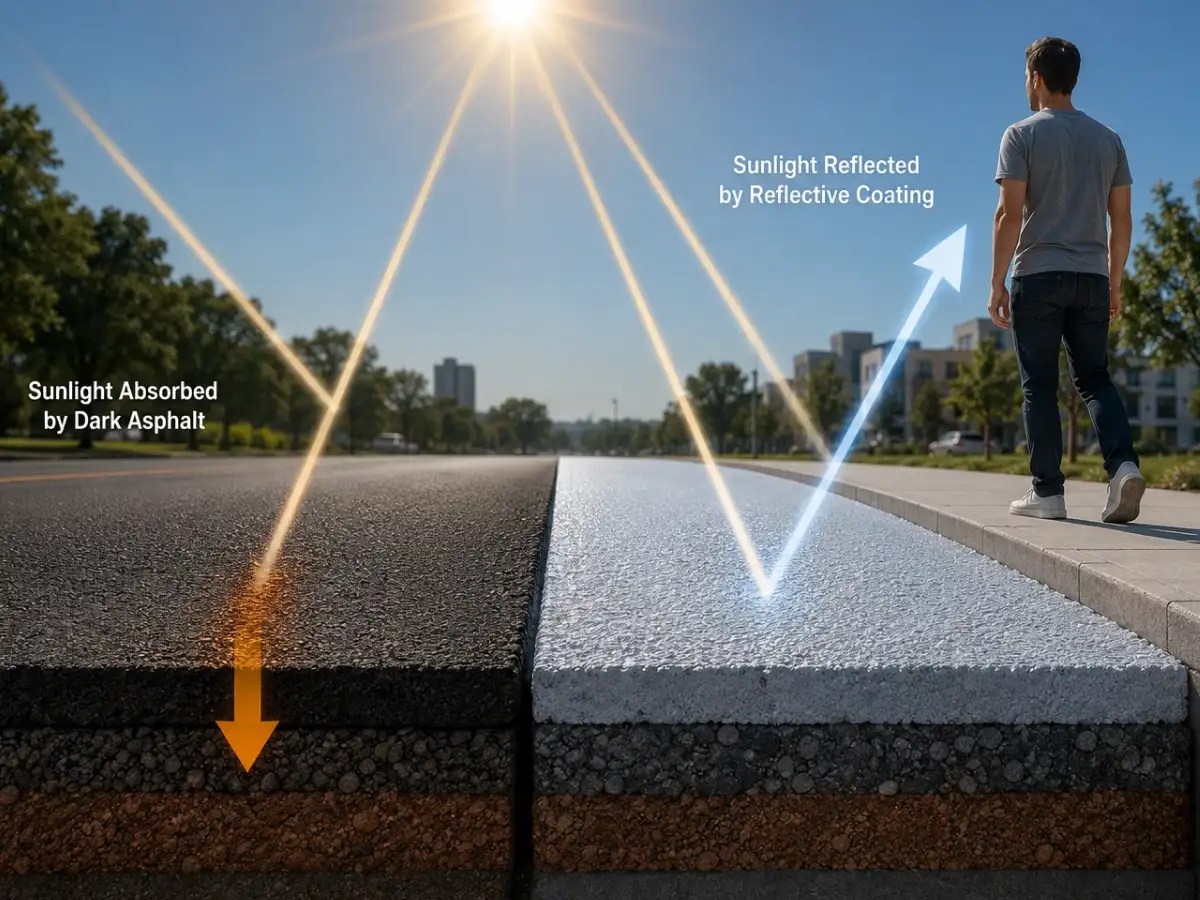
Why a cooler road doesn't always mean a cooler walk: reflected sunlight has to land somewhere (representative image). Image Credits: ChatGPT
The coating also wears off over time. It was brightest just after it was applied and reflected about 33 to 38 percent of sun radiation, but after ten months of exposure, this figure was down to 19 to 30 percent, due to accumulated dirt and general wear. A typical asphalt surface reflects about 12 percent of sunlight. Even a faded coating is better than plain asphalt, but the margin is smaller.
A longer-lasting second version, and a bigger-picture study
Based on these results, Phoenix and ASU tested a new version of the pavement coating in seven additional neighborhoods from May 31 to June 6, 2022, and released their findings in October 2024. Cool pavement technology, according to this phase of the project, is capable of reducing summertime daytime temperatures of pavements by as much as 12°F compared to old pavements, saving money on road maintenance, and having some effect on air temperature.
In a subsequent review of Phoenix's early data, published in Nature Communications, researchers looked at the effect of reflective pavement on surface, air, and radiant heat combined, and found that reflective pavement technology does not work everywhere; it works best on open residential roads and parking lots with no shade and low pedestrian traffic, and should not be applied in places where people congregate at noon, such as playgrounds and plazas.
Cities are still figuring this out
Phoenix is not alone. Other Sun Belt cities, including San Antonio, are also testing cool pavement, according to a report by the American Society of Civil Engineers. Experts quoted in the report admit that cities are still unsure whether it actually improves pedestrian comfort. Some have put programs on hold to study the trade-offs first. The ASCE report says San Antonio tested cool pavement on one street in 2021, then expanded to selected streets in 10 neighborhoods after the city council approved $1 million in 2023. Researchers found the most effective coating cut afternoon surface temperature by an average of 3.58 degrees, with the gap widening to 18 degrees against freshly paved asphalt, a darker, hotter surface than the aged asphalt used as the baseline in Phoenix's own study.
The interest extends well beyond the Sun Belt. A nonprofit called the Global Cool Cities Alliance established the Cool Roadways Partnership to allow member jurisdictions to compare cool pavement information as sealant mixtures and colors are tested, with 28 jurisdictions in the United States participating, 13 of which are planning or actively conducting cool pavement pilot projects. Cool pavement has also been tested in Athens, Greece, where researchers found it reduced near-surface air temperatures by up to 2 degrees Celsius in some locations, and pilots have been conducted in Makkah and Doha, cities that face some of the most extreme heat conditions on Earth. The challenge is consistent across all of them: surface temperature reduction is measurable and reliable, but the pedestrian comfort question remains unresolved.
Shade solves a different problem than reflective coating does
Tree canopy works through an entirely different mechanism than reflective pavement, which is part of why researchers increasingly treat it as a complement rather than a substitute. Trees cool the air directly through evapotranspiration, the process of releasing water vapor through their leaves, which draws heat out of the surrounding air rather than just redirecting sunlight elsewhere. A shaded street also blocks solar radiation from reaching the pavement in the first place, sidestepping the reflection problem entirely, since there's no direct sunlight hitting the surface to bounce back at pedestrians. Urban forestry researchers have also documented that tree canopy coverage in US cities is often unevenly distributed, with lower-income neighborhoods frequently having significantly less shade than wealthier areas nearby, a disparity linked to historical patterns of urban development and investment. That unevenness matters for heat policy specifically because the neighborhoods with the least tree cover are often the same ones facing the highest heat exposure, meaning pavement coatings and shade investment may need to be targeted differently depending on which problem, surface temperature or actual pedestrian relief, a given street most needs solved.
The takeaway
Reflective coatings and cool roofs are already included in several heat action plans around the world, and hot cities around the globe are watching Phoenix closely. Phoenix’s experience is a good reminder before any city paints its roads white or silver: cooling a road surface and cooling the person walking on it are two different problems, and fixing one doesn’t automatically fix the other. The cool pavement technique is neither a gimmick nor a failure. It reduces the surface and sub-surface temperatures, which helps the road last longer. However, if the goal is pedestrian comfort, cities may need to consider shade, tree cover, and where these coatings are used, not just the color of the coating.