How this forgotten result code can redefine the Internet.
It is impossible to overstate the importance of Open Source Software in our lives today. Open source initiatives like Unix, Linux, *BSD power somewhere north of 75% to 90% of the net connected servers worldwide, same goes for the vast majority of web servers (Apache, nginx), mail servers (IMAP, Postfix, Dovecot, Exim), databases (MariaDB, MySQL), all OSX workstations and laptops run BSD under the hood, the list goes on.
Until recently, the economics of working and contributing to open source endeavours were such that a successful project would, or at least could, lead to economic success as well, through add-on services, professional enhancements, consulting and licensing.
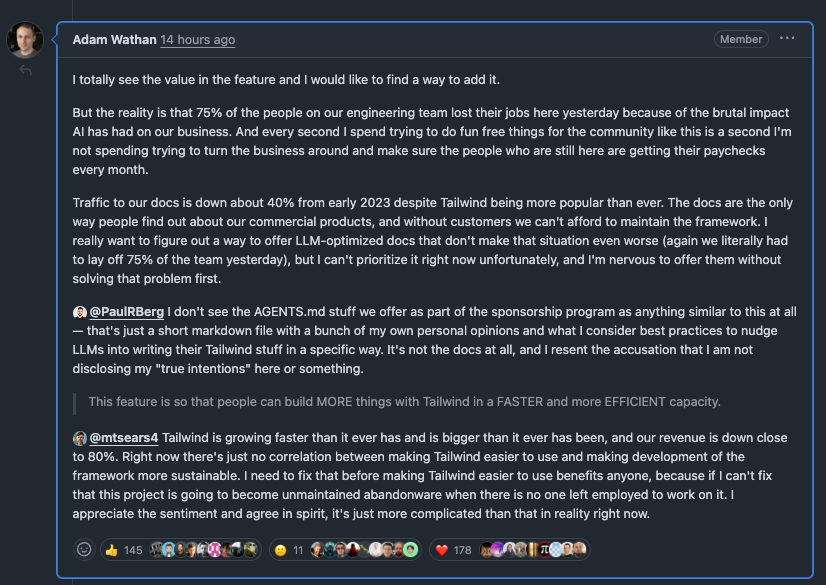
With the explosion of AI and disruptions coming in its wake, all that seems to be under threat of annihilation, as LLMs, AIs and “vibe coding” don’t outright replace open source developers, but they are abstracting them away – burying their visibility, and at least in the case of Tailwind CSS – an extraordinarily successful open source css framework, whose founder recently announced he had to effectively lay off his entire team as a result of the knock-on effects of AI:
Search Engine Optimization (SEO) used to be a game of “reading the mind of Google”, and there was an entire ecosystem of what were called “content websites”, some derived their very existence to being able to rank first for specific, super-niche questions and cocooning the answers within a gauntlet of pay-per-click ads and pop-ups.
Projects like Tailwind also relied on their preeminence in search results owing to their authorship and expertise in their IP.
Now all that has changed. People are just asking AI, or else the search engines are asking for you. No more getting all the clicks for “how many fluid ounces in a litre?” it’s about jockeying for search engine placement so that LLMs will include your pages in their responses.

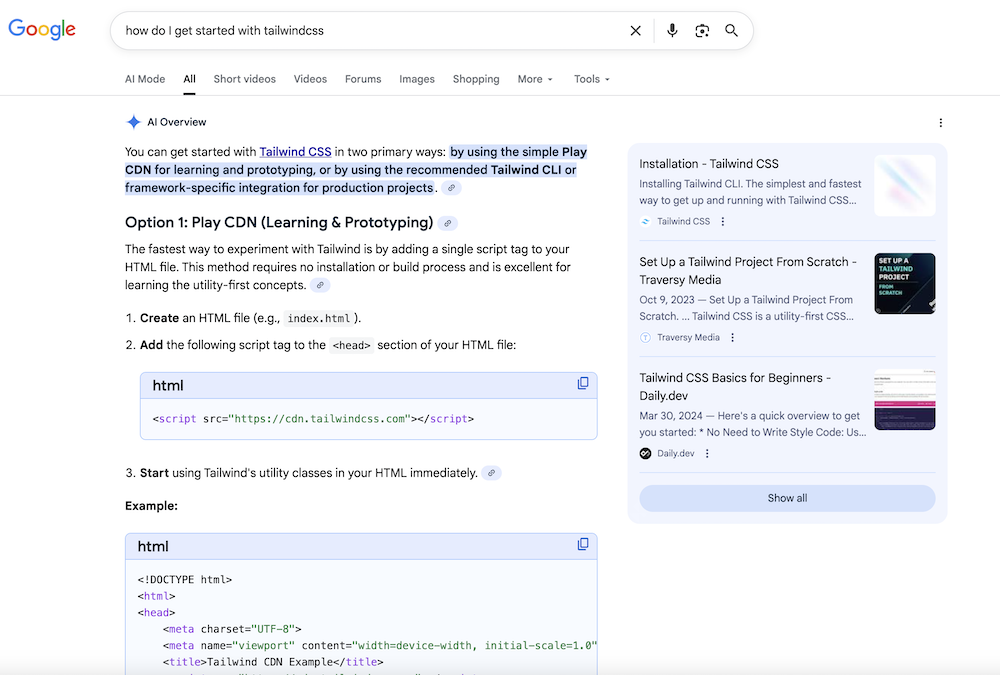
And that also means, when people ask about documentation on things like Tailwind CSS, they just get back an AI-assisted response and they never land on Tailwind’s website:
Around the same time that the Tailwind CSS news began circulating, I saw this chart about the fate of Stackoverflow, which was acquired for $1.8 billion just a little over a year before chatGPT broke onto the scene…
StackOverflow graph of questions asked per month.
Holy shit. pic.twitter.com/Iver1tyOKH
— Sam Rose (@samwhoo) January 3, 2026
Oof.
We’re seeing initiatives like llms.txt and which seek to guide LLMs and AI agents on how to index a website, this issue is the crux behind Tailwind’s dilemma.
Are there ways for developers and site owners to adapt and to pivot to this emerging reality, and do so in a way where they can prosper instead of merely fighting for survival?
It’s been a little over a year since I had my own existential epiphany: the realization that in the future, more of our clients would be AI agents than actual people. That still dogs me as we see the proliferation of MCP endpoints and A2A deployments, while easyDNS grinds away at rebuilding our entire UX… which may get used by fewer and fewer people over time.
The Holy Grail of the Internet Economy: Micropayments
Since the very beginning micropayments were seen as a way to open up the internet economy and bring about a Golden Age for creators, developers and all manner of independent workers and small businesses – the idea that people would pay a small amount to read a high signal article, or to pay for a limited set of executions of some micro-service, or to buy or lease pieces of code.
The only problem was that payment rails didn’t exist to facilitate any of this. Minimum payment thresholds, not to mention processor fees on credit cards precluded it, and early iterations of crypto (Bitcoin, Ethereum) provided near-infinitely divisible denominations, but were too slow.
What that left us with historically, were two alternative monetization paths that largely defined the entire online economy:
- Subscriptions : where everything was geared toward continuity services. Remember those pieces of software you bought once upon a time and installed on your laptop? Those are all now monthly subscriptions in the cloud. Instead of paying one or five cents to read a high quality think piece on Substack, you subscribe monthly. The list goes on.
- Ad Driven / Pay-Per Click: where content or services are free, and networks like Google Adsense drive the monetization model for huge chunks of the internet.This has had all kinds of repercussions – which we can’t do justice to here, but Jaron Lanier has written on this extensively (I reviewed his “10 reasons to delete your social media accounts previously). Suffice it to say, this has given rise to clickbait culture and everything associated with it.
If only there was some way where creators and coders could:
- Get paid in small increments, but at scale, for use of their IP, services or infrastructure.
- Not have to worry about whether the consumer was an LLM or not.
- Be rewarded for success in having search engines and agents seek out their work, instead of penalized.
x402 enters the chat
402 is the HTTP response code for “Payment Required” – it’s been part of the original specification since the very beginning, and was created more or less as a placeholder, since internet payments were non-existent.
In September 2025, we had what I think will be seen as a major development when Coinbase and Cloudflare announced the launch of x402 Foundation: The x402 protocol seeks to become a neutral, open standard for embedding agentic payments directly into the HTTP protocol.
It’s early days, but there is already a measurable ecosystem forming around this initiative – a lot of the early projects were things like memecoins and the like, but I do think this is showing us an early glimpse into where the puck is going:
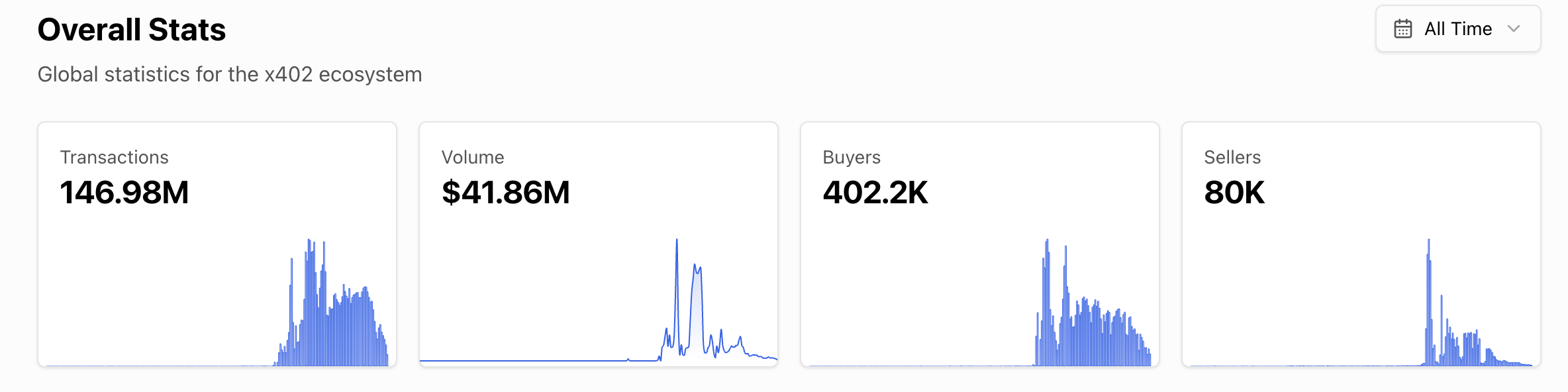
We see from the numbers that our average transaction size pencils out to around 28 cents (~ $41M by 146M transactions).
Right now this all happens on stablecoins like USDC, Tether running on L1’s like Ethereum and Solana, but the protocol is extensible, this could theoretically happen over Lightning on Bitcoin, and any other decentralized Layer 1 protocol.
And this is where I see the opportunity to make micropayments a foundational layer to the next iteration of the network economy.
Imagine if an agentic AI paid Tailwind CSS a few pennies or even a fraction of one for accessing LLM-optimized documentation or snippets of code?
There may be a non-trivial zero-to-one problem with “training” the bots and the people running them to adapt to micropayments, but I think it is already happening.
Anecdotally, I was playing with Dexter, an AI overlay for financial modellng, this past week and I wanted to grab screen captures of it, but under the hood I noticed that all of these interactions with the backend APIs and MCP servers I had configured were negotiating very quick microtransactions via x402.
I’ve been building Dexter for 2 months now.
It’s like Claude Code, but for finance.
What Dexter can do:
• find undervalued stocks
• analyze them in detail
• build investment thesisAll of the code is open source.
Bonus: Dexter can also run on local LLMs. pic.twitter.com/rngoHm5w0G
— virat (@virattt) January 9, 2026
For my part, because I’m a DNS guy, so everything on earth can either be signalled, or discovered, via DNS – I submitted a draft proposal for x402 endpoint discovery via (wait for it)… DNS TXT records to the IETF portal.
This is happening – and I think the more open source devs become aware of it, they’ll see the opportunity that micropayments finally arriving in a credible sense gives the entire ecosystem.