
Sun news December 31 (UTC): Auroras could kick off the New Year!
Those in northerly latitudes could see a magical start to 2026, with auroras in the forecast! That’s because a coronal hole is starting to send its high speed solar wind our way, and a glancing coronal mass ejection (CME) impact is expected late on December 31 into early January 1. These effects will open the door for up to G2 (moderate) geomagnetic storms as the new year begins. That could mean auroras visible as soon as tonight – although more likely tomorrow evening – from locations as far south as northern Scotland, Iceland, and the northernmost U.S. states. Clear skies!
Past 24 hours: The details
(11 UTC December 30 – 11 UTC December 31)
-
- Flare activity: Solar activity remained at low levels, with 13 C-class flares observed in the period.
- Strongest flare: C6.0 from AR4325 at 1:23 UTC on December 31, 2025.
- Lead flare producer: AR4325 was the top flare producer, responsible for the C6.0 flare and numerous additional C-class flares.
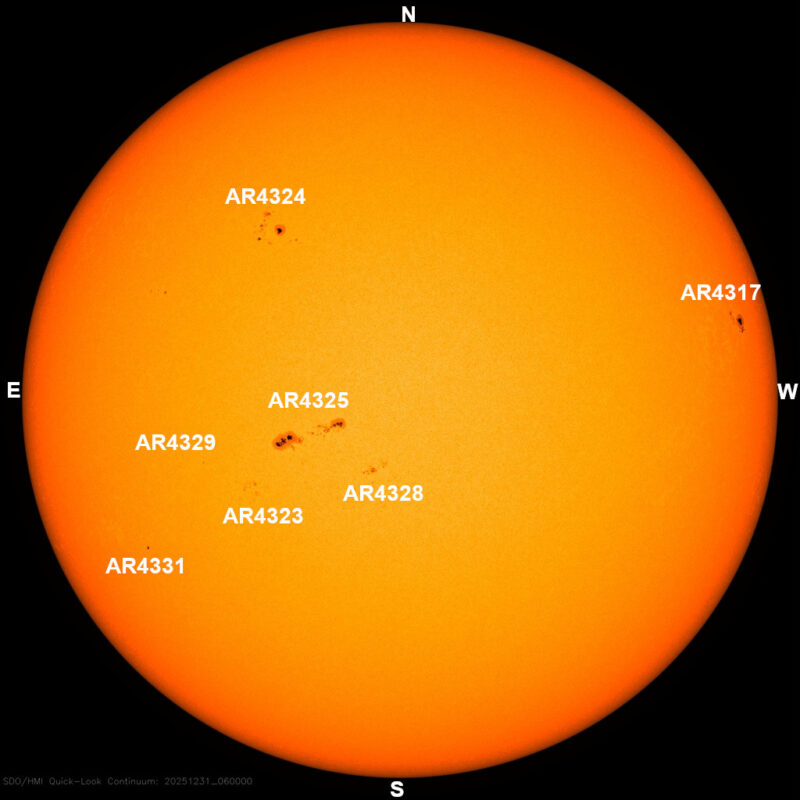
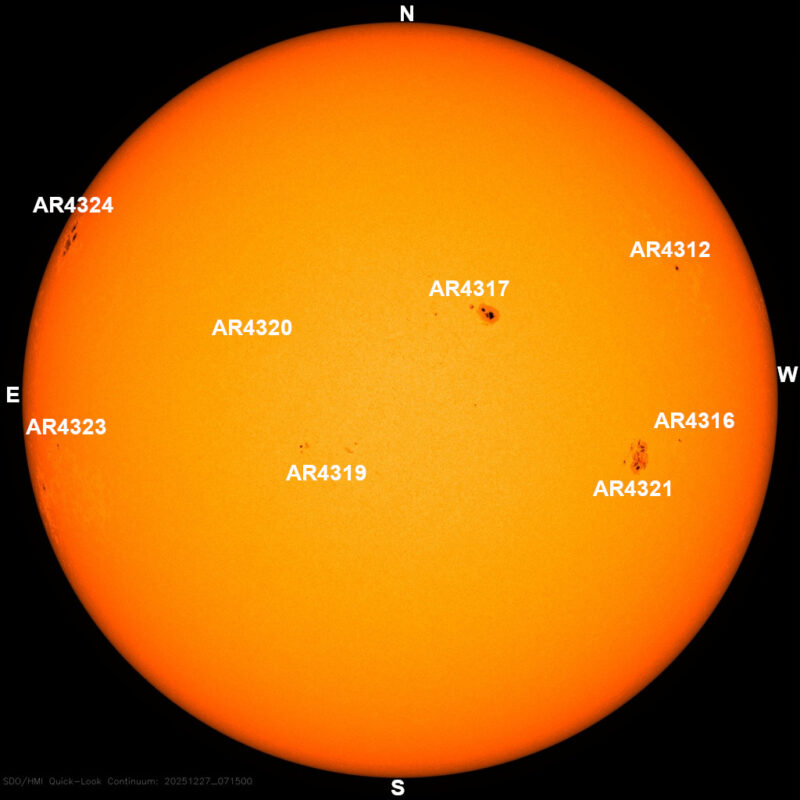
- Sunspot regions: The Earth-facing disk shows several numbered active regions, though none have produced strong new eruptions in the last 24 hours. These regions continue to be tracked for potential moderate activity.
- AR4321 (beta-delta), now near the southwest limb, produced one C-class flare.
- AR4324 (beta-gamma) remained a key source of activity and continues to draw attention in the northeast quadrant.
- AR4325 (beta-delta) lost its gamma configuration but remains a prime candidate for more M and even X flares.
- AR4317 (beta-delta) re-gained additional complexity but did not produce flares during this period. It will soon depart to the far side.
- AR4328 (beta), AR4329 (beta), AR4330 (beta), and AR4331 (alpha) have not yet produced flares.
- Blasts from the sun? No new clearly Earth-directed CMEs were launched during this 24-hour window, but an earlier event remains en route. A partial-halo coronal mass ejection (CME) that left the sun near 23:00 UTC on December 28, 2025 has been modeled, with a glancing impact at Earth expected late on New Year’s Eve.
- Solar wind: Over the past 24 hours, solar wind speeds have fluctuated in the moderate range, generally between about 420 km/s and 450 km/s as Earth’s environment adjusts ahead of the expected CME arrival. Recent measurements show the total interplanetary magnetic field (IMF) strength moderately elevated near ~7 nT, with the north–south component (Bz) varying between northward (~+3 nT) and southward (~–3 nT) orientations.
- Earth’s magnetic field: Earth’s magnetic field ranged from quiet-to-unsettled levels during the period, with no significant storms yet.
- Flare activity: Solar activity remained at low levels, with 13 C-class flares observed in the period.
What’s ahead? Sun–Earth forecast
-
- Flare activity forecast: Solar activity is expected to remain low to moderate over the next three days. Additional M-class flares remain possible (60% chance) from magnetically complex regions still on the Earth-facing disk, particularly AR4325. The chance of an isolated X-class flare remains at 25%.
- Geomagnetic activity forecast:
- December 31: Geomagnetic conditions are forecast to range from quiet to active, as Earth increasingly connects to the coronal hole’s high speed solar wind stream. The expected late-day arrival (around 20:43–22:04 UTC) of the December 28 CME could begin to disturb the solar wind near Earth by the end of the UTC day, but the main geomagnetic response is more likely to manifest on January 1. Brief active intervals (Kp up to 4) are possible late in the period, with aurora mainly over Iceland, northern Scandinavia, and high-latitude Canada and Alaska.
- January 1, 2026: Following the CME’s arrival, forecasters call for up to G2 (moderate) geomagnetic storm levels. Auroras could be visible from cities like Seattle, Minneapolis, and Edinburgh, and potentially as far south as Toronto, Chicago, northern England, Hobart (Tasmania), and New Zealand’s South Island during stronger intervals, especially around local midnight.
- January 2, 2026: As the CME influences wane but high-speed solar wind persists, geomagnetic activity is expected to ease somewhat but remain elevated, with a slight chance of an isolated G1 (minor) storm period if Bz turns strongly southward. Auroras may briefly dip into northern Scotland and similar latitudes if the Kp reaches 4–5.
Sun news December 30 (UTC): 4 more blasts of sun-stuff erupt from our star

Over the past 24 hours, 4 eruptions on our star fired blasts of sun-stuff – coronal mass ejections, or CMEs – into space. Specialists are modeling these eruptions to see if any could be on course for Earth. Meanwhile, forecasters continue to monitor an Earth-directed CME launched on Sunday. Experts expect this CME to arrive late on December 31. If its arrival coincides with a strengthening coronal hole’s high-speed solar wind stream, conditions could escalate to as high as G3 (strong) geomagnetic storms. And that could mean New Year’s Eve auroras!
Past 24 hours: The details
(11 UTC December 29 – 11 UTC December 30)
-
-
- Flare activity: Solar activity dropped to low levels, with only C-class flares recorded. We observed 14 C-class flares during the 24-hour window. The strongest event, a C6.5 flare, erupted from AR4324 and peaked at 20:40 UTC on December 29. Other notable flares included a C5.1 at 6:45 UTC and a C4.9 at 0:27 UTC from AR4325 on December 30, along with a C4.6 flare from AR4321 at 8:43 UTC on December 30. AR4325 and AR4324 led flare production during the period, each generating six C-class flares.
- Sunspot regions: The Earth-facing solar disk displayed nine numbered active regions, several with increasing magnetic complexity and elevated flare potential.
- AR4321 (beta-delta), now near the southwest limb, produced two C-class flares.
- AR4324 (beta-gamma) remained a key source of activity and continues to draw attention in the northeast quadrant.
- AR4325 (beta-gamma-delta) underwent rapid growth and now hosts the most complex magnetic structure on the disk, making it a prime candidate for more M and even X flares.
- AR4317 (beta-gamma) gained additional complexity but did not produce flares during this period.
- Four newly numbered regions – AR4328 (beta), AR4329 (beta), AR4330 (beta), and AR4331 (alpha) – rotated into view and have not yet produced flares.
- Blasts from the sun? Four eruptions during the period produced potentially geoeffective (Earth-affecting) CMEs and are currently under analysis. The first occurred around 15 UTC on December 29 near active regions in the southeast. A second eruption from the northeast quadrant around 18 UTC accompanied a C3.3 flare from AR4324 that peaked at 18:27 UTC. A third eruption followed from the southwest near AR4321 around 19:39 UTC. The fourth occurred in the northeast at 7:12 UTC this morning. Analysts continue to assess all of these events.
- Solar wind: Solar wind speeds gradually declined from about 420 km/s to near 400 km/s for much of the period, before rising slightly back to around 420 km/s by 10 UTC on December 30. The total interplanetary magnetic field (IMF) strength remained weak near 2.7 nT. The north–south component (Bz) fluctuated between about +5 nT early in the period and -5 nT later, settling near -1 nT by 10 UTC.
- Earth’s magnetic field: Earth’s magnetic field stayed quiet to unsettled, with Kp values ranging from 0 to 3. At the time of this report (11 UTC on December 30), the Kp measured 2.
-
Sun news December 29 (UTC): Restless sun fires 4 M flares. Sun-stuff incoming!
A strong M4.2 (moderate) flare around 22 UTC last night capped a day of restless activity from our star, which produced a total of 4 M flares and 14 Cs (common). The M4.2 flare, fired by sunspot region AR4317, sent a burst of solar material and magnetic fields – a coronal mass ejection (CME) – toward Earth. Experts expect this blast to reach us late on December 31. If the impact combines with an incoming coronal hole’s high-speed solar wind stream, it could bring up to G3 (strong) geomagnetic storms. Could we see New Year’s Eve auroras? Stay tuned!
Past 24 hours: The details
(11 UTC December 28 – 11 UTC December 29)
-
-
- Flare activity: Solar activity increased to moderate-to-high, with 18 flares (4 M-class, 14 C-class) observed in a 24-hour window.
- Strongest flare: An M4.2 flare from AR4317 peaked at 22:01 UTC on December 28. It triggered an R1 (minor) radio blackout over the sunlit Pacific Ocean.
- Other M-class flares:
- M1.3 from AR4325 at 21:03 UTC on December 28 (R1, minor high-frequency communication impacts over the Pacific Ocean).
- M2.2 from AR4324 at 23:57 UTC on December 28 (R1, minor radio blackout over the central Pacific).
- M1.0 from AR4325 at 6:34 UTC on December 29 (R1, minor radio impacts over the Indian Ocean and parts of eastern Africa and western Australia).
- Lead flare producers:
- AR4325 was the most prolific sunspot region. It generated a sequence of C- and M-class flares as it continued to grow and develop more complex magnetic structure.
- AR4324 contributed multiple C flares and one M2.2 flare.
- AR4317 produced the period’s strongest M4.2 flare but otherwise showed fading trailing spots and limited additional activity.
- Sunspot regions: The Earth-facing solar disk displayed 11 numbered active regions, with several magnetically complex groups maintaining elevated flare potential.
- AR4321 (beta-delta) remained the largest region on the disk. It became more compact in its interior with increasing intermediate spots, preserving its delta configuration and thus significant flare potential, although during this period it produced only C-class activity.
- AR4324 (beta-gamma) grew in size and spot count. Its mixed-polarity structure supported frequent C-class flares and the M2.2 flare late on December 28, marking it as one of the key sources for ongoing activity.
- AR4325 (beta) is a rapidly developing bipolar group. Over the past day it grew in area and spot number, with more complex magnetic structure emerging in intermediate spots.
- AR4317 (beta) hosted the M4.2 flare but showed fading trailing spots afterward, trending toward a simpler, more unipolar configuration.
- AR4326 and AR4327 (beta) are newly numbered small bipolar regions, contributing little flare activity so far.
- Additional smaller regions were generally simple alpha or beta groups showing minor evolution and mostly low-level C-class or sub-C activity. Overall, the presence of at least one beta-gamma-delta region (AR4321) plus growing bipolar groups (AR4324, AR4325) means a sustained chance for further M-class flaring.
- Blasts from the sun? One newly modeled, potentially geoeffective CME came from the M4.2 flare. This could cause G1–G2 (minor to moderate) geomagnetic storms if the CME’s magnetic field turns sufficiently southward. This could mean auroras extending as far as Toronto, Chicago, Boston, northern England and southern New Zealand.
- Solar wind: The solar wind gradually relaxed toward near-background conditions as the influence of a previous high-speed stream waned. Speeds at Earth generally held between about 450–500 km/s, with a slow and somewhat erratic downward trend. The total interplanetary magnetic field (IMF) strength (Bt) remained weak-to-moderate, mostly around 4–7 nT. The Bz component fluctuated between about +4 and -5 nT, spending significant time near neutral with only brief southward excursions.
- Earth’s magnetic field: Earth’s magnetic field remained mostly quiet, with only brief unsettled intervals and no storm-level activity during the period. Global indices from NOAA show conditions ranging from quiet to unsettled, with Kp values generally at 1–3 and no three-hour periods reaching the G1 (minor) geomagnetic storm threshold of Kp 5. At the report time (11 UTC on 29 December), Kp is near quiet levels.
- Flare activity: Solar activity increased to moderate-to-high, with 18 flares (4 M-class, 14 C-class) observed in a 24-hour window.
-
What’s ahead? Sun–Earth forecast
-
-
- Flare activity forecast: Moderate levels of solar activity are expected to continue over the next three days, with a sustained chance of further M-class (moderate) flares. There is roughly a 45% daily chance of M-class flares, with a slight (~10% or less) chance of an X-class event. The main source regions are the magnetically complex AR4321 (beta-delta), the growing mixed-polarity regions AR4324 and AR4325, and, to a lesser extent, AR4317.
- Geomagnetic activity forecast:
- December 29: Geomagnetic conditions are expected to remain mostly quiet to unsettled as Earth continues to drift out of the influence of the prior high-speed stream. NOAA forecasts predominantly quiet levels, with only isolated unsettled periods possible. Under this regime, auroras should remain largely confined to the usual auroral oval.
- December 30: Quiet-to-unsettled conditions are again favored, with perhaps a slight chance of brief active intervals (Kp 4) if the next coronal hole high-speed stream connects a bit earlier than expected.
- December 31: By New Year’s Eve, conditions become more interesting. A recurrent coronal hole is expected to send a stronger high-speed stream. Modeling predicts the arrival of the coronal mass ejection (CME) associated with the December 28 M4.2 flare late in the day (around 20:43–22:04 UTC). The combined influence of the high-speed stream and CME could raise Kp into the 5–6 range, corresponding to G1–G2 (minor to moderate) geomagnetic storms. Under Kp 5–6, auroras may become visible from Seattle, Minneapolis and the Scottish Highlands, and could reach as far south as Toronto, Chicago, Boston, northern England and the South Island of New Zealand if the CME’s magnetic field turns strongly southward. There is also a very slight chance of isolated G3 (strong) intervals if both the CME and high-speed stream align favorably, which would push potential aurora visibility toward New York, London and northern France, but this is currently a low-confidence scenario.
-

The sun in recent days
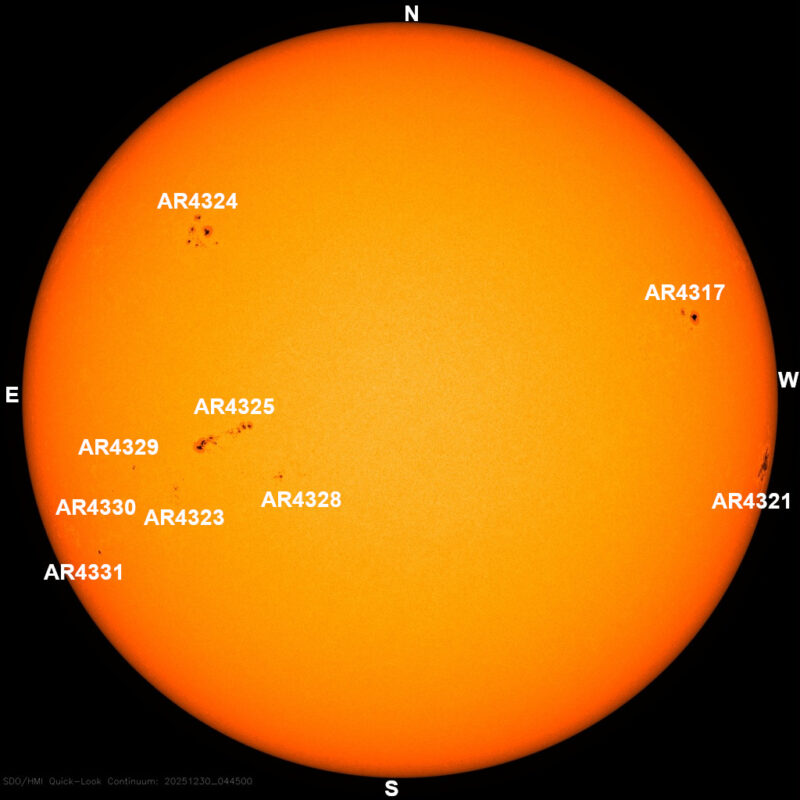
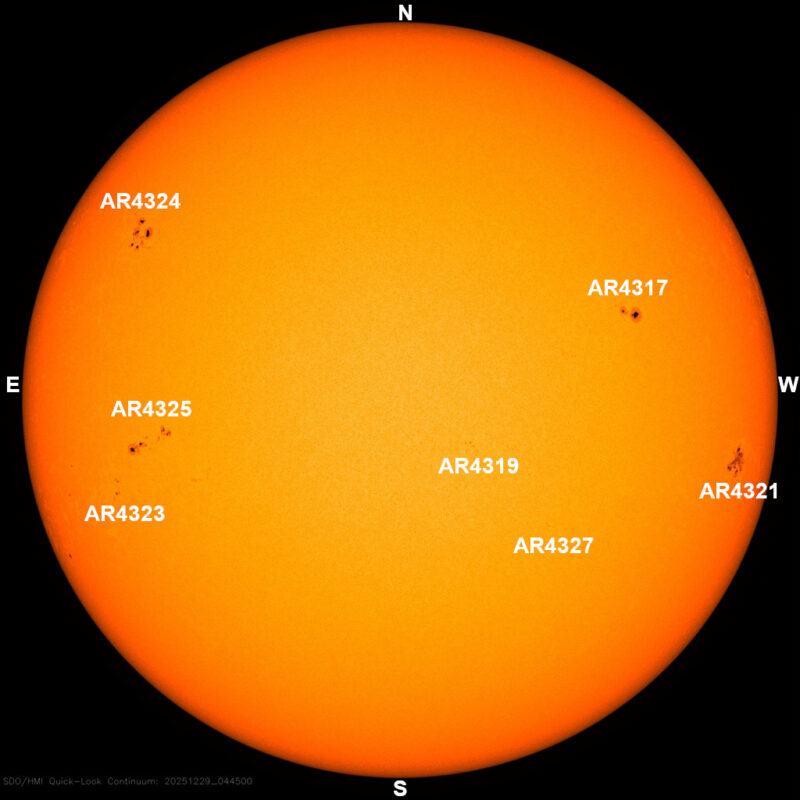
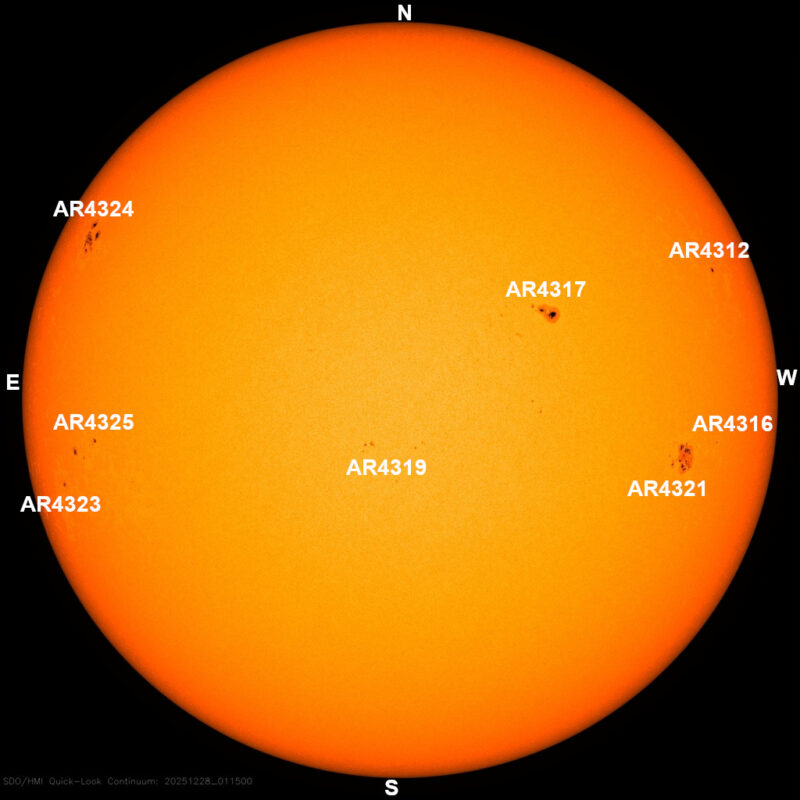
Earlier sun images
Sun images from our community
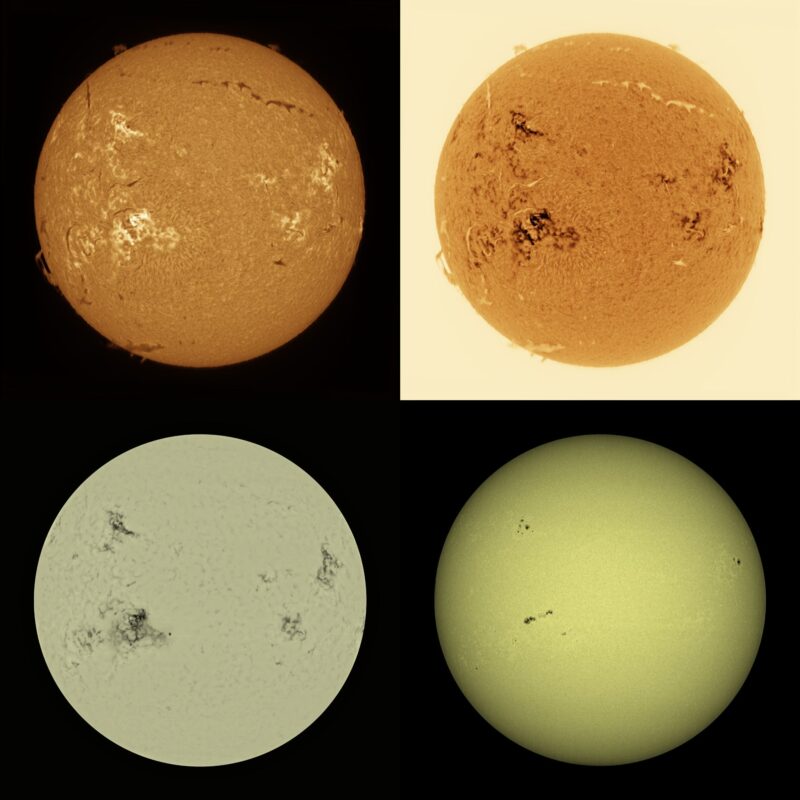
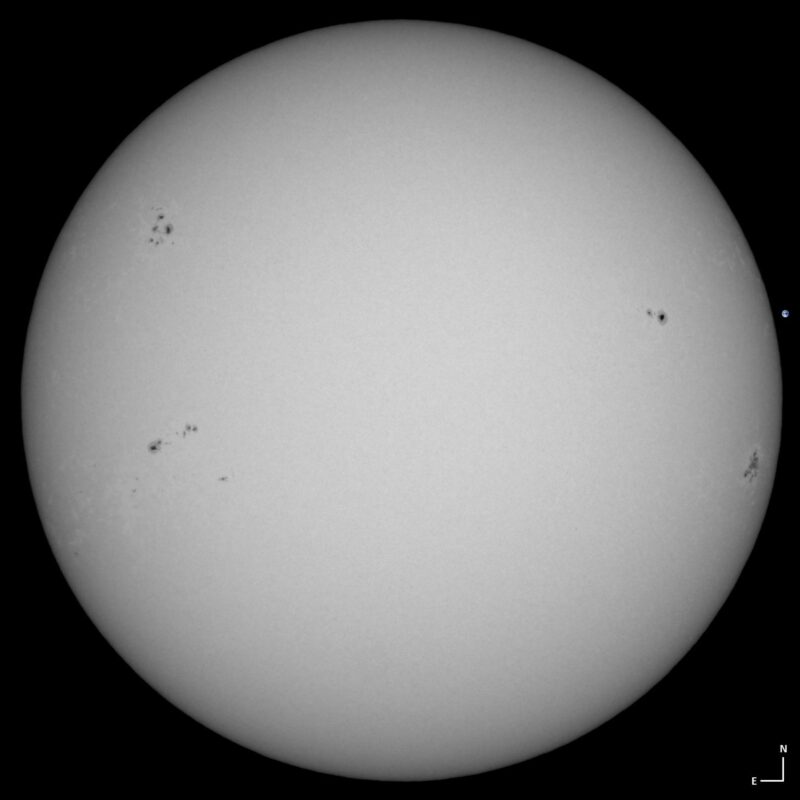
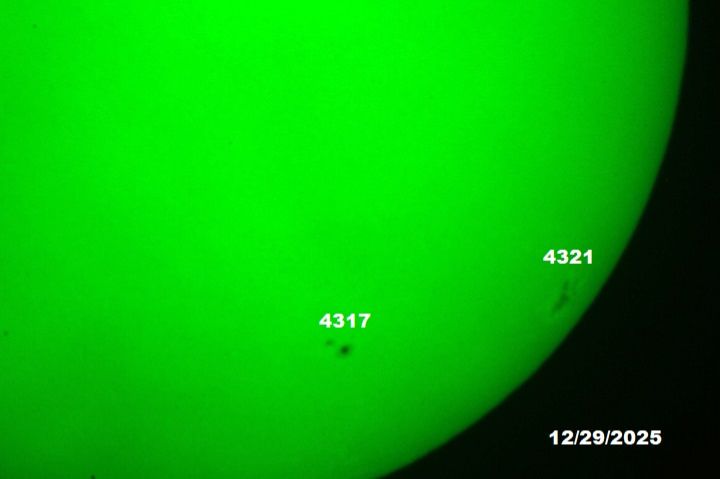
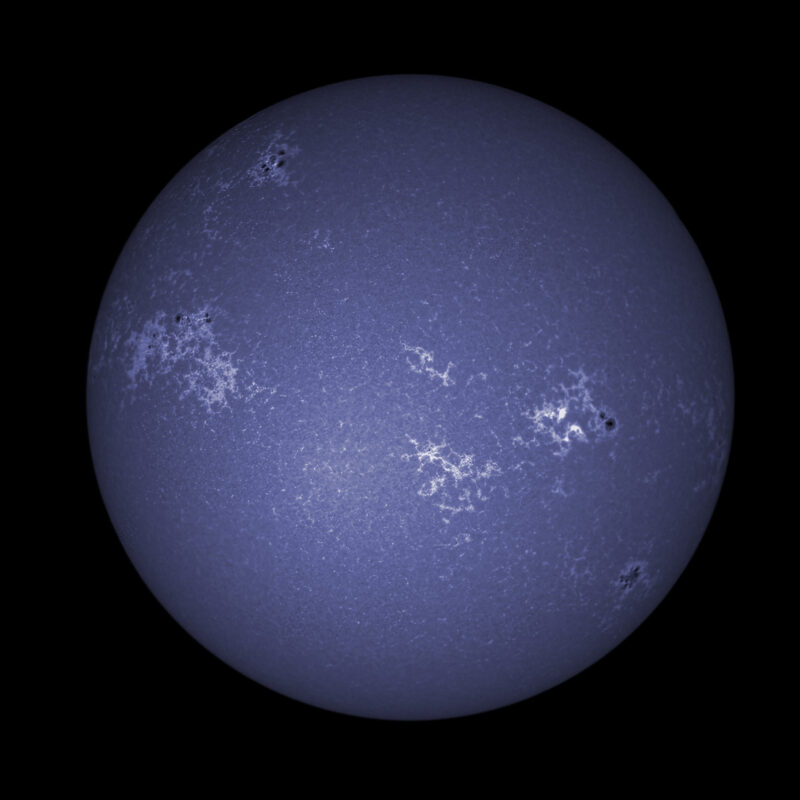
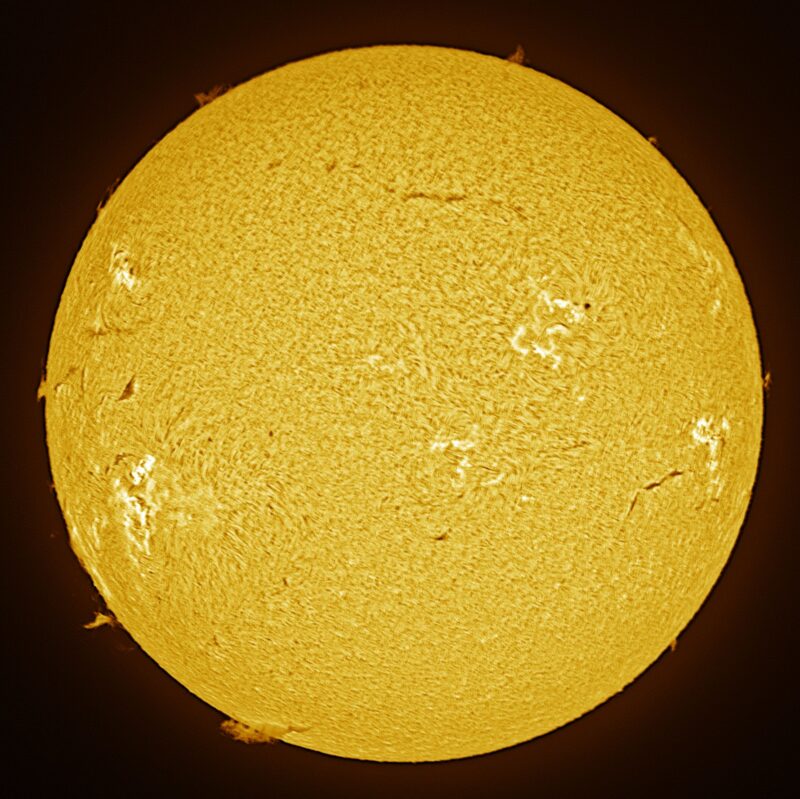
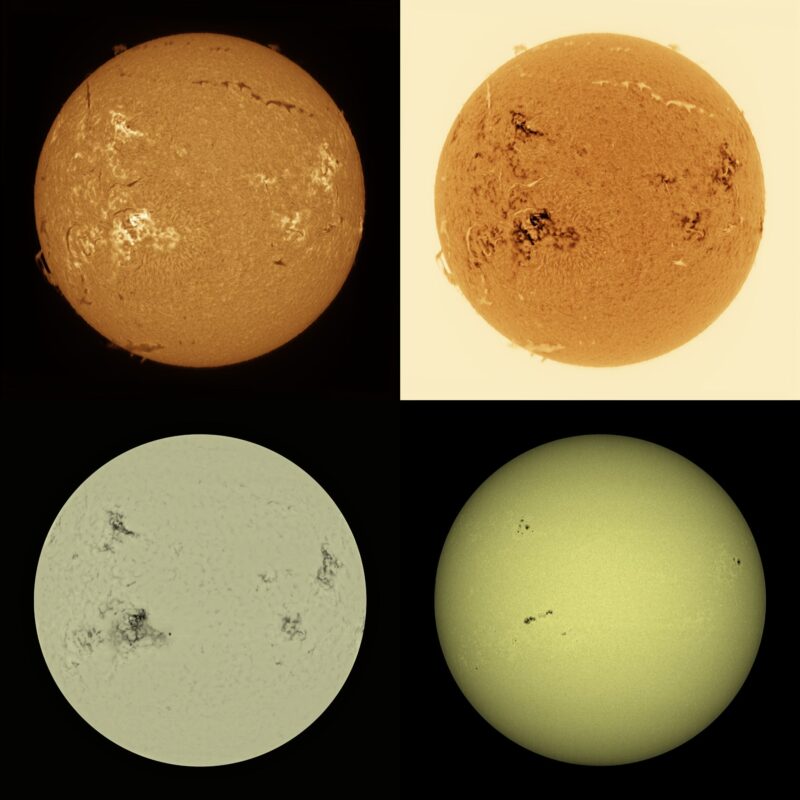
We sometimes feature sun images obtained using hydrogen-alpha filters. Read why.
Bottom line: Sun news December 31, 2025: The New Year might kick off with auroras, as a CME and a stream of fast solar wind approach Earth.
C. Alex Young
About the Author:
C. Alex Young is a solar astrophysicist studying the Sun and space weather. Alex is passionate about sharing science with diverse audiences. This led him to start The Sun Today with his designer wife, Linda. First through Facebook and Twitter then adding an extensive website thesuntoday.org, the two work together to engage the public about the Sun and its role in our solar system. Alex led national engagement efforts for the 2017 total solar eclipse. He is the Associate Director for Science in the Heliophysics Science Division at NASA Goddard Space Flight Center.
About the Author:
Raúl Cortés studied engineering at the Autonomous University of Nuevo León in Monterrey, Mexico, obtained a scholarship to continue his studies in Japan and after returning to Monterrey he got credits on MBA from the Graduate School of Mechanical and Electrical Engineering Faculty. He became a teacher at the University UANL teaching Math and Physics and dedicated the rest of his professional career to serve in engineering areas for USA, Japan and Germany based corporations. His passion for the skies go back to when he was a child, always intrigued about the stars and constellations and reading and researching about the matter. From 2010 on, he dedicated his attention to photographing the stars, constellations, the moon and the sun. Raúl's work on his photography has been published and posted on the ESC as well as in other platforms and has gained attention to be published by local Monterrey newspapers.
Armando Caussade
About the Author:
Armando is known primarily as an astronomy educator, after 30+ years of extensive public outreach and 10 years teaching in colleges. As one of only a handful of science communicators in Puerto Rico during Comet Halley's last visit, he assumed a pioneering role starting in 1985 when science was just beginning to enter the collective mindset. Over the years, his work as a teacher, speaker and writer, inspired people to pursue interests in science and brought enduring change to Puerto Rican culture. After being accepted into the 2014–2015 Antarctic season of PolarTREC, Armando was assigned to the Amundsen-Scott South Pole Station, where in 2015 he successfully conducted 10 days of work at the IceCube Neutrino Observatory. His affiliations include Ana G. Méndez University, Cupey campus (2014 to 2021), the University of Puerto Rico, Aguadilla campus (2015 to 2017), NASA JPL's Solar System Ambassadors (2004 to 2006), and NASA Space Grant (2017 to 2019) where he served as an affiliate representative.