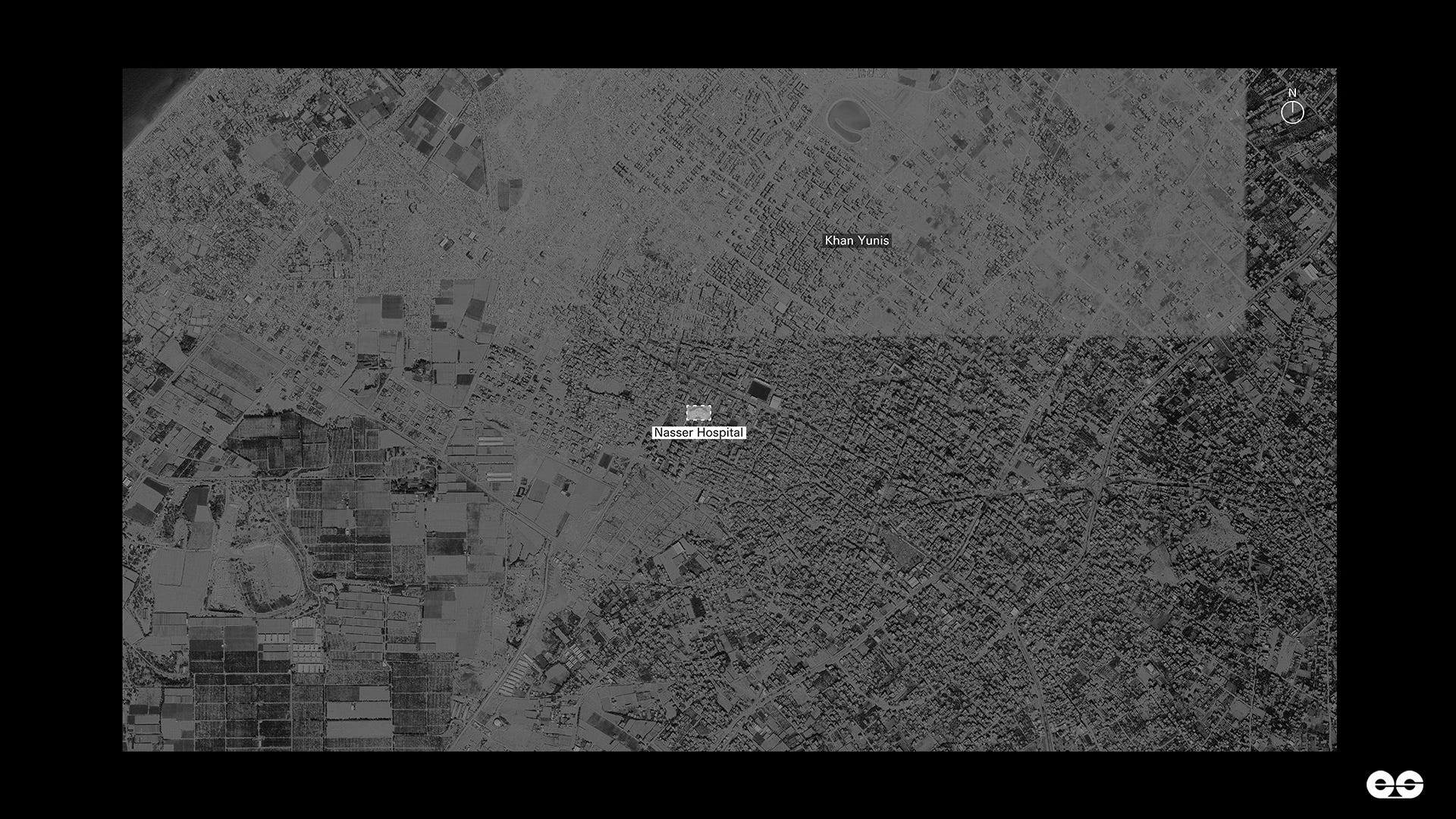
On August 25, 2025, a double-tap strike hit Nasser Hospital in Khan Yunis, Gaza. The first strike at approximately 10:09 am hit the fourth floor stairwell where Reuters cameraman Hussam al-Masri was operating a live feed. Nine minutes later, as rescue workers and journalists arrived at the scene, a second strike hit — two projectiles fired one after the other. 22 civilians were killed, among them five journalists — Hussam al-Masri (Reuters), Mariam Abu Dagga (AP), Mohammed Salama (Al Jazeera), Moaz Abu Taha (freelance), and Ahmed Abu Azizi (Middle East Eye/Quds News Network).
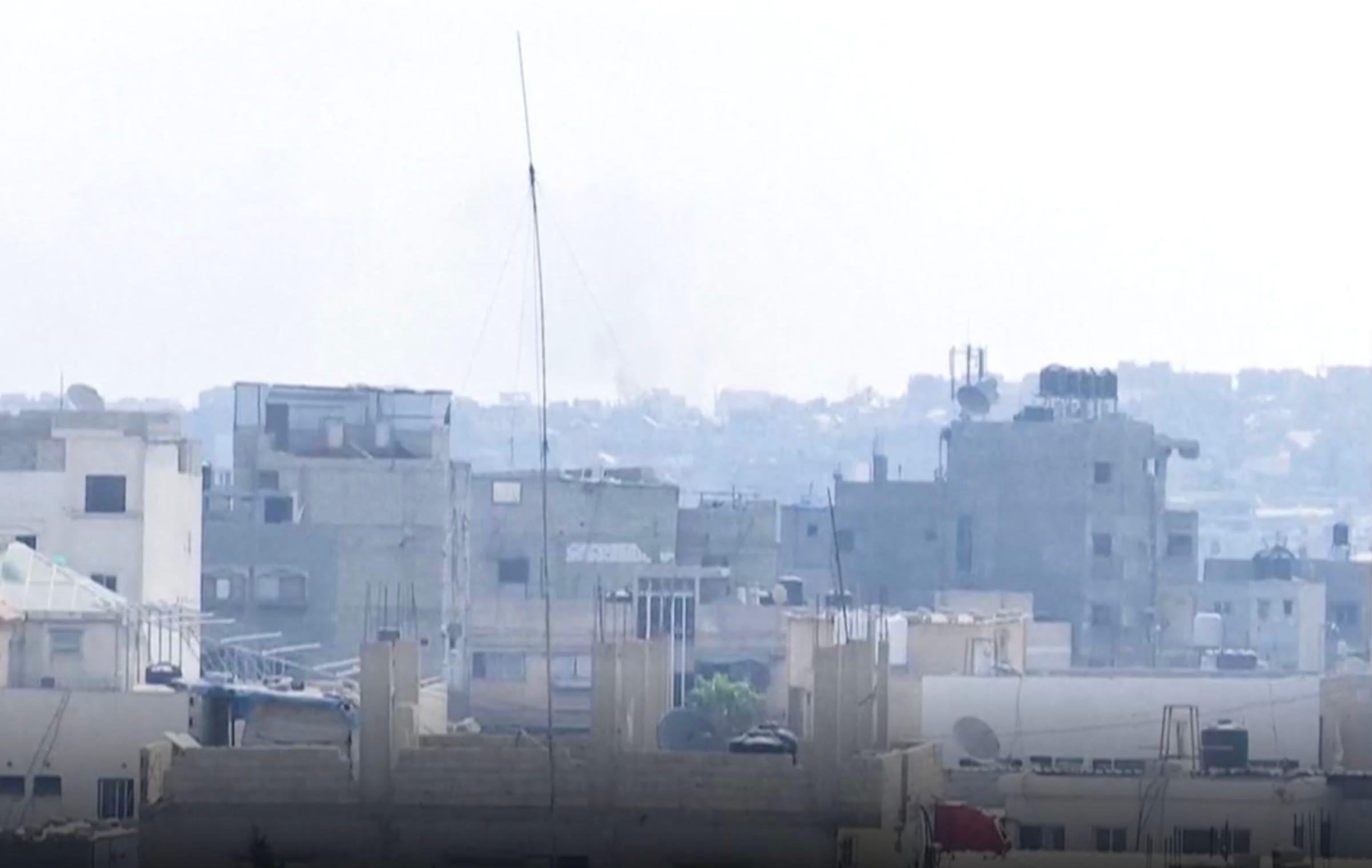
At the epicentre of the second strike, Reuters photojournalist Hatem Omar was filming. When the blast hit, his camera was buried in the rubble, but it kept recording. Omar survived, badly wounded. Though the image shows almost nothing, its soundtrack became central to this investigation.
Since the beginning of the genocide in Gaza in October 2023, the Israeli army has been systematically targeting journalists and press infrastructure across Gaza, the West Bank, and Lebanon. The Committee to Protect Journalists recorded 86 journalists killed by Israeli fire in 2025 alone1. Our work has documented attacks on journalists across multiple cases, including the October 13, 2023 strike in South Lebanon that killed Reuters journalist Issam Abdallah and injured six of his colleagues, and five further cases documented in collaboration with Forbidden Stories2. In each, the same pattern: the Israeli army knowingly conflating press with military targets.
When cameras are targeted — buried in rubble, choked by smoke, their operators killed or forced to flee — the image fails, but sound persists. The soundtrack captures everything the image can no longer reach: the direction of a blast, the weapon used, the distance of a shooter. By listening closely to the sounds of cameras under fire, we can reconstruct what journalists could no longer survive to show and, in doing so, restore the conditions of witnessing under fire. What follows is one such reconstruction.
Optional paid support: If you’d like to support our work, monthly subscriptions are available at $5.00. Earshot is the foremost independent nonprofit organisation producing sonic investigations with and on behalf of communities affected by corporate, state, and environmental violence. Your support enables us to conduct investigations, develop the field, and establish sonic evidence within accountability frameworks.
Following the 10:17 am strike, we were approached to verify a claim circulating in early media coverage that the weapon used may have been a Lahat missile — a guided munition capable of being fired from tanks, drones, or helicopters. Our audio ballistic analysis of five videos documenting this strike rules out that either of the two projectiles fired at Nasser Hospital was a Lahat missile, and identifies both as tank shells. The first of the two projectiles was likely an M329 set to anti-personnel mode, a weapon whose design and deployment we examine in detail below. Our analysis further establishes the likely distance from which the first projectile was fired with the direction from which it approached.
I. The weapon used
By comparing the acoustic signature of the recordings against that of a Lahat missile, we were able to rule it out and identify what was likely used instead.
If the weapon used was a Lahat guided missile, one would typically hear a distinctive whistle as it descends: the sound of the jet propulsion carrying it to its target. The spectrograph below shows what that sounds like: the prominent whistling of the jet engine preceding the detonation of a Lahat missile.
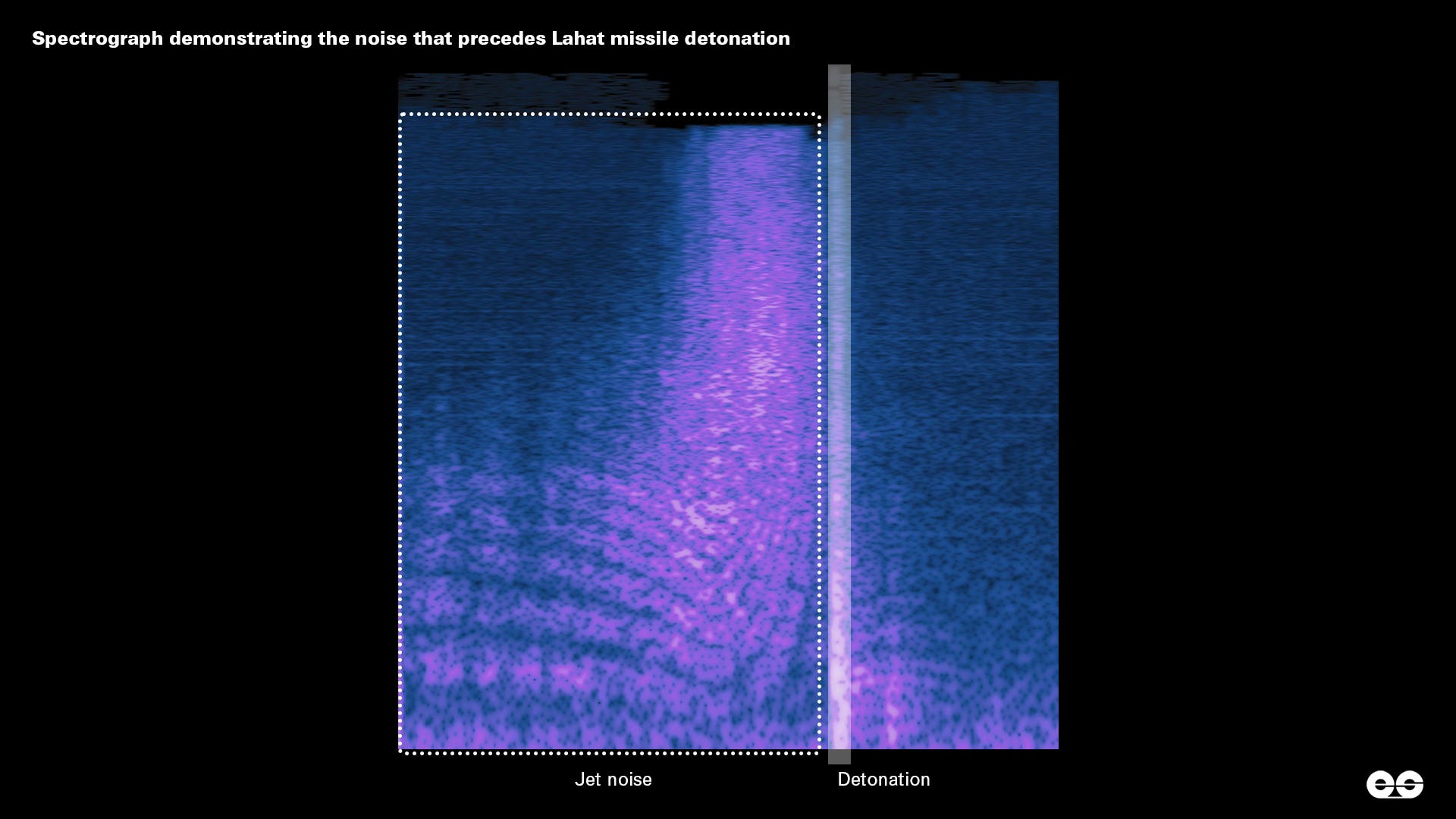
In all five videos, no such sound is present. What we hear instead is something we first encountered in our investigation into the strike on journalists in South Lebanon on October 13, 2023: six distinct detonations occurring within approximately 300 milliseconds of the initial blast. This is the acoustic signature of the M329 set to anti-personnel mode, confirmed in the South Lebanon case by visual evidence of the tank and forensic analysis of fragments recovered from the scene3. We subsequently identified the same signature in an attack on civilians gathering to collect humanitarian aid at Kuwait Roundabout in Gaza on February 6, 2024.
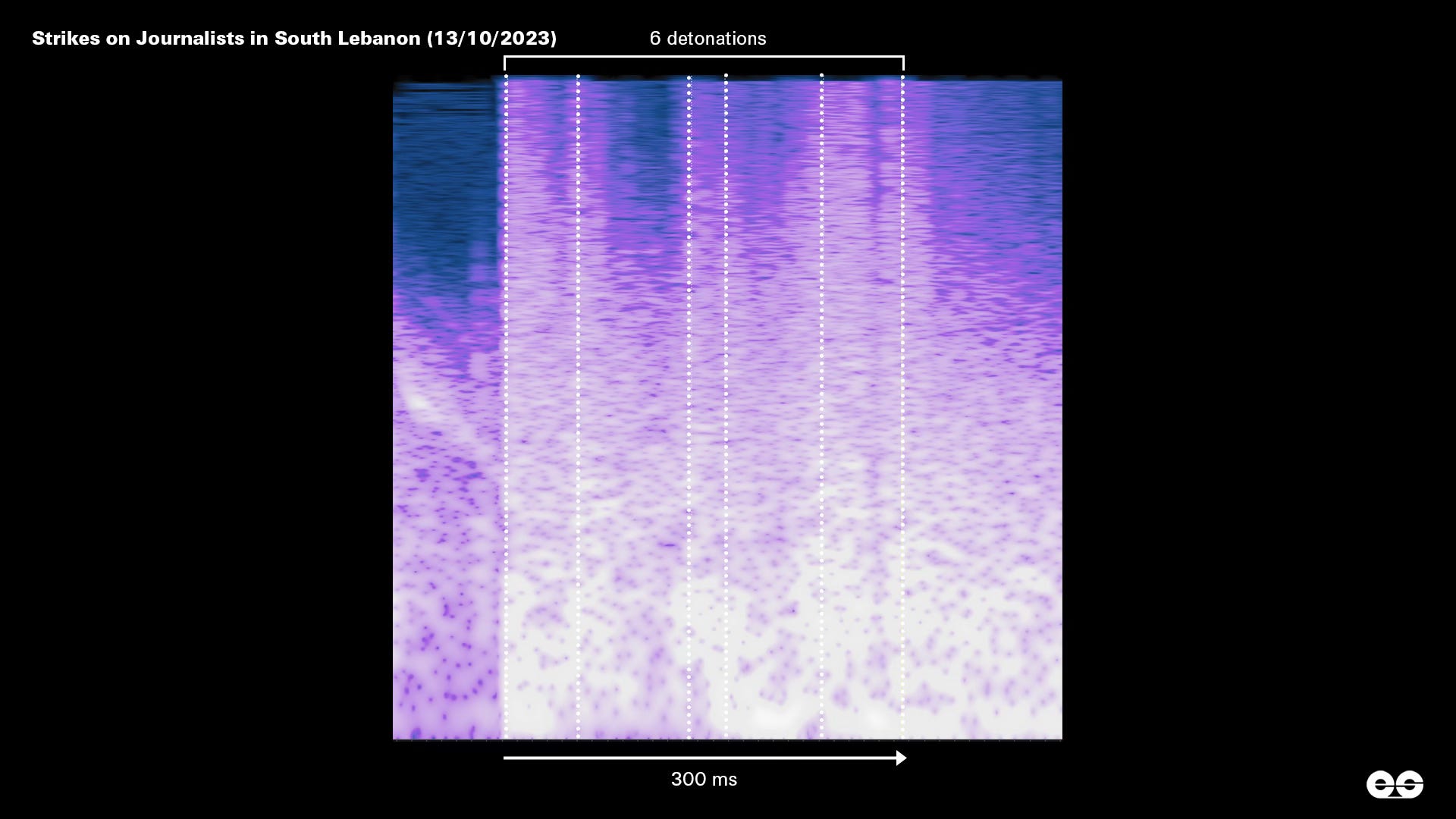
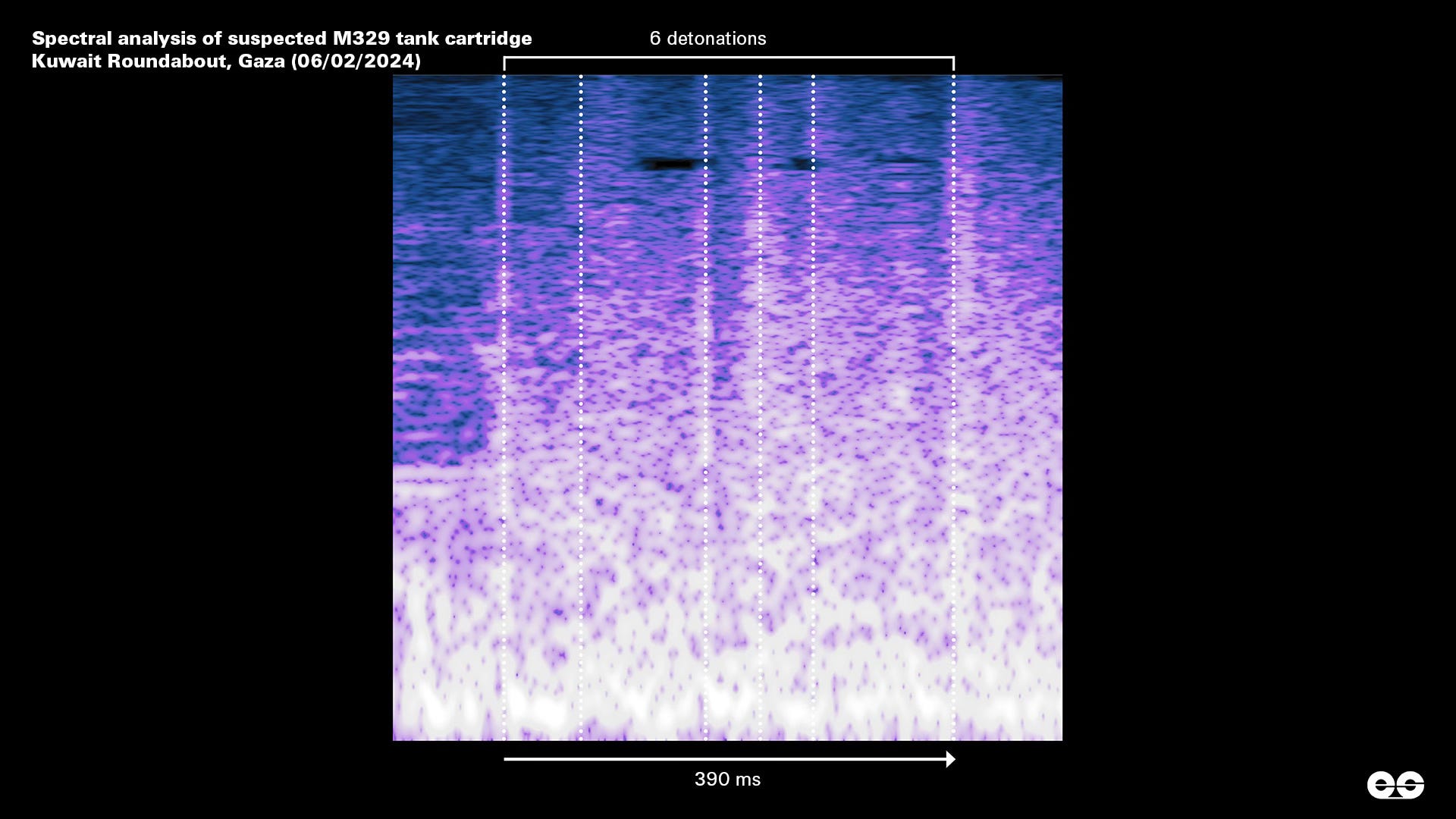
The Nasser Hospital recordings show the same pattern. It is therefore highly likely that the first of the two projectiles that struck the hospital on August 25, 2025, was an M329 set to anti-personnel mode.
This acoustic finding is corroborated by physical evidence recovered at the scene. Reuters obtained photographs of metal fragments found at Nasser Hospital, taken by a doctor present that day. Five munition experts who reviewed the fragments independently identified them as tail fins of Israeli-made 120mm tank rounds4. This is consistent with our acoustic identification of the M329.
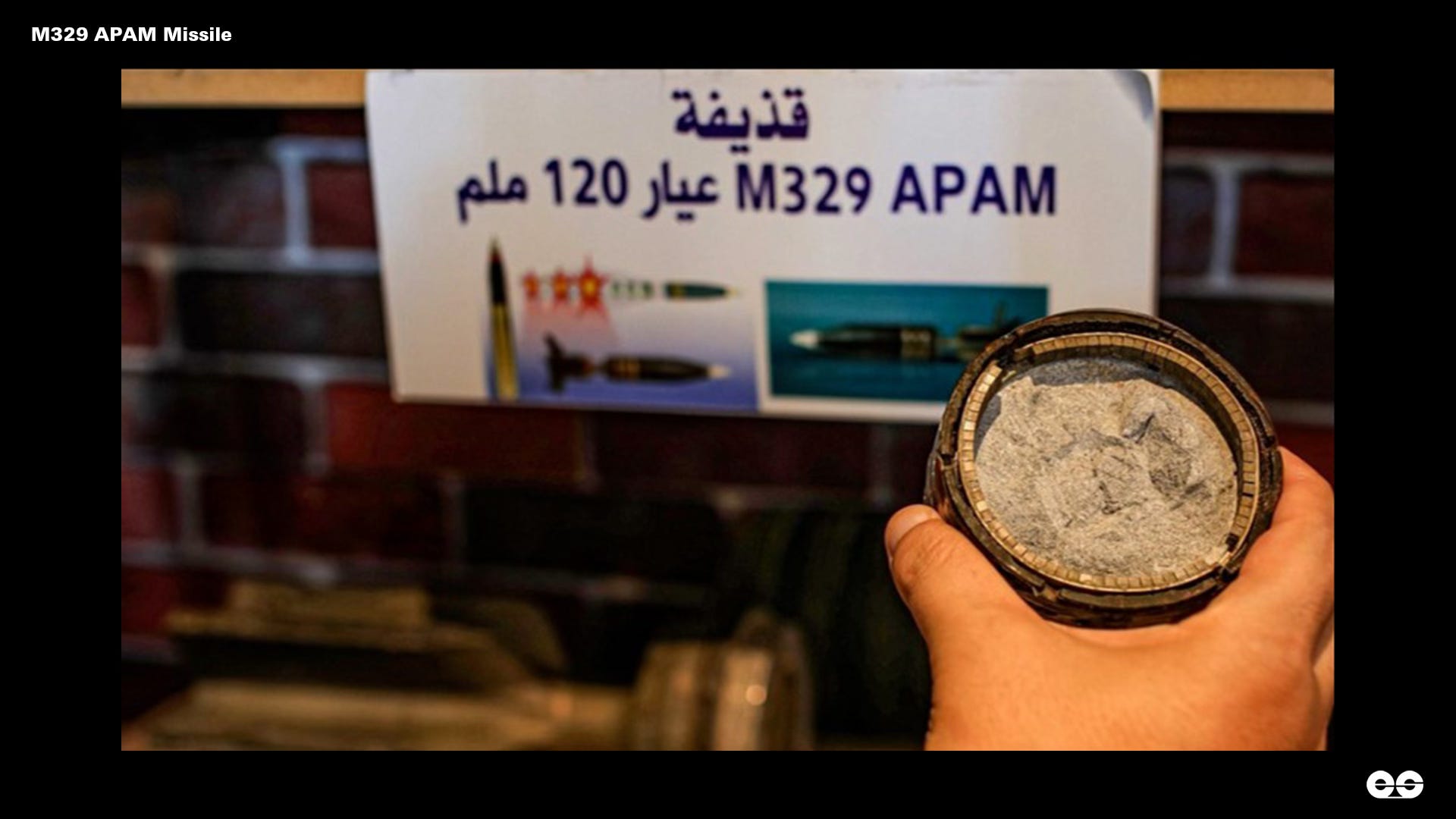
The M329 is a 120mm multi-purpose tank round developed by Elbit Systems. It contains six internal submunitions, each lined with approximately 4,000 tungsten cubes measuring 2mm. In anti-personnel mode, these submunitions are released unguided in mid-air and detonate sequentially across the target area, each spraying tungsten fragments in all directions.
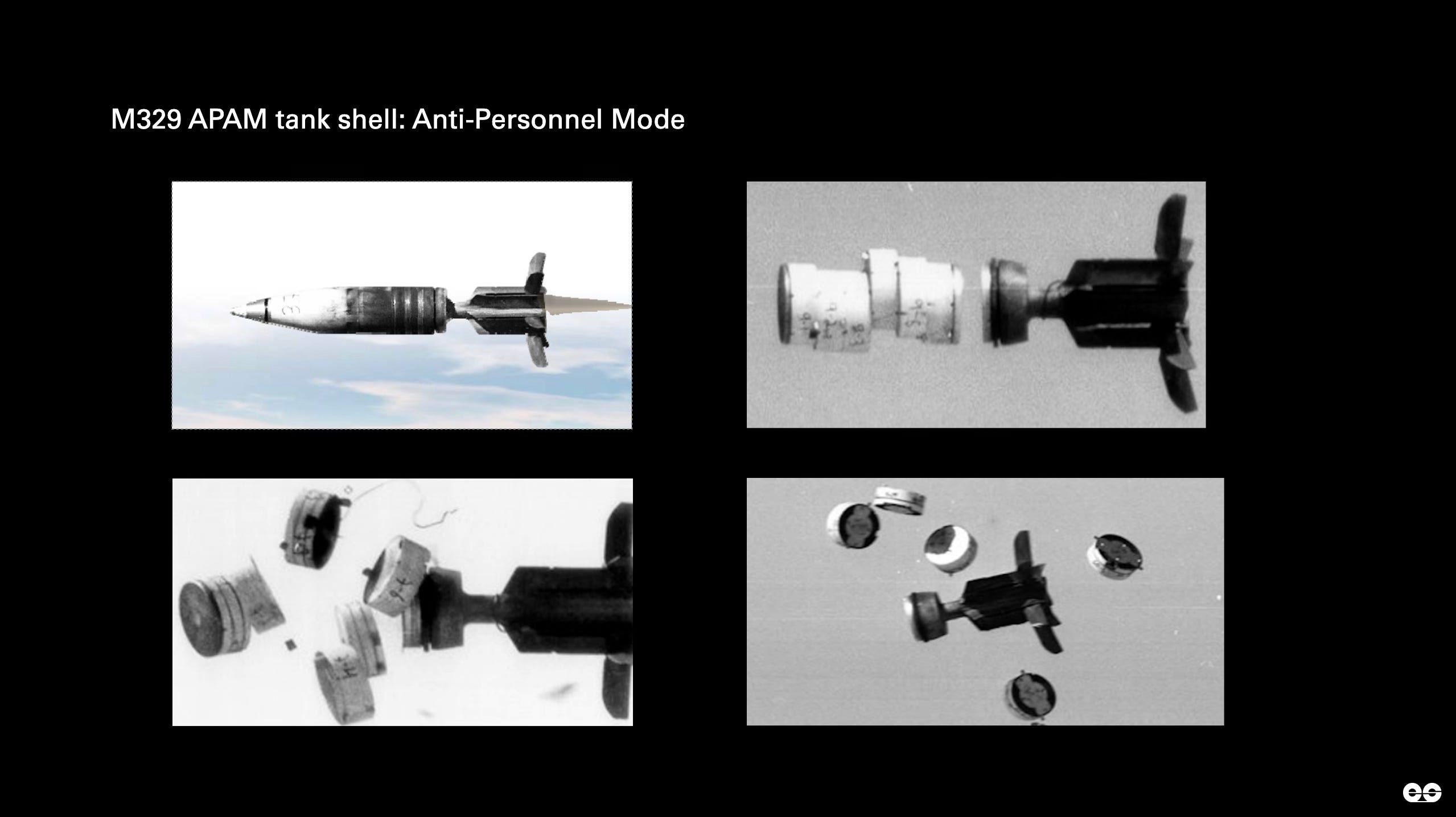
The Israeli army chose a weapon designed to disperse lethal fragments across the widest possible area rather than a guided missile aimed at a single target. That choice is not incidental. In a double-tap strike, the goal of the second projectile is to kill and injure as many as possible among those who respond to the first. The M329 set to anti-personnel mode is precisely the weapon for that purpose — making this a textbook double-tap strike. Its acoustic signature does not only identify what was fired. The selection of this weapon confirms the intention to commit this illegal act.
II. Where it was fired from and how far away
Knowing what struck Nasser Hospital, the recordings allow us to go further: to establish the likely location of the tank from which the projectile was fired.
When a tank fires, it produces two distinct sounds: the detonation of the shell at its target, and the muzzle blast, which is the explosive release of gas from the barrel as the shell is fired. Although both sounds originate from the same firing event, they travel at different speeds. The shell travels at supersonic velocity; the muzzle blast travels at the speed of sound. This means that at the location of impact, the muzzle blast always arrives after the detonation. The gap between the two — measured at the point of impact — represents the time it took the muzzle blast to travel from the tank to the camera. Combined with the known velocity of the shell, this interval allows us to calculate the distance of the tank that fired.
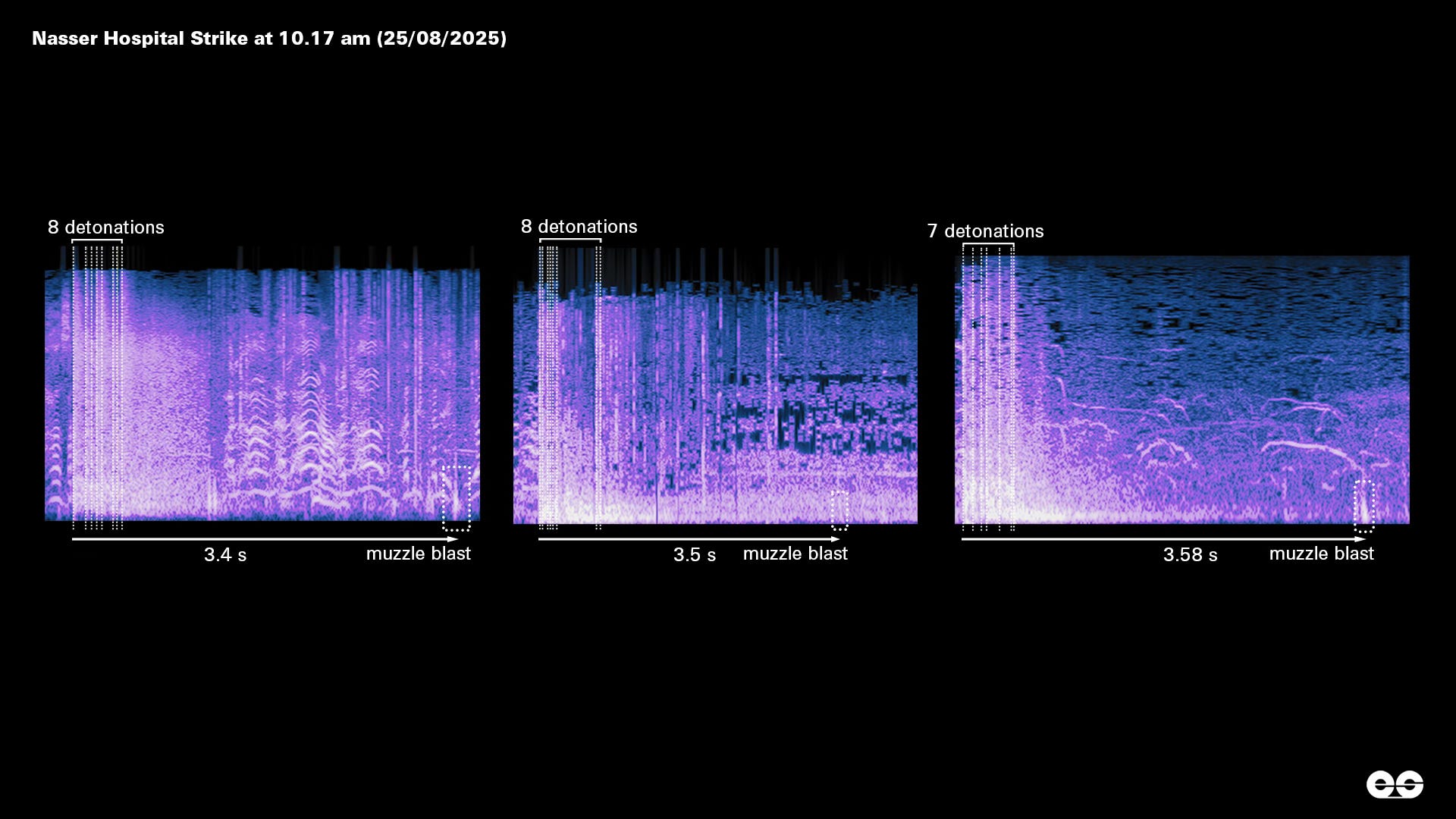
In three of the five videos analysed, each recorded from a distinct location around the hospital, we detected a high-intensity impulse sound in the low-frequencies (0-500 Hz) arriving approximately 3.5 seconds after the first blast. That this sound appears across all 3 recordings simultaneously, each taken from a different position, makes it highly unlikely to be an artefact of any single recording. Its low-frequency profile and consistent timing across locations point to a muzzle blast, most likely from the tank that fired the shell.
II.I. Distance
On the morning of August 25, 2025, the temperature in Khan Yunis was approximately 31 degrees Celsius. At that temperature, the speed of sound is 349 metres per second.
The M329 tank shell has a published muzzle velocity of 900 metres per second. A shell does not maintain this speed over distance. Air resistance causes it to decelerate continuously from the moment it leaves the barrel. Applying a standard ballistic drag model to the M329’s specifications (a 17-kilogram projectile, 120-millimetre calibre, fired at 900 metres per second into air at 31 degrees Celsius) the shell’s average velocity over approximately 2 kilometres is around 827 metres per second, arriving at the target at roughly 761 metres per second.
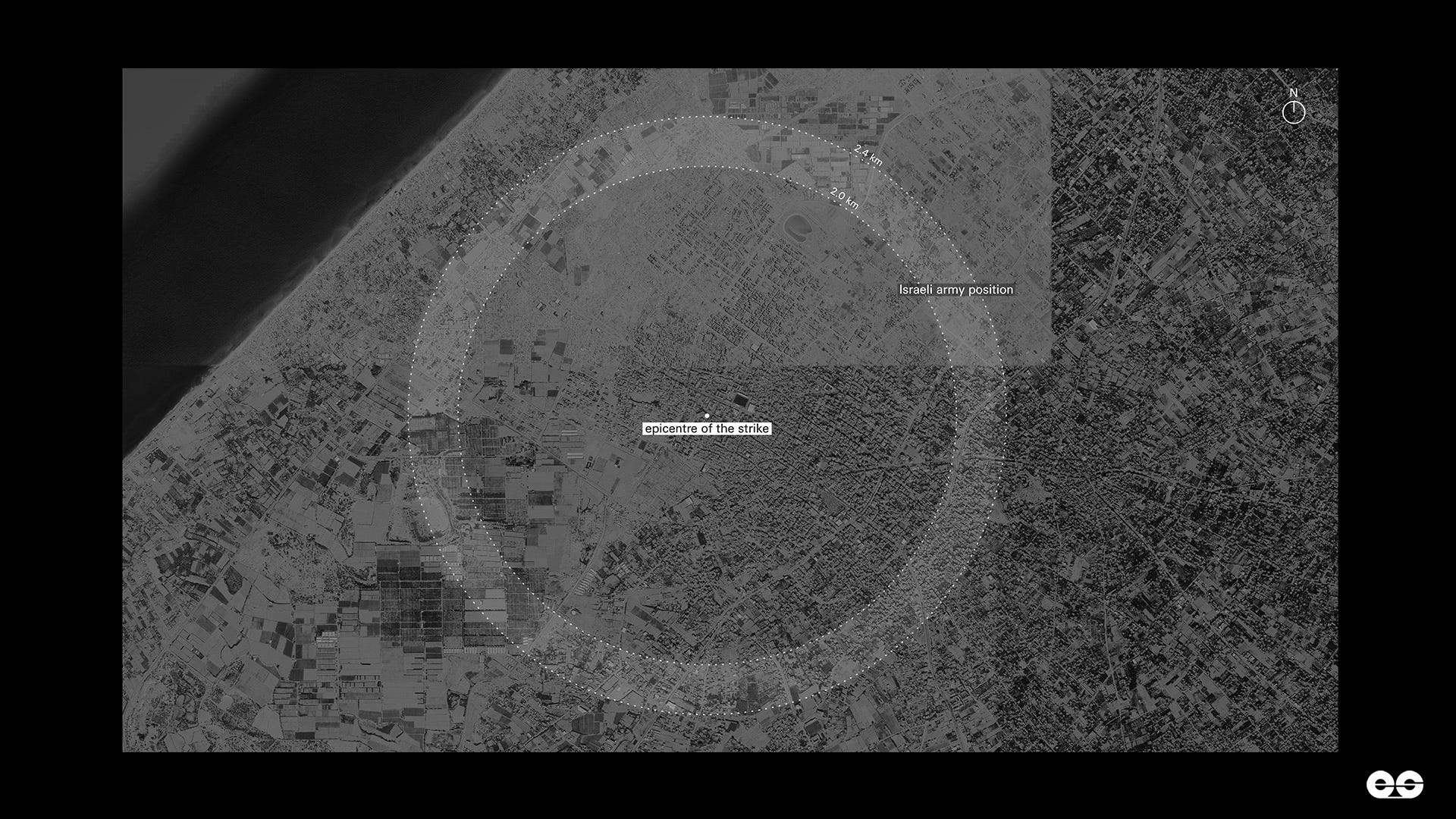
The distance to the firing position is calculated from the muzzle blast delay: the gap between the shell’s detonation and the arrival of the muzzle blast at the camera. Because the shell travels faster than sound, it always arrives first. The delay represents the difference between the time the sound took to travel from the tank gun to the camera, and the time the shell took to cover the same distance. Using the 3.56-second muzzle blast delay recorded at Video 2, positioned at the epicentre of the strike, and accounting for the shell’s deceleration over that distance, our calculation places the tank that fired at approximately 2.0 to 2.4 kilometres from Nasser Hospital.
Avihai Stollar, an arms specialist with Breaking The Silence who served in an IDF infantry unit, told the Washington Post that M329 rounds are accurate up to approximately 3.5 kilometres. At a distance of 2 to 2.5 kilometres, he said, tank crews would have been able to see people gathered at the scene. Whoever ordered the fire “could definitely see what is happening and could see rescue workers moving up and down the stairs of the building.”5
II.II. Trajectory
As three of the recordings contain a detectable muzzle blast, we were able to go a step further than calculating distance alone and estimate the direction from which the shot was fired. To do this we applied a technique known as multilateration. Multilateration, akin to triangulation, entails measuring the time difference between the arrival of a sound at two or more recording positions and converting those time differences into a direction. The variance in time it took the muzzle blast to reach each of the three cameras allowed us to determine the direction of the firing position relative to Nasser Hospital.
Sound travels at a consistent speed in a given environment. When the same sound arrives at multiple recording points at slightly different times, those differences reveal the direction it came from: it reaches the points closest to its source first, and those furthest away last.
The muzzle blast arrived at Video 1, 3.4 seconds after impact. It arrived at Video 2, positioned at the epicentre of the strike, 3.56 seconds after impact. And at Video 3, 3.58 seconds after impact. Because the three cameras were recording independently, their clocks were not synchronised to a common reference. To make the arrival times comparable, a correction was applied using each camera’s GPS-derived distance from the impact point: 49.43 metres for Video 1, 60.39 metres for Video 3, and zero for Video 2, which was positioned at the epicentre of the strike. Factoring in these corrections, the muzzle blast reached Video 1 first, then Video 3 approximately 149 milliseconds later, and Video 2 a further 153 milliseconds after that.
Video 2 is the westernmost of the three cameras; Videos 1 and 3 are positioned to its east. The muzzle blast reached the eastern cameras first and the western camera last. That arrival order, combined with the known positions of the three cameras, places the origin of the sound to the north-east of the hospital.
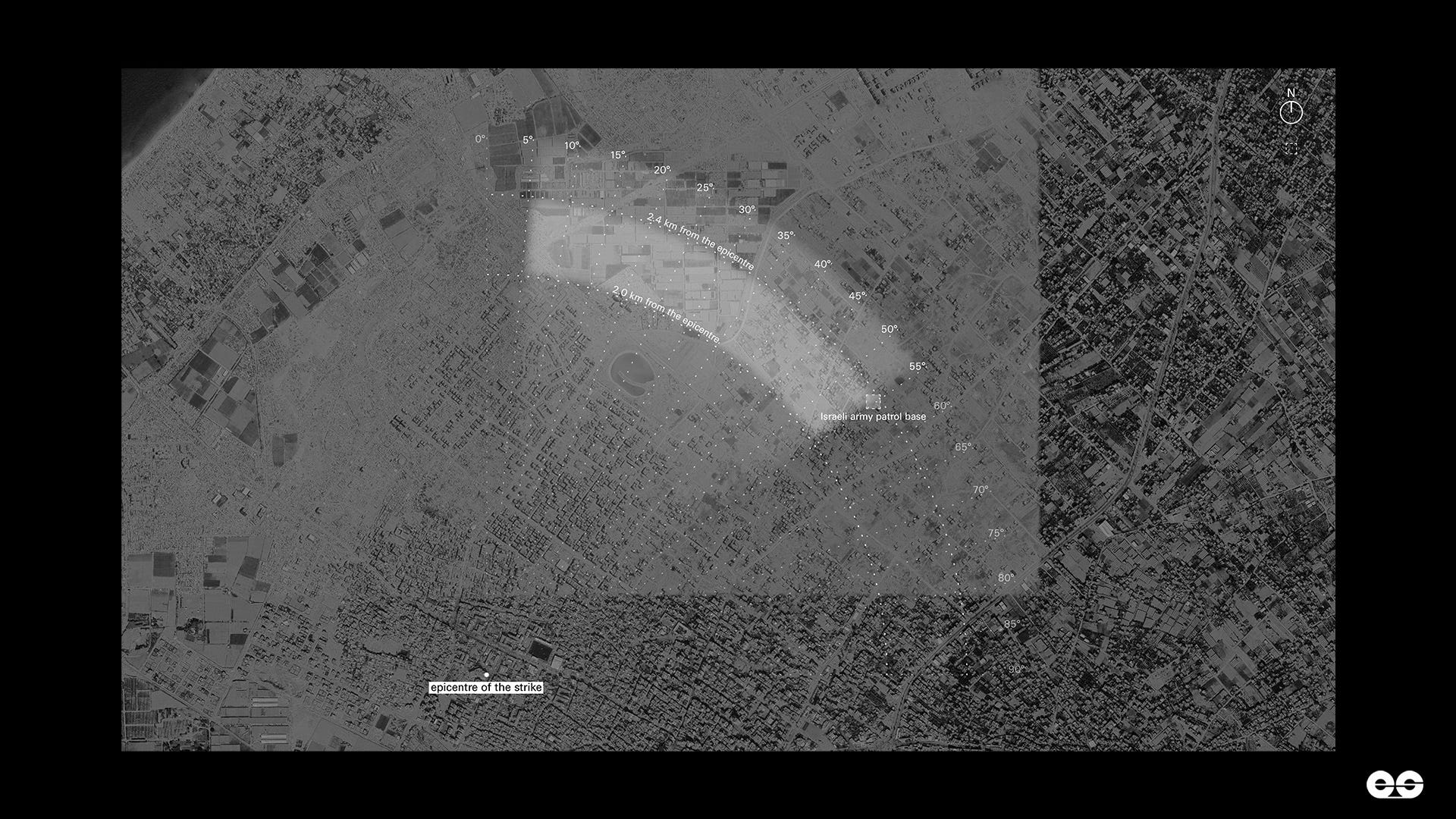
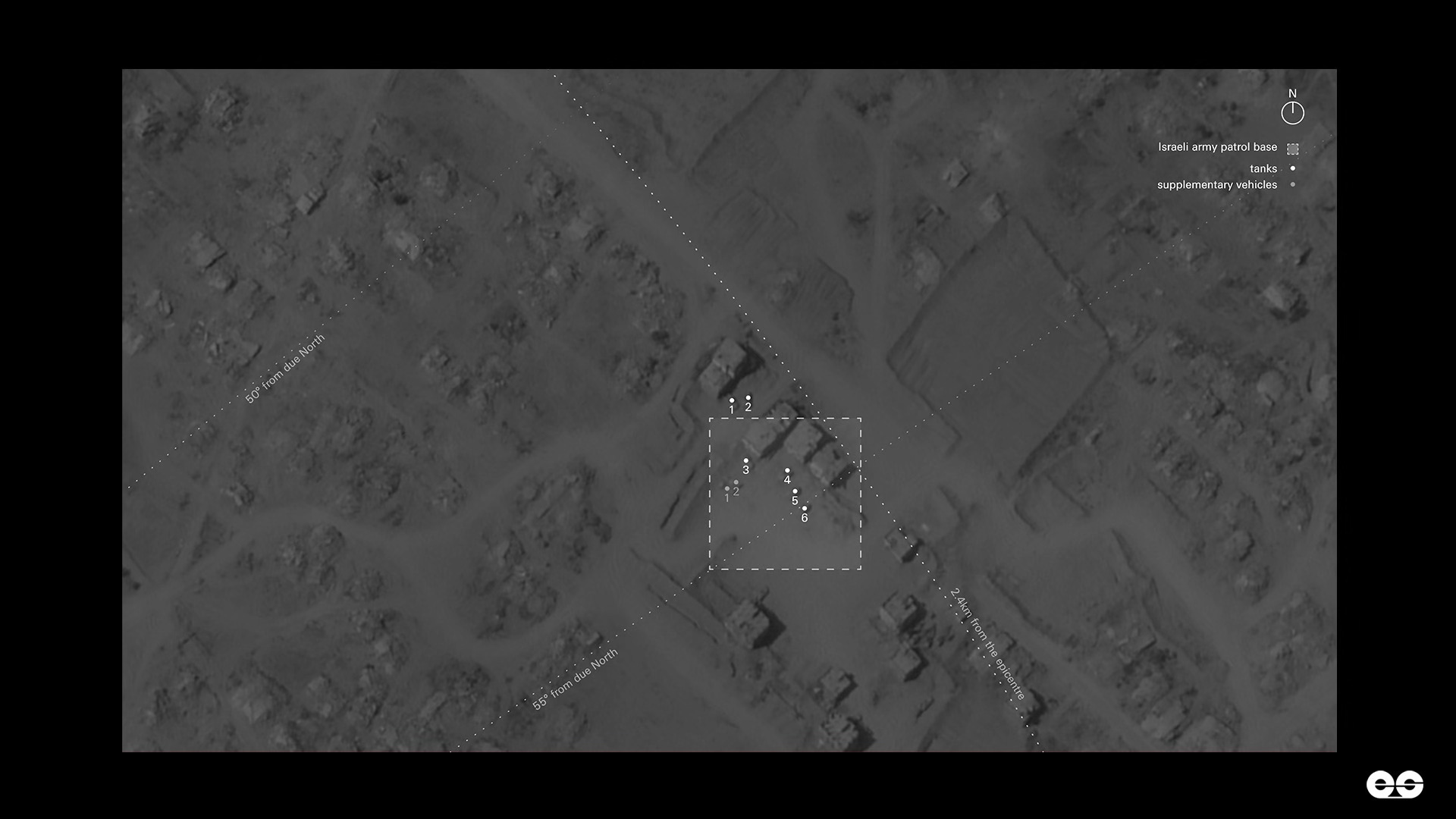
Our acoustic analysis accounting for the shell’s deceleration and the margin of uncertainty in the muzzle blast delay measurement, places the firing position between 2.0 and 2.4 kilometres north-east of the hospital. The Washington Post independently identified an active IDF patrol base approximately 2.5 kilometres north-east of Nasser Hospital. Their analysis of satellite imagery provided by Planet Labs showed Merkava tanks and armoured personnel carriers visible over a 12-day period spanning the date of the strike6. When we calculated the distance to the coordinates provided by the Washington Post, the base extends approximately 150 kilometres in depth along the north-east axis, with its far edge sitting at 2.4 kilometres from the hospital — meaning it falls entirely within our estimated range. The distance and direction established by our analysis are therefore consistent with that base, and it is highly likely that the strike on Nasser Hospital was conducted from this location.
III. Doctors’ testimonies on tungsten submunition injuries
The testimonies that follow were gathered as part of a study on weapons similar to the M329 that contain these tungsten shrapnel conducted with the support of Forensic Architecture’s researchers in Gaza, in which six international doctors who worked in Gaza in 2024 described the injuries they treated. The tungsten cubes they recovered from patients — documented by The Guardian7 — are small enough to be nearly invisible on entry.
Dr Nabeel Rana, a surgeon who worked at Al-Aqsa Hospital in Gaza in June and July 2024, describes what he found when he operated on patients:
“Very, very small entry wounds that sometimes you couldn’t even see the entry wound, but had significant damage and destruction internally. One evening a mother came in with a very small entry hole in her thigh — it had transected her femoral artery. At the exact same time, three of her children, ages one, four, and five, each had a single tiny entry tear in their abdomen, and each one had a bowel or colon injury that had to be repaired. There were no other signs of injury, no abrasions. Another girl, six years old, we could not find any wounds on her at all, and she had absolutely shredded blood vessels and bowel in her pelvis.”
Dr Firoze Sidhwa, a trauma surgeon who worked at Gaza European Hospital between March and April 2024, describes a similarly confounding pattern:
“One very, very small injury on the skin on his right chest and one on the left side — each one or two millimetres at maximum. No rib fractures. No other holes. A very strange and very unusual injury.”
What makes these injuries so devastating is the velocity at which the tungsten pellets travel. Dr Mark Perlmutter, an orthopaedic hand surgeon who worked in Gaza between March and April 2024, explains:
“These little tungsten pellets fly at such an impressively high velocity that they enter the skin and exit the other side of a limb with almost no visible wound, but the tissue on the inside is purely vaporised. Bone has so many fracture fragments that they’re impossible to fix. Muscle is turned to jello, arteries and nerves are thoroughly destroyed, and almost every injury that this causes requires an amputation.”
In two key ways, these projectiles behave like weapons that have already been banned under international law. They function like cluster munitions in that the explosive submunitions are unguided and not designed to engage a single target. And they cause superfluous injury and unnecessary suffering: injuries so severe and so difficult to treat that they present an extreme challenge even under optimal surgical conditions, let alone in a hospital that has been systematically starved of supplies, staff and electricity as part of the same genocidal war that deployed them.
The doctors’ testimonies also attest to the conditions under which this weapon has been deployed. Dr Mahmooda Sayed, a medicine physician who worked at Nasser Hospital between August and September 2024, noted that these injuries appeared consistently during times of evacuation — moments when people were necessarily gathered and in movement. Dr Tammy Abu Ghnaim, an emergency physician who also worked at Nasser Hospital between July and August 2024, describes what she witnessed:
“Most of the patients were paediatric, and they had been at a gathering of some kind. Very commonly, a group of people had gathered under the shade of a tree or canopy when they were hit, and then the cars that came to their rescue would also be hit. On Fridays, when the market was particularly busy, we would receive several groups of casualties from the market. We also saw incidents of people being targeted while waiting for taxis or buses. This was an almost daily occurrence, if not multiple times a day.”
At Nasser Hospital on August 25, 2025, rescue workers and journalists who had rushed to the scene of the first strike were struck by the second at approximately 10:17 am. This was a moment of congregation, exactly as Dr Abu Ghnaim describes. The acoustic signature is the same. The logic is the same. The pattern of the weapon’s deployment, against civilians in places of gathering, constitutes a war crime. The weapon itself, while not yet formally prohibited under international humanitarian law, may meet the criteria for prohibition.
The double-tap strike was once a term used to describe terrorist tactics: a method so condemned that states built entire legal frameworks to prosecute it. It is now state doctrine. The United States deployed it extensively in Pakistan, Yemen, and Afghanistan8. Israel has run it the length of its genocidal war on Gaza. What was once framed as the mark of a terrorist has become, quietly and without accountability, standard military practice.
From a single investigation: Three war crimes.
The first is the double-tap strike itself. It is a tactic that works by design: the first strike draws in responders, the second kills them. In the case of Nasser Hospital, the sequence is visible on camera. Hussam al-Masri was hit by the first strike. The colleagues and rescue workers who ran towards him were hit by the second, nine minutes later. Under international humanitarian law, double-tap strikes constitute a war crime. Either the second strike is deliberately aimed at those responding to the first, or it is fired with complete disregard for the civilians it will predictably kill. There is no version of a double-tap that is consistent with the obligation to protect civilian life.
The second is the striking of a protected medical facility. Hospitals are afforded explicit protection under international humanitarian law. Nasser Hospital was not an incidental target. It was struck twice, nine minutes apart, with a weapon designed to maximise lethal area effect, at a location known to be used daily by journalists and medical staff.
The third is the deliberate targeting of journalists and press infrastructure. 5 named journalists were killed in a strike that Netanyahu initially called a tragic mishap9, before the Israeli army reversed course and asserted it had targeted and killed terrorists10. The two statements cannot both be true11. Since October 7, 2023, the Committee to Protect Journalists has recorded over 197 journalists killed by Israeli fire12. This is not a series of tragic mishaps. It is a systematic campaign to eliminate those who document what is being done.
Beyond these three war crimes, the practice that runs through them all may open the door to new legal ground. The double-tap strike on Nasser Hospital is the most widely documented use of the M329 to date. A weapon indiscriminate by design, deployed without discrimination: its effects alone satisfy multiple criteria for prohibition under international humanitarian law. The conditions of its deployment add further weight. Together, they constitute the evidentiary foundation from which a formal prohibition can be built.
These findings are not isolated. They are instances of a method that has run the length of Israel’s genocidal war on Gaza, extended into Lebanon, and is now visible in Iran13. What distinguishes its current use is the scale and the consistency.
This is the normalisation of a method designed to kill the people who respond to violence, and to silence those who survive to document it.
Optional paid support: If you’d like to support our work, monthly subscriptions are available at $5.00. Earshot is the foremost independent nonprofit organization producing sonic investigations with and on behalf of communities affected by corporate, state, and environmental violence. Your support enables us to conduct investigations, develop the field, and establish sonic evidence within accountability frameworks.