On March 15 2025, between 275,000 and 325,000 people gathered along Belgrade’s Kralja Milana Boulevard for a 15-minute silent vigil. They stood in collective mourning for the 15 people who died when Novi Sad’s railway station canopy collapsed months earlier. The silence was so profound that witnesses described hearing someone cough 200 meters away.
Then something happened.
“And then from that complete silence, I heard this sound.” (Witness 05)
The crowd suddenly split down the middle of the boulevard, compelled by a sound they consistently described as an unidentifiable vehicle approaching at high speed. Serbian authorities deny any attack occurred. The Federal Security Service (FSB) claims the disorder began with fireworks. But 3,244 written statements and 15 in-depth earwitness interviews tell a different story.
“It was not just what we heard, it was more the feeling. That we felt it was something that made us run away from there. So, this is what I experienced (…) This feeling that something is happening, and we don’t know what is going on, it just made us run away. This feeling that I never felt before because I don’t know what is going on.” (Witness 08)
At Earshot, we specialise in investigating what cannot be seen — the acoustic dimensions of violence that visual evidence misses. This case presented a unique challenge: a sound that barely registered on recording devices, yet was experienced intensely by thousands of people. How do you document violence that leaves no trace?
Optional paid support: If you'd like to support our work, monthly subscriptions are available at $5.00. Earshot is the foremost independent nonprofit organisation producing sonic investigations with and on behalf of communities affected by corporate, state, and environmental violence. Your support enables us to conduct investigations, develop the field, and establish sonic evidence within accountability frameworks.
We partnered with the Centre for Research, Transparency and Accountability (CRTA) to gather first-hand witness accounts. CRTA collected 3,244 written statements from protesters present on the boulevard that evening. These statements described various acoustic characteristics — unfamiliar sounds, rapid approach, physical sensations — which informed our creation for a reference library of 26 sound samples spanning jet engines, fireworks, vortex cannons, and other potential sources.
Over two 3-hour sessions, we interviewed 15 witnesses who were positioned at different points along the boulevard. We asked them to describe not just what they heard, but what they felt. We played them the 26 sound samples, asking them to identify what matched their experience. What emerged was striking in its consistency. All 15 witnesses described:
An unfamiliar sound they had never heard before.
Something rapidly approaching from the northern end of Kralja Milana Boulevard.
A physical sensation — not just auditory — that moved through their bodies.
An overwhelming urge to move away from the center of the boulevard.
"Nothing was happening. We were just standing. It was quiet because of the 15 minutes that we were giving for the people that are not with us anymore." (Witness 03)
Backed by the FSB report, Serbian authorities claim the disorder began with fireworks. We sought to verify this claim. To do so, we first needed to establish whether witnesses could reliably distinguish between different sounds during the vigil — whether a firework or other explainable sound could have caused the mass panic visible in circulating videos.
We began by asking each witness to describe all the sounds they remembered hearing during the silent vigil:
“Nothing special. Sounds, the sounds in the dead silence were only from drones. And eventually from some phones, notifications on phones.” (Witness 13)
“Before the attack, it was all silent because I can hear someone cough maybe 200 metres away from me because it was so much silent. And then the attack itself.” (Witness 08)
These accounts reveal the crowd’s extraordinary attentiveness. Interruptions of the silence were registered acutely because of the collective effort to remain silent. The ability to discern and recall a cough from 200 meters demonstrates the exceptional acoustic condition these protesters collectively manifested.
From our analysis of 11 video recordings, we derived an ambient noise level of approximately 50dB during the vigil. Witnesses mentioned hearing coughs, phone notifications, drones, and popcorn machines — often noting how far away these sounds were. Most would have measured at or below the general ambiance: 35-45dB for a distant cough, 50dB for a quadcopter 50 meters overhead, 40-60dB for a nearby phone notification.
Though microphones can have broader sensitivity to sound pressure and frequencies than the human ear, the ear possesses far more sophisticated auditory processing. Our findings demonstrate that the crowd exhibited the capacity to recall and discriminate a wide range of sounds at varying intensities. This establishes the necessity of incorporating earwitness testimony when determining the presence of sonic weaponry — and the limits of relying solely on video recordings.
“Lead investigator: OK. And do you feel that there, as the sound got louder, it was easier to disassociate that sound from the one that the people could have been making.
Witness 07: Oh yeah, of course, of course, especially when it flew over us and that that was then I was I was sure something happened.”
During interviews, we systematically eliminated potential sound sources. Witnesses ruled out fireworks, quadcopters flying overhead, and stampede noises created by layering footsteps. In fact, witnesses clearly differentiated between stampede sounds and the attack. They also ruled out sirens, sine sweeps typical of sonic weapons, and even the vortex cannon sound we’d initially identified in our preliminary assessment.
Two witnesses identified motorcycles in the distance during the vigil — significant because it demonstrates their ability to distinguish between vehicular sounds and the vehicular quality of the attack they later experienced:
“That was very quiet. I heard just drones recording above us and 1 motorcycle that tried to go over, but it stopped and [was turned off] in the middle of the street.” (Witness 12)
“I saw two drones above our heads. And then, uh, you can hear the whirr of the drone. And then they were, I think gone.” (Witness 14)
An unfamiliar sound
“The sound was very strange and alien to me. I don’t know if I can actually reproduce something like that.” (Witness 11)
Having established witnesses’ capacity to identify sounds during the vigil, we turned to the sound of the attack itself. Eight witnesses explicitly stated they had never heard “a sound like that” before. All 15 witnesses, along with more than 60% of the written statements, used a combination of at least two sounds to describe what they heard — suggesting the attack was experienced as an unfamiliar auditory event.
“Yeah. I think it wasn’t people because I felt something, like it’s something that you don’t see, but you feel it. And maybe I felt like, uh, it’s going to like, take us from the ground and put us on the floor. I felt something like that. It’s going to take me and I’m going to be on the floor, all of us.” (Witness 03)
An embodied sound
“It wasn’t that much the sound. It was the feeling. The heart rates jumped up and me and people around me had this, you know, need to move away from the spot that we were in and this is it.” (Witness 09)
For many, the experience wasn’t simply auditory — it was accompanied by intense physical sensation. In 2,335 written statements (72%), the sound came with such sensation. Eight witnesses described it as a force permeating or entering the body, prompting an instinctive reaction to move away from the center of the boulevard.
“It was not just what we heard, it was more the feeling. That we felt it was something that made us run away from there. So, this is what I experienced (…) This feeling that something is happening, and we don’t know what is going on, it just made us run away. This feeling that I never felt before because I don’t know what is going on.” (Witness 08)
“I felt like this sound was going through my body like I felt it in my bones, in my muscles. And throughout the head with the chills in my body as I felt the sound.” (Witness 09)
“It’s like, it’s coming towards me (…) and then it was in me. You know it’s like that.” (Witness 11)
This consistent description of sound as internal sensation provides a crucial clue. It’s unique to highly directional acoustic weapons to channel intense sounds in narrow streams, causing a disorienting sensation that witnesses describe as moving “inside” or “through” them. The experience was unfamiliar both in its perceived appearance and as an acoustic phenomenon — witnesses described hearing an unfamiliar sound that also behaved in acoustically anomalous ways.
A vehicular sound, approaching at high speed
“I thought that 200 bikers, people on the motorcycles are coming towards us (…) My biggest Impression is basically that feeling that, uh, that fear that some machine is going to get over” (Witness 02)
“And then I heard very weird sound like I was 100% sure that a vehicle is approaching (…) coming towards us.” (Witness 06)
The sound approached witnesses in a highly directional way from the northern end of Kralja Milana Boulevard, from Terazje Square — emphasized by 11 of 15 witnesses, all confirming the same direction. Nine witnesses explicitly reported how the sound advanced rapidly, approaching them in a vehicle-like manner. 1,907 written statements (59%) described the sound as having a machinic, vehicle-like quality.
“A sound I never heard before. It was a mixture of like a herd of horses coming towards me, but also with something mechanical, not as a car but something bigger and louder coming towards me. So, something in between.” (Witness 05)
“I could hear the sound when, like, you know, when you start the engine, and you hit the gas pedal hard and that sound I could hear, that sound like approaching and becoming more distant. That is why I was 100% sure that some things ran through the crowd.” (Witness 06)
“It was just a roaring sound of like a jet engine or something like that. It just went through the crowd.” (Witness 07)
Seven of eight witnesses who heard a jet engine sample recognized it as similar in intensity and sonic profile. The comparison was rarely based on one sound alone — they responded to how the sample mimicked perceived movement: advancing from a distance, growing in strength, occupying vertical or overhead space. This corroborates numerous accounts of a fast-approaching directional force resembling aircraft or high-speed mechanical propulsion.
"Lead investigator: So, we're going to play a couple of sounds and see if they were present.
Witness 08: Yes, yes, yes, yes.
Lead investigator: Like this, huh? Something like that. I see. And you felt it, like coming closer. Closer.
Witness 08: Yes, coming closer in high speed."The fear of what cannot be seen
“You know how, but and it was so unreal, and you cannot explain it to your brain that you hear the car coming, but you cannot see.” (Witness 01)
Of 15 witnesses, 11 described something rapidly approaching, prompting immediate reaction. Though all could identify where the sound originated, they couldn’t locate a visible source — explicitly stated by eight witnesses. This absence of visible source for such an intense physical experience created pervasive fear and disorientation.
“Well, just the shock of it, it was, I don’t know, we’ve, as I said, we’ve been to a lot of protest and every time when it’s the end of the silence, you get this release because everyone starts making noise again and we, everyone knows what it means. Everyone knows why we are there. So, we were just waiting for that to happen and instead of that we got something that we didn’t know what it was.” (Witness 07)
Contrary to the FSB report’s claim that the crowd showed no acute distress, five witnesses described immediate sense of imminent threat. Crucially, this fear didn’t stem from the sound’s volume but from its unfamiliar acoustic profile, marked directionality, and lack of identifiable source. Witnesses constantly described anticipatory dread — the sensation that something was approaching at high speed, suggesting impending projectile or vehicle impact.
393 written statements (12%) explicitly mentioned fear, discomfort, unease, and impending danger. Though no physical impact occurred, the convergence of testimonies describing this anticipatory response suggests the sound was collectively interpreted as a threat.
“So, the intensity is what stuck with me and the moment I felt it, it was like I felt it in my chest. Then the heart started pumping. And then and like, a panic (…) I felt anxiety in my chest” (Witness 04)
“Mostly it was something that caused strong fear in me, like something I had to explain for.” (Witness 06)
For some, the sound triggered something deeper — responses linked to past trauma. Two witnesses explicitly referenced memories of NATO’s 1999 aerial bombardment of Belgrade, noting acoustic similarities. Even without physical harm, the sound activated conditioned fear responses, functioning as a psychological weapon by reanimating latent or inherited memories of violence.
“I thought of NATO bombing. (...) That fear and discomfort that I felt in my body, not the sounds. Because those rackets and everything you couldn’t hear it, you couldn’t see it. You couldn’t see when the bomb [hit], [it] felt like bombing.” (Witness 01)
“I remember the similar sound when it was bombing of Serbia and I was in my hometown and one of these bombs went straight above my head (...) Or just because of the memory of the attack, it’s uncomfortable. The memory of the bombing of Serbia, which what made it uncomfortable.” (Witness 08)
The consistency of these testimonies enabled us to categorise the sound according to four characteristics: highly directional, engine-like, embodied, and perceptually ambiguous. These characteristics would guide our reconstruction.
From these testimonies, we reconstructed the sound heard by witnesses. By layering elements witnesses consistently identified and applying spatial effects corresponding to the four acoustic characteristics, we created a plausible acoustic reconstruction.
This reconstruction doesn't replicate the original sound at its source. Rather, it produces a composite drawing from the timbral qualities and perceptual impressions of spatial movement that witnesses described. The significance lies in substantiating a mass auditory experience shared by thousands. The ability to reconstruct the sound testifies to striking consistency between our 15 interviewed witnesses and CRTA's 3,244 written statements.
Despite Serbian authorities’ denials that a sonic weapon was used, and despite our inability to identify verifiable traces in available recordings (addressed in Part 4 of our report), the cross-corroborative accounts from thousands of individuals form substantial evidence. This reconstruction approximates how witnesses experienced the sound — countering ongoing efforts to negate the protesters’ accounts of that night.
📄 Full investigation: For complete technical analysis, sound propagation modeling, and all 15 earwitness testimonies, read our full report: Sonic Attack on a Silent Vigil (EN/SR)
In an interview with N1 Belgrade about our investigation, the interviewing journalist mentioned he had been present on Kralja Milana that night. When he heard our reconstructed sound, he confirmed: this was what he experienced.
Days after the vigil, Serbian parliament member Marinika Tepić revealed procurement documents showing the Ministry of Internal Affairs had requested seven LRAD 450XL devices. Ahead of a press conference where she made these documents public, she posted an image on X of what appears to be such a device mounted on a police vehicle near the National Assembly, captioned: “On the right - a gathering of students and citizens. Left - POLICE HOLDING A SOUND CANNON on a jeep near the National Assembly of the State of Serbia.”
The LRAD 450XL is a highly directional acoustic weapon that can transmit sounds at up to 145 dB and remain intelligible over 1.7 kilometers. Its unique emission pattern — a 30° cone with dramatic sound decay outside the beam — could explain why the attack barely registered on recordings while being intensely experienced by those in its path.
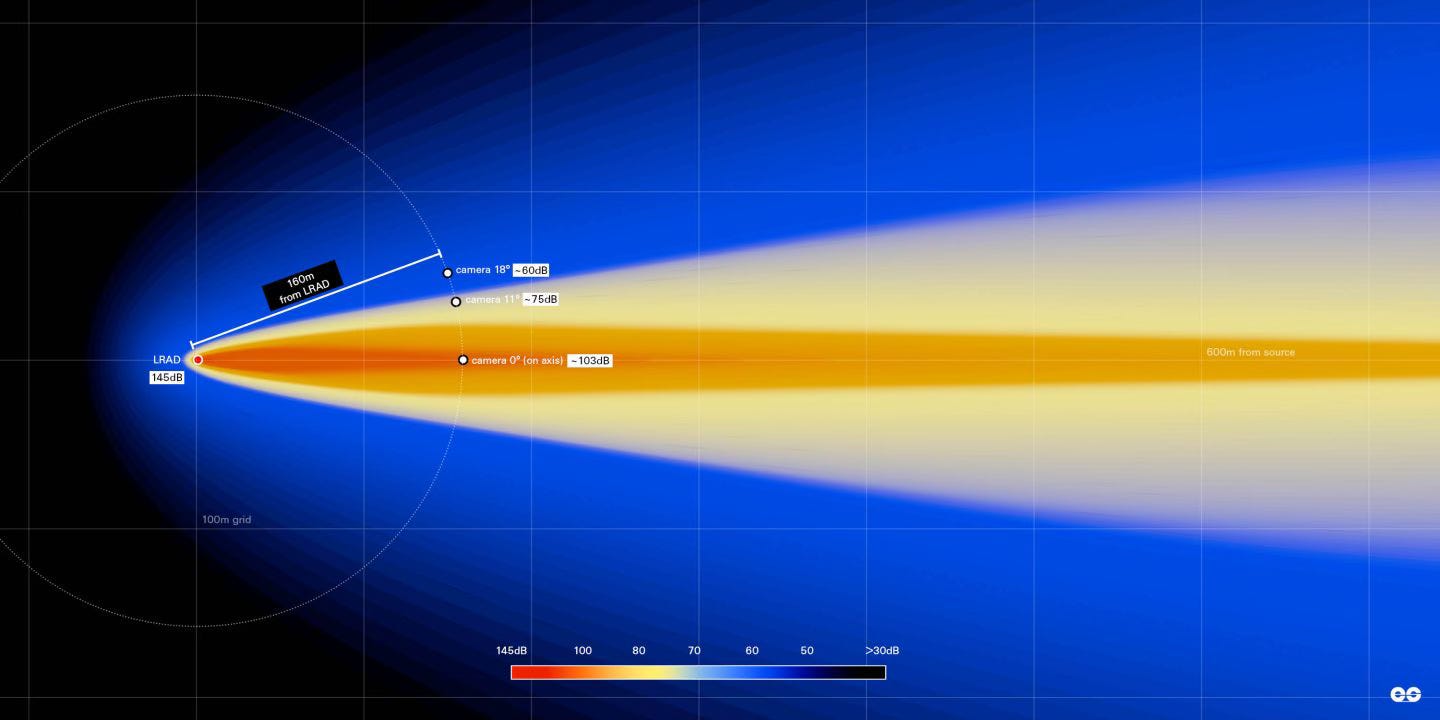
We simulated the LRAD’s propagation characteristics. A listener positioned directly in the beam 160 meters from the source would hear it as loud as a chainsaw (103 dB).
Move just 12° off axis, and it drops to the volume of a vacuum cleaner (75 dB).
At 18° off axis — outside the 30° beam — it becomes as quiet as normal conversation (60 dB), potentially indistinguishable from ambient noise on recording devices positioned at the edges of the boulevard.
The correlation between witness testimony and LRAD characteristics is striking. The four characteristics witnesses consistently described — unfamiliarity, marked directionality, embodied physical sensation, and absence of visible source — map precisely onto the LRAD 450XL’s technical specifications. The device’s narrow directional beam explains why witnesses identified the sound’s origin while unable to locate a visual source. Its capacity to generate intense pressure waves accounts for the physical sensations. And crucially, the narrow beam resolves the acoustic paradox: how thousands experienced an intensely physical sound that left minimal trace on recordings captured outside the beam’s path.
The reconstruction of the sound of the attack serves as a sonic identikit of a fugitive sound, one that evaded capture on recording devices and is denied by Serbian authorities, despite an overwhelming body of witness testimony.
By presenting a reconstruction built by its earwitnesses, our intent was to give form to an experience lived by thousands. When 3,259 people describe the same anomalous experience in remarkably consistent terms — across 3,244 written statements and 15 in-depth interviews — that consistency itself becomes evidence. This case demonstrates how sound captures forms of violence that resist visual documentation — from slow violence and environmental degradation to acoustic weapons explicitly designed to undermine collective action. It challenges how we think about accountability for state and corporate violence.
Our investigation transforms protester testimonies into a document about power itself: how subjugation operates through division, and resistance succeeds through collective action. This is a story not only about a violent attack but about resistance, for two sonic forces confronted each other on the evening of March 15, 2025: one was an acoustic weapon — our investigation concludes it was highly likely the LRAD 450XL; the other was a punishing and enduring 15 minutes of collective silence manifested by hundreds of thousands in response to governmental corruption and neglect.
The protesters that night exercised their fundamental right to peaceful assembly, choosing collective silence as their form of political action. What authorities attacked was not simply individual bodies but this collective right itself — the right to gather and manifest political will through coordinated silence.
On that night, protesters were targeted by a weapon that turned the collective body into its singular component parts. Sound was weaponised by authorities to divide. This investigation — through the reconstruction of a sound experienced by hundreds of thousands — demonstrates how sonic documentation becomes an act of resistance through restoration: reassembling what division sought to fragment.
Optional paid support: If you'd like to support our work, monthly subscriptions are available at $5.00. Earshot is the foremost independent nonprofit organization producing sonic investigations with and on behalf of communities affected by corporate, state, and environmental violence. Your support enables us to conduct investigations, develop the field, and establish sonic evidence within accountability frameworks.