Five years ago, freelancing felt like arbitrage: same work, better pay, without leaving Spain. So I left my full-time job in the middle of the pandemic and gave it a shot.
It worked. I made more money, had more freedom, and worked with all sorts of companies on projects across data science, machine learning, and AI products.
But that was also the problem. Freelancing rewarded my flexibility and never forced me to go too deep into any topic. Eventually, that flexibility became a ceiling.
This is a recap of how I got in, how much I made, how I found gigs, and what I’ve learned in the process.
How I got in
I started thinking about freelancing in 2019, two years before I landed my first contract. That year, I joined a platform that promised you a better-paying job in exchange for a cut of your future earnings. The idea was simple: they would introduce you to people already doing the kind of work you wanted to do, and those people would help you land a similar job.
The platform suggested a few introductions, and one of them stuck with me: a freelance data scientist.
In our first chat, he mentioned almost in passing that he was charging over €600 a day. That blew my mind. He was doing the same work I was doing, but making much more money, and he didn’t have to leave his hometown! I asked if he’d mentor me and help me land a freelance contract. He said yes, then shared his secret sauce: spam people on LinkedIn.
So that’s what I did.
I set up a bot that messaged pretty much everyone involved in data science in Europe: managers, recruiters, and a few confused interns. Most people ignored me. A few wrote back to ask whether what I was doing was even legal. Most recruiters dismissed me because I had no prior freelancing experience.
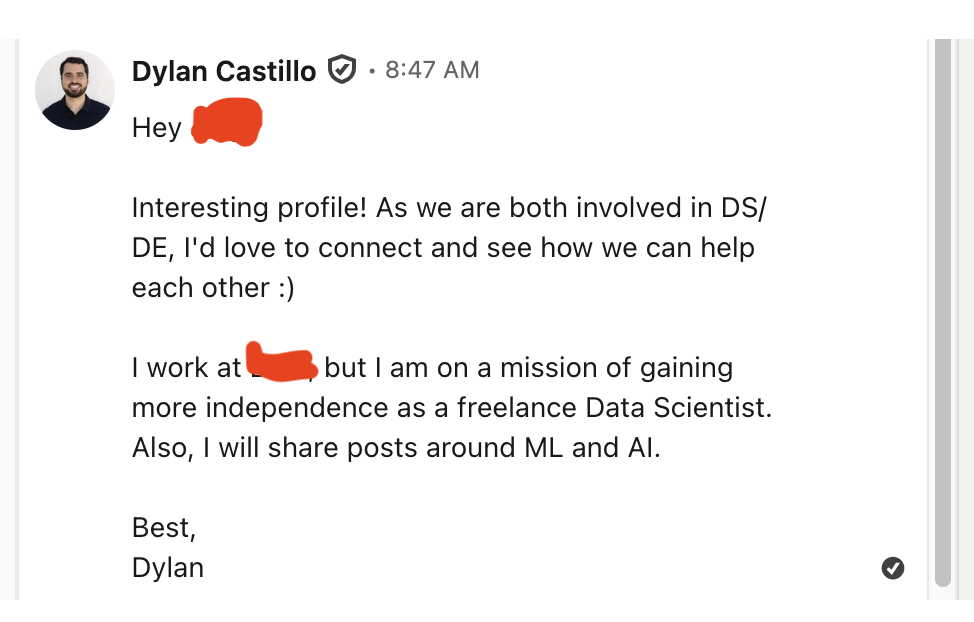
I grew from something like 500 connections to close to 4,000, but the approach didn’t bear fruit. Eventually, I realized our incentives weren’t aligned. His plan was for me to spray LinkedIn messages across Europe while he sent me humblebrag motivational messages to keep me going. If I landed a contract, he’d get a nice cut for the next four years. If LinkedIn blocked my account, that was my problem. So we parted ways.
Instead, I decided to start a blog, share useful projects and tutorials on LinkedIn, and apply to contracting opportunities in the hope that something would pan out. It was a better long-term strategy, but in the short term, it produced zero results.
I started getting desperate. Then COVID hit.
By early 2021, the freelance market in Europe exploded. A friend at the European Commission made an intro, and I got my first contract offer within a couple of days. I also got into multiple hiring processes for contractors around the same time. My first gig was with the European Commission, and shortly after I switched to Deliveroo.
I expected getting into freelancing to be hard. I just didn’t expect the path to involve a failed spam campaign, two years of waiting, and a global pandemic.
What freelancing gave me
My first freelance contract paid €350 a day. From there, my rates grew quickly. For the last few years, I’ve usually charged between €600 and €900 a day. For very short engagements, I generally charge more. In the US or parts of Northern Europe, good freelancers can definitely do better.
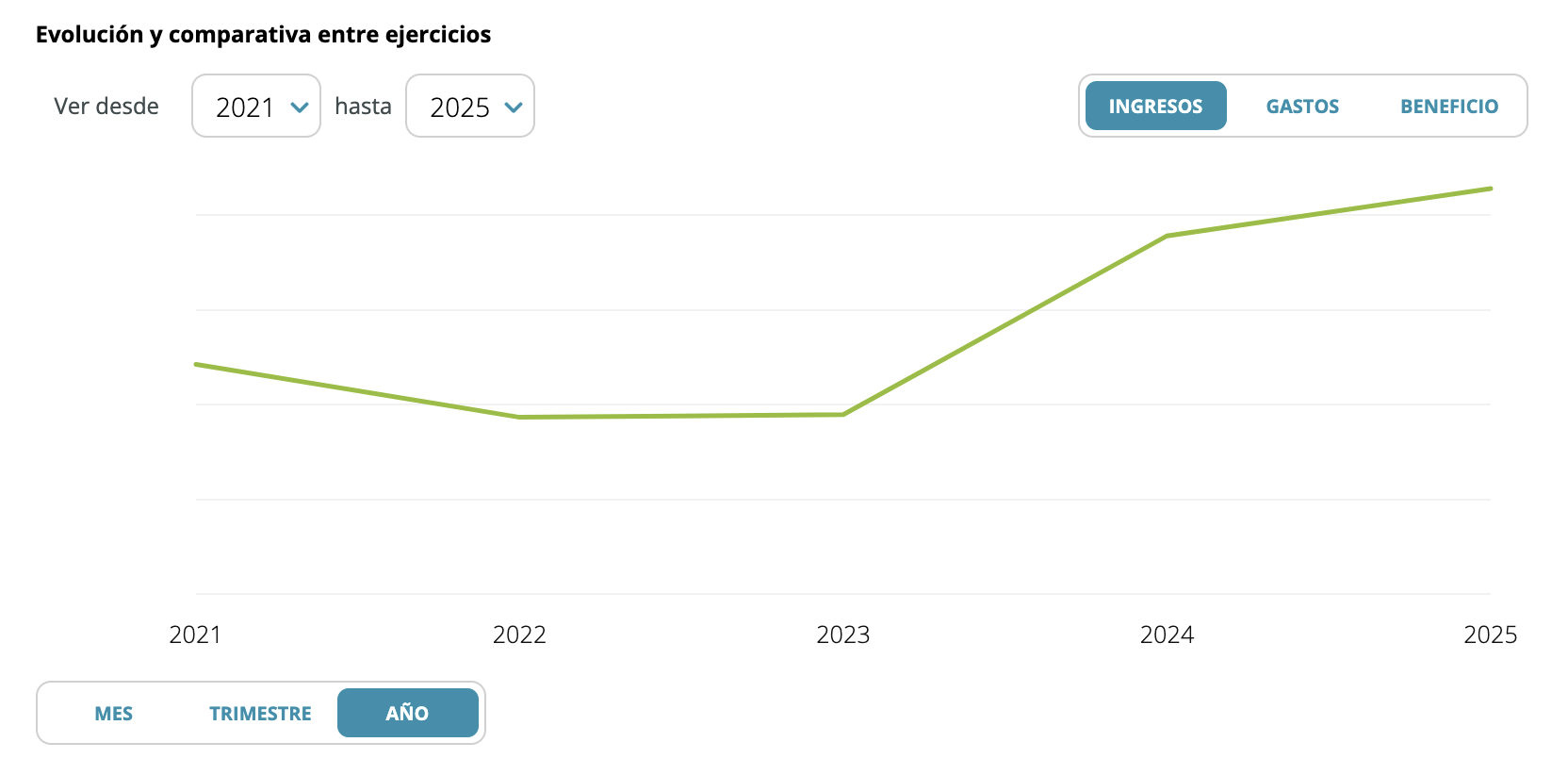
Every year since I started freelancing, I’ve made more than I did in my last full-time job. But my income has still varied a lot depending on how much time I chose to spend on client work. In 2022 and 2023, I spent a lot of time on business ideas, and that shows in the numbers. In 2024 and 2025, I went in the opposite direction: back-to-back contracts and fewer experiments. I worked my ass off. That shows too.
If you have a good lead flow, freelancing gives you a very direct link between effort and income. Work hard, and you will be rewarded accordingly.
That matters to me. My wife and I are immigrants, and we provide financial support for my family and extended family. So yes, I care about money. I also wanted to earn more without leaving Spain, because my wife’s work makes relocating difficult. Freelancing gave me that option.
The second thing it gave me is freedom and comfort. I work fully remotely from home and can often set my own schedule. I stay healthy: I hit the gym four days a week and walk 12,000 steps every day with my walking pad while I work. I also avoid most corporate theater: 360 reviews or recurring “how are you feeling?” meetings.
The third is variety. On one project I’m acting as a technical product manager, scoping a product and figuring out what should be built. On another I’m a data scientist, planning and analyzing experiments. On another I’m an AI engineer, shipping features for workflows or agents. I love the intellectual range of things I get to do.
The fourth is the room it has given me to work on my own things. Because I could work intensely for a few months, save enough to coast for the rest of the year, and then step away, I had real time to try out business ideas and side projects. None of my business ideas worked out, but I’m glad I got to try.
How I got work
How much you make heavily depends on where your clients are. In Europe, Northern European clients usually pay much better than Southern European ones. Even while living in Spain, most of my clients are not local.
For a bit of wider market context, I once took part in a survey of AI freelancers. Among the Europeans in that group, median yearly gross revenue was around €85k. For the US-based freelancers, it was closer to $150k (roughly €128k).
Pricing model matters too. I’ve experimented with deliverable-based pricing, and I usually prefer it. When the contract is tied to an outcome rather than time, my effective rate goes up and the incentives are cleaner: the client cares less about my hours and more about the result.
The danger is scope. If you misjudge the work, you can accidentally sell yourself a very stressful unpaid internship.
But pricing only matters if you have demand. Without lead flow, you have no leverage. For me, that demand has come from a few places.
After the first contract, many projects came from being active on LinkedIn. Some of my posts got good traction. For example, Ask Seneca, a small demo that showcased a simple RAG system in the early days of LLMs. It ended up on the front page of Hacker News and got mentioned in The Economist. Other projects followed similar paths. That visibility translated into people reaching out about work.
Another big channel has been personal relationships. Friends from Entrepreneur First, past clients, and former employers have reached out when they had projects I’d be a good fit for. These are the best types of leads because they require very little effort to close.
I’m also in a couple of freelance platforms (á la Toptal). They can be useful for lead flow, but over time the rates have gotten worse. Platforms make comparison easy, and comparison turns you into a commodity. That is bad for your rates.
The thing I have neglected lately is content. Which is stupid, because that’s how you build authority and get strangers to trust you. I once heard Jason Liu summarize the best way to charge high consulting rates: “be famous.” I agree. There’s a world of difference between someone wanting to hire “an AI engineer” and someone wanting to hire Dylan Castillo. No one can outcompete me at being me.
I’ve gotten a bit lazy on that front because I’m rarely out of projects. But I’m probably missing out on better opportunities, clearer positioning, and higher rates by not putting more work into the world.
Finally, freelancing runs on a much shorter horizon than full-time work. Projects typically run three to six months, and I rarely know in advance whether a contract will be extended — or whether I’ll even want to stay. That forces you into a permanent “always be selling” mode. Even when I’m fully engaged with a client, part of my brain is scanning for the next gig.
How I positioned myself
Over the last five years, I’ve worked across data science, data engineering, ML, backend systems, and AI products.
Early on, most of the work was classic data and ML. Since 2023, it has shifted heavily toward AI: building workflows and agents for B2B clients, helping startups ship AI products, supporting academic research groups, teaching courses, and leading technical work on personalization and experimentation.
At some point, I tried to position myself as the person who could help teams take AI products from zero to one. But that quickly blurred into something less useful: “the guy who knows about AI.”
That is the trade-off I’ve been struggling with. Clients generally hire me because I can get things done. I know how to connect the dots between product, data, backend, and AI. But I’m not getting hired because someone thinks of me as the expert in one particular topic.
Freelancing made it easy to stay that way. Contracts tend to be short, and I usually picked projects based on what I found interesting and what paid well. I never made a proper plan for what I wanted to become. So even as my rates grew, I never found a way to stop looking like just another freelancer.
That is the ceiling I’ve hit. I can still find work. But I don’t yet have a strong enough answer to “Why you?” to go above the rates I charge now. At higher rates, clients want more than competence. They pay for reputation and/or deep expertise, not just a get-things-done guy.
What I’d do differently
With hindsight, these are the things I’d do differently if I were starting over:
Don’t start by trying to convince strangers. The boring answer is the right answer: use your network. And by that, I don’t mean LinkedIn randos. Reach out to former colleagues, old bosses, past clients, and people who already know your work. That’s the simplest way to get started. It’s awkward, but it has, by far, the highest chance of success.
Pick a lane earlier. I never committed to a specific niche or to publishing consistently, so I did not build much of a reputation beyond my close network. If I were starting again, I would choose a problem space and start making content about it. Even if I got it wrong at first, forcing myself to put work into the world would help me sharpen my positioning.
Treat client work as market research. I spent too much time on random side projects and not enough time asking which parts of my client work could become repeatable services or products.
Don’t be greedy. I would have been more deliberate about choosing projects that exposed me to better problems or helped me build expertise I could later productize. A slightly lower-paying project in the right direction can have a better ROI than a high-paying project that keeps you stuck.
What’s next for me
I’ve never felt this uncertain about the future – for reasons both good and bad.
On the optimistic side, Iwana Labs is starting to change. Until now, it has mostly been a vehicle for my own freelance work, with occasional projects where I brought in collaborators. Some of those collaborations have kept growing, and by the end of the year, I hope to go from a one-man show to a small team.
We don’t want to be just another AI development agency™. Yes, I know everyone says the same thing when they get started. But we have a few areas where we’ve built expertise over the years, and I hope we can position ourselves around them.
On the scary side, I genuinely don’t know what’s going to happen to the software industry. The changes from AI have been amazing to watch. But my best guess is that we’re heading toward a much more unequal distribution of the profits. I worry the economics are shifting from something like the top 20% capturing 80% of the value to something closer to the top 1% capturing 99%.
We’ve already seen the $1B one-man company and companies with crazy growth rates. Work that used to require a full team can increasingly be done by fewer people with better tools. Maybe the amount of work to be done will keep growing even faster than the supply of people able to do it. I hope so. But I’m not sure.
When AI gives everyone the ability to build, being “pretty good at building” becomes less valuable. You need taste, distribution, deeper expertise, and stronger relationships.
And honestly, I have to ask myself whether I’ll make it into that top 1%. I’m optimistic about my skills, but the real world doesn’t care about that. There are tons of amazing, highly motivated people out there. We’re in an industry with almost no barriers to entry, where the money has been good so far, and where AI can already do a lot of the work. What was already an extremely competitive industry just got much more competitive.
The next chapter is partly about responding to all of that. Finding the right people to grow with, and figuring out where we can set ourselves apart. Five years in, I love what freelancing has taught me and the opportunities it has given me. But the next five years will need to look different if I want to stay relevant through what’s coming.
Citation
BibTeX citation:
@online{castillo2026,
  author = {Castillo, Dylan},
  title = {Five {Years} of {Freelancing}},
  date = {2026-04-25},
  url = {https://dylancastillo.co/posts/5-years-freelancing-in-europe.html},
  langid = {en}
}
For attribution, please cite this work as: