Taylor Swift made headlines last year when she was reported to have taken a 40-second flight in her private jet, a Dassault Falcon 7X, to travel from Los Angeles to Santa Monica—a distance that can be covered by car in under an hour. The incident reignited public debate over celebrity use of private aviation, highlighting the disproportionate environmental footprint of short-haul private flights and the broader questions they raise about accountability and climate responsibility.
It made me start to wonder: with all these flights that the rich and wealthy are taking, what are the health risks associated with flying? Prolonged air travel is known to increase the risk of DVT, dehydration, and circadian rhythm disruption. But an interesting and less discussed aspect of frequent flying is exposure to cosmic radiation. A transcontinental flight is about 0.035 mSv, equivalent to 1-2 standard chest X-rays. So, all of Taylor’s many flights can’t be good for her, right? As we’ll see, her radiation dosage was not as much as I was expecting.
At sea level, we’re shielded from most cosmic radiation by Earth’s atmosphere and magnetic field. But as you climb higher, that protection thins out. At typical cruising altitudes, radiation exposure increases significantly compared to ground level. Pilots, flight attendants, and yes, even frequent-flying pop stars, absorb more cosmic radiation than the average person.
We calculate radiation dosage using Flight Time Equivalent Dose (FED), which estimates the amount of ionizing radiation absorbed during air travel based on flight duration, altitude, and latitude. Taking a look online (Thanks Wikipedia!), FED is calculated by taking a known dose (in millisieverts) and dividing it by the average dose rate at an altitude of 10,000 m, a typical cruising altitude for a commercial airliner. (1)
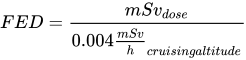
While radiological dose at cruising altitudes varies with latitude, for FED calculations, the radiological dose rate at an altitude of 10,000 m has been standardized to be 0.004 mSv/h, about 15 times greater than the average dose rate at the Earth’s surface.
This gives us a cool chart of different activities standardized to the “flight-hours” unit of measurement:
Source | Frequency | Dose (mSv)| Equivalent Flight Time
Airport backscatter x-ray scan | singular | 0.00001 | 9 seconds
One hour of sun exposure | singular0.00004 |36 seconds
Household smoke detector | annual | 0.00008 | 1.2 minutes
Living near a nuclear generating station | annual | 0.00009 | 1.3 minutes
Eating one banana | singular | 0.0001 | 1.5 minutes
Living near a coal generating station | annual | 0.0003 | 4.5 minutes
Crowns or false teeth | annual | 0.0007 | 10.5 minutes
Bone scan or extremity (arm) x-ray | singular | 0.00115 minutes
One hour of air travel | singular | 0.004 | 1 hour
Dental (intraoral) or knee x-ray | singular | 0.005 | 1.2 hours
Dental (panoramic) or shoulder x-ray | singular0.01 | 2.5 hours
Sleeping next to someone | annual | 0.02 | 5 hours
Bone scan with CT | singular | 0.04 | 10 hours
Living in a stone or brick building | annual | 0.07 | 17.5 hours
Chest or skull x-ray | singular | 0.1 | 25 hours
I calculated Taylor Swift’s Flight-Time Equivalent dose by collecting comprehensive flight data from her private jet (N621MM) spanning from 2023 to the present, sourced from celebrityprivatejettracker.com (2). After copying the flight logs into an Excel spreadsheet, I processed the data in a Jupyter notebook.
The data extraction proved challenging because the flight information—including distances in miles and durations in hours and minutes—was stored as plain text strings rather than numerical values. To overcome this, I developed custom parsing functions using regular expressions to extract flight miles and flight times.
02/11/2025Morristown Municipal Airport (MMU)
New JerseyNashville International Airport (BNA)
TennesseeMorristown Municipal Airport (MMU), New Jersey was the originating location for the previous incoming trip that took 2 hours, required 570 gallons of jet fuel, flew almost 740 flight miles long and emitted about 6 metric tons of CO2 pollution.
Verified:02/11/2025Nashville International Airport (BNA)
TennesseeMorristown Municipal Airport (MMU)
New JerseyNashville International Airport (BNA), Tennessee was the origin for the last trip which burned 890 gallons of jet fuel, took nearly three hours, created eleven metric tons of carbon dioxide emissions and flew around 740 flight miles long.
Verified:
I created a comprehensive parsing function to extract flight miles, flight times, and dates from the text data:
def string_search(df, idx, string_type=’flight miles’):
    # Conversion dictionary for word to digit
    WORD_TO_NUM = {
        ‘one’: 1, ‘two’: 2, ‘three’: 3, ‘four’: 4, ‘five’: 5,
        ‘six’: 6, ‘seven’: 7, ‘eight’: 8, ‘nine’: 9, ‘ten’: 10,
        ‘eleven’: 11, ‘twelve’: 12, ‘thirteen’: 13, ‘fourteen’: 14, ‘fifteen’: 15,
        ‘sixteen’: 16, ‘seventeen’: 17, ‘eighteen’: 18, ‘nineteen’: 19, ‘twenty’: 20,
        ‘thirty’: 30, ‘forty’: 40, ‘fifty’: 50
    }

    def word_to_number(word):
        “”“Convert word to number, or return as int if already numeric.”“”
        if word.isdigit():
            return int(word)
        return WORD_TO_NUM.get(word.lower(), 0)

    def parse_duration(text):
        “”“Parse duration text and return standardized format.”“”
        match = re.search(pattern, text.lower())
        if not match:
            return None
        hours = word_to_number(match.group(’hours’))
        minutes = word_to_number(match.group(’minutes’)) if match.group(’minutes’) else 0
        return hours * 60 + minutes

    # Locate string
    my_str = df[df[’group’] == idx].iloc[1,1]

    if string_type == ‘flight miles’:
        matches = re.search(r”\b\d{1,3}(?:,\d{3})*\s+flight miles\b”, my_str)[0]
        return float(matches.split(’ ‘)[0].replace(’,’,’‘))

    if string_type == ‘flight time’:
        pattern = r’(?P<hours>\d+|one|two|three|four|five|six|seven|eight|nine|ten|eleven|twelve)\s+hours?(?:\s+and\s+(?P<minutes>\d+|one|two|three|four|five|six|seven|eight|nine|ten|eleven|twelve|thirteen|fourteen|fifteen|sixteen|seventeen|eighteen|nineteen|twenty|thirty|forty|fifty)\s+minutes?)?’
        return parse_duration(my_str)

    if string_type == ‘flight date’:
        return df[df[’group’] == idx].iloc[0,0].date()
I created visualizations showing the total flight time and distance traveled by year:
# Total flight time by year
sns.barplot(swift, x=”Year”, y=”Time (min)”, estimator=”sum”, errorbar=None)

# Total miles by year
sns.barplot(swift, x=”Year”, y=”Miles”, estimator=”sum”, errorbar=None)
Let’s look at her charts:
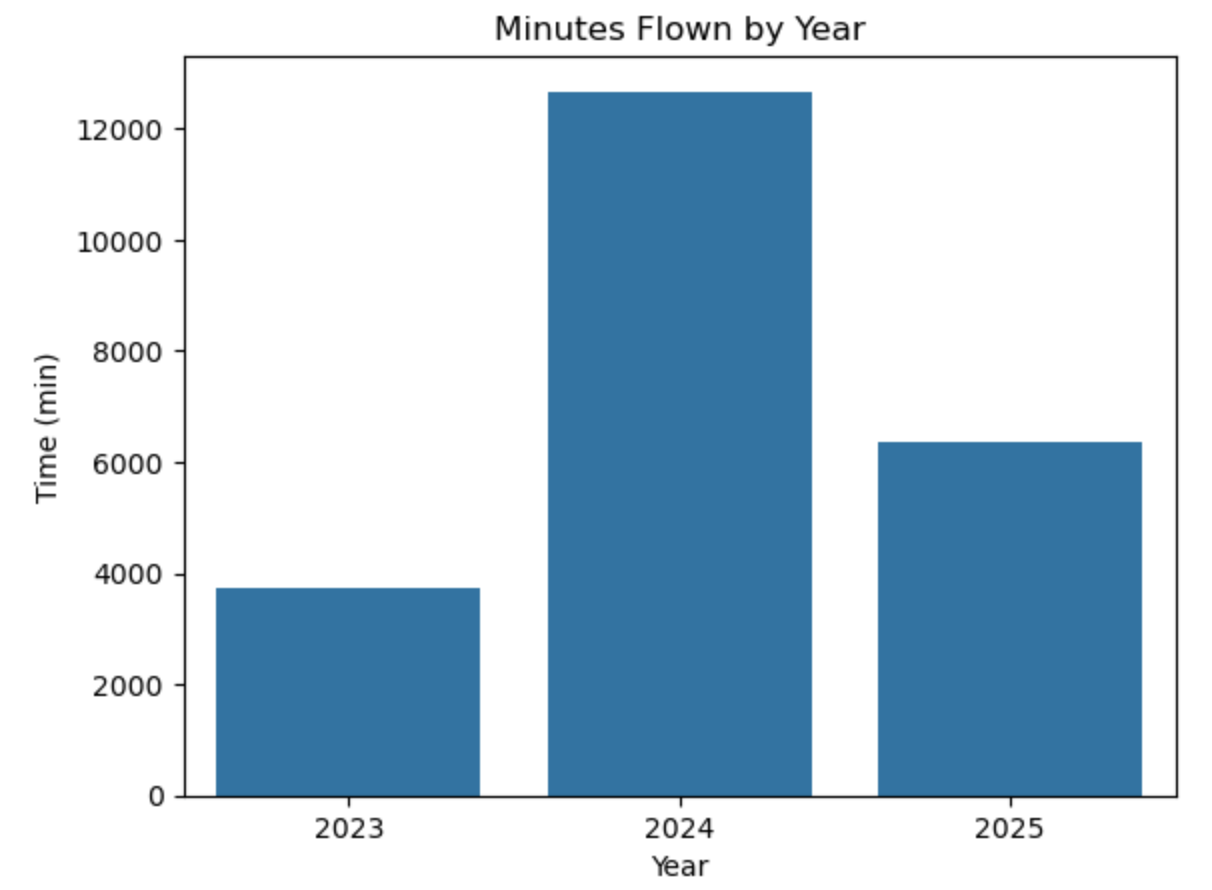
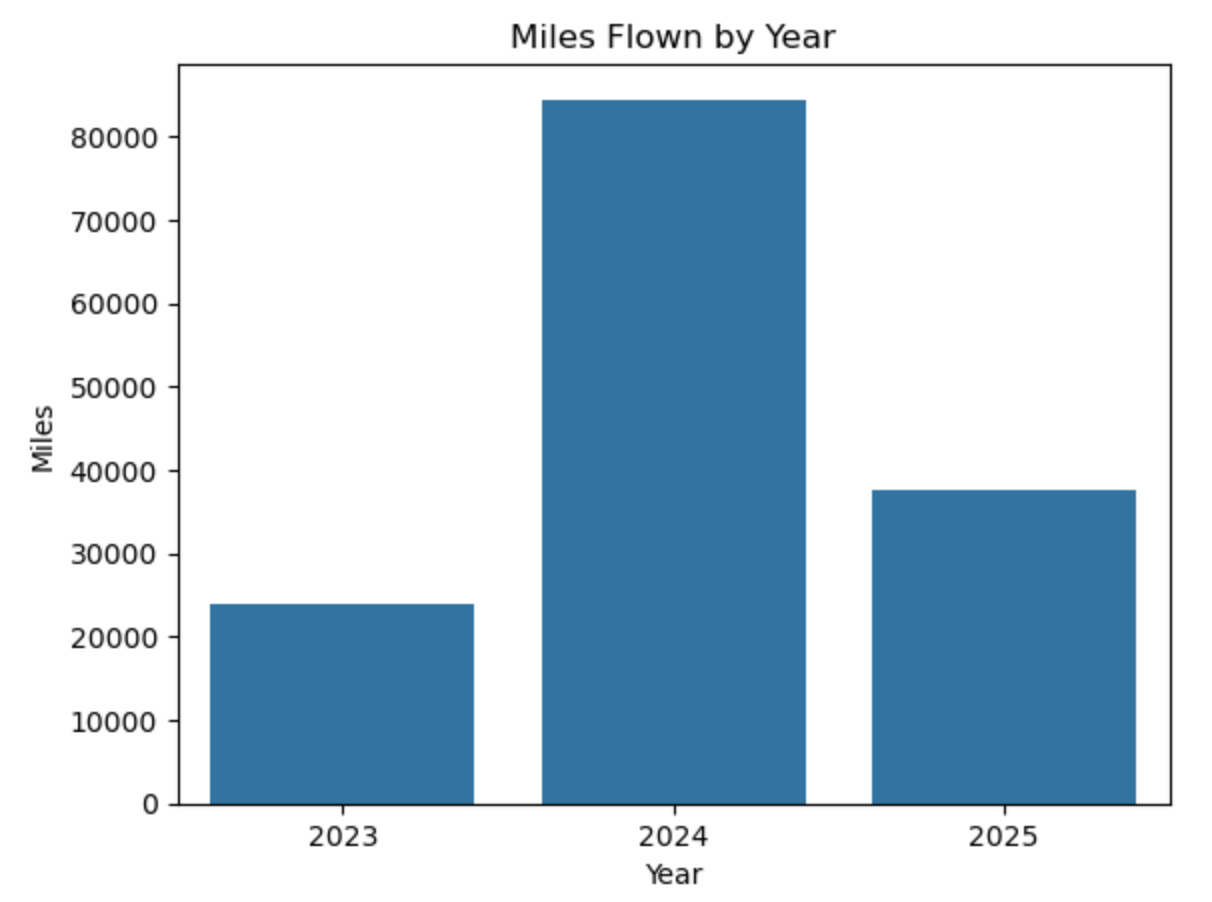
Taylor flew for almost 360 hours these past few years, with a maximum of 200 hours in 2024. This equates to:
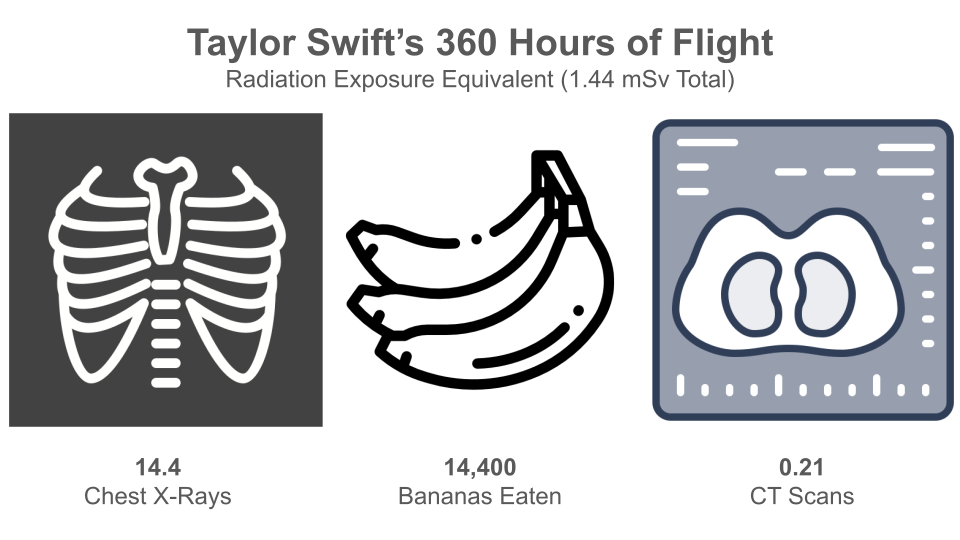
This is far less than the average 900 hours/year that commercial airline pilots fly. Furthermore, my analysis assumes that all of those 360 hours were spent at cruising altitude, so her actual flight-hours are much lower.
While there are no defined dose limitations for US aircrews, the International Commission on Radiological Protection (ICRP) recommends an effective dose limit of 20 mSv per year averaged over 5 years (totaling 100 mSv in 5 years) for radiation workers. However, for the general public, the recommended limit is 1 mSv per year. (3).
So, even after decades of this level of flying, the cumulative excess cancer risk would remain small and far below designated thresholds.
Taylor Swift’s jet-setting lifestyle exposes her to more cosmic radiation than most people, but the cancer risk from this exposure alone is negligible, and she flies nowhere near levels that should cause concern.
So while the environmental impact of private jet travel remains a valid concern, Taylor Swift probably doesn’t need to worry about cosmic radiation giving her cancer. The universe has plenty of other things to throw at us—this just isn’t one of the big ones.
(1) https://en.wikipedia.org/wiki/Flight-time_equivalent_dose
(2) https://celebrityprivatejettracker.com/taylor-swift-n621mm/
(3) https://www.versantphysics.com/2024/03/27/flight-crews-and-radiation-exposure/
Headline image courtesy of Business Insiders - I take no credit for the photo and is for educational purposes only.
*Note: I’m not an expert, this was just a fun thought experiment. This analysis is for educational purposes. Actual radiation exposure varies based on flight routes, and many additional factors.*