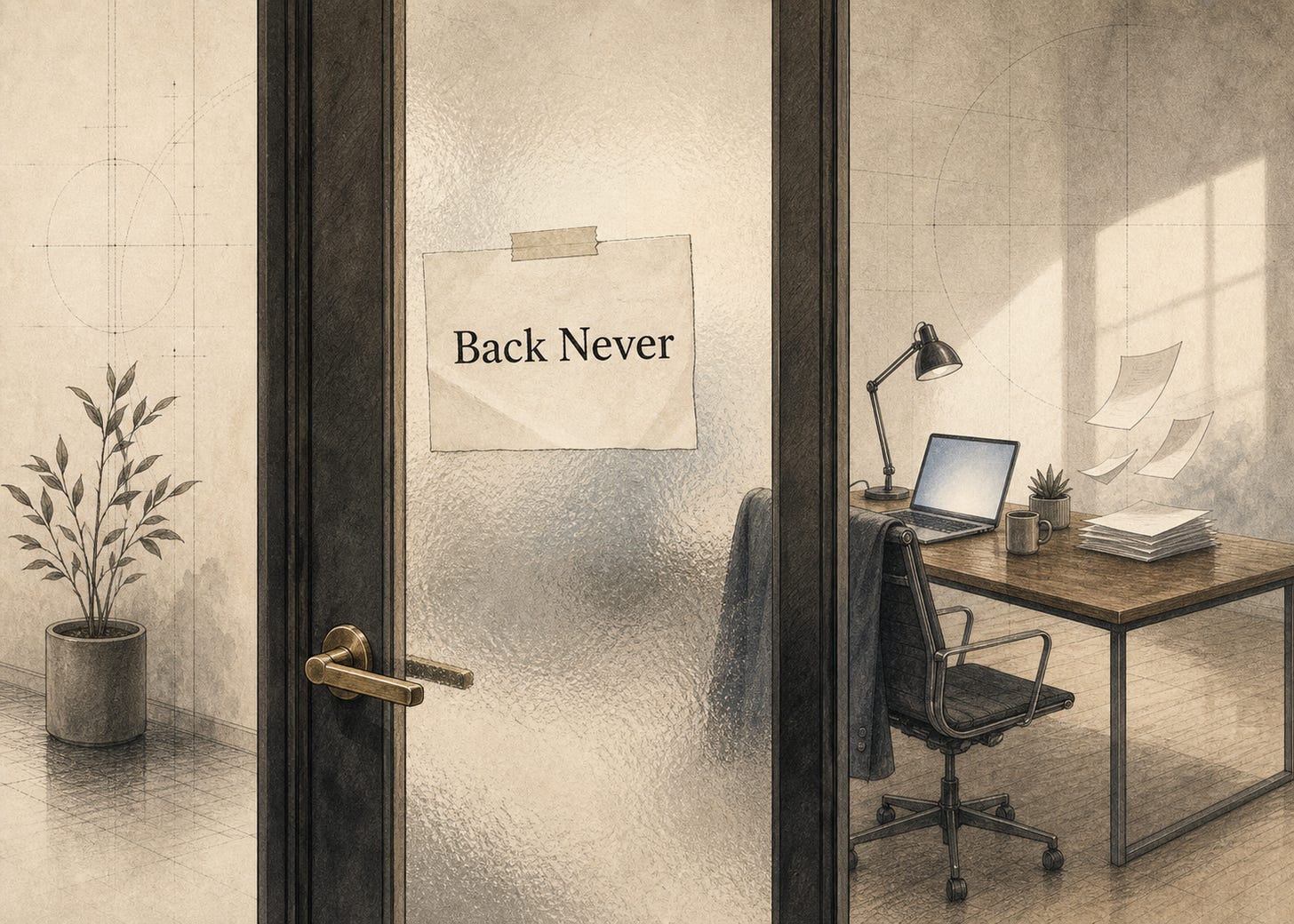
Mass unemployment engenders alarm. It calls to mind breadlines, despair, humiliation, wasted lives, social collapse. That’s why the prospect of AI putting millions out of work is everyone’s nightmare.
Then again, it is also one of humanity’s most enduring dreams.
Homer imagined a god who forged himself metal attendants. Aristotle wrote that “if the shuttle could weave by itself and the plectrum pluck the lyre, masters would have no need of slaves.” Folklore is full of genies who do our bidding, apprentices delegating chores to enchanted brooms, and elves who work while we sleep. And a modern comic strip gives us Calvin’s cardboard-box Duplicator: a machine to send a copy of himself to do the boring work while he goes off to play with Hobbes.
The question of the day seems to be: how many jobs will AI destroy, and how many will it create? That matters. But it is a spectator's question. The deeper question is more unsettling: might we want AI to take our jobs?
“The goal of the future is full unemployment, so we can play” — Arthur C. Clarke
The familiar has a strong pull. Resist its grip for a minute, and it’s easy to see both the appeal of Calvin’s Duplicator, and how his fantasy could become a real political choice.
Imagine you had a digital twin that you sent to work in your stead. It answers your emails, writes your memos, handles your spreadsheets, attends your meetings. Your boss doesn’t notice the switcheroo, so your paychecks keep coming. Back at the ranch, you’re sleeping more, lifting more, traveling more, reading more, volunteering more, and spending more time with family and friends.
Would you call that unemployment? More probably you’d call it magic.
Your employer might call it magic too. For the same salary, they now get a version of you that is lower maintenance, while working faster, longer, and smarter. Everyone wins.
Dwell on that. You are not working, yet your employer’s productivity is up. You are drawing a wage for doing nothing, yet no one is out of pocket. How come?
Well, in classic unemployment, if you’re not working, the work isn’t getting done. Society is making less, so there’s less to go around. Cue the breadlines and social collapse.
When your digital twin takes your place, you’re not working but your work is getting done, and then some. Production is decoupled from your exertion. So although you’re working less, society is making more, and there’s more to go around.
The thought experiment shows that when we’re replaced by a more productive technology, there’s enough money in the system to pay everyone a generous wage, without anyone losing out. Taken ad extremum, that logic holds even at 100% unemployment. Cue abundance.
So why does the prospect of AI agents working instead of us feel less like deliverance and more like disaster?
“You’re fired.” — The Apprentice
The way things are going, your digital twin may, in fact, soon do your job and increase output — but you won’t own your digital doppelgänger. Your employer will. Now your salary becomes their margin. You don’t get leisure. You get a severance package.
Same digital stand-in. Same growing pie. Different distribution. Opposite social outcome.
That is the thing we fear. Not that machines will work instead of us. That they will work for someone else.
Left to market forces, we do not have to strain to imagine how that plays out. Most succinctly, the AI revolution can be summarized in three words: capital displaces labor. Great if you have capital earning for you. Less great if you sell your labor for a living.
I understand that “distribution” is a loaded term, and “redistribution” can be triggering. When I talk about the AI surplus, people quickly reach for bludgeons like “socialism” and “communism.” Let me try to parry those.
I am a capitalist. I think markets, entrepreneurship, competition, private ownership, and the profit motive have done more than anything to boost humanity’s lifespan and quality of life. The AI era does not call on us to abandon capitalism. It calls on us to notice when elements of its machinery start to warp.
The wage economy has been central to capitalism. Its bargain is simple: people work because they are paid. Because people work, society produces more and there’s more to go around. Everyone is better off.
That bargain has not only been productive. It has been morally powerful. It underwrites meritocracy: work hard, develop useful skills, take risks, create value, and you deserve to keep a meaningful share of what you produce.
But the bargain rests on a formula: human labor is central to production, and a share in production — wages, bonuses, stock options — is the best motivator for human labor.
If production becomes decoupled from humans and their incentives, that formula unravels.
Robots do not work harder because they want a promotion. Models do not answer more prompts because they hope to buy a house. AIs are not motivated by salaries, benefits, school fees, or retirement accounts. They are not participants in the wage economy. They are capital.
If machines produce more of the output while humans remain entitled to income mainly through wages, the social contract that underpins capitalism wobbles. That will become glaringly obvious if the job apocalypse materializes, but may well manifest as yawning inequality even if employment levels remain high.
A shrinking share of labor in the economy also does violence to the moral underpinnings of the current bargain. In a human-labor economy, unequal outcomes can at least be defended by saying that people contributed unequally. That’s what meritocracy argues for.
But in an AI-heavy economy, more and more income may flow not to those doing the work, but to those who own the systems that do. Their competitive advantage won’t be that they work harder or smarter than you — their AI will be working hard and smart — it will be that they can afford more tokens than you.
None of this makes markets useless. It doesn’t mean private property should end, entrepreneurship no longer matters, or risk should not be rewarded. It is not an argument for central planning.
But it does mean the old moral and economic logic cannot simply be carried forward unchanged. If machines produce more of the output, humans need some claim other than “I personally performed the labor.” Otherwise the economy may grow richer while much of society grows poorer. That’ll look less like a meritocracy and more like a return to feudalism.
As machines assume more of society’s productive burden, we’ll have to adopt policies to ensure everyone benefits from the resulting abundance. This is where proposals like Universal High Income come in. People like Elon Musk have argued for it; the MOSAIC AI Policy Institute, where I volunteer, has put forward a concrete model for how such a thing might be implemented.
My point here is not to advocate for specific plumbing, but to underline that the ancient dream is not economically incoherent. What was a flight of fancy for millennia is now a credible policy option. But we haven’t laid the pipes for it yet, and they aren’t going to lay themselves.
“The hardest work in the world is being out of work.” — Whitney M. Young Jr.
Even if proposals like the MOSAIC Model became policy, we’d still have much designing to do.
Work has never been only about the paycheck. It is also one of the ways people get structure, status, discipline, community, usefulness, dignity, and the feeling that they matter.
This is a deep problem. It deserves its own essay, and probably its own institutions. A society that loosens the identification of livelihood with employment will still need ways for people to be needed, stretched, respected, and useful outside the old compulsion of the wage.
But that is not a reason to preserve economic precarity. We don't want jobs for their own sake. We want what jobs provide. A job is one mechanism for delivering those goods. It is not the good itself.
We already have encouraging examples of people flourishing outside the ordinary wage bargain. Many retirees live lives of family, friendship, hobbies, reading, volunteering, worship, and travel, with monthly income that bears no correlation to how they spend their days. Stay-at-home parents live busy, creative, and deeply fulfilling lives, with their workload entirely decoupled from how they pay the bills.
We see another version in the university. When tenure works as planned, a professor of Medieval Studies, Linguistics, Philology, or Philosophy may spend their days reading manuscripts of deep personal resonance but of no commercial or popular interest. And their paycheck will not vary depending on how they actually spend their days.
It is not obvious that we can scale retirement, parenthood, or academia. These are partial analogies, not blueprints. Retirees had careers first; stay-at-home parents have dependents whose needs govern their days; tenured professors passed through a brutal tournament before they won protection from it. None of this tells us how to rebuild meaning for a 22-year-old whose first job has just been automated. But it does show that fulfillment, status, discipline, and contribution need not always be routed through familiar wage labor.
“I like work: I can sit and look at it for hours.” — Jerome K. Jerome
So: who wants to work anyway? It depends what we mean.
If work means a livelihood, everyone wants that. If work means contribution, mastery, care, duty, creativity, and purpose, then almost everyone wants work of some kind.
But if work means performing tasks a machine could do better merely so society can route income through a paycheck; if it means preserving toil because we lack the imagination to distribute abundance any other way — then I’m not so sure.
AI forces the question because it may finally make the old fantasy real. Machines that can labor in our place are no longer myth, folklore, or cardboard-box cartoons. They are arriving.
The current debate about AI and unemployment asks whether things will end well if something cataclysmic changes — humanity loses its monopoly on intelligence and capital displaces labor — yet we change nothing about our worldview, our social contract, our public policies, or our conception of capitalism.
That’s easy. No. That is the nightmare.
The more constructive question is this: can we change our worldview, our social contract, our public policies, and our conception of capitalism so that we can all live richer lives — in all the currencies that matter — if capital displaces labor?
The answer to that is not easy. But it is yes. If we stop forecasting and start designing.