So, I recently learned how pen caps work. I think it’s neat, so I’m going to tell you about it, but I also think the experience of figuring this out illustrates some other interesting things about the world, so I’m going to tell you about that too.
First, pen caps.
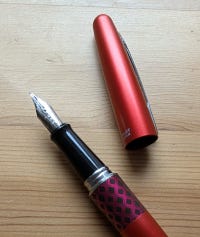
Some context: I mostly write with a fountain pen.1 I often put it down when I’m mid-writing because I need to think something through, get distracted, and as a result I leave it out having forgotten to put the lid back on and the nib dries out. This is mildly annoying.
One time recently I had done this and thought “Oh, that’s annoying, I should have put the pen cap on”. Then I stared at the pen cap for a bit and went “Wait, hang on… how on earth does that work?”
My naive intuitive model of this is that it’s like vegetables. If you put cut vegetables in an open bowl in the fridge, they’ll dry out. If you put them in a sealed container or bag, they won’t. If anything they’ll seem damper when they come out.
The reason it works like this though is that vegetables contain a lot of water. When in dry air, that water evaporates and is released into the air. The dryer the air, the more water is released. The more humid the air, the less, until at a certain level of wetness the amount of water condensing onto the vegetable is the same or equal to the amount of water evaporating from it, and the vegetable stops getting drier. The reason why putting vegetables into a container stops them drying out too much is because they release water into the air until the air is humid enough that it reaches that point and they stop drying out further.
Something you can see from this is why it matters that the container be small. If you think about it, just putting them in a bowl in the fridge is also putting them in a sealed air tight container, it’s just a fridge sized one.2 Because the fridge is so large relative to the vegetables, they can never release enough water to reach the point where they stop drying out. In contrast, a small container doesn’t have much air in it, so the vegetables can easily make it humid. The smaller the container, the better this works - the ideal is a small bag you’ve pressed out all the air from.
The thing is, a pen nib doesn’t have a lot of liquid on it, and the cap is quite large. I can’t give you actual numbers so this may be wildly off, but based on how quickly a pen nib dries out in air, and how little ink is lost when you do that, I’d be astonished if it could reach equilibrium before the pen nib is just thoroughly dried out. Also if you take the lid off and on again a lot, you’d be let the humid air out of the cap, restarting the whole process, which doesn’t track my experience that cycling putting the cap on and taking it off again doesn’t result in the pen drying out.3
So: Intuitive theory that the way pen caps work is just keeping the nib in a closed environment, seemingly false.
My second theory was that the cap was structured so that the nib was actually pressing against metal on the inside, so there was little to no air contact causing the evaporation. I did some fiddling with putting the pen away and it’s a little hard to tell for sure, but the shape of the pen cap doesn’t seem to support this: The nib is straight, while the cap on my pen is curved. Also the cap is much longer than the part of the pen above the seal.
At this point I performed the ultimate experiment: I looked up the answer. As one would expect from the internet, there is an an entire website dedicated to fountain pen design, and after a bit of googling I found both it and this specific page on fountain pen cap mechanics and physics.
The key bit of this page is:
In summary:
Inserting a pen into a cap as well as removing the cap from the pen causes pumping action
taking the cap off → suction, some vacuum is caused inside the cap
putting it on → compression of air inside the cap
That is: It’s not just, or even necessarily primarily, that putting a cap on the pen keeps it dry. Taking a cap off a pen makes it wet again, because it draws out the ink from the reservoir through suction .
This is an easy experiment to perform, so I did: I waited for my pen to get dry, put the cap on, and immediately took it off. The pen was still a little dry but had become wet enough to be usable for writing again. Claim validated.
At this point, my mind was absolutely blown. This is not a mechanism that it would ever have occurred to me was in use here. It makes complete sense in retrospect, but it simply wasn’t on my radar as a possibility.
An additional wrinkle: Some subsequent experimentation caused me to conclude that it wasn’t just this that was going on, and my earlier theory that it was like vegetables actually does hold some water. I investigated the other pen I use on the regular, a uni-ball eye,4 and by shining a flashlight down it, the way the cap is designed very clearly has a tiny near-airtight well at the end that the nib goes into. The nib isn’t in contact with the lid, but it is enclosed in a very small space, which means that it’s much easier for it to reach equilibrium with the air. This also has an air tight cap, and it’s harder to make a rollerball dry out, but some experimentation with it made it clear that there’s still some of the same effect going on and the nib has much more ink on it when the cap is put on and removed.
Once I had spotted this, I experimented with running the fountain pen nib down the inside of the lid, and realised that there is a slight ridge around where the actual nib will reach, so there’s clearly an extra air tight seal happening there, putting the nib in a much smaller area.
Speculating, I think this is particularly important for long term nib usage: If I keep the fountain pen closed for hours or days, especially if it’s in a bag, more ink will come out of it as it moves (if you shake a fountain pen vigorously, ink will fly out, so presumably moderate shaking also causes moderate flow), and so reaching equilibrium with the air in the cap quickly helps prevent that drying out.
This detail aside, for short term usage of the pen cap, what clearly dominates is the suction effect of the cap.
Why am I telling you about this?
Well because it turns out that pen caps’ mechanics are fascinating, and if you didn’t find this information incredibly interesting I really don’t know what to tell you. I’m probably not going to go out and become a pen cap enthusiast,5 but I’m really delighted to have learned this fact and wanted to share the delight.
It’s also incredibly useful to know about for when the pen does dry out, because it’s far more effective as a means of fixing that than anything else I was doing before I knew this,6 and hopefully some of you will find that useful too. Although, according to the fountain pen mechanics site, don’t do this too often as it may cause your pen to drip by filling up the feed too much.7
But I also think this interesting for a couple of more generalisable reasons.
The first is that it’s an interesting encounter with reality having a surprising amount of detail. Pens seem… if not simple, at least not something that you have to think about the complexity of that much. I know how pens work, in much the same way that I know how bicycles or toilets work - I couldn’t build one, but I could sketch out enough of the details of how they work and express the bounds on my ignorance that I’m not going to embarrass myself too badly when I try to explain them.
But we’ve been using pens for thousands of years, and fountain pens for at least hundreds of years, and that’s a lot of time for the design to evolve, and for us to figure out how to solve problems with previous designs, and looking at the modern version of them you might not even realise that they’re solving those problems because you’ve never really noticed you had them in the first place.
The second thing is that it illustrates a principle that I don’t have a very pithy name for, but is something like… how things work is how you work with them.
You may not realise that you have those problems, but you still have those problems, and if you use things wrong they will not solve those problems for you. The ideal device is designed so that you never have to think about that, and even in non-ideal cases you can often get away with not thinking about it, but there will inevitably come times where knowing how it works will make life better for you - because it’s broken, or because you want to do something unusual with it, or even just because you want it to work better.
Most things though are not ideal, because we cannot build perfect systems, and as a result you will use them wrong if you don’t have some understanding of what they do. A trivial example of this is dishwashers. A lot of people seem to treat dishwashers as magic “put dishes in, clean things come out”, and as a result stack dishes in them like an insane person in a way that obviously cannot possibly work if you think for a second about how a dishwasher cleans things through the straightforward mechanical application of water to them, because the flow of water to the dish is blocked.8
I’ve run into this a lot with software too. For a lot of previous companies I ended up as the local expert in git, because unlike everyone else I’d bothered to acquire a rudimentary working knowledge of how git worked, so things like “Yes, the remote branch and the local branch are different things and can diverge” were not mysteries to me. I think these days enough general git knowledge has diffused into the population of programmers that this happens less, but maybe I’ve just stopped paying attention.
The same thing happens in Hypothesis. A lot of it is designed to just magically work, which is great up until the point where it doesn’t. Users don’t need to care about how shrinking works, until suddenly their generated test cases are horribly complicated because they wrote their code “wrong”, and now they need to know how it works.9
The process by which I found out how this worked is also interesting, because I think it’s quite illustrative of how discovering how things work in general goes.
I had a problem which I cared about (my pen nibs were drying out). I knew the solution (I should put the cap on more reliably)10, but then I asked “Why does that work…?”
I didn’t need to know why this worked, but I was curious, and being curious about silly and basic things is important.
I generated an explanation, but the explanation felt wrong. I was analogising from a similar situation I understood, but the more I thought about the analogy the more it didn’t hold up. Following that sense of wrongness until you get to a point where the pieces fit together is important. It’s very easy to get to wrong explanations, it’s important to check them.
And then I looked up the answer. Doing science is all very well, and it’s important to be able to do it well enough to notice problems and understand other people’s explanations, but in this case I just wanted to know the answer and other people clearly know how fountain pens work so I may as well draw on that expert knowledge.
And now I’m telling you about it, because sharing stories is how we learn from each other.