This post is part 2 of a series on Postgres internals – for part 1, see How Postgres stores data on disk – this one’s a page turner.
Where we left off last time, we had a table stored as heap segments, with each segment containing a bunch of pages, each of size 8 KiB. This was working fantastically for our table of countries, but you might be wondering – if each page is 8 KiB in size and a single row can’t span multiple pages, what happens if we’ve got a single value which is bigger than 8 KiB?
Let’s find out.
Recap
(If you’ve just come from part 1 and still have the database setup, feel free to skip over this bit.)
Last time we spin up a fresh Postgres instance and inserted a load of countries in from CSV. You can re-create this by running:
1
mkdir pg-data
2
3
curl 'https://raw.githubusercontent.com/lukes/ISO-3166-Countries-with-Regional-Codes/master/all/all.csv' \
4
--output ./pg-data/countries.csv
5
6
docker run -d --rm -v ./pg-data:/var/lib/postgresql/data -e POSTGRES_PASSWORD=password postgres:16
7
8
pg_container_id=$(docker ps --filter expose=5432 --format "{{.ID}}")
9
10
docker exec $pg_container_id psql -U postgres -c 'create database blogdb; create extension pageinspect;'
Now the database is set up, you can start a psql session with:
1
docker exec -it $pg_container_id psql -U postgres blogdb
Next create the schema and load the data in with:
1
create table countries (
2
id integer primary key generated always as identity,
3
name text not null unique,
4
alpha_2 char(2) not null,
5
alpha_3 char(3) not null,
6
numeric_3 char(3) not null,
7
iso_3166_2 text not null,
8
region text,
9
sub_region text,
10
intermediate_region text,
11
region_code char(3),
12
sub_region_code char(3),
13
intermediate_region_code char(3)
14
);
15
16
copy countries (
17
name,
18
alpha_2,
19
alpha_3,
20
numeric_3,
21
iso_3166_2,
22
region,
23
sub_region,
24
intermediate_region,
25
region_code,
26
sub_region_code,
27
intermediate_region_code
28
)
29
from '/var/lib/postgresql/data/countries.csv'
30
with csv header;
From this we explained how Postgres stores tables in separate 1 GiB files called segments, with each segment consisting of a series of pages of 8 KiB each. Each page has a number of tuples within it which represents a snapshot view of a row at a particular time. Updating or deleting a row does not remove the tuple but instead creates a new tuple at the end of the last page. The old or “dead” tuple is only cleared out once Postgres runs a vacuum.
The filename of the first segment is stored in base/{database oid}/{filenode} where OID = Object IDentifier and filenode is an integer that starts off equal to table OID but diverges over time as the database runs vacuums and other operations. You can find your database’s OID and table’s filenode by running:
1
-- Database object ID
2
select oid from pg_database where datname = 'blogdb';
3
4
-- Table filenode
5
select relfilenode from pg_class where relname = 'countries';
Within each row there is a secret column not returned from select * called ctid that refers to the tuple’s physical location on disk. It looks like (page index, tuple index within page), e.g. (3, 7) refers to tuple #7 within page #3. You can return this secret column by simply doing select ctid, * instead of select *.
You can use the built-in pageinspect extension to examine page headers and their raw data using page_header() and heap_page_items() functions alongside get_raw_page().
Let’s create another table
Last time we made a table of countries from the ISO 3611-1 spec. Let’s say now that we want to add some of the greatest creative works that these countries have to offer (that also happen to have their copyright expired).
To prepare for this, we’ll create a new table for these culturally important creative works.
If you didn’t go through the recap steps above, make sure your database is running:
1
docker run -d --rm -v ./pg-data:/var/lib/postgresql/data -e POSTGRES_PASSWORD=password postgres:16
2
pg_container_id=$(docker ps --filter expose=5432 --format "{{.ID}}")
Reminder: To open an interactive psql session, run:
1
docker exec -it $pg_container_id psql -U postgres blogdb
Here’s our table schema:
1
create table creative_works (
2
id integer primary key generated always as identity,
3
title text,
4
authors jsonb,
5
-- In real life this would probably be a many-to-many relationship instead of
6
-- one-to-many, just take a look at:
7
-- https://en.wikipedia.org/wiki/Wikipedia:Lamest_edit_wars/Ethnic_feuds#People
8
country_id integer references countries (id),
9
content text
10
);
I’ve prepared three poems of varying length and formatted it as CSV so that you can quickly load it into your database:
1
curl 'https://drew.silcock.dev/data/poems.csv' --output ./pg-data/poems.csv
Next let’s copy the CSV into our new table – we’ll use a temporary table to resolve the country code to country ID.
1
begin;
2
3
create temporary table creative_works_temp (
4
title text,
5
authors jsonb,
6
country_code char(2),
7
content text
8
) on commit drop;
9
10
copy creative_works_temp (title, authors, country_code, content)
11
from '/var/lib/postgresql/data/poems.csv'
12
with csv header;
13
14
insert into creative_works
15
select cw.title, cw.authors, c.id, cw.content
16
from creative_works_temp cw
17
left join countries c on c.alpha_2 = cw.country_code;
18
19
end;
Just like before, we’re going to use the pageinspect functions to explore what the raw data looks like1:
1
blogdb=# select id, title, authors, country_id, length(content) from creative_works;
2
id | title | authors | country_id | length
3
----+----------------------+-------------------------------------------------------------------------------------+------------+--------
4
12 | Ozymandias | [{"name": "Percy Bysshe Shelley", "birth_year": 1792, "death_year": 1822}] | 235 | 631
5
13 | Ode on a Grecian Urn | [{"name": "Keats, John", "birth_year": 1795, "death_year": 1821}] | 235 | 2442
6
14 | The Waste Land | [{"name": "Eliot, T. S. (Thomas Stearns)", "birth_year": 1888, "death_year": 1965}] | 236 | 19950
7
(3 rows)
8
9
blogdb=# select lp, lp_off, lp_flags, lp_len, t_xmin, t_xmax, t_field3, t_ctid, t_infomask2, t_infomask, t_hoff, t_bits, t_oid, length(t_data)
10
blogdb-# from heap_page_items(get_raw_page('creative_works', 0));
11
lp | lp_off | lp_flags | lp_len | t_xmin | t_xmax | t_field3 | t_ctid | t_infomask2 | t_infomask | t_hoff | t_bits | t_oid | length
12
----+--------+----------+--------+--------+--------+----------+--------+-------------+------------+--------+--------+-------+--------
13
1 | 7408 | 1 | 781 | 1074 | 0 | 8 | (0,1) | 5 | 2818 | 24 | | | 757
14
2 | 5536 | 1 | 1868 | 1074 | 0 | 8 | (0,2) | 5 | 2818 | 24 | | | 1844
15
3 | 5360 | 1 | 174 | 1074 | 0 | 8 | (0,3) | 5 | 2822 | 24 | | | 150
16
(3 rows)
We can see that we have added three classic poems to our table of increasing length:
- Ozymandias by Percy Bysshe Shelley – a short but intense exploration of the futility of hubris and how time washes away even the greatest of empires. Clocking in at 631 characters, this is the shortest poem of the lot. The size of the whole row is 757 bytes which makes sense – 631 for the actual poem and 126 for the title, authors and country ID2.
- Ode on a Grecian Urn by John Keats – a slightly longer 2,442 character ode praising an ancient Greek urn and the scenes depicted on it. This poem is 2,442 characters long, and yet the whole row is only 1,844 bytes 🤔
- The Waste Land by T. S. Eliot – the 434 lines of this 1922 poem are split between 5 sections and flows between different styles, times, places, narrators and themes. This is by far the longest at 19,950 characters yet the tuple in the heap table is only 150 bytes!
Show me the data
We can figure out what’s going on by looking at the raw data for each row. Let’s write a little helper Bash function for this:
1
function run-and-decode {
2
# You can replace `hexyl` for `xxd` if you don't have hexyl installed.
3
docker exec $pg_container_id psql -U postgres blogdb --tuples-only -c "$1" | cut -c4- | xxd -r -p | hexyl
4
}
5
6
function print-cw-data {
7
query="with cw as (
8
select ctid
9
from creative_works where title = '$1'
10
)
11
select t_data
12
from heap_page_items(
13
get_raw_page(
14
'creative_works',
15
(select (ctid::text::point)[0]::bigint from cw)
16
)
17
)
18
where t_ctid = (select ctid from cw)
19
order by lp desc limit 1"
20
run-and-decode "$query"
21
}
Let’s start with Ozymandias:
1
$ print-cw-data 'Ozymandias'
2
┌────────┬─────────────────────────┬─────────────────────────┬────────┬────────┐
3
│00000000│ 01 00 00 00 17 4f 7a 79 ┊ 6d 61 6e 64 69 61 73 c3 │•⋄⋄⋄•Ozy┊mandias×│
4
│00000010│ 01 00 00 40 58 00 00 d0 ┊ 03 00 00 20 04 00 00 80 │•⋄⋄@X⋄⋄×┊•⋄⋄ •⋄⋄×│
5
│00000020│ 0a 00 00 00 0a 00 00 00 ┊ 14 00 00 00 08 00 00 10 │_⋄⋄⋄_⋄⋄⋄┊•⋄⋄⋄•⋄⋄•│
6
│00000030│ 08 00 00 10 6e 61 6d 65 ┊ 62 69 72 74 68 5f 79 65 │•⋄⋄•name┊birth_ye│
7
│00000040│ 61 72 64 65 61 74 68 5f ┊ 79 65 61 72 50 65 72 63 │ardeath_┊yearPerc│
8
│00000050│ 79 20 42 79 73 73 68 65 ┊ 20 53 68 65 6c 6c 65 79 │y Bysshe┊ Shelley│
9
│00000060│ 20 00 00 00 00 80 00 07 ┊ 20 00 00 00 00 80 1e 07 │ ⋄⋄⋄⋄×⋄•┊ ⋄⋄⋄⋄ו•│
10
│00000070│ eb 00 00 00 04 0a 00 00 ┊ 49 20 6d 65 74 20 61 20 │×⋄⋄⋄•_⋄⋄┊I met a │
11
│00000080│ 74 72 61 76 65 6c 6c 65 ┊ 72 20 66 72 6f 6d 20 61 │travelle┊r from a│
12
│00000090│ 6e 20 61 6e 74 69 71 75 ┊ 65 20 6c 61 6e 64 2c 0a │n antiqu┊e land,_│
13
│000000a0│ 57 68 6f 20 73 61 69 64 ┊ e2 80 94 e2 80 9c 54 77 │Who said┊××××××Tw│
14
│000000b0│ 6f 20 76 61 73 74 20 61 ┊ 6e 64 20 74 72 75 6e 6b │o vast a┊nd trunk│
15
│000000c0│ 6c 65 73 73 20 6c 65 67 ┊ 73 20 6f 66 20 73 74 6f │less leg┊s of sto│
16
│000000d0│ 6e 65 0a 53 74 61 6e 64 ┊ 20 69 6e 20 74 68 65 20 │ne_Stand┊ in the │
17
│000000e0│ 64 65 73 65 72 74 2e 20 ┊ 2e 20 2e 20 2e 20 4e 65 │desert. ┊. . . Ne│
18
│000000f0│ 61 72 20 74 68 65 6d 2c ┊ 20 6f 6e 20 74 68 65 20 │ar them,┊ on the │
19
│00000100│ 73 61 6e 64 2c 0a 48 61 ┊ 6c 66 20 73 75 6e 6b 20 │sand,_Ha┊lf sunk │
20
│00000110│ 61 20 73 68 61 74 74 65 ┊ 72 65 64 20 76 69 73 61 │a shatte┊red visa│
21
│00000120│ 67 65 20 6c 69 65 73 2c ┊ 20 77 68 6f 73 65 20 66 │ge lies,┊ whose f│
22
│00000130│ 72 6f 77 6e 2c 0a 41 6e ┊ 64 20 77 72 69 6e 6b 6c │rown,_An┊d wrinkl│
23
│00000140│ 65 64 20 6c 69 70 2c 20 ┊ 61 6e 64 20 73 6e 65 65 │ed lip, ┊and snee│
24
│00000150│ 72 20 6f 66 20 63 6f 6c ┊ 64 20 63 6f 6d 6d 61 6e │r of col┊d comman│
25
│00000160│ 64 2c 0a 54 65 6c 6c 20 ┊ 74 68 61 74 20 69 74 73 │d,_Tell ┊that its│
26
│00000170│ 20 73 63 75 6c 70 74 6f ┊ 72 20 77 65 6c 6c 20 74 │ sculpto┊r well t│
27
│00000180│ 68 6f 73 65 20 70 61 73 ┊ 73 69 6f 6e 73 20 72 65 │hose pas┊sions re│
28
│00000190│ 61 64 0a 57 68 69 63 68 ┊ 20 79 65 74 20 73 75 72 │ad_Which┊ yet sur│
29
│000001a0│ 76 69 76 65 2c 20 73 74 ┊ 61 6d 70 65 64 20 6f 6e │vive, st┊amped on│
30
│000001b0│ 20 74 68 65 73 65 20 6c ┊ 69 66 65 6c 65 73 73 20 │ these l┊ifeless │
31
│000001c0│ 74 68 69 6e 67 73 2c 0a ┊ 54 68 65 20 68 61 6e 64 │things,_┊The hand│
32
│000001d0│ 20 74 68 61 74 20 6d 6f ┊ 63 6b 65 64 20 74 68 65 │ that mo┊cked the│
33
│000001e0│ 6d 2c 20 61 6e 64 20 74 ┊ 68 65 20 68 65 61 72 74 │m, and t┊he heart│
34
│000001f0│ 20 74 68 61 74 20 66 65 ┊ 64 3b 0a 41 6e 64 20 6f │ that fe┊d;_And o│
35
│00000200│ 6e 20 74 68 65 20 70 65 ┊ 64 65 73 74 61 6c 2c 20 │n the pe┊destal, │
36
│00000210│ 74 68 65 73 65 20 77 6f ┊ 72 64 73 20 61 70 70 65 │these wo┊rds appe│
37
│00000220│ 61 72 3a 0a 4d 79 20 6e ┊ 61 6d 65 20 69 73 20 4f │ar:_My n┊ame is O│
38
│00000230│ 7a 79 6d 61 6e 64 69 61 ┊ 73 2c 20 4b 69 6e 67 20 │zymandia┊s, King │
39
│00000240│ 6f 66 20 4b 69 6e 67 73 ┊ 3b 0a 4c 6f 6f 6b 20 6f │of Kings┊;_Look o│
40
│00000250│ 6e 20 6d 79 20 57 6f 72 ┊ 6b 73 2c 20 79 65 20 4d │n my Wor┊ks, ye M│
41
│00000260│ 69 67 68 74 79 2c 20 61 ┊ 6e 64 20 64 65 73 70 61 │ighty, a┊nd despa│
42
│00000270│ 69 72 21 0a 4e 6f 74 68 ┊ 69 6e 67 20 62 65 73 69 │ir!_Noth┊ing besi│
43
│00000280│ 64 65 20 72 65 6d 61 69 ┊ 6e 73 2e 20 52 6f 75 6e │de remai┊ns. Roun│
44
│00000290│ 64 20 74 68 65 20 64 65 ┊ 63 61 79 0a 4f 66 20 74 │d the de┊cay_Of t│
45
│000002a0│ 68 61 74 20 63 6f 6c 6f ┊ 73 73 61 6c 20 57 72 65 │hat colo┊ssal Wre│
46
│000002b0│ 63 6b 2c 20 62 6f 75 6e ┊ 64 6c 65 73 73 20 61 6e │ck, boun┊dless an│
47
│000002c0│ 64 20 62 61 72 65 0a 54 ┊ 68 65 20 6c 6f 6e 65 20 │d bare_T┊he lone │
48
│000002d0│ 61 6e 64 20 6c 65 76 65 ┊ 6c 20 73 61 6e 64 73 20 │and leve┊l sands │
49
│000002e0│ 73 74 72 65 74 63 68 20 ┊ 66 61 72 20 61 77 61 79 │stretch ┊far away│
50
│000002f0│ 2e e2 80 9d 0a ┊ │.×××_ ┊ │
51
└────────┴─────────────────────────┴─────────────────────────┴────────┴────────┘
We can see here the first 4 bytes are the ID, then the title, then a bunch of bytes for the jsonb blob containing the authors (Postgres does not store jsonb values as plain strings but that’s a story for another post), then we can see eb 00 00 00 – this is the country ID (in my database, the UK has ID 235 = 0xeb) – then we have the 4 bytes 04 0a 00 00 and finally the poem itself, in full. We mentioned those pesky 4 bytes in the last blog post that holds the varlena metadata – we’re going to talk about them again a little bit later on in this post.
Let’s take a look at Keats:
1
$ print-cw-data 'Ode on a Grecian Urn' | head -n 30
2
┌────────┬─────────────────────────┬─────────────────────────┬────────┬────────┐
3
│00000000│ 02 00 00 00 2b 4f 64 65 ┊ 20 6f 6e 20 61 20 47 72 │•⋄⋄⋄+Ode┊ on a Gr│
4
│00000010│ 65 63 69 61 6e 20 55 72 ┊ 6e b3 01 00 00 40 50 00 │ecian Ur┊nו⋄⋄@P⋄│
5
│00000020│ 00 d0 03 00 00 20 04 00 ┊ 00 80 0a 00 00 00 0a 00 │⋄ו⋄⋄ •⋄┊⋄×_⋄⋄⋄_⋄│
6
│00000030│ 00 00 0b 00 00 00 09 00 ┊ 00 10 08 00 00 10 6e 61 │⋄⋄•⋄⋄⋄_⋄┊⋄••⋄⋄•na│
7
│00000040│ 6d 65 62 69 72 74 68 5f ┊ 79 65 61 72 64 65 61 74 │mebirth_┊yeardeat│
8
│00000050│ 68 5f 79 65 61 72 4b 65 ┊ 61 74 73 2c 20 4a 6f 68 │h_yearKe┊ats, Joh│
9
│00000060│ 6e 00 20 00 00 00 00 80 ┊ 03 07 20 00 00 00 00 80 │n⋄ ⋄⋄⋄⋄×┊•• ⋄⋄⋄⋄×│
10
│00000070│ 1d 07 00 00 eb 00 00 00 ┊ f2 1a 00 00 8c 09 00 00 │••⋄⋄×⋄⋄⋄┊ו⋄⋄×_⋄⋄│
11
│00000080│ 00 54 68 6f 75 20 73 74 ┊ 69 00 6c 6c 20 75 6e 72 │⋄Thou st┊i⋄ll unr│
12
│00000090│ 61 76 00 69 73 68 27 64 ┊ 20 62 72 00 69 64 65 20 │av⋄ish'd┊ br⋄ide │
13
│000000a0│ 6f 66 20 71 00 75 69 65 ┊ 74 6e 65 73 73 18 2c 0a │of q⋄uie┊tness•,_│
14
│000000b0│ 20 03 01 02 31 66 6f 73 ┊ 00 74 65 72 2d 63 68 69 │ •••1fos┊⋄ter-chi│
15
│000000c0│ 6c 02 64 01 27 73 69 6c ┊ 65 6e 63 00 65 20 61 6e │l•d•'sil┊enc⋄e an│
16
│000000d0│ 64 20 73 6c 00 6f 77 20 ┊ 74 69 6d 65 2c 00 0a 53 │d sl⋄ow ┊time,⋄_S│
17
│000000e0│ 79 6c 76 61 6e 20 00 68 ┊ 69 73 74 6f 72 69 61 00 │ylvan ⋄h┊istoria⋄│
18
│000000f0│ 6e 2c 20 77 68 6f 20 63 ┊ 00 61 6e 73 74 20 74 68 │n, who c┊⋄anst th│
19
│00000100│ 75 00 73 20 65 78 70 72 ┊ 65 73 02 73 05 5c 41 20 │u⋄s expr┊es•s•\A │
20
│00000110│ 66 6c 6f 77 00 65 72 79 ┊ 20 74 61 6c 65 00 20 6d │flow⋄ery┊ tale⋄ m│
21
│00000120│ 6f 72 65 20 73 77 00 65 ┊ 65 74 6c 79 20 74 68 00 │ore sw⋄e┊etly th⋄│
22
│00000130│ 61 6e 20 6f 75 72 20 72 ┊ 00 68 79 6d 65 3a 0a 57 │an our r┊⋄hyme:_W│
23
│00000140│ 68 00 61 74 20 6c 65 61 ┊ 66 2d 00 66 72 69 6e 67 │h⋄at lea┊f-⋄fring│
24
│00000150│ 27 64 20 00 6c 65 67 65 ┊ 6e 64 20 68 00 61 75 6e │'d ⋄lege┊nd h⋄aun│
25
│00000160│ 74 73 20 61 62 04 6f 75 ┊ 01 66 79 20 73 68 61 04 │ts ab•ou┊•fy sha•│
26
│00000170│ 70 65 05 63 4f 66 20 64 ┊ 65 00 69 74 69 65 73 20 │pe•cOf d┊e⋄ities │
27
│00000180│ 6f 72 41 01 62 74 61 6c ┊ 73 2c 01 0c 6f c0 66 20 │orA•btal┊s,•_o×f │
28
│00000190│ 62 6f 74 68 06 e9 05 01 ┊ 00 49 6e 20 54 65 6d 70 │both•×••┊⋄In Temp│
29
│000001a0│ 65 01 01 24 74 68 65 20 ┊ 64 61 6c 01 01 3d 66 20 │e••$the ┊dal••=f │
30
│000001b0│ 41 72 63 61 64 8c 79 3f ┊ 05 30 02 91 6d 65 6e 01 │Arcad×y?┊•0•×men•│
31
│000001c0│ 28 00 67 6f 64 73 20 61 ┊ 72 65 11 01 31 73 65 3f │(⋄gods a┊re••1se?│
I’ve cut it off at 30 lines because we don’t really need to see the whole thing. Again, we see 02 00 00 00 for the row ID, the title as a plain string followed by the jsonb blob then the country ID – again eb 00 00 00 – next we have the 4-byte varlena metadata 2f 1a 00 00 before we get into the data.
You’ll notice that the data looks a little bit different this time – it starts off looking normal but over time more and more of the text turns into gibberish! This is because Postgres has decided that the string is sufficiently long that it needs compressing to fit it into the page. What you’re looking at here is the compressed version of the poem. Compression is a fascinating topic which I could do a whole blog series on in itself. Without going into too much detail, Postgres uses the pglz compression algorithm which is an implementation of the LZ compression algorithm. This uses a simple history table to refer back to previously seen values instead of repeating them. For instance, the poem starts Thou still... on the first line and Thou foster-child... on the second line, but you can see that the second Thou has been replaced with 03 01 02 31 which encodes the previously seen instance of Thou , thereby saving 1 byte. (Okay, not that impressive in this case, but it obviously reduces space over the course of the whole poem a lot!)
This explains why the row was only 1,844 bytes long when the poem itself is 2,442 characters.
Finally, let’s look at The Waste Land:
1
$ print-cw-data 'The Waste Land'
2
┌────────┬─────────────────────────┬─────────────────────────┬────────┬────────┐
3
│00000000│ 03 00 00 00 1f 54 68 65 ┊ 20 57 61 73 74 65 20 4c │•⋄⋄⋄•The┊ Waste L│
4
│00000010│ 61 6e 64 db 01 00 00 40 ┊ 64 00 00 d0 03 00 00 20 │andו⋄⋄@┊d⋄⋄ו⋄⋄ │
5
│00000020│ 04 00 00 80 0a 00 00 00 ┊ 0a 00 00 00 1d 00 00 00 │•⋄⋄×_⋄⋄⋄┊_⋄⋄⋄•⋄⋄⋄│
6
│00000030│ 0b 00 00 10 08 00 00 10 ┊ 6e 61 6d 65 62 69 72 74 │•⋄⋄••⋄⋄•┊namebirt│
7
│00000040│ 68 5f 79 65 61 72 64 65 ┊ 61 74 68 5f 79 65 61 72 │h_yearde┊ath_year│
8
│00000050│ 45 6c 69 6f 74 2c 20 54 ┊ 2e 20 53 2e 20 28 54 68 │Eliot, T┊. S. (Th│
9
│00000060│ 6f 6d 61 73 20 53 74 65 ┊ 61 72 6e 73 29 00 00 00 │omas Ste┊arns)⋄⋄⋄│
10
│00000070│ 20 00 00 00 00 80 60 07 ┊ 20 00 00 00 00 80 ad 07 │ ⋄⋄⋄⋄×`•┊ ⋄⋄⋄⋄×ו│
11
│00000080│ ec 00 00 00 01 12 ed 4e ┊ 00 00 24 2d 00 00 ff 66 │×⋄⋄⋄••×N┊⋄⋄$-⋄⋄×f│
12
│00000090│ 00 00 d5 61 00 00 ┊ │⋄⋄×a⋄⋄ ┊ │
13
└────────┴─────────────────────────┴─────────────────────────┴────────┴────────┘
This row is puny by comparison. It’s got the usual ID, title, authors and country ID (this time ec 00 00 00 = 236 = USA), then 01 12 ed 4e for the varlena metadata3, but then instead of the poem it’s just got 14 bytes of gibbberish – where’s it gone‽
Let’s talk about TOAST
I’ve managed to go all the main thus far without actually explaining what anything has got to do with TOAST or even what TOAST is, but now I can’t avoid it.
TOAST = The Oversized-Attribute Storage Technique
This is the name that Postgres gives its technique for handling these pesky values that just won’t fit into their page like a good value. We’ve seen it in action already, we just didn’t know that that’s what it was called!
These three poems have been carefully selected4 to showcase the two TOAST tools that Postgres uses: compression and out-of-lining. These tools can be used on many variable length field, not just strings like our poems. For instance, bytea and jsonb values are commonly “TOAST-ed” as well.
What is this “out-of-lining”, I hear you say? It’s precisely what it sounds like: Postgres takes the value out of the line that the rest of the row sits in, and puts it a separate relation where it can really think about its actions until its small enough to come back inside the main heap file.
It’s still being stored somewhere, so how do we track down where it’s snuck off to? This is where we turn to our old friend pg_class:
1
blogdb=# select oid, relname, relfilenode, reltoastrelid
2
blogdb-# from pg_class where relname = 'creative_works';
3
oid | relname | relfilenode | reltoastrelid | relnamespace
4
-------+----------------+-------------+---------------+--------------
5
25042 | creative_works | 26735 | 25045 | 2200
6
(1 row)
Ahah, there’s a column called reltoastrelid that points from the main relation to the toast relation – let’s follow it.
1
blogdb=# select oid, relname, relfilenode, reltoastrelid, relnamespace
2
blogdb-# from pg_class where oid = (
3
blogdb-# select reltoastrelid from pg_class where relname = 'creative_works'
4
blogdb-# );
5
oid | relname | relfilenode | reltoastrelid | relnamespace
6
-------+----------------+-------------+---------------+--------------
7
25045 | pg_toast_25042 | 26738 | 0 | 99
8
(1 row)
You can see that the name of the toast table is just pg_toast_{main table oid}.
You might be thinking “I’ve never seen this pg_toast_25042 table before in my schema, where is it hiding? Notice that the relnamespace for the main table and the toast table is different – this means that the TOAST table is in a different schema. We find can out the name of the schema by looking at pg_catalog.pg_namespace:
1
blogdb=# select * from pg_catalog.pg_namespace;
2
oid | nspname | nspowner | nspacl
3
-------+--------------------+----------+---------------------------------------------------------------
4
99 | pg_toast | 10 |
5
11 | pg_catalog | 10 | {postgres=UC/postgres,=U/postgres}
6
2200 | public | 6171 | {pg_database_owner=UC/pg_database_owner,=U/pg_database_owner}
7
13212 | information_schema | 10 | {postgres=UC/postgres,=U/postgres}
8
26359 | pg_temp_3 | 10 |
9
26360 | pg_toast_temp_3 | 10 |
10
(6 rows)
So the main table is in the default public schema (2200) while the pg_toast_25042 table is in the pg_toast schema (99). Now that we know that, we can go back to our friend pageinspect to dig into the toast table:
1
blogdb=# select lp, lp_off, lp_flags, lp_len, t_xmin, t_xmax, t_field3, t_ctid, t_infomask2, t_infomask, t_hoff, t_bits, t_oid
2
blogdb-# from heap_page_items(get_raw_page('pg_toast.pg_toast_25042', 0));
3
lp | lp_off | lp_flags | lp_len | t_xmin | t_xmax | t_field3 | t_ctid | t_infomask2 | t_infomask | t_hoff | t_bits | t_oid
4
----+--------+----------+--------+--------+--------+----------+--------+-------------+------------+--------+--------+-------
5
1 | 6160 | 1 | 2032 | 1136 | 0 | 5 | (0,1) | 3 | 2050 | 24 | |
6
2 | 4128 | 1 | 2032 | 1136 | 0 | 5 | (0,2) | 3 | 2050 | 24 | |
7
3 | 2096 | 1 | 2032 | 1136 | 0 | 5 | (0,3) | 3 | 2050 | 24 | |
8
4 | 64 | 1 | 2032 | 1136 | 0 | 5 | (0,4) | 3 | 2050 | 24 | |
9
(4 rows)
10
11
blogdb=# select lp, lp_off, lp_flags, lp_len, t_xmin, t_xmax, t_field3, t_ctid, t_infomask2, t_infomask, t_hoff, t_bits, t_oid
12
blogdb-# from heap_page_items(get_raw_page('pg_toast.pg_toast_25042', 1));
13
lp | lp_off | lp_flags | lp_len | t_xmin | t_xmax | t_field3 | t_ctid | t_infomask2 | t_infomask | t_hoff | t_bits | t_oid
14
----+--------+----------+--------+--------+--------+----------+--------+-------------+------------+--------+--------+-------
15
1 | 6160 | 1 | 2032 | 1136 | 0 | 5 | (1,1) | 3 | 2050 | 24 | |
16
2 | 4544 | 1 | 1612 | 1136 | 0 | 5 | (1,2) | 3 | 2050 | 24 | |
17
(2 rows)
Not only has our poem been split into multiple pages, it’s been split into multiple tuples within each page!
In our case, we’ve only got one out-of-lined value, so linking the attribute to the toast tuples is fairly simple, but in general this isn’t the case. So how do we actually link the data in the main table tuple and the out-of-lined data in the toast table?
Use the source, Luke
When you get to this level of detail, it’s easier to just read the source code rather than trying to cobble together bits of information from other sources, so let’s take a quick peek at the Postgres source code for this stuff.
PostgreSQL source code as reproduced here is copyrighted by PostgreSQL Global Development Group under the PostgreSQL License.
The function that “de-TOASTs” data is detoast_attr() in the src/backend/access/common/detoast.c file. It’s not that long, but we’re only thinking about the first if block at the moment:
103 collapsed lines
1
/*-------------------------------------------------------------------------
2
*
3
* detoast.c
4
* Retrieve compressed or external variable size attributes.
5
*
6
* Copyright (c) 2000-2024, PostgreSQL Global Development Group
7
*
8
* IDENTIFICATION
9
* src/backend/access/common/detoast.c
10
*
11
*-------------------------------------------------------------------------
12
*/
13
14
#include "postgres.h"
15
16
#include "access/detoast.h"
17
#include "access/table.h"
18
#include "access/tableam.h"
19
#include "access/toast_internals.h"
20
#include "common/int.h"
21
#include "common/pg_lzcompress.h"
22
#include "utils/expandeddatum.h"
23
#include "utils/rel.h"
24
25
static struct varlena *toast_fetch_datum(struct varlena *attr);
26
static struct varlena *toast_fetch_datum_slice(struct varlena *attr,
27
int32 sliceoffset,
28
int32 slicelength);
29
static struct varlena *toast_decompress_datum(struct varlena *attr);
30
static struct varlena *toast_decompress_datum_slice(struct varlena *attr, int32 slicelength);
31
32
/* ----------
33
* detoast_external_attr -
34
*
35
* Public entry point to get back a toasted value from
36
* external source (possibly still in compressed format).
37
*
38
* This will return a datum that contains all the data internally, ie, not
39
* relying on external storage or memory, but it can still be compressed or
40
* have a short header. Note some callers assume that if the input is an
41
* EXTERNAL datum, the result will be a pfree'able chunk.
42
* ----------
43
*/
44
struct varlena *
45
detoast_external_attr(struct varlena *attr)
46
{
47
struct varlena *result;
48
49
if (VARATT_IS_EXTERNAL_ONDISK(attr))
50
{
51
/*
52
* This is an external stored plain value
53
*/
54
result = toast_fetch_datum(attr);
55
}
56
else if (VARATT_IS_EXTERNAL_INDIRECT(attr))
57
{
58
/*
59
* This is an indirect pointer --- dereference it
60
*/
61
struct varatt_indirect redirect;
62
63
VARATT_EXTERNAL_GET_POINTER(redirect, attr);
64
attr = (struct varlena *) redirect.pointer;
65
66
/* nested indirect Datums aren't allowed */
67
Assert(!VARATT_IS_EXTERNAL_INDIRECT(attr));
68
69
/* recurse if value is still external in some other way */
70
if (VARATT_IS_EXTERNAL(attr))
71
return detoast_external_attr(attr);
72
73
/*
74
* Copy into the caller's memory context, in case caller tries to
75
* pfree the result.
76
*/
77
result = (struct varlena *) palloc(VARSIZE_ANY(attr));
78
memcpy(result, attr, VARSIZE_ANY(attr));
79
}
80
else if (VARATT_IS_EXTERNAL_EXPANDED(attr))
81
{
82
/*
83
* This is an expanded-object pointer --- get flat format
84
*/
85
ExpandedObjectHeader *eoh;
86
Size resultsize;
87
88
eoh = DatumGetEOHP(PointerGetDatum(attr));
89
resultsize = EOH_get_flat_size(eoh);
90
result = (struct varlena *) palloc(resultsize);
91
EOH_flatten_into(eoh, (void *) result, resultsize);
92
}
93
else
94
{
95
/*
96
* This is a plain value inside of the main tuple - why am I called?
97
*/
98
result = attr;
99
}
100
101
return result;
102
}
103
104
105
/* ----------
106
* detoast_attr -
107
*
108
* Public entry point to get back a toasted value from compression
109
* or external storage. The result is always non-extended varlena form.
110
*
111
* Note some callers assume that if the input is an EXTERNAL or COMPRESSED
112
* datum, the result will be a pfree'able chunk.
113
* ----------
114
*/
115
struct varlena *
116
detoast_attr(struct varlena *attr)
117
{
118
if (VARATT_IS_EXTERNAL_ONDISK(attr))
119
{
120
/*
121
* This is an externally stored datum --- fetch it back from there
122
*/
123
attr = toast_fetch_datum(attr);
124
/* If it's compressed, decompress it */
125
if (VARATT_IS_COMPRESSED(attr))
126
{
127
struct varlena *tmp = attr;
128
129
attr = toast_decompress_datum(tmp);
130
pfree(tmp);
131
}
132
}
133
else if (VARATT_IS_EXTERNAL_INDIRECT(attr))
134
{
135
/*
136
* This is an indirect pointer --- dereference it
137
*/
138
struct varatt_indirect redirect;
139
140
VARATT_EXTERNAL_GET_POINTER(redirect, attr);
141
attr = (struct varlena *) redirect.pointer;
142
143
/* nested indirect Datums aren't allowed */
144
Assert(!VARATT_IS_EXTERNAL_INDIRECT(attr));
145
146
/* recurse in case value is still extended in some other way */
147
attr = detoast_attr(attr);
148
149
/* if it isn't, we'd better copy it */
150
if (attr == (struct varlena *) redirect.pointer)
151
{
152
struct varlena *result;
153
154
result = (struct varlena *) palloc(VARSIZE_ANY(attr));
155
memcpy(result, attr, VARSIZE_ANY(attr));
156
attr = result;
157
}
158
}
159
else if (VARATT_IS_EXTERNAL_EXPANDED(attr))
160
{
161
/*
162
* This is an expanded-object pointer --- get flat format
163
*/
164
attr = detoast_external_attr(attr);
165
/* flatteners are not allowed to produce compressed/short output */
166
Assert(!VARATT_IS_EXTENDED(attr));
167
}
168
else if (VARATT_IS_COMPRESSED(attr))
169
{
170
/*
171
* This is a compressed value inside of the main tuple
172
*/
173
attr = toast_decompress_datum(attr);
174
}
175
else if (VARATT_IS_SHORT(attr))
176
{
177
/*
178
* This is a short-header varlena --- convert to 4-byte header format
179
*/
180
Size data_size = VARSIZE_SHORT(attr) - VARHDRSZ_SHORT;
181
Size new_size = data_size + VARHDRSZ;
182
struct varlena *new_attr;
183
184
new_attr = (struct varlena *) palloc(new_size);
185
SET_VARSIZE(new_attr, new_size);
186
memcpy(VARDATA(new_attr), VARDATA_SHORT(attr), data_size);
187
attr = new_attr;
188
}
189
190
return attr;
191
}
192
454 collapsed lines
193
194
/* ----------
195
* detoast_attr_slice -
196
*
197
* Public entry point to get back part of a toasted value
198
* from compression or external storage.
199
*
200
* sliceoffset is where to start (zero or more)
201
* If slicelength < 0, return everything beyond sliceoffset
202
* ----------
203
*/
204
struct varlena *
205
detoast_attr_slice(struct varlena *attr,
206
int32 sliceoffset, int32 slicelength)
207
{
208
struct varlena *preslice;
209
struct varlena *result;
210
char *attrdata;
211
int32 slicelimit;
212
int32 attrsize;
213
214
if (sliceoffset < 0)
215
elog(ERROR, "invalid sliceoffset: %d", sliceoffset);
216
217
/*
218
* Compute slicelimit = offset + length, or -1 if we must fetch all of the
219
* value. In case of integer overflow, we must fetch all.
220
*/
221
if (slicelength < 0)
222
slicelimit = -1;
223
else if (pg_add_s32_overflow(sliceoffset, slicelength, &slicelimit))
224
slicelength = slicelimit = -1;
225
226
if (VARATT_IS_EXTERNAL_ONDISK(attr))
227
{
228
struct varatt_external toast_pointer;
229
230
VARATT_EXTERNAL_GET_POINTER(toast_pointer, attr);
231
232
/* fast path for non-compressed external datums */
233
if (!VARATT_EXTERNAL_IS_COMPRESSED(toast_pointer))
234
return toast_fetch_datum_slice(attr, sliceoffset, slicelength);
235
236
/*
237
* For compressed values, we need to fetch enough slices to decompress
238
* at least the requested part (when a prefix is requested).
239
* Otherwise, just fetch all slices.
240
*/
241
if (slicelimit >= 0)
242
{
243
int32 max_size = VARATT_EXTERNAL_GET_EXTSIZE(toast_pointer);
244
245
/*
246
* Determine maximum amount of compressed data needed for a prefix
247
* of a given length (after decompression).
248
*
249
* At least for now, if it's LZ4 data, we'll have to fetch the
250
* whole thing, because there doesn't seem to be an API call to
251
* determine how much compressed data we need to be sure of being
252
* able to decompress the required slice.
253
*/
254
if (VARATT_EXTERNAL_GET_COMPRESS_METHOD(toast_pointer) ==
255
TOAST_PGLZ_COMPRESSION_ID)
256
max_size = pglz_maximum_compressed_size(slicelimit, max_size);
257
258
/*
259
* Fetch enough compressed slices (compressed marker will get set
260
* automatically).
261
*/
262
preslice = toast_fetch_datum_slice(attr, 0, max_size);
263
}
264
else
265
preslice = toast_fetch_datum(attr);
266
}
267
else if (VARATT_IS_EXTERNAL_INDIRECT(attr))
268
{
269
struct varatt_indirect redirect;
270
271
VARATT_EXTERNAL_GET_POINTER(redirect, attr);
272
273
/* nested indirect Datums aren't allowed */
274
Assert(!VARATT_IS_EXTERNAL_INDIRECT(redirect.pointer));
275
276
return detoast_attr_slice(redirect.pointer,
277
sliceoffset, slicelength);
278
}
279
else if (VARATT_IS_EXTERNAL_EXPANDED(attr))
280
{
281
/* pass it off to detoast_external_attr to flatten */
282
preslice = detoast_external_attr(attr);
283
}
284
else
285
preslice = attr;
286
287
Assert(!VARATT_IS_EXTERNAL(preslice));
288
289
if (VARATT_IS_COMPRESSED(preslice))
290
{
291
struct varlena *tmp = preslice;
292
293
/* Decompress enough to encompass the slice and the offset */
294
if (slicelimit >= 0)
295
preslice = toast_decompress_datum_slice(tmp, slicelimit);
296
else
297
preslice = toast_decompress_datum(tmp);
298
299
if (tmp != attr)
300
pfree(tmp);
301
}
302
303
if (VARATT_IS_SHORT(preslice))
304
{
305
attrdata = VARDATA_SHORT(preslice);
306
attrsize = VARSIZE_SHORT(preslice) - VARHDRSZ_SHORT;
307
}
308
else
309
{
310
attrdata = VARDATA(preslice);
311
attrsize = VARSIZE(preslice) - VARHDRSZ;
312
}
313
314
/* slicing of datum for compressed cases and plain value */
315
316
if (sliceoffset >= attrsize)
317
{
318
sliceoffset = 0;
319
slicelength = 0;
320
}
321
else if (slicelength < 0 || slicelimit > attrsize)
322
slicelength = attrsize - sliceoffset;
323
324
result = (struct varlena *) palloc(slicelength + VARHDRSZ);
325
SET_VARSIZE(result, slicelength + VARHDRSZ);
326
327
memcpy(VARDATA(result), attrdata + sliceoffset, slicelength);
328
329
if (preslice != attr)
330
pfree(preslice);
331
332
return result;
333
}
334
335
/* ----------
336
* toast_fetch_datum -
337
*
338
* Reconstruct an in memory Datum from the chunks saved
339
* in the toast relation
340
* ----------
341
*/
342
static struct varlena *
343
toast_fetch_datum(struct varlena *attr)
344
{
345
Relation toastrel;
346
struct varlena *result;
347
struct varatt_external toast_pointer;
348
int32 attrsize;
349
350
if (!VARATT_IS_EXTERNAL_ONDISK(attr))
351
elog(ERROR, "toast_fetch_datum shouldn't be called for non-ondisk datums");
352
353
/* Must copy to access aligned fields */
354
VARATT_EXTERNAL_GET_POINTER(toast_pointer, attr);
355
356
attrsize = VARATT_EXTERNAL_GET_EXTSIZE(toast_pointer);
357
358
result = (struct varlena *) palloc(attrsize + VARHDRSZ);
359
360
if (VARATT_EXTERNAL_IS_COMPRESSED(toast_pointer))
361
SET_VARSIZE_COMPRESSED(result, attrsize + VARHDRSZ);
362
else
363
SET_VARSIZE(result, attrsize + VARHDRSZ);
364
365
if (attrsize == 0)
366
return result; /* Probably shouldn't happen, but just in
367
* case. */
368
369
/*
370
* Open the toast relation and its indexes
371
*/
372
toastrel = table_open(toast_pointer.va_toastrelid, AccessShareLock);
373
374
/* Fetch all chunks */
375
table_relation_fetch_toast_slice(toastrel, toast_pointer.va_valueid,
376
attrsize, 0, attrsize, result);
377
378
/* Close toast table */
379
table_close(toastrel, AccessShareLock);
380
381
return result;
382
}
383
384
/* ----------
385
* toast_fetch_datum_slice -
386
*
387
* Reconstruct a segment of a Datum from the chunks saved
388
* in the toast relation
389
*
390
* Note that this function supports non-compressed external datums
391
* and compressed external datums (in which case the requested slice
392
* has to be a prefix, i.e. sliceoffset has to be 0).
393
* ----------
394
*/
395
static struct varlena *
396
toast_fetch_datum_slice(struct varlena *attr, int32 sliceoffset,
397
int32 slicelength)
398
{
399
Relation toastrel;
400
struct varlena *result;
401
struct varatt_external toast_pointer;
402
int32 attrsize;
403
404
if (!VARATT_IS_EXTERNAL_ONDISK(attr))
405
elog(ERROR, "toast_fetch_datum_slice shouldn't be called for non-ondisk datums");
406
407
/* Must copy to access aligned fields */
408
VARATT_EXTERNAL_GET_POINTER(toast_pointer, attr);
409
410
/*
411
* It's nonsense to fetch slices of a compressed datum unless when it's a
412
* prefix -- this isn't lo_* we can't return a compressed datum which is
413
* meaningful to toast later.
414
*/
415
Assert(!VARATT_EXTERNAL_IS_COMPRESSED(toast_pointer) || 0 == sliceoffset);
416
417
attrsize = VARATT_EXTERNAL_GET_EXTSIZE(toast_pointer);
418
419
if (sliceoffset >= attrsize)
420
{
421
sliceoffset = 0;
422
slicelength = 0;
423
}
424
425
/*
426
* When fetching a prefix of a compressed external datum, account for the
427
* space required by va_tcinfo, which is stored at the beginning as an
428
* int32 value.
429
*/
430
if (VARATT_EXTERNAL_IS_COMPRESSED(toast_pointer) && slicelength > 0)
431
slicelength = slicelength + sizeof(int32);
432
433
/*
434
* Adjust length request if needed. (Note: our sole caller,
435
* detoast_attr_slice, protects us against sliceoffset + slicelength
436
* overflowing.)
437
*/
438
if (((sliceoffset + slicelength) > attrsize) || slicelength < 0)
439
slicelength = attrsize - sliceoffset;
440
441
result = (struct varlena *) palloc(slicelength + VARHDRSZ);
442
443
if (VARATT_EXTERNAL_IS_COMPRESSED(toast_pointer))
444
SET_VARSIZE_COMPRESSED(result, slicelength + VARHDRSZ);
445
else
446
SET_VARSIZE(result, slicelength + VARHDRSZ);
447
448
if (slicelength == 0)
449
return result; /* Can save a lot of work at this point! */
450
451
/* Open the toast relation */
452
toastrel = table_open(toast_pointer.va_toastrelid, AccessShareLock);
453
454
/* Fetch all chunks */
455
table_relation_fetch_toast_slice(toastrel, toast_pointer.va_valueid,
456
attrsize, sliceoffset, slicelength,
457
result);
458
459
/* Close toast table */
460
table_close(toastrel, AccessShareLock);
461
462
return result;
463
}
464
465
/* ----------
466
* toast_decompress_datum -
467
*
468
* Decompress a compressed version of a varlena datum
469
*/
470
static struct varlena *
471
toast_decompress_datum(struct varlena *attr)
472
{
473
ToastCompressionId cmid;
474
475
Assert(VARATT_IS_COMPRESSED(attr));
476
477
/*
478
* Fetch the compression method id stored in the compression header and
479
* decompress the data using the appropriate decompression routine.
480
*/
481
cmid = TOAST_COMPRESS_METHOD(attr);
482
switch (cmid)
483
{
484
case TOAST_PGLZ_COMPRESSION_ID:
485
return pglz_decompress_datum(attr);
486
case TOAST_LZ4_COMPRESSION_ID:
487
return lz4_decompress_datum(attr);
488
default:
489
elog(ERROR, "invalid compression method id %d", cmid);
490
return NULL; /* keep compiler quiet */
491
}
492
}
493
494
495
/* ----------
496
* toast_decompress_datum_slice -
497
*
498
* Decompress the front of a compressed version of a varlena datum.
499
* offset handling happens in detoast_attr_slice.
500
* Here we just decompress a slice from the front.
501
*/
502
static struct varlena *
503
toast_decompress_datum_slice(struct varlena *attr, int32 slicelength)
504
{
505
ToastCompressionId cmid;
506
507
Assert(VARATT_IS_COMPRESSED(attr));
508
509
/*
510
* Some callers may pass a slicelength that's more than the actual
511
* decompressed size. If so, just decompress normally. This avoids
512
* possibly allocating a larger-than-necessary result object, and may be
513
* faster and/or more robust as well. Notably, some versions of liblz4
514
* have been seen to give wrong results if passed an output size that is
515
* more than the data's true decompressed size.
516
*/
517
if ((uint32) slicelength >= TOAST_COMPRESS_EXTSIZE(attr))
518
return toast_decompress_datum(attr);
519
520
/*
521
* Fetch the compression method id stored in the compression header and
522
* decompress the data slice using the appropriate decompression routine.
523
*/
524
cmid = TOAST_COMPRESS_METHOD(attr);
525
switch (cmid)
526
{
527
case TOAST_PGLZ_COMPRESSION_ID:
528
return pglz_decompress_datum_slice(attr, slicelength);
529
case TOAST_LZ4_COMPRESSION_ID:
530
return lz4_decompress_datum_slice(attr, slicelength);
531
default:
532
elog(ERROR, "invalid compression method id %d", cmid);
533
return NULL; /* keep compiler quiet */
534
}
535
}
536
537
/* ----------
538
* toast_raw_datum_size -
539
*
540
* Return the raw (detoasted) size of a varlena datum
541
* (including the VARHDRSZ header)
542
* ----------
543
*/
544
Size
545
toast_raw_datum_size(Datum value)
546
{
547
struct varlena *attr = (struct varlena *) DatumGetPointer(value);
548
Size result;
549
550
if (VARATT_IS_EXTERNAL_ONDISK(attr))
551
{
552
/* va_rawsize is the size of the original datum -- including header */
553
struct varatt_external toast_pointer;
554
555
VARATT_EXTERNAL_GET_POINTER(toast_pointer, attr);
556
result = toast_pointer.va_rawsize;
557
}
558
else if (VARATT_IS_EXTERNAL_INDIRECT(attr))
559
{
560
struct varatt_indirect toast_pointer;
561
562
VARATT_EXTERNAL_GET_POINTER(toast_pointer, attr);
563
564
/* nested indirect Datums aren't allowed */
565
Assert(!VARATT_IS_EXTERNAL_INDIRECT(toast_pointer.pointer));
566
567
return toast_raw_datum_size(PointerGetDatum(toast_pointer.pointer));
568
}
569
else if (VARATT_IS_EXTERNAL_EXPANDED(attr))
570
{
571
result = EOH_get_flat_size(DatumGetEOHP(value));
572
}
573
else if (VARATT_IS_COMPRESSED(attr))
574
{
575
/* here, va_rawsize is just the payload size */
576
result = VARDATA_COMPRESSED_GET_EXTSIZE(attr) + VARHDRSZ;
577
}
578
else if (VARATT_IS_SHORT(attr))
579
{
580
/*
581
* we have to normalize the header length to VARHDRSZ or else the
582
* callers of this function will be confused.
583
*/
584
result = VARSIZE_SHORT(attr) - VARHDRSZ_SHORT + VARHDRSZ;
585
}
586
else
587
{
588
/* plain untoasted datum */
589
result = VARSIZE(attr);
590
}
591
return result;
592
}
593
594
/* ----------
595
* toast_datum_size
596
*
597
* Return the physical storage size (possibly compressed) of a varlena datum
598
* ----------
599
*/
600
Size
601
toast_datum_size(Datum value)
602
{
603
struct varlena *attr = (struct varlena *) DatumGetPointer(value);
604
Size result;
605
606
if (VARATT_IS_EXTERNAL_ONDISK(attr))
607
{
608
/*
609
* Attribute is stored externally - return the extsize whether
610
* compressed or not. We do not count the size of the toast pointer
611
* ... should we?
612
*/
613
struct varatt_external toast_pointer;
614
615
VARATT_EXTERNAL_GET_POINTER(toast_pointer, attr);
616
result = VARATT_EXTERNAL_GET_EXTSIZE(toast_pointer);
617
}
618
else if (VARATT_IS_EXTERNAL_INDIRECT(attr))
619
{
620
struct varatt_indirect toast_pointer;
621
622
VARATT_EXTERNAL_GET_POINTER(toast_pointer, attr);
623
624
/* nested indirect Datums aren't allowed */
625
Assert(!VARATT_IS_EXTERNAL_INDIRECT(attr));
626
627
return toast_datum_size(PointerGetDatum(toast_pointer.pointer));
628
}
629
else if (VARATT_IS_EXTERNAL_EXPANDED(attr))
630
{
631
result = EOH_get_flat_size(DatumGetEOHP(value));
632
}
633
else if (VARATT_IS_SHORT(attr))
634
{
635
result = VARSIZE_SHORT(attr);
636
}
637
else
638
{
639
/*
640
* Attribute is stored inline either compressed or not, just calculate
641
* the size of the datum in either case.
642
*/
643
result = VARSIZE(attr);
644
}
645
return result;
646
}
The rest of the function goes on to check the other TOAST cases which aren’t particularly relevant to us right now. The important thing is that VARATT_IS_EXTERNAL_ONDISK() is a macro that tells you whether a varlena struct refers to an out-of-line (a.k.a. external) value stored on disk (i.e. in a TOAST table). You can also see that the out-of-line attributes can also be compressed within the external TOAST table.
Remember that varlena is the struct that holds the main table data for a variable length attribute – in our case that’s the 18 bytes of gibberish we saw earlier. To understand these weird 18 bytes and to understand varlena more broadly, we need to look at the src/include/varatt.h file in the Postgres codebase – I’ve highlighted the most important bits and collapsed the bits we don’t really care about:
16 collapsed lines
1
/*-------------------------------------------------------------------------
2
*
3
* varatt.h
4
* variable-length datatypes (TOAST support)
5
*
6
*
7
* Portions Copyright (c) 1996-2024, PostgreSQL Global Development Group
8
* Portions Copyright (c) 1995, Regents of the University of California
9
*
10
* src/include/varatt.h
11
*
12
*-------------------------------------------------------------------------
13
*/
14
15
#ifndef VARATT_H
16
#define VARATT_H
17
18
/*
19
* struct varatt_external is a traditional "TOAST pointer", that is, the
20
* information needed to fetch a Datum stored out-of-line in a TOAST table.
21
* The data is compressed if and only if the external size stored in
22
* va_extinfo is less than va_rawsize - VARHDRSZ.
23
*
24
* This struct must not contain any padding, because we sometimes compare
25
* these pointers using memcmp.
26
*
27
* Note that this information is stored unaligned within actual tuples, so
28
* you need to memcpy from the tuple into a local struct variable before
29
* you can look at these fields! (The reason we use memcmp is to avoid
30
* having to do that just to detect equality of two TOAST pointers...)
31
*/
32
typedef struct varatt_external
33
{
34
int32 va_rawsize; /* Original data size (includes header) */
35
uint32 va_extinfo; /* External saved size (without header) and
36
* compression method */
37
Oid va_valueid; /* Unique ID of value within TOAST table */
38
Oid va_toastrelid; /* RelID of TOAST table containing it */
39
} varatt_external;
40
37 collapsed lines
41
/*
42
* These macros define the "saved size" portion of va_extinfo. Its remaining
43
* two high-order bits identify the compression method.
44
*/
45
#define VARLENA_EXTSIZE_BITS 30
46
#define VARLENA_EXTSIZE_MASK ((1U << VARLENA_EXTSIZE_BITS) - 1)
47
48
/*
49
* struct varatt_indirect is a "TOAST pointer" representing an out-of-line
50
* Datum that's stored in memory, not in an external toast relation.
51
* The creator of such a Datum is entirely responsible that the referenced
52
* storage survives for as long as referencing pointer Datums can exist.
53
*
54
* Note that just as for struct varatt_external, this struct is stored
55
* unaligned within any containing tuple.
56
*/
57
typedef struct varatt_indirect
58
{
59
struct varlena *pointer; /* Pointer to in-memory varlena */
60
} varatt_indirect;
61
62
/*
63
* struct varatt_expanded is a "TOAST pointer" representing an out-of-line
64
* Datum that is stored in memory, in some type-specific, not necessarily
65
* physically contiguous format that is convenient for computation not
66
* storage. APIs for this, in particular the definition of struct
67
* ExpandedObjectHeader, are in src/include/utils/expandeddatum.h.
68
*
69
* Note that just as for struct varatt_external, this struct is stored
70
* unaligned within any containing tuple.
71
*/
72
typedef struct ExpandedObjectHeader ExpandedObjectHeader;
73
74
typedef struct varatt_expanded
75
{
76
ExpandedObjectHeader *eohptr;
77
} varatt_expanded;
78
79
/*
80
* Type tag for the various sorts of "TOAST pointer" datums. The peculiar
81
* value for VARTAG_ONDISK comes from a requirement for on-disk compatibility
82
* with a previous notion that the tag field was the pointer datum's length.
83
*/
84
typedef enum vartag_external
85
{
86
VARTAG_INDIRECT = 1,
87
VARTAG_EXPANDED_RO = 2,
88
VARTAG_EXPANDED_RW = 3,
89
VARTAG_ONDISK = 18
90
} vartag_external;
91
9 collapsed lines
92
/* this test relies on the specific tag values above */
93
#define VARTAG_IS_EXPANDED(tag) \
94
(((tag) & ~1) == VARTAG_EXPANDED_RO)
95
96
#define VARTAG_SIZE(tag) \
97
((tag) == VARTAG_INDIRECT ? sizeof(varatt_indirect) : \
98
VARTAG_IS_EXPANDED(tag) ? sizeof(varatt_expanded) : \
99
(tag) == VARTAG_ONDISK ? sizeof(varatt_external) : \
100
(AssertMacro(false), 0))
101
102
/*
103
* These structs describe the header of a varlena object that may have been
104
* TOASTed. Generally, don't reference these structs directly, but use the
105
* macros below.
106
*
107
* We use separate structs for the aligned and unaligned cases because the
108
* compiler might otherwise think it could generate code that assumes
109
* alignment while touching fields of a 1-byte-header varlena.
110
*/
111
typedef union
112
{
113
struct /* Normal varlena (4-byte length) */
114
{
115
uint32 va_header;
116
char va_data[FLEXIBLE_ARRAY_MEMBER];
117
} va_4byte;
118
struct /* Compressed-in-line format */
119
{
120
uint32 va_header;
121
uint32 va_tcinfo; /* Original data size (excludes header) and
122
* compression method; see va_extinfo */
123
char va_data[FLEXIBLE_ARRAY_MEMBER]; /* Compressed data */
124
} va_compressed;
125
} varattrib_4b;
126
127
typedef struct
128
{
129
uint8 va_header;
130
char va_data[FLEXIBLE_ARRAY_MEMBER]; /* Data begins here */
131
} varattrib_1b;
132
133
/* TOAST pointers are a subset of varattrib_1b with an identifying tag byte */
134
typedef struct
135
{
136
uint8 va_header; /* Always 0x80 or 0x01 */
137
uint8 va_tag; /* Type of datum */
138
char va_data[FLEXIBLE_ARRAY_MEMBER]; /* Type-specific data */
139
} varattrib_1b_e;
140
69 collapsed lines
141
/*
142
* Bit layouts for varlena headers on big-endian machines:
143
*
144
* 00xxxxxx 4-byte length word, aligned, uncompressed data (up to 1G)
145
* 01xxxxxx 4-byte length word, aligned, *compressed* data (up to 1G)
146
* 10000000 1-byte length word, unaligned, TOAST pointer
147
* 1xxxxxxx 1-byte length word, unaligned, uncompressed data (up to 126b)
148
*
149
* Bit layouts for varlena headers on little-endian machines:
150
*
151
* xxxxxx00 4-byte length word, aligned, uncompressed data (up to 1G)
152
* xxxxxx10 4-byte length word, aligned, *compressed* data (up to 1G)
153
* 00000001 1-byte length word, unaligned, TOAST pointer
154
* xxxxxxx1 1-byte length word, unaligned, uncompressed data (up to 126b)
155
*
156
* The "xxx" bits are the length field (which includes itself in all cases).
157
* In the big-endian case we mask to extract the length, in the little-endian
158
* case we shift. Note that in both cases the flag bits are in the physically
159
* first byte. Also, it is not possible for a 1-byte length word to be zero;
160
* this lets us disambiguate alignment padding bytes from the start of an
161
* unaligned datum. (We now *require* pad bytes to be filled with zero!)
162
*
163
* In TOAST pointers the va_tag field (see varattrib_1b_e) is used to discern
164
* the specific type and length of the pointer datum.
165
*/
166
167
/*
168
* Endian-dependent macros. These are considered internal --- use the
169
* external macros below instead of using these directly.
170
*
171
* Note: IS_1B is true for external toast records but VARSIZE_1B will return 0
172
* for such records. Hence you should usually check for IS_EXTERNAL before
173
* checking for IS_1B.
174
*/
175
176
#ifdef WORDS_BIGENDIAN
177
178
#define VARATT_IS_4B(PTR) \
179
((((varattrib_1b *) (PTR))->va_header & 0x80) == 0x00)
180
#define VARATT_IS_4B_U(PTR) \
181
((((varattrib_1b *) (PTR))->va_header & 0xC0) == 0x00)
182
#define VARATT_IS_4B_C(PTR) \
183
((((varattrib_1b *) (PTR))->va_header & 0xC0) == 0x40)
184
#define VARATT_IS_1B(PTR) \
185
((((varattrib_1b *) (PTR))->va_header & 0x80) == 0x80)
186
#define VARATT_IS_1B_E(PTR) \
187
((((varattrib_1b *) (PTR))->va_header) == 0x80)
188
#define VARATT_NOT_PAD_BYTE(PTR) \
189
(*((uint8 *) (PTR)) != 0)
190
191
/* VARSIZE_4B() should only be used on known-aligned data */
192
#define VARSIZE_4B(PTR) \
193
(((varattrib_4b *) (PTR))->va_4byte.va_header & 0x3FFFFFFF)
194
#define VARSIZE_1B(PTR) \
195
(((varattrib_1b *) (PTR))->va_header & 0x7F)
196
#define VARTAG_1B_E(PTR) \
197
(((varattrib_1b_e *) (PTR))->va_tag)
198
199
#define SET_VARSIZE_4B(PTR,len) \
200
(((varattrib_4b *) (PTR))->va_4byte.va_header = (len) & 0x3FFFFFFF)
201
#define SET_VARSIZE_4B_C(PTR,len) \
202
(((varattrib_4b *) (PTR))->va_4byte.va_header = ((len) & 0x3FFFFFFF) | 0x40000000)
203
#define SET_VARSIZE_1B(PTR,len) \
204
(((varattrib_1b *) (PTR))->va_header = (len) | 0x80)
205
#define SET_VARTAG_1B_E(PTR,tag) \
206
(((varattrib_1b_e *) (PTR))->va_header = 0x80, \
207
((varattrib_1b_e *) (PTR))->va_tag = (tag))
208
209
#else /* !WORDS_BIGENDIAN */
210
211
#define VARATT_IS_4B(PTR) \
212
((((varattrib_1b *) (PTR))->va_header & 0x01) == 0x00)
213
#define VARATT_IS_4B_U(PTR) \
214
((((varattrib_1b *) (PTR))->va_header & 0x03) == 0x00)
215
#define VARATT_IS_4B_C(PTR) \
216
((((varattrib_1b *) (PTR))->va_header & 0x03) == 0x02)
217
#define VARATT_IS_1B(PTR) \
218
((((varattrib_1b *) (PTR))->va_header & 0x01) == 0x01)
219
#define VARATT_IS_1B_E(PTR) \
220
((((varattrib_1b *) (PTR))->va_header) == 0x01)
221
#define VARATT_NOT_PAD_BYTE(PTR) \
222
(*((uint8 *) (PTR)) != 0)
223
224
/* VARSIZE_4B() should only be used on known-aligned data */
225
#define VARSIZE_4B(PTR) \
226
((((varattrib_4b *) (PTR))->va_4byte.va_header >> 2) & 0x3FFFFFFF)
227
#define VARSIZE_1B(PTR) \
228
((((varattrib_1b *) (PTR))->va_header >> 1) & 0x7F)
229
#define VARTAG_1B_E(PTR) \
230
(((varattrib_1b_e *) (PTR))->va_tag)
231
232
#define SET_VARSIZE_4B(PTR,len) \
233
(((varattrib_4b *) (PTR))->va_4byte.va_header = (((uint32) (len)) << 2))
234
#define SET_VARSIZE_4B_C(PTR,len) \
235
(((varattrib_4b *) (PTR))->va_4byte.va_header = (((uint32) (len)) << 2) | 0x02)
236
#define SET_VARSIZE_1B(PTR,len) \
237
(((varattrib_1b *) (PTR))->va_header = (((uint8) (len)) << 1) | 0x01)
238
#define SET_VARTAG_1B_E(PTR,tag) \
239
(((varattrib_1b_e *) (PTR))->va_header = 0x01, \
240
((varattrib_1b_e *) (PTR))->va_tag = (tag))
241
21 collapsed lines
242
#endif /* WORDS_BIGENDIAN */
243
244
#define VARDATA_4B(PTR) (((varattrib_4b *) (PTR))->va_4byte.va_data)
245
#define VARDATA_4B_C(PTR) (((varattrib_4b *) (PTR))->va_compressed.va_data)
246
#define VARDATA_1B(PTR) (((varattrib_1b *) (PTR))->va_data)
247
#define VARDATA_1B_E(PTR) (((varattrib_1b_e *) (PTR))->va_data)
248
249
/*
250
* Externally visible TOAST macros begin here.
251
*/
252
253
#define VARHDRSZ_EXTERNAL offsetof(varattrib_1b_e, va_data)
254
#define VARHDRSZ_COMPRESSED offsetof(varattrib_4b, va_compressed.va_data)
255
#define VARHDRSZ_SHORT offsetof(varattrib_1b, va_data)
256
257
#define VARATT_SHORT_MAX 0x7F
258
#define VARATT_CAN_MAKE_SHORT(PTR) \
259
(VARATT_IS_4B_U(PTR) && \
260
(VARSIZE(PTR) - VARHDRSZ + VARHDRSZ_SHORT) <= VARATT_SHORT_MAX)
261
#define VARATT_CONVERTED_SHORT_SIZE(PTR) \
262
(VARSIZE(PTR) - VARHDRSZ + VARHDRSZ_SHORT)
263
264
/*
265
* In consumers oblivious to data alignment, call PG_DETOAST_DATUM_PACKED(),
266
* VARDATA_ANY(), VARSIZE_ANY() and VARSIZE_ANY_EXHDR(). Elsewhere, call
267
* PG_DETOAST_DATUM(), VARDATA() and VARSIZE(). Directly fetching an int16,
268
* int32 or wider field in the struct representing the datum layout requires
269
* aligned data. memcpy() is alignment-oblivious, as are most operations on
270
* datatypes, such as text, whose layout struct contains only char fields.
271
*
272
* Code assembling a new datum should call VARDATA() and SET_VARSIZE().
273
* (Datums begin life untoasted.)
274
*
275
* Other macros here should usually be used only by tuple assembly/disassembly
276
* code and code that specifically wants to work with still-toasted Datums.
277
*/
278
#define VARDATA(PTR) VARDATA_4B(PTR)
279
#define VARSIZE(PTR) VARSIZE_4B(PTR)
280
281
#define VARSIZE_SHORT(PTR) VARSIZE_1B(PTR)
282
#define VARDATA_SHORT(PTR) VARDATA_1B(PTR)
283
284
#define VARTAG_EXTERNAL(PTR) VARTAG_1B_E(PTR)
285
#define VARSIZE_EXTERNAL(PTR) (VARHDRSZ_EXTERNAL + VARTAG_SIZE(VARTAG_EXTERNAL(PTR)))
286
#define VARDATA_EXTERNAL(PTR) VARDATA_1B_E(PTR)
287
288
#define VARATT_IS_COMPRESSED(PTR) VARATT_IS_4B_C(PTR)
289
#define VARATT_IS_EXTERNAL(PTR) VARATT_IS_1B_E(PTR)
290
#define VARATT_IS_EXTERNAL_ONDISK(PTR) \
291
(VARATT_IS_EXTERNAL(PTR) && VARTAG_EXTERNAL(PTR) == VARTAG_ONDISK)
292
#define VARATT_IS_EXTERNAL_INDIRECT(PTR) \
293
(VARATT_IS_EXTERNAL(PTR) && VARTAG_EXTERNAL(PTR) == VARTAG_INDIRECT)
294
#define VARATT_IS_EXTERNAL_EXPANDED_RO(PTR) \
295
(VARATT_IS_EXTERNAL(PTR) && VARTAG_EXTERNAL(PTR) == VARTAG_EXPANDED_RO)
296
#define VARATT_IS_EXTERNAL_EXPANDED_RW(PTR) \
297
(VARATT_IS_EXTERNAL(PTR) && VARTAG_EXTERNAL(PTR) == VARTAG_EXPANDED_RW)
298
#define VARATT_IS_EXTERNAL_EXPANDED(PTR) \
299
(VARATT_IS_EXTERNAL(PTR) && VARTAG_IS_EXPANDED(VARTAG_EXTERNAL(PTR)))
300
#define VARATT_IS_EXTERNAL_NON_EXPANDED(PTR) \
301
(VARATT_IS_EXTERNAL(PTR) && !VARTAG_IS_EXPANDED(VARTAG_EXTERNAL(PTR)))
302
#define VARATT_IS_SHORT(PTR) VARATT_IS_1B(PTR)
303
#define VARATT_IS_EXTENDED(PTR) (!VARATT_IS_4B_U(PTR))
304
54 collapsed lines
305
#define SET_VARSIZE(PTR, len) SET_VARSIZE_4B(PTR, len)
306
#define SET_VARSIZE_SHORT(PTR, len) SET_VARSIZE_1B(PTR, len)
307
#define SET_VARSIZE_COMPRESSED(PTR, len) SET_VARSIZE_4B_C(PTR, len)
308
309
#define SET_VARTAG_EXTERNAL(PTR, tag) SET_VARTAG_1B_E(PTR, tag)
310
311
#define VARSIZE_ANY(PTR) \
312
(VARATT_IS_1B_E(PTR) ? VARSIZE_EXTERNAL(PTR) : \
313
(VARATT_IS_1B(PTR) ? VARSIZE_1B(PTR) : \
314
VARSIZE_4B(PTR)))
315
316
/* Size of a varlena data, excluding header */
317
#define VARSIZE_ANY_EXHDR(PTR) \
318
(VARATT_IS_1B_E(PTR) ? VARSIZE_EXTERNAL(PTR)-VARHDRSZ_EXTERNAL : \
319
(VARATT_IS_1B(PTR) ? VARSIZE_1B(PTR)-VARHDRSZ_SHORT : \
320
VARSIZE_4B(PTR)-VARHDRSZ))
321
322
/* caution: this will not work on an external or compressed-in-line Datum */
323
/* caution: this will return a possibly unaligned pointer */
324
#define VARDATA_ANY(PTR) \
325
(VARATT_IS_1B(PTR) ? VARDATA_1B(PTR) : VARDATA_4B(PTR))
326
327
/* Decompressed size and compression method of a compressed-in-line Datum */
328
#define VARDATA_COMPRESSED_GET_EXTSIZE(PTR) \
329
(((varattrib_4b *) (PTR))->va_compressed.va_tcinfo & VARLENA_EXTSIZE_MASK)
330
#define VARDATA_COMPRESSED_GET_COMPRESS_METHOD(PTR) \
331
(((varattrib_4b *) (PTR))->va_compressed.va_tcinfo >> VARLENA_EXTSIZE_BITS)
332
333
/* Same for external Datums; but note argument is a struct varatt_external */
334
#define VARATT_EXTERNAL_GET_EXTSIZE(toast_pointer) \
335
((toast_pointer).va_extinfo & VARLENA_EXTSIZE_MASK)
336
#define VARATT_EXTERNAL_GET_COMPRESS_METHOD(toast_pointer) \
337
((toast_pointer).va_extinfo >> VARLENA_EXTSIZE_BITS)
338
339
#define VARATT_EXTERNAL_SET_SIZE_AND_COMPRESS_METHOD(toast_pointer, len, cm) \
340
do { \
341
Assert((cm) == TOAST_PGLZ_COMPRESSION_ID || \
342
(cm) == TOAST_LZ4_COMPRESSION_ID); \
343
((toast_pointer).va_extinfo = \
344
(len) | ((uint32) (cm) << VARLENA_EXTSIZE_BITS)); \
345
} while (0)
346
347
/*
348
* Testing whether an externally-stored value is compressed now requires
349
* comparing size stored in va_extinfo (the actual length of the external data)
350
* to rawsize (the original uncompressed datum's size). The latter includes
351
* VARHDRSZ overhead, the former doesn't. We never use compression unless it
352
* actually saves space, so we expect either equality or less-than.
353
*/
354
#define VARATT_EXTERNAL_IS_COMPRESSED(toast_pointer) \
355
(VARATT_EXTERNAL_GET_EXTSIZE(toast_pointer) < \
356
(toast_pointer).va_rawsize - VARHDRSZ)
357
358
#endif
There’s quite a lot going on here, especially if you’re not too familiar with C, so let’s break it down a bit.
First, let’s take a look at the different structs we’ve got here. There are essentially 4 different possible structures that the varlena can have:
1. varattrib_4b.va_4byte
This is the normal 4-byte header that’s used when the value is not long enough to be compressed or out-of-lined. The header itself contains the length of the data within the 4-byte header, but as we’ll see in varattrib_4b.va_compressed and varattrib_1b, the first bit of the varlena header is used to hold a flag indicating whether the data uses the varattrib_1b or varattrib_1b_e formats and the second bit is used to hold a flag indicating whether the data is compressed, so the actual length is stored in the other 30 bits.
This means that the maximum length we can have is which is probably big enough given the default page size is 8,192 bytes.
2. varattrib_4b.va_compressed
This is an 8-byte header used when the value is big enough to need compressing, but not big enough to need out-of-lining. This struct is the same as the 4-byte header but adds an extra uint32 to store information about the compression.
Note: for people unfamiliar with union in C, this is basically saying that the struct varattrib_4b can refer to either the struct va_4byte or va_compressed within the same bit of memory. It’s not immediately clear to me why these two structs are in a union but the other two aren’t. Based on the comment above these structs, I presume it’s because the varattrib_4b union members are aligned as they consist of uint32 fields, whereas the varattrib_1b and varattrib_1b_e structs are not aligned because they have one or two uint8 fields inside them. I’m not entirely certain on this, though, so if any C experts want to chime in, feel free.
Also, while we’re at it, it seems silly that va_compressed is part of varattrib_4b when the header is 8 bytes long, not 4 bytes as the name implies, but I guess I’ve never written a database used by millions so I can’t really criticise.
3. varattrib_1b
This is referred to as a “short-header” varlena. It’s essentially the same as the va_4byte variant but it is packed into a single byte instead of 4 bytes.
The first bit is used to indicate whether it is external or not while the other 7 bits contain the length of the data. This means that the varattrib_1b non-external struct can only be used to store values less than 0x7f = 127 bytes in length.
For an example of this, we can look at the bytes for the title of the poem “Ozymandias”, which looks like 17 4f 7a 79 6d 61 6e 64 69 61 73 = \x17 O z y m a n d i a s. In this case, the header is 0x17 but remember that the first bit is used for the “external” flag, so we need to shift it down one bit to get the actual size value: 0x17 << 1 = 0xb = 11. The title of the poem, “Ozymandias”, is 10 characters long so the length here is 11 including the 1-byte header itself.
4. varattrib_1b_e
This extends the varattrib_1b struct to add an additional byte, called the vartag, to indicate what type of TOASTed data we are looking at. You can tell whether a varlena uses varattrib_1b or varattrib_1b_e by checking whether the first byte is exactly equal to 0x01, meaning the “length” part of the first byte is zero. This would be 0x80 on big-endian systems and 0x01 on little-endian systems.
The enum for this data type, called vartag_external, has 4 options:
- indirect,
- expanded (read-only),
- expanded (read-write) and
- on-disk.
We’re talking about the “on-disk” variant while the other types of external TOAST data refer to where the TOAST pointer refers to a value in the memory of the server process. For more details on indirect and expanded, check out PostgreSQL Documentation: 73.2.2. Out-of-Line, In-Memory TOAST Storage.
To help visualise these, here’s a handy flow diagram:
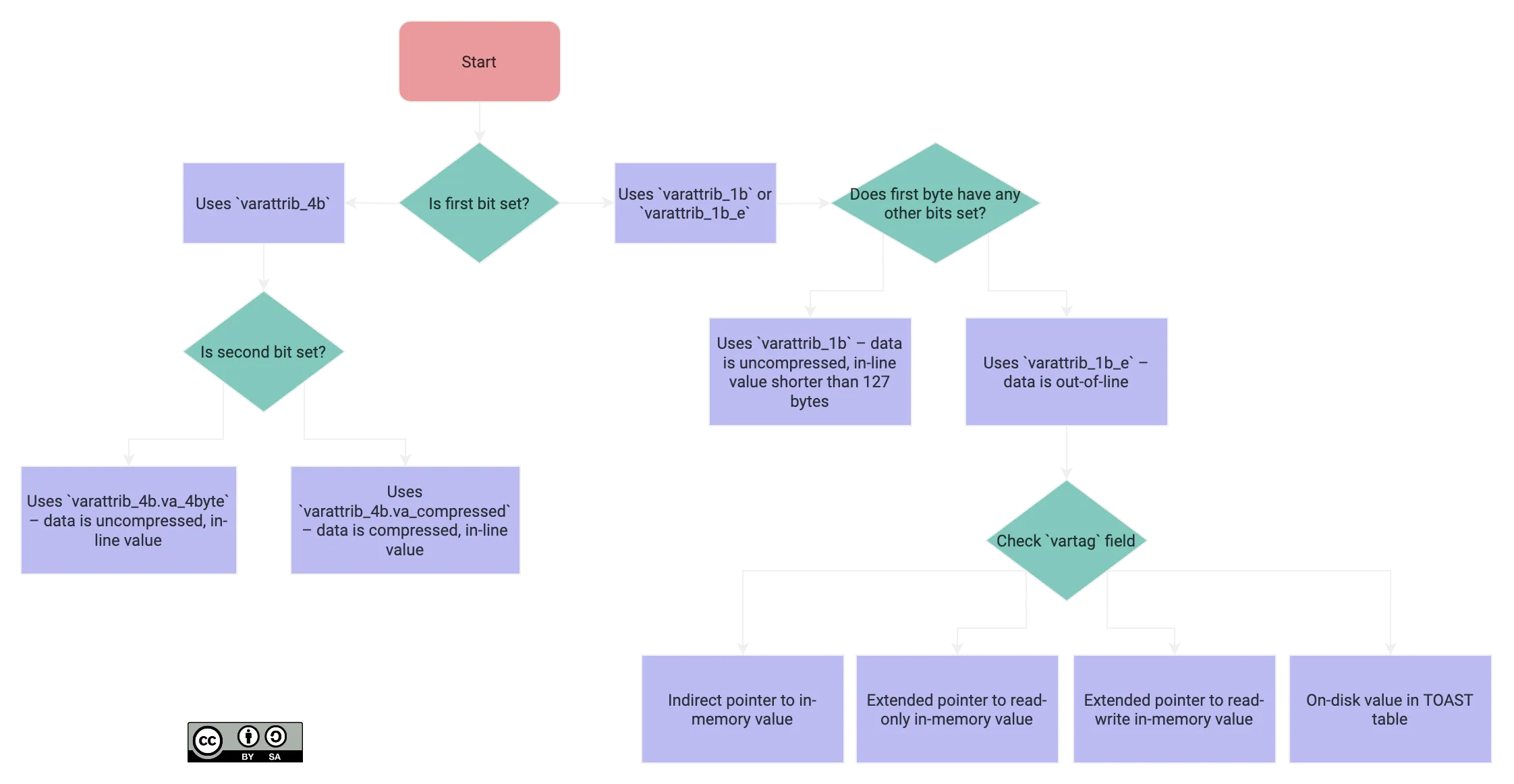
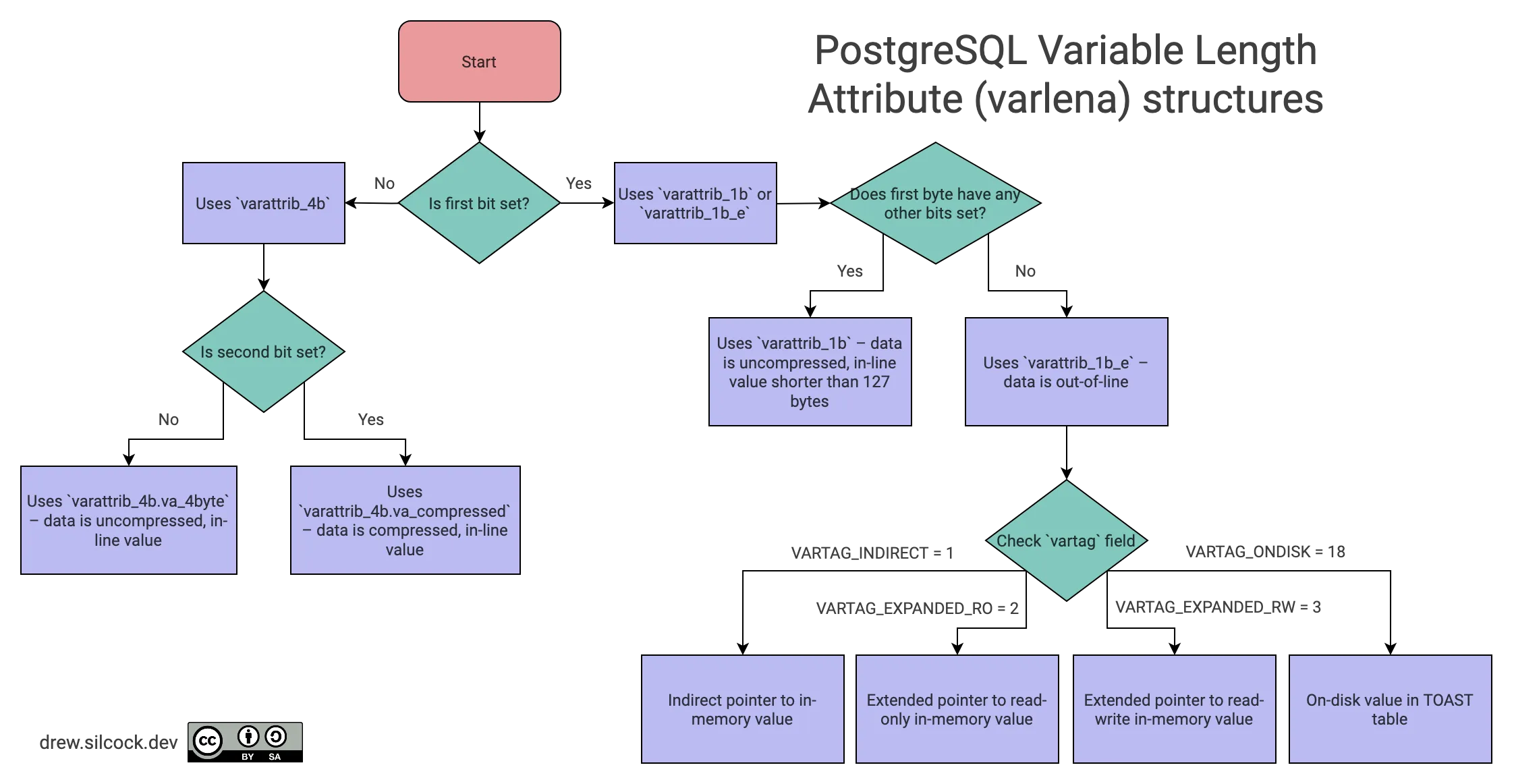
Now that we understand what structs the variable length attributes can correspond to, we can reinterpret the headers for our poems:
“Ozymandias” header – 04 0a 00 00
First things first, we can see that the first byte is 0x04 = 0b00000100 so neither of the first two bits are set. This means that the value is in-line and uncompressed which means we’re looking at the varattrib_4b.va_4byte struct.
We can then get the length of the poem in bytes by doing (header >> 2) - header size = (0x0a04 >> 2) - 4 = 0x281 - 4 = 641 - 4 = 637.
If you’ve got a good memory and eye for numbers, you might be thinking “why is this giving 637 when the length earlier gave 631”? The answer is that length() does not give you the size of the string in bytes but the length of the string in characters. In our poem we have three non-ASCII characters – U+2014 — (UTF-8 e2 80 94), U+201C “ (UTF-8 value e2 80 9c) and U+201D ” (UTF-8 value e2 80 9d) which count as 3 characters but total 9 bytes, making up the 6 byte difference.
Let’s look at the first byte again: 0xf2 = 0b11110010. This has the first bit unset meaning it is not using the 1b format but the second bit is set, meaning the value is compressed. Taking (0x1af2 >> 2) - 8 = 0x6B4 = 1716 gives the size in bytes.
The second 4-byte value 0x098c gives us the decompressed size and compression method. The first 30 bits are used for the uncompressed size while the last 2 bits are used for the compression method. To get the uncompressed size, we need to bitwise-and 0x098c with a the bitmask (1 << 30) - 1, i.e. a 32-bit number with 1 in the first 30 places and 0 in the last 2 places: 0x098c & ((1 << 30) - 1) = 0x098c & 0x3fffffff = 0x98c so the uncompressed size is 2,444 bytes. The poem is 2,442 characters long so that makes sense – there’s probably an em dash in there somewhere5.
There is also a single null byte before the actual poem starts. I’m not exactly sure what this is but I presume it’s an artifact of the compression method being used.
”The Waste Land” header - 01 12
This one has a short header. The first byte is simply 0x01 which tells you that this is an external value. Looking at the next byte, the vartag, you see 0x12 = 18 which tells you that this is an external on-disk TOAST pointer.
We’ve made great progress in understanding how Postgres stores variable length attributes, but we still haven’t tracked down the actual TOASTed values from the main-table tuple data. So what’s the next step?
Following the white rabbit
Let’s look at the whole 18 bytes for the content column value in the main table data for “The Waste Land”:
1
┌────────┬─────────────────────────┬─────────────────────────┬────────┬────────┐
2
│00000000│ 01 12 ed 4e 00 00 24 2d ┊ 00 00 ff 66 00 00 d5 61 │••×N⋄⋄$-┊⋄⋄×f⋄⋄×a│
3
│00000010│ 00 00 ┊ │⋄⋄ ┊ │
4
└────────┴─────────────────────────┴─────────────────────────┴────────┴────────┘
We understand the first 2 bytes now, but there’s still 16 bytes left that we haven’t explained.
Looking back at the detoast_attr() function, we can see that the function calls attr = toast_fetch_datum(attr) to retrieve the data from the external store. The answer must be in there somewhere.
333 collapsed lines
1
/*-------------------------------------------------------------------------
2
*
3
* detoast.c
4
* Retrieve compressed or external variable size attributes.
5
*
6
* Copyright (c) 2000-2024, PostgreSQL Global Development Group
7
*
8
* IDENTIFICATION
9
* src/backend/access/common/detoast.c
10
*
11
*-------------------------------------------------------------------------
12
*/
13
14
#include "postgres.h"
15
16
#include "access/detoast.h"
17
#include "access/table.h"
18
#include "access/tableam.h"
19
#include "access/toast_internals.h"
20
#include "common/int.h"
21
#include "common/pg_lzcompress.h"
22
#include "utils/expandeddatum.h"
23
#include "utils/rel.h"
24
25
static struct varlena *toast_fetch_datum(struct varlena *attr);
26
static struct varlena *toast_fetch_datum_slice(struct varlena *attr,
27
int32 sliceoffset,
28
int32 slicelength);
29
static struct varlena *toast_decompress_datum(struct varlena *attr);
30
static struct varlena *toast_decompress_datum_slice(struct varlena *attr, int32 slicelength);
31
32
/* ----------
33
* detoast_external_attr -
34
*
35
* Public entry point to get back a toasted value from
36
* external source (possibly still in compressed format).
37
*
38
* This will return a datum that contains all the data internally, ie, not
39
* relying on external storage or memory, but it can still be compressed or
40
* have a short header. Note some callers assume that if the input is an
41
* EXTERNAL datum, the result will be a pfree'able chunk.
42
* ----------
43
*/
44
struct varlena *
45
detoast_external_attr(struct varlena *attr)
46
{
47
struct varlena *result;
48
49
if (VARATT_IS_EXTERNAL_ONDISK(attr))
50
{
51
/*
52
* This is an external stored plain value
53
*/
54
result = toast_fetch_datum(attr);
55
}
56
else if (VARATT_IS_EXTERNAL_INDIRECT(attr))
57
{
58
/*
59
* This is an indirect pointer --- dereference it
60
*/
61
struct varatt_indirect redirect;
62
63
VARATT_EXTERNAL_GET_POINTER(redirect, attr);
64
attr = (struct varlena *) redirect.pointer;
65
66
/* nested indirect Datums aren't allowed */
67
Assert(!VARATT_IS_EXTERNAL_INDIRECT(attr));
68
69
/* recurse if value is still external in some other way */
70
if (VARATT_IS_EXTERNAL(attr))
71
return detoast_external_attr(attr);
72
73
/*
74
* Copy into the caller's memory context, in case caller tries to
75
* pfree the result.
76
*/
77
result = (struct varlena *) palloc(VARSIZE_ANY(attr));
78
memcpy(result, attr, VARSIZE_ANY(attr));
79
}
80
else if (VARATT_IS_EXTERNAL_EXPANDED(attr))
81
{
82
/*
83
* This is an expanded-object pointer --- get flat format
84
*/
85
ExpandedObjectHeader *eoh;
86
Size resultsize;
87
88
eoh = DatumGetEOHP(PointerGetDatum(attr));
89
resultsize = EOH_get_flat_size(eoh);
90
result = (struct varlena *) palloc(resultsize);
91
EOH_flatten_into(eoh, (void *) result, resultsize);
92
}
93
else
94
{
95
/*
96
* This is a plain value inside of the main tuple - why am I called?
97
*/
98
result = attr;
99
}
100
101
return result;
102
}
103
104
105
/* ----------
106
* detoast_attr -
107
*
108
* Public entry point to get back a toasted value from compression
109
* or external storage. The result is always non-extended varlena form.
110
*
111
* Note some callers assume that if the input is an EXTERNAL or COMPRESSED
112
* datum, the result will be a pfree'able chunk.
113
* ----------
114
*/
115
struct varlena *
116
detoast_attr(struct varlena *attr)
117
{
118
if (VARATT_IS_EXTERNAL_ONDISK(attr))
119
{
120
/*
121
* This is an externally stored datum --- fetch it back from there
122
*/
123
attr = toast_fetch_datum(attr);
124
/* If it's compressed, decompress it */
125
if (VARATT_IS_COMPRESSED(attr))
126
{
127
struct varlena *tmp = attr;
128
129
attr = toast_decompress_datum(tmp);
130
pfree(tmp);
131
}
132
}
133
else if (VARATT_IS_EXTERNAL_INDIRECT(attr))
134
{
135
/*
136
* This is an indirect pointer --- dereference it
137
*/
138
struct varatt_indirect redirect;
139
140
VARATT_EXTERNAL_GET_POINTER(redirect, attr);
141
attr = (struct varlena *) redirect.pointer;
142
143
/* nested indirect Datums aren't allowed */
144
Assert(!VARATT_IS_EXTERNAL_INDIRECT(attr));
145
146
/* recurse in case value is still extended in some other way */
147
attr = detoast_attr(attr);
148
149
/* if it isn't, we'd better copy it */
150
if (attr == (struct varlena *) redirect.pointer)
151
{
152
struct varlena *result;
153
154
result = (struct varlena *) palloc(VARSIZE_ANY(attr));
155
memcpy(result, attr, VARSIZE_ANY(attr));
156
attr = result;
157
}
158
}
159
else if (VARATT_IS_EXTERNAL_EXPANDED(attr))
160
{
161
/*
162
* This is an expanded-object pointer --- get flat format
163
*/
164
attr = detoast_external_attr(attr);
165
/* flatteners are not allowed to produce compressed/short output */
166
Assert(!VARATT_IS_EXTENDED(attr));
167
}
168
else if (VARATT_IS_COMPRESSED(attr))
169
{
170
/*
171
* This is a compressed value inside of the main tuple
172
*/
173
attr = toast_decompress_datum(attr);
174
}
175
else if (VARATT_IS_SHORT(attr))
176
{
177
/*
178
* This is a short-header varlena --- convert to 4-byte header format
179
*/
180
Size data_size = VARSIZE_SHORT(attr) - VARHDRSZ_SHORT;
181
Size new_size = data_size + VARHDRSZ;
182
struct varlena *new_attr;
183
184
new_attr = (struct varlena *) palloc(new_size);
185
SET_VARSIZE(new_attr, new_size);
186
memcpy(VARDATA(new_attr), VARDATA_SHORT(attr), data_size);
187
attr = new_attr;
188
}
189
190
return attr;
191
}
192
193
194
/* ----------
195
* detoast_attr_slice -
196
*
197
* Public entry point to get back part of a toasted value
198
* from compression or external storage.
199
*
200
* sliceoffset is where to start (zero or more)
201
* If slicelength < 0, return everything beyond sliceoffset
202
* ----------
203
*/
204
struct varlena *
205
detoast_attr_slice(struct varlena *attr,
206
int32 sliceoffset, int32 slicelength)
207
{
208
struct varlena *preslice;
209
struct varlena *result;
210
char *attrdata;
211
int32 slicelimit;
212
int32 attrsize;
213
214
if (sliceoffset < 0)
215
elog(ERROR, "invalid sliceoffset: %d", sliceoffset);
216
217
/*
218
* Compute slicelimit = offset + length, or -1 if we must fetch all of the
219
* value. In case of integer overflow, we must fetch all.
220
*/
221
if (slicelength < 0)
222
slicelimit = -1;
223
else if (pg_add_s32_overflow(sliceoffset, slicelength, &slicelimit))
224
slicelength = slicelimit = -1;
225
226
if (VARATT_IS_EXTERNAL_ONDISK(attr))
227
{
228
struct varatt_external toast_pointer;
229
230
VARATT_EXTERNAL_GET_POINTER(toast_pointer, attr);
231
232
/* fast path for non-compressed external datums */
233
if (!VARATT_EXTERNAL_IS_COMPRESSED(toast_pointer))
234
return toast_fetch_datum_slice(attr, sliceoffset, slicelength);
235
236
/*
237
* For compressed values, we need to fetch enough slices to decompress
238
* at least the requested part (when a prefix is requested).
239
* Otherwise, just fetch all slices.
240
*/
241
if (slicelimit >= 0)
242
{
243
int32 max_size = VARATT_EXTERNAL_GET_EXTSIZE(toast_pointer);
244
245
/*
246
* Determine maximum amount of compressed data needed for a prefix
247
* of a given length (after decompression).
248
*
249
* At least for now, if it's LZ4 data, we'll have to fetch the
250
* whole thing, because there doesn't seem to be an API call to
251
* determine how much compressed data we need to be sure of being
252
* able to decompress the required slice.
253
*/
254
if (VARATT_EXTERNAL_GET_COMPRESS_METHOD(toast_pointer) ==
255
TOAST_PGLZ_COMPRESSION_ID)
256
max_size = pglz_maximum_compressed_size(slicelimit, max_size);
257
258
/*
259
* Fetch enough compressed slices (compressed marker will get set
260
* automatically).
261
*/
262
preslice = toast_fetch_datum_slice(attr, 0, max_size);
263
}
264
else
265
preslice = toast_fetch_datum(attr);
266
}
267
else if (VARATT_IS_EXTERNAL_INDIRECT(attr))
268
{
269
struct varatt_indirect redirect;
270
271
VARATT_EXTERNAL_GET_POINTER(redirect, attr);
272
273
/* nested indirect Datums aren't allowed */
274
Assert(!VARATT_IS_EXTERNAL_INDIRECT(redirect.pointer));
275
276
return detoast_attr_slice(redirect.pointer,
277
sliceoffset, slicelength);
278
}
279
else if (VARATT_IS_EXTERNAL_EXPANDED(attr))
280
{
281
/* pass it off to detoast_external_attr to flatten */
282
preslice = detoast_external_attr(attr);
283
}
284
else
285
preslice = attr;
286
287
Assert(!VARATT_IS_EXTERNAL(preslice));
288
289
if (VARATT_IS_COMPRESSED(preslice))
290
{
291
struct varlena *tmp = preslice;
292
293
/* Decompress enough to encompass the slice and the offset */
294
if (slicelimit >= 0)
295
preslice = toast_decompress_datum_slice(tmp, slicelimit);
296
else
297
preslice = toast_decompress_datum(tmp);
298
299
if (tmp != attr)
300
pfree(tmp);
301
}
302
303
if (VARATT_IS_SHORT(preslice))
304
{
305
attrdata = VARDATA_SHORT(preslice);
306
attrsize = VARSIZE_SHORT(preslice) - VARHDRSZ_SHORT;
307
}
308
else
309
{
310
attrdata = VARDATA(preslice);
311
attrsize = VARSIZE(preslice) - VARHDRSZ;
312
}
313
314
/* slicing of datum for compressed cases and plain value */
315
316
if (sliceoffset >= attrsize)
317
{
318
sliceoffset = 0;
319
slicelength = 0;
320
}
321
else if (slicelength < 0 || slicelimit > attrsize)
322
slicelength = attrsize - sliceoffset;
323
324
result = (struct varlena *) palloc(slicelength + VARHDRSZ);
325
SET_VARSIZE(result, slicelength + VARHDRSZ);
326
327
memcpy(VARDATA(result), attrdata + sliceoffset, slicelength);
328
329
if (preslice != attr)
330
pfree(preslice);
331
332
return result;
333
}
334
335
/* ----------
336
* toast_fetch_datum -
337
*
338
* Reconstruct an in memory Datum from the chunks saved
339
* in the toast relation
340
* ----------
341
*/
342
static struct varlena *
343
toast_fetch_datum(struct varlena *attr)
344
{
345
Relation toastrel;
346
struct varlena *result;
347
struct varatt_external toast_pointer;
348
int32 attrsize;
349
350
if (!VARATT_IS_EXTERNAL_ONDISK(attr))
351
elog(ERROR, "toast_fetch_datum shouldn't be called for non-ondisk datums");
352
353
/* Must copy to access aligned fields */
354
VARATT_EXTERNAL_GET_POINTER(toast_pointer, attr);
355
356
attrsize = VARATT_EXTERNAL_GET_EXTSIZE(toast_pointer);
357
358
result = (struct varlena *) palloc(attrsize + VARHDRSZ);
359
360
if (VARATT_EXTERNAL_IS_COMPRESSED(toast_pointer))
361
SET_VARSIZE_COMPRESSED(result, attrsize + VARHDRSZ);
362
else
363
SET_VARSIZE(result, attrsize + VARHDRSZ);
364
365
if (attrsize == 0)
366
return result; /* Probably shouldn't happen, but just in
367
* case. */
368
369
/*
370
* Open the toast relation and its indexes
371
*/
372
toastrel = table_open(toast_pointer.va_toastrelid, AccessShareLock);
373
374
/* Fetch all chunks */
375
table_relation_fetch_toast_slice(toastrel, toast_pointer.va_valueid,
376
attrsize, 0, attrsize, result);
377
378
/* Close toast table */
379
table_close(toastrel, AccessShareLock);
380
381
return result;
382
}
383
263 collapsed lines
384
/* ----------
385
* toast_fetch_datum_slice -
386
*
387
* Reconstruct a segment of a Datum from the chunks saved
388
* in the toast relation
389
*
390
* Note that this function supports non-compressed external datums
391
* and compressed external datums (in which case the requested slice
392
* has to be a prefix, i.e. sliceoffset has to be 0).
393
* ----------
394
*/
395
static struct varlena *
396
toast_fetch_datum_slice(struct varlena *attr, int32 sliceoffset,
397
int32 slicelength)
398
{
399
Relation toastrel;
400
struct varlena *result;
401
struct varatt_external toast_pointer;
402
int32 attrsize;
403
404
if (!VARATT_IS_EXTERNAL_ONDISK(attr))
405
elog(ERROR, "toast_fetch_datum_slice shouldn't be called for non-ondisk datums");
406
407
/* Must copy to access aligned fields */
408
VARATT_EXTERNAL_GET_POINTER(toast_pointer, attr);
409
410
/*
411
* It's nonsense to fetch slices of a compressed datum unless when it's a
412
* prefix -- this isn't lo_* we can't return a compressed datum which is
413
* meaningful to toast later.
414
*/
415
Assert(!VARATT_EXTERNAL_IS_COMPRESSED(toast_pointer) || 0 == sliceoffset);
416
417
attrsize = VARATT_EXTERNAL_GET_EXTSIZE(toast_pointer);
418
419
if (sliceoffset >= attrsize)
420
{
421
sliceoffset = 0;
422
slicelength = 0;
423
}
424
425
/*
426
* When fetching a prefix of a compressed external datum, account for the
427
* space required by va_tcinfo, which is stored at the beginning as an
428
* int32 value.
429
*/
430
if (VARATT_EXTERNAL_IS_COMPRESSED(toast_pointer) && slicelength > 0)
431
slicelength = slicelength + sizeof(int32);
432
433
/*
434
* Adjust length request if needed. (Note: our sole caller,
435
* detoast_attr_slice, protects us against sliceoffset + slicelength
436
* overflowing.)
437
*/
438
if (((sliceoffset + slicelength) > attrsize) || slicelength < 0)
439
slicelength = attrsize - sliceoffset;
440
441
result = (struct varlena *) palloc(slicelength + VARHDRSZ);
442
443
if (VARATT_EXTERNAL_IS_COMPRESSED(toast_pointer))
444
SET_VARSIZE_COMPRESSED(result, slicelength + VARHDRSZ);
445
else
446
SET_VARSIZE(result, slicelength + VARHDRSZ);
447
448
if (slicelength == 0)
449
return result; /* Can save a lot of work at this point! */
450
451
/* Open the toast relation */
452
toastrel = table_open(toast_pointer.va_toastrelid, AccessShareLock);
453
454
/* Fetch all chunks */
455
table_relation_fetch_toast_slice(toastrel, toast_pointer.va_valueid,
456
attrsize, sliceoffset, slicelength,
457
result);
458
459
/* Close toast table */
460
table_close(toastrel, AccessShareLock);
461
462
return result;
463
}
464
465
/* ----------
466
* toast_decompress_datum -
467
*
468
* Decompress a compressed version of a varlena datum
469
*/
470
static struct varlena *
471
toast_decompress_datum(struct varlena *attr)
472
{
473
ToastCompressionId cmid;
474
475
Assert(VARATT_IS_COMPRESSED(attr));
476
477
/*
478
* Fetch the compression method id stored in the compression header and
479
* decompress the data using the appropriate decompression routine.
480
*/
481
cmid = TOAST_COMPRESS_METHOD(attr);
482
switch (cmid)
483
{
484
case TOAST_PGLZ_COMPRESSION_ID:
485
return pglz_decompress_datum(attr);
486
case TOAST_LZ4_COMPRESSION_ID:
487
return lz4_decompress_datum(attr);
488
default:
489
elog(ERROR, "invalid compression method id %d", cmid);
490
return NULL; /* keep compiler quiet */
491
}
492
}
493
494
495
/* ----------
496
* toast_decompress_datum_slice -
497
*
498
* Decompress the front of a compressed version of a varlena datum.
499
* offset handling happens in detoast_attr_slice.
500
* Here we just decompress a slice from the front.
501
*/
502
static struct varlena *
503
toast_decompress_datum_slice(struct varlena *attr, int32 slicelength)
504
{
505
ToastCompressionId cmid;
506
507
Assert(VARATT_IS_COMPRESSED(attr));
508
509
/*
510
* Some callers may pass a slicelength that's more than the actual
511
* decompressed size. If so, just decompress normally. This avoids
512
* possibly allocating a larger-than-necessary result object, and may be
513
* faster and/or more robust as well. Notably, some versions of liblz4
514
* have been seen to give wrong results if passed an output size that is
515
* more than the data's true decompressed size.
516
*/
517
if ((uint32) slicelength >= TOAST_COMPRESS_EXTSIZE(attr))
518
return toast_decompress_datum(attr);
519
520
/*
521
* Fetch the compression method id stored in the compression header and
522
* decompress the data slice using the appropriate decompression routine.
523
*/
524
cmid = TOAST_COMPRESS_METHOD(attr);
525
switch (cmid)
526
{
527
case TOAST_PGLZ_COMPRESSION_ID:
528
return pglz_decompress_datum_slice(attr, slicelength);
529
case TOAST_LZ4_COMPRESSION_ID:
530
return lz4_decompress_datum_slice(attr, slicelength);
531
default:
532
elog(ERROR, "invalid compression method id %d", cmid);
533
return NULL; /* keep compiler quiet */
534
}
535
}
536
537
/* ----------
538
* toast_raw_datum_size -
539
*
540
* Return the raw (detoasted) size of a varlena datum
541
* (including the VARHDRSZ header)
542
* ----------
543
*/
544
Size
545
toast_raw_datum_size(Datum value)
546
{
547
struct varlena *attr = (struct varlena *) DatumGetPointer(value);
548
Size result;
549
550
if (VARATT_IS_EXTERNAL_ONDISK(attr))
551
{
552
/* va_rawsize is the size of the original datum -- including header */
553
struct varatt_external toast_pointer;
554
555
VARATT_EXTERNAL_GET_POINTER(toast_pointer, attr);
556
result = toast_pointer.va_rawsize;
557
}
558
else if (VARATT_IS_EXTERNAL_INDIRECT(attr))
559
{
560
struct varatt_indirect toast_pointer;
561
562
VARATT_EXTERNAL_GET_POINTER(toast_pointer, attr);
563
564
/* nested indirect Datums aren't allowed */
565
Assert(!VARATT_IS_EXTERNAL_INDIRECT(toast_pointer.pointer));
566
567
return toast_raw_datum_size(PointerGetDatum(toast_pointer.pointer));
568
}
569
else if (VARATT_IS_EXTERNAL_EXPANDED(attr))
570
{
571
result = EOH_get_flat_size(DatumGetEOHP(value));
572
}
573
else if (VARATT_IS_COMPRESSED(attr))
574
{
575
/* here, va_rawsize is just the payload size */
576
result = VARDATA_COMPRESSED_GET_EXTSIZE(attr) + VARHDRSZ;
577
}
578
else if (VARATT_IS_SHORT(attr))
579
{
580
/*
581
* we have to normalize the header length to VARHDRSZ or else the
582
* callers of this function will be confused.
583
*/
584
result = VARSIZE_SHORT(attr) - VARHDRSZ_SHORT + VARHDRSZ;
585
}
586
else
587
{
588
/* plain untoasted datum */
589
result = VARSIZE(attr);
590
}
591
return result;
592
}
593
594
/* ----------
595
* toast_datum_size
596
*
597
* Return the physical storage size (possibly compressed) of a varlena datum
598
* ----------
599
*/
600
Size
601
toast_datum_size(Datum value)
602
{
603
struct varlena *attr = (struct varlena *) DatumGetPointer(value);
604
Size result;
605
606
if (VARATT_IS_EXTERNAL_ONDISK(attr))
607
{
608
/*
609
* Attribute is stored externally - return the extsize whether
610
* compressed or not. We do not count the size of the toast pointer
611
* ... should we?
612
*/
613
struct varatt_external toast_pointer;
614
615
VARATT_EXTERNAL_GET_POINTER(toast_pointer, attr);
616
result = VARATT_EXTERNAL_GET_EXTSIZE(toast_pointer);
617
}
618
else if (VARATT_IS_EXTERNAL_INDIRECT(attr))
619
{
620
struct varatt_indirect toast_pointer;
621
622
VARATT_EXTERNAL_GET_POINTER(toast_pointer, attr);
623
624
/* nested indirect Datums aren't allowed */
625
Assert(!VARATT_IS_EXTERNAL_INDIRECT(attr));
626
627
return toast_datum_size(PointerGetDatum(toast_pointer.pointer));
628
}
629
else if (VARATT_IS_EXTERNAL_EXPANDED(attr))
630
{
631
result = EOH_get_flat_size(DatumGetEOHP(value));
632
}
633
else if (VARATT_IS_SHORT(attr))
634
{
635
result = VARSIZE_SHORT(attr);
636
}
637
else
638
{
639
/*
640
* Attribute is stored inline either compressed or not, just calculate
641
* the size of the datum in either case.
642
*/
643
result = VARSIZE(attr);
644
}
645
return result;
646
}
Here we see how Postgres is linking the main table data back to the external TOAST table. It’s casting the 16 bytes to the struct varatt_external() and using the fields varatt_external.va_toastrelid and varatt_external.va_valueid to pull in the values from the TOAST table.
We’ve already seen this struct, in fact – it’s in the src/include/varatt.h file we saw earlier. It’s got 4 fields in total, each one 4 bytes long:
30
...
31
32
typedef struct varatt_external
33
{
34
int32 va_rawsize; /* Original data size (includes header) */
35
uint32 va_extinfo; /* External saved size (without header) and
36
* compression method */
37
Oid va_valueid; /* Unique ID of value within TOAST table */
38
Oid va_toastrelid; /* RelID of TOAST table containing it */
39
}
40
41
...
Each of these 4 struct fields is 4 bytes each, making up the 16 bytes left. The va_rawsize and va_extinfo aren’t particularly interesting for us at the moment but the final last fields give us what we need. We can see that the ID of the value within the toast table, va_valueid, is ff 66 00 00 = 26367 while the toast relation ID, va_toastrelid, is d5 61 00 00 = 25045 – this matches the OID of the pg_toast_25042 we saw earlier6.
We can follow the va_valueid through to the TOAST table like so7:
1
blogdb=# select ctid, chunk_id, chunk_seq
2
blogdb-# from pg_toast.pg_toast_25042
3
blogdb-# where chunk_id = 26367;
4
ctid | chunk_id | chunk_seq
5
-------+----------+-----------
6
(0,1) | 26367 | 0
7
(0,2) | 26367 | 1
8
(0,3) | 26367 | 2
9
(0,4) | 26367 | 3
10
(1,1) | 26367 | 4
11
(1,2) | 26367 | 5
12
(6 rows)
So then we can see that all the detoast_attr() function is doing is pulling these chunks together in order according to the chunk_seq values to get the full poem back out. Let’s write a quick helper to look at this data:
1
function print-toast-data {
2
run-and-decode "select chunk_data from pg_toast.pg_toast_25042 where chunk_id = $1 and chunk_seq = $2"
3
}
We can run through the 6 chunks to see the bits and pieces of the poem, still compressed but recognisable:
1
$ print-toast-data 26367 0 | head -n 20
2
┌────────┬─────────────────────────┬─────────────────────────┬────────┬────────┐
3
│00000000│ e9 4e 00 00 00 20 20 e2 ┊ 80 9c 4e 61 6d 00 20 53 │×N⋄⋄⋄ ×┊××Nam⋄ S│
4
│00000010│ 69 62 79 6c 6c 61 00 6d ┊ 20 71 75 69 64 65 6d 00 │ibylla⋄m┊ quidem⋄│
5
│00000020│ 20 43 75 6d 69 73 20 65 ┊ 00 67 6f 20 69 70 73 65 │ Cumis e┊⋄go ipse│
6
│00000030│ 20 00 6f 63 75 6c 69 73 ┊ 20 6d 00 65 69 73 0a 20 │ ⋄oculis┊ m⋄eis_ │
7
│00000040│ 20 76 69 00 64 69 20 69 ┊ 6e 20 61 6d 00 70 75 6c │ vi⋄di i┊n am⋄pul│
8
│00000050│ 6c 61 20 70 65 00 6e 64 ┊ 65 72 65 2c 20 65 00 74 │la pe⋄nd┊ere, e⋄t│
9
│00000060│ 20 63 75 6d 20 69 6c 00 ┊ 6c 69 20 70 75 65 72 69 │ cum il⋄┊li pueri│
10
│00000070│ 00 20 64 69 63 65 72 65 ┊ 6e 00 74 3a 0a 20 20 ce │⋄ dicere┊n⋄t:_ ×│
11
│00000080│ a3 e1 00 bd b7 ce b2 cf ┊ 85 ce bb 00 ce bb ce b1 │××⋄×××××┊×××⋄××××│
12
│00000090│ 20 cf 84 e1 00 bd b7 20 ┊ ce b8 e1 bd b3 00 ce bb │ ×××⋄×× ┊×××××⋄××│
13
│000000a0│ ce b5 ce b9 cf 82 00 3b ┊ 20 72 65 73 70 6f 6e 20 │××××××⋄;┊ respon │
14
│000000b0│ 64 65 62 61 74 01 48 61 ┊ 3a 00 20 e1 bc 80 cf 80 │debat•Ha┊:⋄ ×××××│
15
│000000c0│ ce bf 00 ce b8 ce b1 ce ┊ bd ce b5 20 e1 bf 96 ce │××⋄×××××┊××× ××××│
16
│000000d0│ bd 05 36 cf 89 80 2e e2 ┊ 80 9d 0a 0a 20 05 01 00 │ו6×××.×┊××__ ••⋄│
17
│000000e0│ 5f 46 6f 72 20 45 7a 72 ┊ 80 61 20 50 6f 75 6e 64 │_For Ezr┊×a Pound│
18
│000000f0│ 07 19 00 69 6c 20 6d 69 ┊ 67 6c 69 00 6f 72 20 66 │••⋄il mi┊gli⋄or f│
19
│00000100│ 61 62 62 72 18 6f 5f 0a ┊ 01 01 03 1d 49 2e 20 00 │abbr•o__┊••••I. ⋄│
20
│00000110│ 54 48 45 20 42 55 52 49 ┊ 20 41 4c 20 4f 46 02 0e │THE BURI┊ AL OF••│
21
│00000120│ 44 45 04 41 44 02 22 41 ┊ 70 72 69 6c 00 20 69 73 │DE•AD•"A┊pril⋄ is│
22
23
$ print-toast-data 26367 5 | head -n 20
24
┌────────┬─────────────────────────┬─────────────────────────┬────────┬────────┐
25
│00000000│ 10 68 6f 72 64 31 c8 77 ┊ 61 72 06 6d a4 71 21 47 │•hord1×w┊ar•m×q!G│
26
│00000010│ 65 6e 64 6c 65 04 73 73 ┊ 71 5a 69 6e 73 2c 20 cc │endle•ss┊qZins, ×│
27
│00000020│ 73 74 a1 fb 62 df 6e 20 ┊ 35 d2 c1 3a 85 81 f1 52 │st××b×n ┊5××:×××R│
28
│00000030│ b1 3f 64 20 62 79 c4 93 ┊ 84 61 74 01 57 69 7a 6f │×?d by××┊×at•Wizo│
29
│00000040│ 6e 13 ce 9d 0f 01 16 33 ┊ f2 d0 07 ed 31 07 74 79 │n•×ו••3┊×ו×1•ty│
30
│00000050│ 23 d8 cd 4d 8e 43 01 84 ┊ d3 70 72 65 e1 ae 03 0c │#××M×C•×┊×pre×ו_│
31
│00000060│ 20 62 75 72 73 74 26 df ┊ 76 69 8c 6f 6c 61 00 12 │ burst&×┊vi×ola⋄•│
32
│00000070│ 20 46 61 6c 02 c1 01 e6 ┊ 21 4a 65 72 75 73 61 6c │ Fal•×•×┊!Jerusal│
33
│00000080│ 10 65 6d 20 41 b1 96 73 ┊ 20 41 80 6c 65 78 61 6e │•em A××s┊ A×lexan│
34
│00000090│ 64 72 f2 9f 00 56 69 65 ┊ 6e 6e 61 20 4c 08 6f 6e │dr××⋄Vie┊nna L•on│
35
│000000a0│ 64 12 3e 55 6e 72 65 0c ┊ 61 6c 82 dc 13 c8 20 64 │d•>Unre_┊al××•× d│
36
│000000b0│ 72 65 12 77 31 5d 20 6c ┊ 31 ed 62 6c 61 80 63 6b │re•w1] l┊1×bla×ck│
37
│000000c0│ 20 68 61 69 72 b1 9b 0c ┊ 20 74 81 f2 34 c0 66 69 │ hair××_┊ t××4×fi│
38
│000000d0│ 64 64 03 e1 fe a4 65 20 ┊ 6d 75 73 69 63 73 13 f2 │dd•×××e ┊musics•×│
39
│000000e0│ 11 8a 73 74 41 3d 82 e1 ┊ 01 c2 61 c4 74 73 c3 ac │•×stA=××┊•×a×ts××│
40
│000000f0│ 62 61 62 94 26 0c d0 83 ┊ 92 4e 73 75 73 74 6c 65 │bab×&_××┊×Nsustle│
41
│00000100│ 64 b3 46 c2 62 61 fb 74 ┊ 68 65 69 51 e8 31 e4 49 │d×F×ba×t┊heiQ×1×I│
42
│00000110│ 0f 01 17 33 38 42 c6 6e ┊ 64 11 da 77 5f 01 aa 32 │•••38B×n┊d•×w_•×2│
43
│00000120│ 3e f1 7c a1 51 f3 85 61 ┊ 03 e2 65 ca 6e 01 c9 61 │>×|×Q××a┊•×e×n•×a│
You can see that as this goes on, the compression takes over more and more and the actual data becomes less and less intelligible. From this we can ascertain that the compression is done before the data is split into chunks, which makes sense because it means you can take advantage of the larger history table for the compression. This fits with the detoast_attr() function we saw earlier, which retrieved the full TOASTed value before decompressing it.
TOAST-ing strategies
Now that we’ve got a good understanding of the different TOAST techniques that Postgres utilises, is there any way we can customise Postgres’ behaviour? In fact, there is!
There are four configuration options which you can select on a per-column basis:
| Strategy | Explanation |
|---|---|
| plain | Prevents compression or out-of-lining. For non-TOAST-able types this is the only possible strategy. |
| extended | This is the default strategy that allows both compression and out-of-lining, as deemed appropriate. As we saw above, Postgres tries to compress it first and if it’s still too big, it will out-of-line it. |
| external | Allows out-of-lining but not compression. This might seem like a weird choice, but if you choose external, Postgres can actually optimise some substring operations because Postgres knows that it only needs to query specific chunk(s) of the whole TOAST slice instead of the whole thing. If your out-of-line data is compressed, you can’t do that because you need to pull in the whole TOAST slice to be able to decompress it before you can do any substring operations. |
| main | Allows compression but not out-of-lining, unless out-of-lining is absolutely necessary to be able to be able to fit the data on disk. |
So how do you change this? Let’s try it out.
1
blogdb=# \d+ creative_works
2
Table "public.creative_works"
3
Column | Type | Collation | Nullable | Default | Storage | Compression | Stats target | Description
4
------------+---------+-----------+----------+------------------------------+----------+-------------+--------------+-------------
5
id | integer | | not null | generated always as identity | plain | | |
6
title | text | | | | extended | | |
7
authors | jsonb | | | | extended | | |
8
country_id | integer | | | | plain | | |
9
content | text | | | | extended | | |
10
Indexes:
11
"creative_works_pkey" PRIMARY KEY, btree (id)
12
Foreign-key constraints:
13
"creative_works_country_id_fkey" FOREIGN KEY (country_id) REFERENCES countries(id)
14
Access method: heap
15
16
-- This doesn't actually change anything, it just updates the strategy for future
17
-- updates.
18
blogdb=# alter table creative_works alter column content set storage plain;
19
ALTER TABLE
20
21
-- Trigger an update for the "Ode on a Grecian Urn" poem.
22
blogdb=# update creative_works
23
blogdb-# set content = concat(content, e'\nThe end')
24
blogdb-# where title = 'Ode on a Grecian Urn';
25
UPDATE 1
Let’s print out the poem data again to see what it looks like:
1
$ print-cw-data 'Ode on a Grecian Urn' | head -n 30
2
┌────────┬─────────────────────────┬─────────────────────────┬────────┬────────┐
3
│00000000│ 0d 00 00 00 2b 4f 64 65 ┊ 20 6f 6e 20 61 20 47 72 │_⋄⋄⋄+Ode┊ on a Gr│
4
│00000010│ 65 63 69 61 6e 20 55 72 ┊ 6e 01 12 5c 00 00 00 58 │ecian Ur┊n••\⋄⋄⋄X│
5
│00000020│ 00 00 00 5d 70 00 00 d5 ┊ 61 00 00 00 eb 00 00 00 │⋄⋄⋄]p⋄⋄×┊a⋄⋄⋄×⋄⋄⋄│
6
│00000030│ 6c 26 00 00 54 68 6f 75 ┊ 20 73 74 69 6c 6c 20 75 │l&⋄⋄Thou┊ still u│
7
│00000040│ 6e 72 61 76 69 73 68 27 ┊ 64 20 62 72 69 64 65 20 │nravish'┊d bride │
8
│00000050│ 6f 66 20 71 75 69 65 74 ┊ 6e 65 73 73 2c 0a 20 20 │of quiet┊ness,_ │
9
│00000060│ 20 20 20 20 20 54 68 6f ┊ 75 20 66 6f 73 74 65 72 │ Tho┊u foster│
10
│00000070│ 2d 63 68 69 6c 64 20 6f ┊ 66 20 73 69 6c 65 6e 63 │-child o┊f silenc│
11
│00000080│ 65 20 61 6e 64 20 73 6c ┊ 6f 77 20 74 69 6d 65 2c │e and sl┊ow time,│
12
│00000090│ 0a 53 79 6c 76 61 6e 20 ┊ 68 69 73 74 6f 72 69 61 │_Sylvan ┊historia│
13
│000000a0│ 6e 2c 20 77 68 6f 20 63 ┊ 61 6e 73 74 20 74 68 75 │n, who c┊anst thu│
14
│000000b0│ 73 20 65 78 70 72 65 73 ┊ 73 0a 20 20 20 20 20 20 │s expres┊s_ │
15
│000000c0│ 20 41 20 66 6c 6f 77 65 ┊ 72 79 20 74 61 6c 65 20 │ A flowe┊ry tale │
16
│000000d0│ 6d 6f 72 65 20 73 77 65 ┊ 65 74 6c 79 20 74 68 61 │more swe┊etly tha│
17
│000000e0│ 6e 20 6f 75 72 20 72 68 ┊ 79 6d 65 3a 0a 57 68 61 │n our rh┊yme:_Wha│
18
│000000f0│ 74 20 6c 65 61 66 2d 66 ┊ 72 69 6e 67 27 64 20 6c │t leaf-f┊ring'd l│
19
│00000100│ 65 67 65 6e 64 20 68 61 ┊ 75 6e 74 73 20 61 62 6f │egend ha┊unts abo│
20
│00000110│ 75 74 20 74 68 79 20 73 ┊ 68 61 70 65 0a 20 20 20 │ut thy s┊hape_ │
21
│00000120│ 20 20 20 20 4f 66 20 64 ┊ 65 69 74 69 65 73 20 6f │ Of d┊eities o│
22
│00000130│ 72 20 6d 6f 72 74 61 6c ┊ 73 2c 20 6f 72 20 6f 66 │r mortal┊s, or of│
23
│00000140│ 20 62 6f 74 68 2c 0a 20 ┊ 20 20 20 20 20 20 20 20 │ both,_ ┊ │
24
│00000150│ 20 20 20 20 20 20 49 6e ┊ 20 54 65 6d 70 65 20 6f │ In┊ Tempe o│
25
│00000160│ 72 20 74 68 65 20 64 61 ┊ 6c 65 73 20 6f 66 20 41 │r the da┊les of A│
26
│00000170│ 72 63 61 64 79 3f 0a 20 ┊ 20 20 20 20 20 20 57 68 │rcady?_ ┊ Wh│
27
│00000180│ 61 74 20 6d 65 6e 20 6f ┊ 72 20 67 6f 64 73 20 61 │at men o┊r gods a│
28
│00000190│ 72 65 20 74 68 65 73 65 ┊ 3f 20 57 68 61 74 20 6d │re these┊? What m│
29
│000001a0│ 61 69 64 65 6e 73 20 6c ┊ 6f 74 68 3f 0a 57 68 61 │aidens l┊oth?_Wha│
30
│000001b0│ 74 20 6d 61 64 20 70 75 ┊ 72 73 75 69 74 3f 20 57 │t mad pu┊rsuit? W│
31
│000001c0│ 68 61 74 20 73 74 72 75 ┊ 67 67 6c 65 20 74 6f 20 │hat stru┊ggle to │
It’s no longer compressed! But there’s a problem – “The Waste Land” is too big to fit into the main table, but we’ve disallowed the column from being out-of-lined, so what happens if we trigger an update for this poem?
1
blogdb=# vacuum full;
2
ERROR: row is too big: size 20280, maximum size 8160
When we trigger a recomputation by doing a full vacuum, Postgres gives us an error telling us that we can’t fit the full poem in a single tuple. Let’s try “external” next:
1
blogdb=# alter table creative_works alter column content set storage external;
2
ALTER TABLE
3
4
blogdb=# vacuum full;
5
VACUUM
Let’s take a look at the data:
1
$ print-cw-data 'Ode on a Grecian Urn'
2
┌────────┬─────────────────────────┬─────────────────────────┬────────┬────────┐
3
│00000000│ 0d 00 00 00 2b 4f 64 65 ┊ 20 6f 6e 20 61 20 47 72 │_⋄⋄⋄+Ode┊ on a Gr│
4
│00000010│ 65 63 69 61 6e 20 55 72 ┊ 6e b3 01 00 00 40 50 00 │ecian Ur┊nו⋄⋄@P⋄│
5
│00000020│ 00 d0 03 00 00 20 04 00 ┊ 00 80 0a 00 00 00 0a 00 │⋄ו⋄⋄ •⋄┊⋄×_⋄⋄⋄_⋄│
6
│00000030│ 00 00 0b 00 00 00 09 00 ┊ 00 10 08 00 00 10 6e 61 │⋄⋄•⋄⋄⋄_⋄┊⋄••⋄⋄•na│
7
│00000040│ 6d 65 62 69 72 74 68 5f ┊ 79 65 61 72 64 65 61 74 │mebirth_┊yeardeat│
8
│00000050│ 68 5f 79 65 61 72 4b 65 ┊ 61 74 73 2c 20 4a 6f 68 │h_yearKe┊ats, Joh│
9
│00000060│ 6e 00 20 00 00 00 00 80 ┊ 03 07 20 00 00 00 00 80 │n⋄ ⋄⋄⋄⋄×┊•• ⋄⋄⋄⋄×│
10
│00000070│ 1d 07 00 00 eb 00 00 00 ┊ 01 12 a3 09 00 00 9f 09 │••⋄⋄×⋄⋄⋄┊••×_⋄⋄×_│
11
│00000080│ 00 00 54 71 00 00 d5 61 ┊ 00 00 │⋄⋄Tq⋄⋄×a┊⋄⋄ │
12
└────────┴─────────────────────────┴─────────────────────────┴────────┴────────┘
Our poem has now been out-of-lined! By looking at the data, we can see that the chunk ID is 54 71 00 00 = 29012:
1
$ print-toast-data 29012 0 | head -n 20
2
┌────────┬─────────────────────────┬─────────────────────────┬────────┬────────┐
3
│00000000│ 54 68 6f 75 20 73 74 69 ┊ 6c 6c 20 75 6e 72 61 76 │Thou sti┊ll unrav│
4
│00000010│ 69 73 68 27 64 20 62 72 ┊ 69 64 65 20 6f 66 20 71 │ish'd br┊ide of q│
5
│00000020│ 75 69 65 74 6e 65 73 73 ┊ 2c 0a 20 20 20 20 20 20 │uietness┊,_ │
6
│00000030│ 20 54 68 6f 75 20 66 6f ┊ 73 74 65 72 2d 63 68 69 │ Thou fo┊ster-chi│
7
│00000040│ 6c 64 20 6f 66 20 73 69 ┊ 6c 65 6e 63 65 20 61 6e │ld of si┊lence an│
8
│00000050│ 64 20 73 6c 6f 77 20 74 ┊ 69 6d 65 2c 0a 53 79 6c │d slow t┊ime,_Syl│
9
│00000060│ 76 61 6e 20 68 69 73 74 ┊ 6f 72 69 61 6e 2c 20 77 │van hist┊orian, w│
10
│00000070│ 68 6f 20 63 61 6e 73 74 ┊ 20 74 68 75 73 20 65 78 │ho canst┊ thus ex│
11
│00000080│ 70 72 65 73 73 0a 20 20 ┊ 20 20 20 20 20 41 20 66 │press_ ┊ A f│
12
│00000090│ 6c 6f 77 65 72 79 20 74 ┊ 61 6c 65 20 6d 6f 72 65 │lowery t┊ale more│
13
│000000a0│ 20 73 77 65 65 74 6c 79 ┊ 20 74 68 61 6e 20 6f 75 │ sweetly┊ than ou│
14
│000000b0│ 72 20 72 68 79 6d 65 3a ┊ 0a 57 68 61 74 20 6c 65 │r rhyme:┊_What le│
15
│000000c0│ 61 66 2d 66 72 69 6e 67 ┊ 27 64 20 6c 65 67 65 6e │af-fring┊'d legen│
16
│000000d0│ 64 20 68 61 75 6e 74 73 ┊ 20 61 62 6f 75 74 20 74 │d haunts┊ about t│
17
│000000e0│ 68 79 20 73 68 61 70 65 ┊ 0a 20 20 20 20 20 20 20 │hy shape┊_ │
18
│000000f0│ 4f 66 20 64 65 69 74 69 ┊ 65 73 20 6f 72 20 6d 6f │Of deiti┊es or mo│
19
│00000100│ 72 74 61 6c 73 2c 20 6f ┊ 72 20 6f 66 20 62 6f 74 │rtals, o┊r of bot│
20
│00000110│ 68 2c 0a 20 20 20 20 20 ┊ 20 20 20 20 20 20 20 20 │h,_ ┊ │
21
│00000120│ 20 20 49 6e 20 54 65 6d ┊ 70 65 20 6f 72 20 74 68 │ In Tem┊pe or th│
We can see that our out-of-line data is present in its full uncompressed form, just as we’d expected. Similarly, we can try out “main”:
1
blogdb=# alter table creative_works alter column content set storage main;
2
ALTER TABLE
3
4
blogdb=# vacuum full;
5
VACUUM
Now let’s check out the data:
1
$ print-cw-data 'Ode on a Grecian Urn' | head -n 20
2
┌────────┬─────────────────────────┬─────────────────────────┬────────┬────────┐
3
│00000000│ 0d 00 00 00 2b 4f 64 65 ┊ 20 6f 6e 20 61 20 47 72 │_⋄⋄⋄+Ode┊ on a Gr│
4
│00000010│ 65 63 69 61 6e 20 55 72 ┊ 6e 01 12 5c 00 00 00 58 │ecian Ur┊n••\⋄⋄⋄X│
5
│00000020│ 00 00 00 a4 73 00 00 d5 ┊ 61 00 00 00 eb 00 00 00 │⋄⋄⋄×s⋄⋄×┊a⋄⋄⋄×⋄⋄⋄│
6
│00000030│ 1e 1b 00 00 9f 09 00 00 ┊ 00 54 68 6f 75 20 73 74 │••⋄⋄×_⋄⋄┊⋄Thou st│
7
│00000040│ 69 00 6c 6c 20 75 6e 72 ┊ 61 76 00 69 73 68 27 64 │i⋄ll unr┊av⋄ish'd│
8
│00000050│ 20 62 72 00 69 64 65 20 ┊ 6f 66 20 71 00 75 69 65 │ br⋄ide ┊of q⋄uie│
9
│00000060│ 74 6e 65 73 73 18 2c 0a ┊ 20 03 01 02 31 66 6f 73 │tness•,_┊ •••1fos│
10
│00000070│ 00 74 65 72 2d 63 68 69 ┊ 6c 02 64 01 27 73 69 6c │⋄ter-chi┊l•d•'sil│
11
│00000080│ 65 6e 63 00 65 20 61 6e ┊ 64 20 73 6c 00 6f 77 20 │enc⋄e an┊d sl⋄ow │
12
│00000090│ 74 69 6d 65 2c 00 0a 53 ┊ 79 6c 76 61 6e 20 00 68 │time,⋄_S┊ylvan ⋄h│
13
│000000a0│ 69 73 74 6f 72 69 61 00 ┊ 6e 2c 20 77 68 6f 20 63 │istoria⋄┊n, who c│
14
│000000b0│ 00 61 6e 73 74 20 74 68 ┊ 75 00 73 20 65 78 70 72 │⋄anst th┊u⋄s expr│
15
│000000c0│ 65 73 02 73 05 5c 41 20 ┊ 66 6c 6f 77 00 65 72 79 │es•s•\A ┊flow⋄ery│
16
│000000d0│ 20 74 61 6c 65 00 20 6d ┊ 6f 72 65 20 73 77 00 65 │ tale⋄ m┊ore sw⋄e│
17
│000000e0│ 65 74 6c 79 20 74 68 00 ┊ 61 6e 20 6f 75 72 20 72 │etly th⋄┊an our r│
18
│000000f0│ 00 68 79 6d 65 3a 0a 57 ┊ 68 00 61 74 20 6c 65 61 │⋄hyme:_W┊h⋄at lea│
19
│00000100│ 66 2d 00 66 72 69 6e 67 ┊ 27 64 20 00 6c 65 67 65 │f-⋄fring┊'d ⋄lege│
20
│00000110│ 6e 64 20 68 00 61 75 6e ┊ 74 73 20 61 62 04 6f 75 │nd h⋄aun┊ts ab•ou│
21
│00000120│ 01 66 79 20 73 68 61 04 ┊ 70 65 05 63 4f 66 20 64 │•fy sha•┊pe•cOf d│
We’re back to our compressed form. What’s more, interestingly, changing the storage type for the content column has also changed how the authors jsonb blob is being stored. Instead of being stored inline, as it was before, it’s now been moved to external. You can spot this by seeing the characteristic 01 12 after the end of the title of the poem, which indicates that the next field is stored “external on-disk”.
What’s happening here is that Postgres is doing it’s utmost effort to make as much space as possible in the main table to ensure the content column has the maximum likelihood of being able to be stored inline. It’s still not enough for The Waste Land which is never going to fit in the main table, but it doesn’t produce an error this time because “main” still allows out-of-lining as a last resort.
When should you use each strategy?
Depending on your specific use-case, different strategies can produce different performance characteristics.
For instance, if you are doing lots of substring operations on really wide string values, using “external” is probably a good bet as long as you don’t mind the increased size on-disk.
If you’re always pulling the whole row including the full variable length attribute in question, you might find that using main reduces the time spent pulling data out of external toast tables.
On the other hand, if you are often pulling through all the values other than the variable-length attribute in question, it might make more sense to out-of-line it so that you don’t have to skip over these large values in the main table when doing a read of contiguous rows on disk. Having smaller rows can often lead to performance improvements due purely to the smaller row size, meaning more rows fit in the shared buffer cache and that sorts can more often be done entirely in-memory.
As always, it’s never a good idea to base production decisions around abstract thinking when it comes to database performance – there can be a million possible things that can affect database performance based on your individual use case and it only takes one limiting factor to ruin your query performance. Always do proper performance comparisons with real or representative data and base your decisions on a thorough analysis of all those statistics and explain analyse outputs8.
Conclusion
If you’ve made it this far, you should have a thorough understanding of how Postgres handles variable length attributes including compression and out-of-lining. We talked about how Postgres indicates which type of struct is being used to store the variable length attribute header information and how to track down TOAST slices based on the data within the main table.
We talked about the different TOAST strategies you can select within your schema and how this can affect the performance characteristics of your database.
Hopefully, this’ll come in useful for you one day when you’re analysing and optimising some particularly nasty performance issues. If nothing else, it’s an impressive thing to be able to talk about in detail if you’re in a job interview.
I’ll leave you with my favourite excerpt from these poems:
And I will show you something different from either
Your shadow at morning striding behind you
Or your shadow at evening rising to meet you;
I will show you fear in a handful of dust.
— T. S. Eliot, The Waste Land
Further reading
- PostgreSQL documentation – 73.2. TOAST
- PostgreSQL source code documentation
- PostgreSQL wiki – TOAST
- Quadcode on Medium – TOAST tables in PostgreSQL
- Crunchy Data blog – Postgres TOAST: The Greatest Thing Since Sliced Bread?
- Timescale blog – What Is TOAST (and Why It Isn’t Enough for Data Compression in Postgres)
-
T. S. Eliot was born an American but later renounced his American citizenship to become a naturalised British citizen. The Waste Land was written in 1922 after his move to England but before his transition from American to British citizen, so I’ve put “US” down for country – don’t @ me. ↩
-
Fun fact: Ozymandias was written as a playful challenge between Shelley and his friend Horace Smith, who tasked each other with having a sonnet published in The Examiner under pen names with the title of and under the topic of Ozymandias, the Greek name for the pharaoh Ramesses II. They both managed to get their sonnets published but Shelley’s version is now one of the most popular and impactful poems in the English language, so think we can say that Shelley won the competition. ↩
-
In fact this value doesn’t have the usual 4-byte varlena header, it’s got a 2-byte header instead – we’ll see this in action in just a minute. ↩
-
The smaller and bigger were easier but finding a poem of just the right length to be compressed but not out-of-lined was tricky – big shout out to that Grecian urn 🙏🏻⚱️ ↩
-
I checked – there is indeed an em dash in there, on the penultimate line, in fact: “Beauty is truth, truth beauty,—that is all/Ye know on earth, and all ye need to know.” This is untrue – you also need to know about how Postgres handles variable length attributes, obviously. ↩
-
Remember that I’m running this on a little endian machine (and you most likely are too) so we need to swap the bytes around, so
ff 66 00 00becomes0x000066ffwhen we want to convert it to decimal. ↩ -
You can actually convert from hex to decimal within the Postgres query itself by replacing
where chunk_id = 26367withwhere chunk_id = x'66ff'::int. Neat! ↩ -
If you’re wondering, yes I do insist on using the British spelling for
explain analyse. Why would Postgres implement the alias unless they want snobby Brits like me to use it? ↩