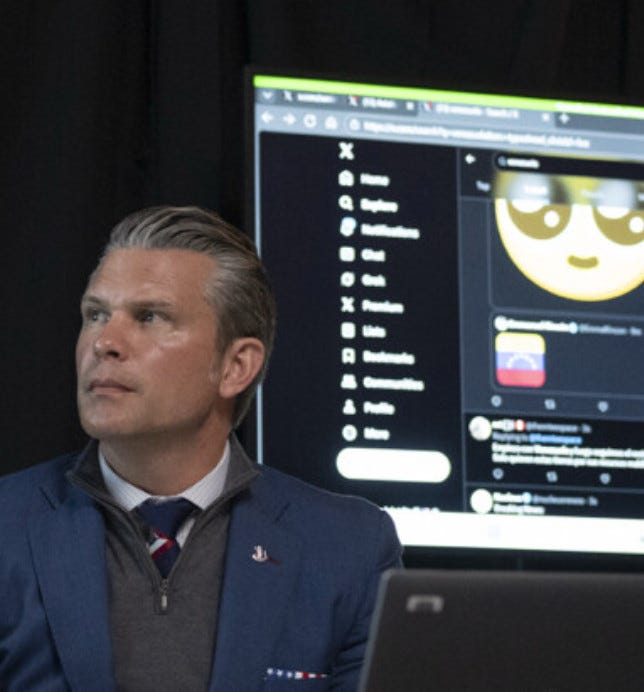
One of the strangest moments to emerge from the U.S. kidnapping of Nicolás Maduro was the flurry of images posted by President Trump on Truth Social. It felt a bit like a student who can’t decide which spring break photos look cutest, so they just upload them all.
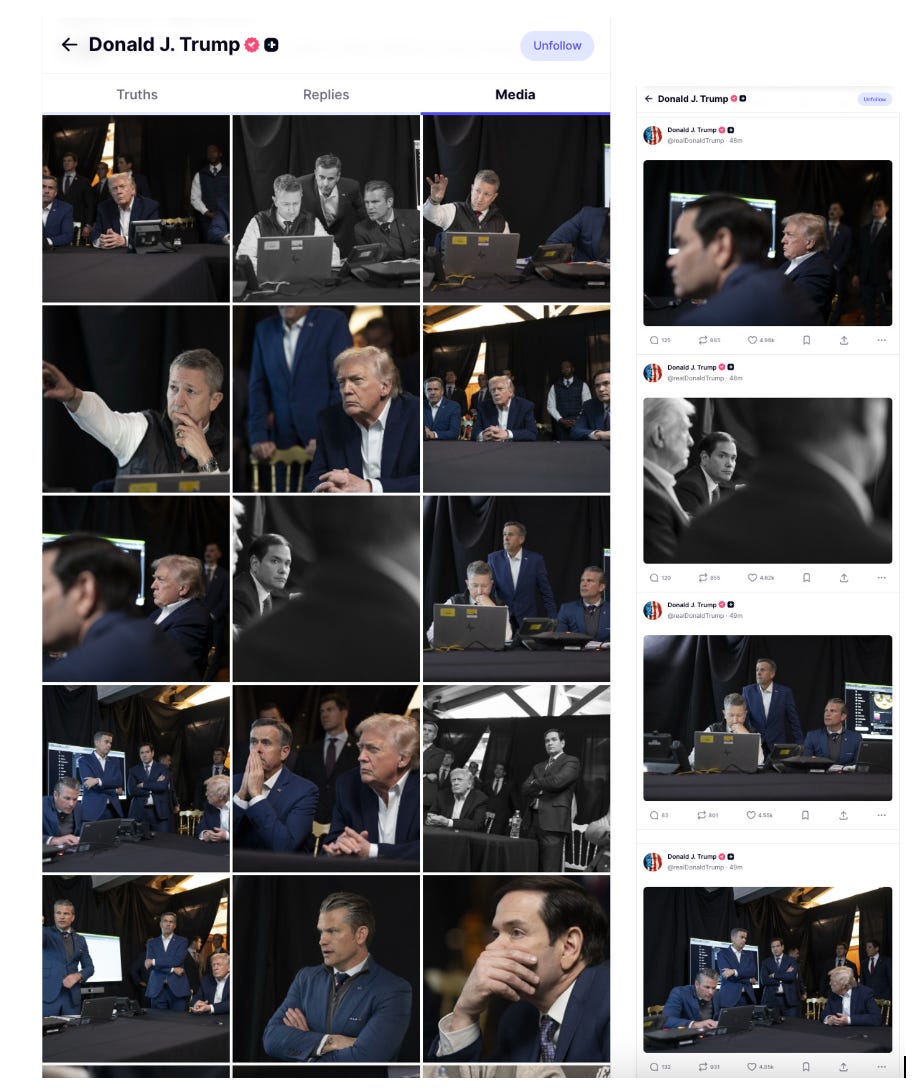
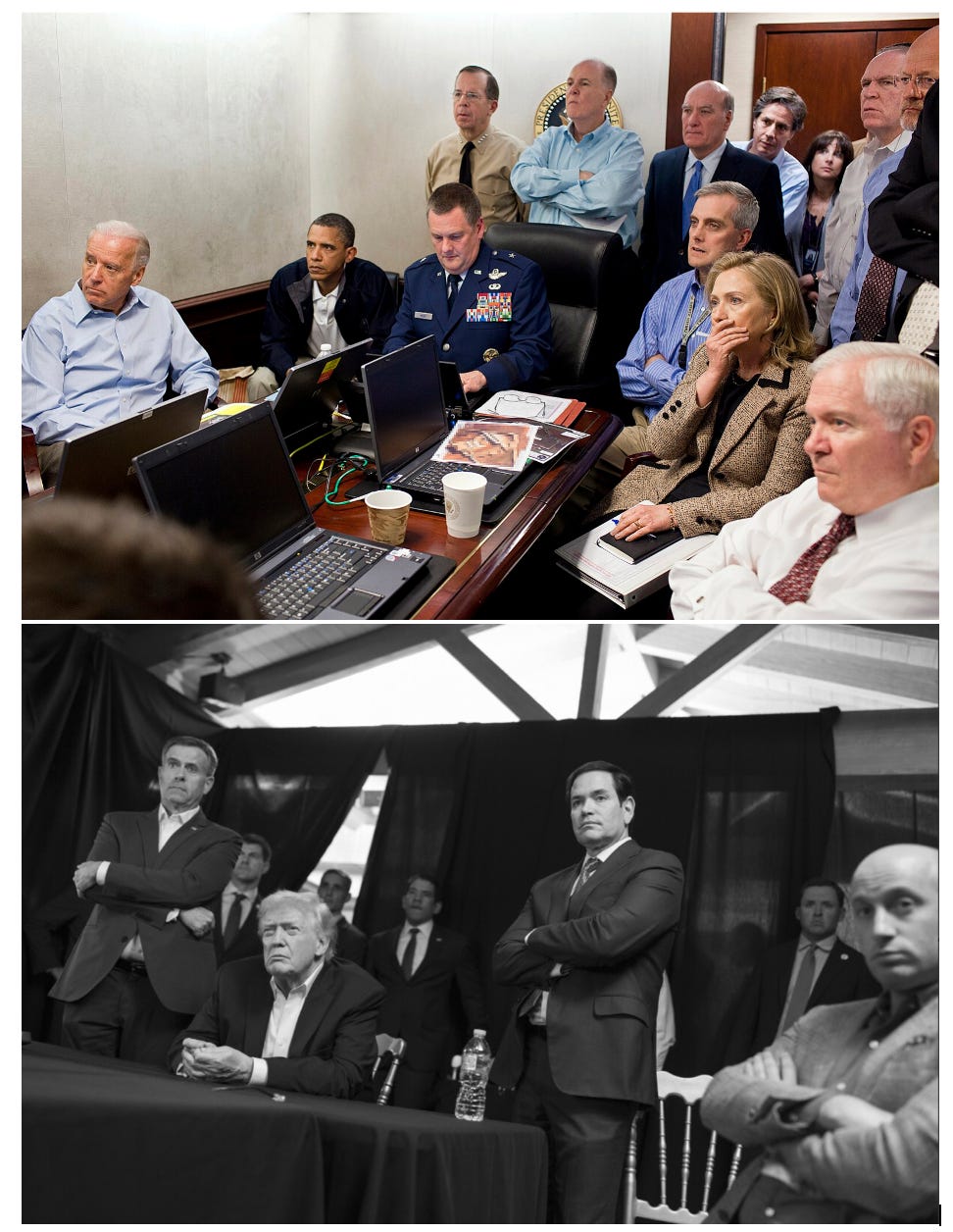
The intent seemed to be to create an iconic image reminiscent of the White House Situation Room during the raid that killed Osama bin Laden—a gathering of stoic men (no girls allowed!) staring grimly at some unseen screen. The message: "Look how serious and important our work is!" Yet, the staged nature of these photos undermines that effect, leaving the whole scene feeling less like history in the making and more like an amateur theater production of a Broadway classic.
In one image, the Director of the CIA, the Chair of the Joint Chiefs of Staff, and the Secretary of Defense are grouped around a laptop. Behind them, unmistakably, a screen displays a feed from X—complete with a prominent yellow emoji. In other pictures, “Venezuela” appears to be in the search box.
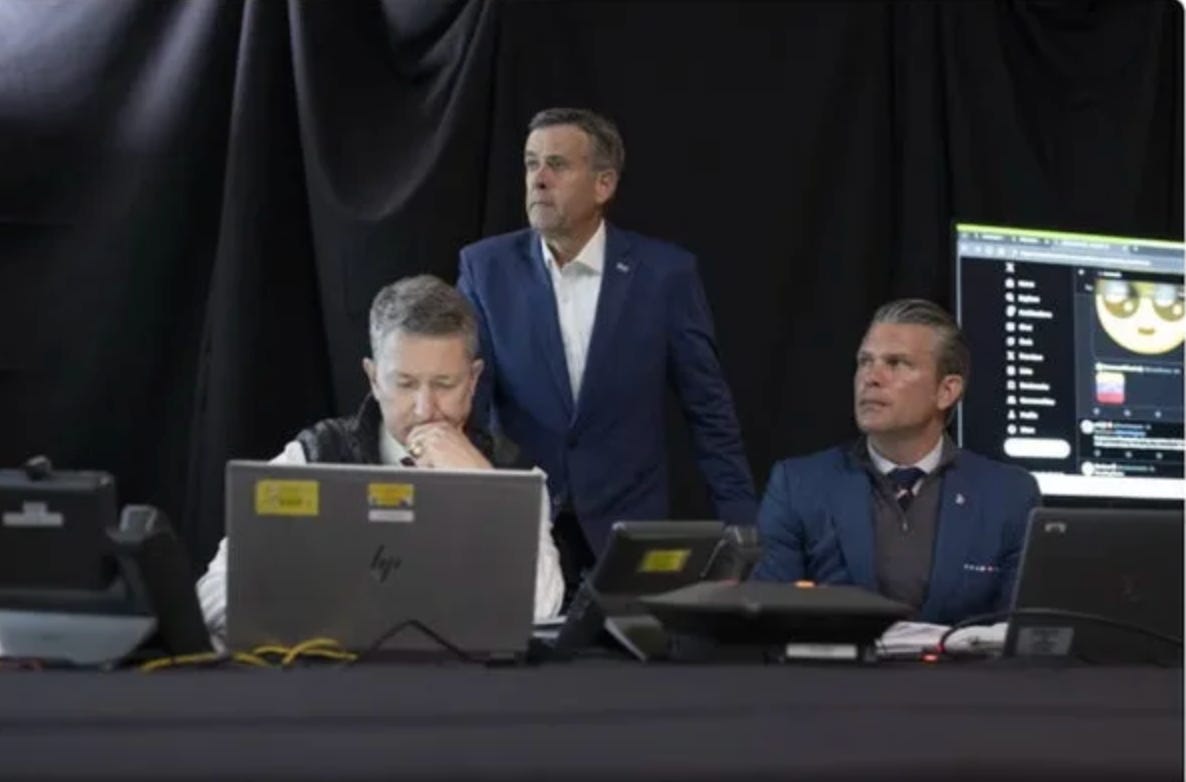
With the best intelligence systems in the world at their fingertips, they were checking X in the midst of the mission? Combined with the curtains separating some section of Mar‑A‑Lago from the rest of the President’s resort, the images create an almost surreal air. It felt as if a group of twelve-year-old boys in a basement had been handed control of the most lethal military in history—and were using it to boost their online brands.
Trump is undoubtedly the American president who has most effectively wielded social media: drawing attention, reshaping norms, and fueling conspiracy theories. The successful use of social media, for example, turned avowed MAGA isolationists into enthusiastic colonial imperialists overnight.
But I want to suggest that what we are witnessing from the Trump administration is not just skillful manipulation of social media—it’s something more profoundly worrying. Today, we live in a Clicktatorship, ruled by a LOLviathan. Our algothracy is governed by poster brains.1
What do I mean by a Clicktatorship? A Clicktatorship is a form of government that combines a social media worldview with authoritarian tendencies. Government officials in the Clicktatorship are not just using online platforms as a mode of communication; their beliefs, judgment, and decisionmaking reflect, are influenced by, and are directly responsive to the online world to an extreme degree. The Clicktatorship views everything as content, including basic policy decisions and implementation practices.
It’s worth remembering that social media operates like a drug, feeding us dopamine and rewiring our brains’ reward pathways. The fundamentally unhealthy dynamics are worsened by the fact that standing out online often demands being awful—channeling negative emotions like anger and outrage, usually based on misinformation or conspiracy theories.
None of this is new. Indeed, there is a booming political science literature on the effects of social media on voter behavior. Chris Hayes and others have written persuasively about the how toxic attention farming is for us personally and for our democracy. But I want to make the case that we should also consider how social media it is affecting how policymakers use public power.
What I’m arguing is that the Trump administration isn’t just using social media to shape a narrative. Many of its members are deeply addicted to it. We would be concerned if a senior government official was an alcoholic or drug addict, knowing it could impair judgment and decisionmaking. But we should be equally concerned about Pete Hegseth and Elon Musk’s social media compulsions—just as much as their alcohol or ketamine use, respectively.
Overexposure to online engagement has cooked the brains of some of the most powerful people in the world. This is not exclusively an American phenomenon. President Yoon Suk Yeol seemed to have genuinely believed online conspiracy theories about election fraud, motivating his declaration of martial law and triggering a constitutional crisis, and his eventual arrest, in Korea.
But in the US government, poster brain feels endemic. The Trump administration is made up of a cabinet of posters. For many, that’s how they won Trump’s attention. The head of the FBI, for example, is a podcaster—that’s his main qualifier for the job.
They view the world through a social media lens in a way that is plausibly corrupting their judgment and undermining their performance. Lets think through how poster brain can affect how people in government operate.
The adage that “Twitter is not real life” reflects the point that most people don’t spend much time on social media. The outrage farmers win large followings and drive narratives, aided by bots programmed to exacerbate division.
Spending excessive time online leads to more extreme behavior in an unrealistic and increasingly toxic environment—just to keep the dopamine coming. These bubbles are far worse for the rich and powerful, who already have limited contact with people not beholden to them. It hardly needs pointing out that this is less than ideal for a representative government. But its bad at every level of government, such as when posters become responsible for government media accounts, and post a torrent of white nationalist propaganda because this is the bubble they live in.
Traditionally, those representing institutions are careful with their public statements. It would be odd for the head of a university to be a shitposter, for example. Trump’s officials are under no such restraint, maintaining online personas that fit into Trump’s image. But when public officials must operate in professional contexts, the tension between online and institutional expectations can reach breaking points.
The clearest example: administration officials testifying before Congress. There, their lack of professionalism—online and otherwise—gets called out. Some choose to resolve this tension by fully embracing their online personas, arriving at Congressional hearings armed with zingers. When hearings resemble X posts, executive accountability takes a nosedive.
Harmeet Dhillon exemplifies poster brain. If you don’t know her, she’s an enthusiastic knitter who dedicates significant time to social media.
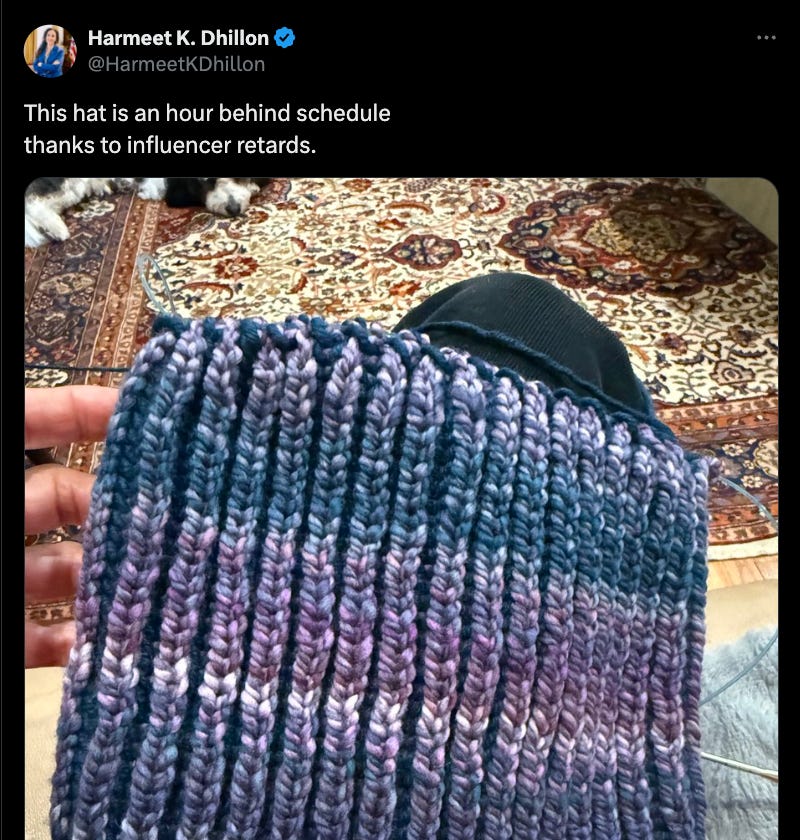
Unfortunately, Dhillon is also the head of the Civil Rights Division at the Department of Justice. Her office has a Disability Rights Section, tasked with defending the rights of people with disabilities. But there she is, complaining she cannot stick to her knitting by using what people in the disability community widely consider to be an ableist slur, one designed to mock by equating others to those with developmental disabilities. How confident can we feel that she will uphold disability rights?
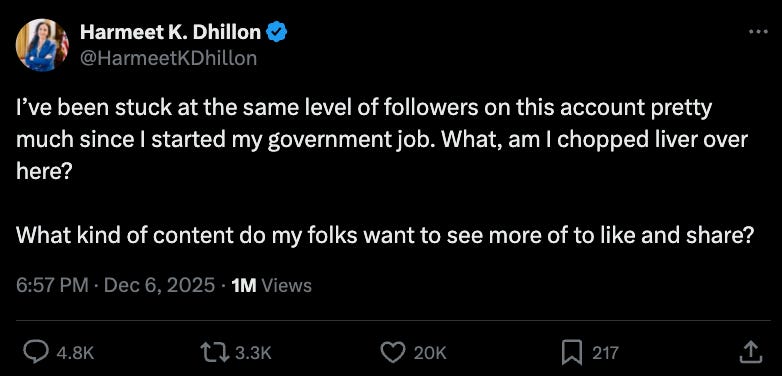
Dhillon is also an example of someone who spends a lot of time online. In the above post, her beef is with the online MAGAverse that believes the conspiracy theories they have been fed, and want Dhillon to do more. They cannot be blamed for their disappointment, since in other cases, Dhillon has using online posts to set investigative priorities for her office.
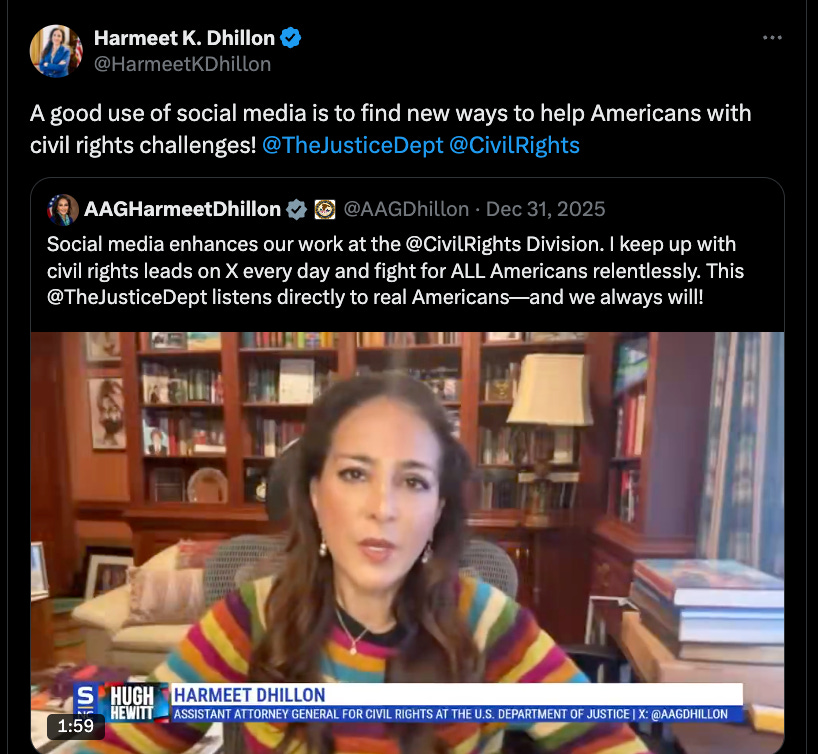
Yet, despite her social media championing, Dhillon suffers from clout envy: as a lawyer heading the Civil Rights Division at DOJ, she still wonders what she can do to rack up a few more retweets and follows.
Many of the very online seek to please their imagined audiences. For instance, the Podcaster/Director of the FBI reportedly fired veteran FBI leaders to curry favor with online critics. USAID was the first federal agency killed by online conspiracy theories—with tragic results.
The current administration is so invested in the online world that MAGA online influencers have now become paid lobbyists for industries trying to shape government policy, as well as contractors for the government trying to shape public beliefs. For example, internal documents reveal ICE planning to spend $8 million to influencers “whose followers are largely Gen Z and millennials and who were in the “military families,” “fitness” and “tactical/lifestyle enthusiast communities.””
Senior Department of Health and Human Services officials tagged the “excellent work” of a right-wing YouTuber who made largely debunked claims about massive childcare fraud, justifying a total cutoff of federal childcare funding for Minnesota. No due process, no review—just the word of some online guy.
To clarify their intent, they extended the freeze to other safety net programs, denying over $10 billion in funding—but only to five Democratic states. This mirrors what happened during the shutdown, with infrastructure funding was canceled almost exclusively in blue states. Online conspiracy theories are fine, as long as their effects are felt elsewhere.
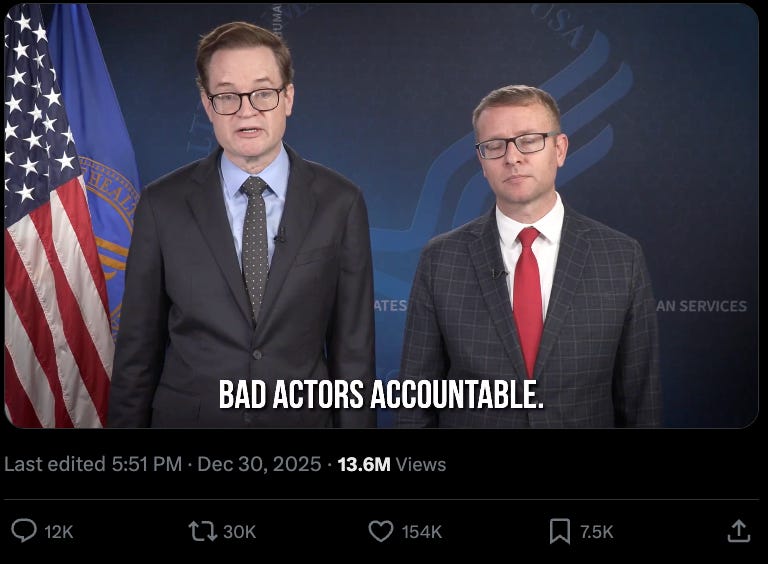
Trump became president because of “The Apprentice” and the no-nonsense executive image it created. He has an entertainer’s instinct for the power of narrative, modeled on professional wrestling conflicts. Sustaining the narrative means generating content. We see obvious changes to government websites and social media accounts, which now speak directly in the language of MAGA, offering Trump as a heroic figure.
Government decisionmakers are deeply aware of how visually powerful their choices can be. Consider, again, Trump’s wave of Maduro photos. How much do the potential optics influence decisions?
Images that demonstrate power and dominance are especially prized. It’s disturbing enough when they’re AI-generated, like Trump dropping shit on protesters from a jet. It’s worse when they’re real—requiring government spending, and causing real human suffering.
The Department of Homeland Security has transformed immigration arrests into visual propaganda: masked officials waving guns and chasing immigrants, edited to seem like an action movie or video game. Helmet cams, embedded videographers, and propulsive soundtracks reinforce the impression that the goal is virality.
It’s part of a pattern where social media teams, at the urging of the White House, are playing an unprecedented role in shaping operations and in misrepresenting the facts on the ground. Content that portrays cities as war torn, or masked agents aggressively taking down immigrants are prized, as is the humiliation of those arrested, which often include US citizens who are protesting. “If the truth of the operation does not match the narrative of the ‘worst of the worst,’ it’s going to be killed,” said one public affairs official.
One especially dramatic DHS video showcased a military-style assault on a Chicago apartment building—agents rappelling from helicopters and breaking down doors. The result? Zero criminal charges.
Never mind, the images are then used to recruit immigration agents who find them attractive, presenting the job as an opportunity to defend the homeland from foreign invaders. The emphasis on military-style images with none of the accompanying military discipline will attract people anxious to engage in violent combat against immigrants and others. This is how a former ICE Director explained it to the Washington Post:
The appeal to law enforcement should not be “the quicker we get out there and run over people, the better off this country will be,” she said. “That mentality you’re fostering tends to inculcate in people a certain aggressiveness that may not be necessary in 85 percent of what you do.”
The combination of white nationalist tropes with violence in social media recruitment tools changes the nature of who serves in government, and what they think their purpose is. As immigration agents are accused of engaging in excessive force, there is little reason to be surprised, since the ability to engage in state-sanctioned violence is precisely what was marketed to them as a reason to join the government. Even their dress suggests they are cosplaying as video game characters.
I’m just scratching the surface here. Pick any federal agency, and you can find examples of poster brains making important decisions. This trend is likely to only get worse as digital natives enter key government roles. And there are likely a host of other ways these patterns are undermining the professional behavior of people in government that I have not identified. In particular, the Trump administration represents the intersection of poster brain, personalism, and authoritarianism that seems especially toxic.
Even if my account here is preliminary and incomplete, this feels like a big issue that people intuitively understand but is not fully framed as a governance problem. Since I initially posted this, I’m adding other recent descriptions of the same phenomena by Cooper Lund, Charlie Warzel, and Ryan Broderick.
The bottom line is that it we need to take more seriously how social media has rewired the brains—and behavior—of those running our country.