Most people are reluctant to acknowledge their own racism. This makes studying racist behavior quite hard.
Social scientists use the term “social desirability bias” to reflect the point that even in anonymous surveys, people are reluctant to express views they know are subject to societal disapproval. And some people might not be fully conscious of their own discriminatory views.
And so researchers came up with an ingenious way to get at people’s willingness to engage in discriminatory behavior: the audit study. The audit study is an experiment, where people are usually asked to respond to information about two people who are identical except in terms of a key characteristic, such as gender or race.
The classic version of the audit study involves sending two sets of fictional resumes out to employers, where the resumes are identical except for one factor: the name. One name might be a White-sounding name. Another might be a name that sounds more likely to belong to a minority: someone who is Black, or Hispanic, or Middle-Eastern. People will infer the race of the sender by the name. If the responses to the two resumes are the same, no discrimination. But if one name gets systematically less responses, it is reasonable to infer discriminatory behavior.
The research literature based on audit studies has been impressive in offering hard-to-dispute causal evidence of systemic discrimination.1 For example, key findings include:
White job applicants receive systematically more callbacks than equally qualified Black or Latino job candidates, a pattern that has not improved over time.
In housing, discrimination against non-white renters and buyers has remained significant and relatively stable over time.
My own minor contribution came to this literature a few years ago, when an audit study I worked on with Asmus Olsen and Jonas Høgh Kyhse-Andersen, when we found that Muslim students in Denmark had a harder time getting school officials to allow them to join their school relative to students with classically Danish names.
Audit studies are attractive because they provide clean causal evidence of hard-to-observe behavior. Researchers can control for all of the potential reasons why people might disfavor one group other than bias. For example, people might assume a minority group has less education, but you can ensure the fictional resumes feature the exact same level of education. In real life, of course, it is not so easy to control such factors.
But what if you could find a real life example where the minority candidate was given every possible advantage. Was not just the same, but clearly better. Would we still see signs of discrimination?
The Michigan primaries threw up such as case. In one Republican primary for a seat in the 8th District, Tom Smith faced Amir Hassan. Neither are incumbents in the seat.
Who do you think won? Of course, you are thinking Smith, right?
But what if I were to tell you that Hassan had one extraordinary advantage that Smith lacked: the coveted Trump endorsement, in a district that Trump won in 2024.
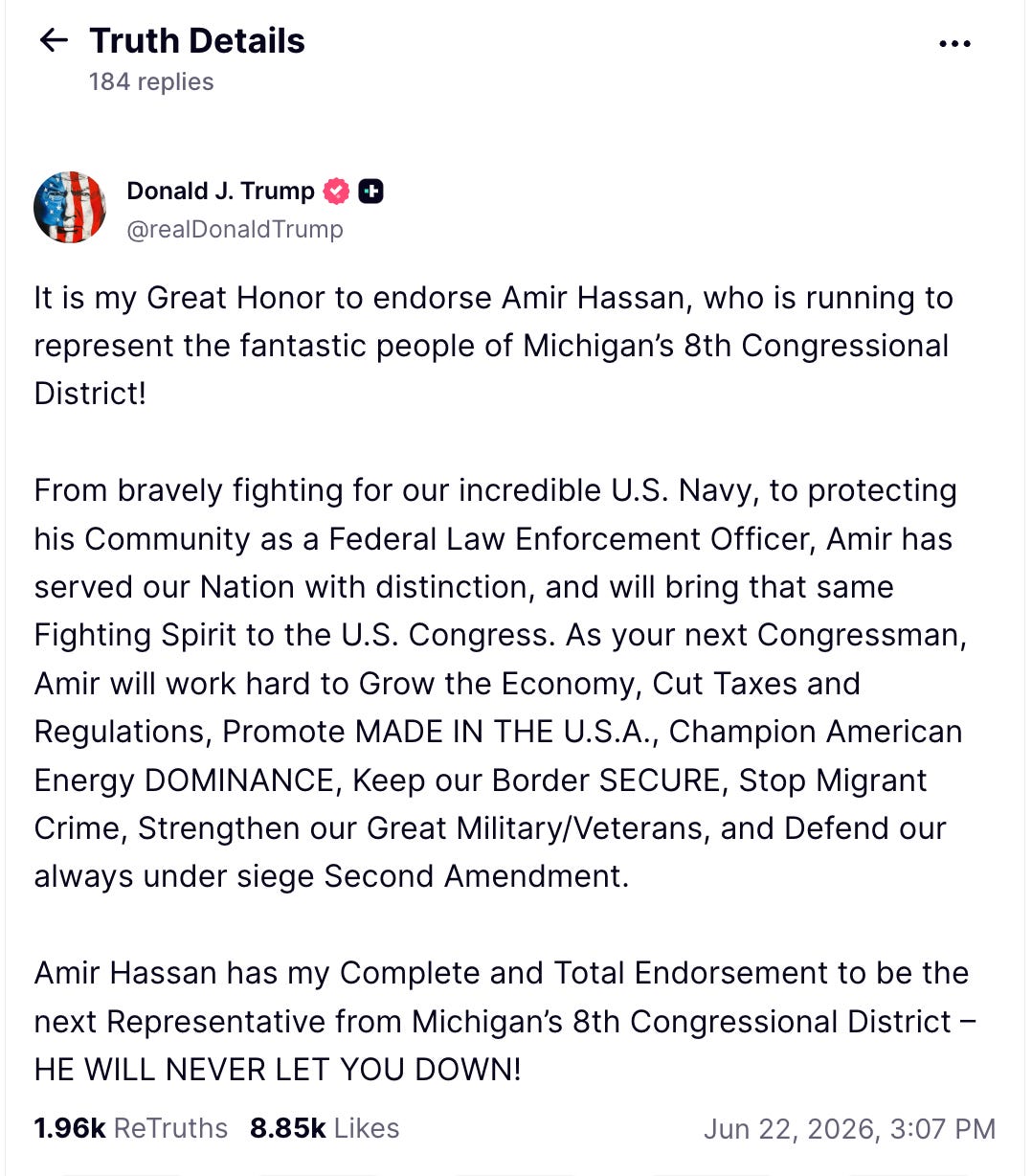
Trump even rallied with him.
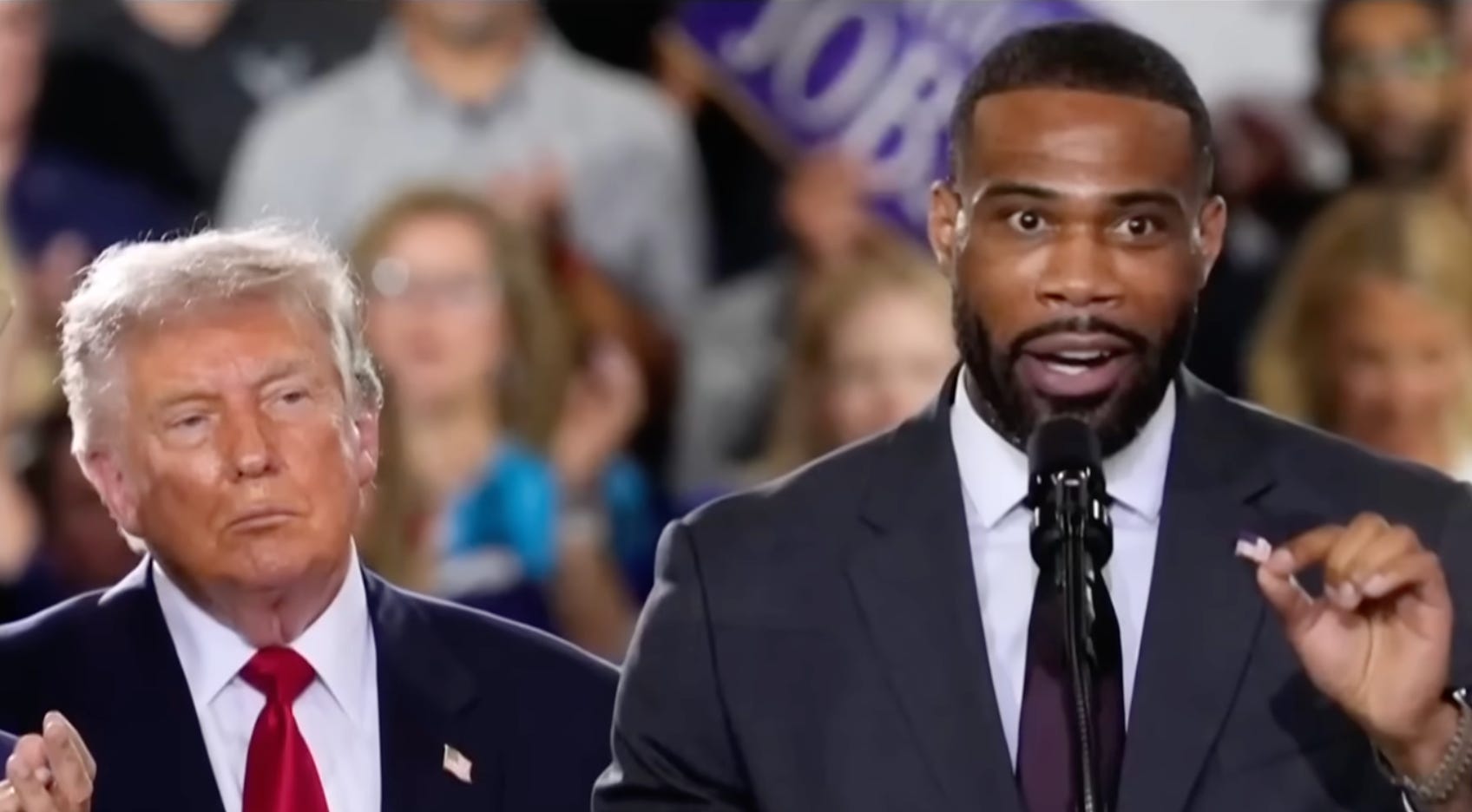
And Hassan was chosen by the GOP precisely because they thought he could win in this district. Speaker Mike Johnson endorsed him. And Hassan was a Navy veteran.
Now, who do you think won?
If you still say Smith…you know Republican primary voters well. Smith won with 50% of the vote, while Hassan received 33%.
Maybe there is stuff we are missing here that made Smith a better candidate? Maybe he ran a better race, was more organized, or had more money on hand? No, no, and no. And here is where things get really weird. Smith had dropped out of the race in July. His Facebook campaign page had 95 followers, and he had raised less than $2000 according to All In with Chris Hayes. Hassan reported spending $622,841.
This is the note Smith sent to the Federal Election Commission, testifying to his inability to raise funds, and, uh, to completing election forms:
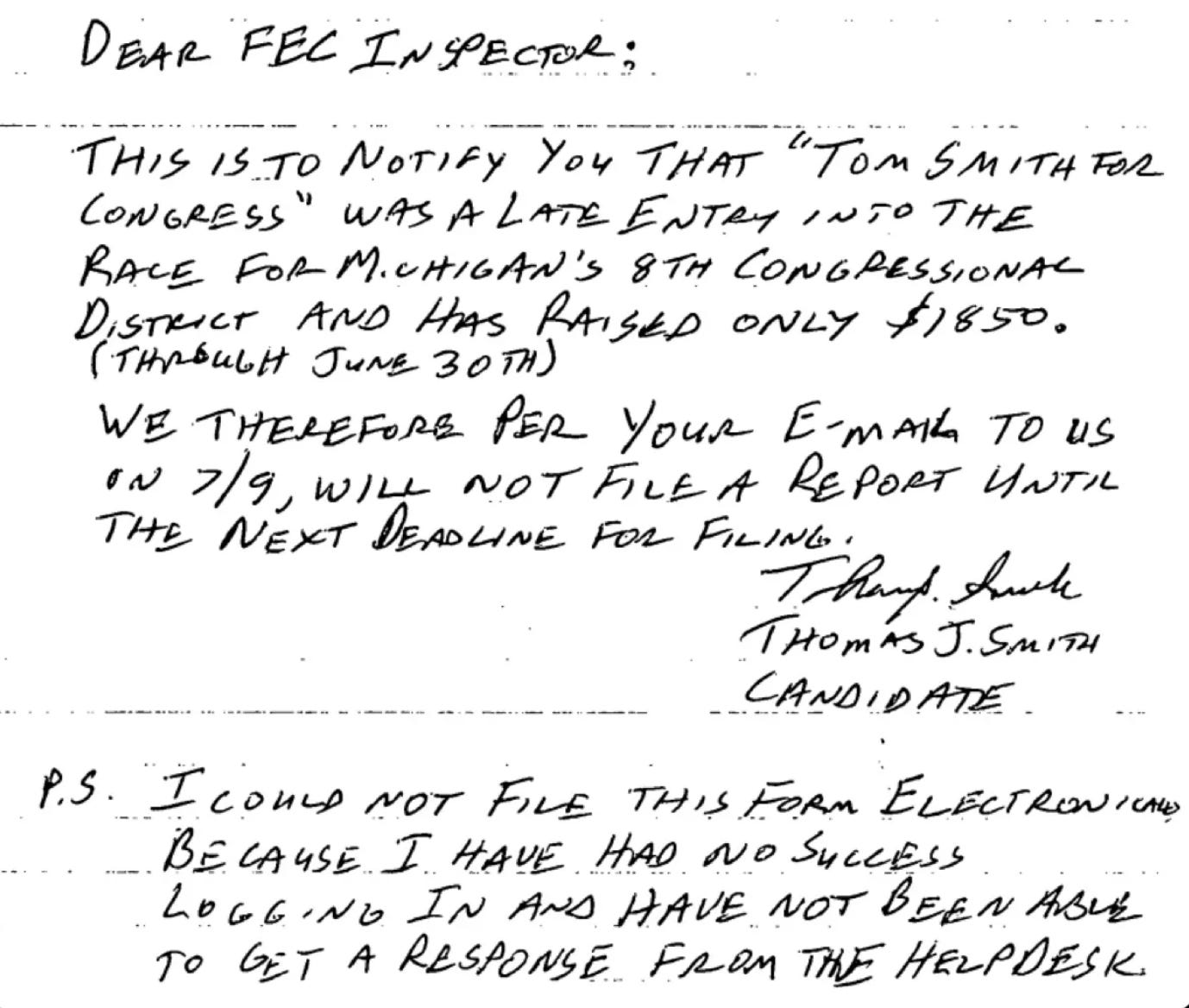
Why did Tom Smith, a candidate with no money, no experience, no organization AND WHO HAD DROPPED OUT OF THE RACE defeat Trump-endorsed Amir Hassan? There is no obvious metric by which Smith was the better candidate. Save one: his name. And even Republicans acknowledged it. According to the Detroit News:
State Rep. Tim Kelly, R-Saginaw, said he could only speculate why Hassan lost but added that voters were shying away from what he described as Arabic-sounding names. Other Republicans echoed Kelly's analysis, saying the outcome was sad.
Hassan Nehme, a Muslim Republican candidate, blamed the Christian nationalist movement in the district, saying: “They’re scared of the Arab Americans taking over in the area.”
Hassan faced a wave of bigotry accusing him of being an immigrant (untrue) and Muslim. Hassan was once Muslim but is now an avowed Christian who has become fairly critical of his former faith. His campaign bio states:
He recently reaffirmed his commitment to Christ, stating “Jesus Christ is his Lord and Savior.” Having served at Guantanamo Bay, Amir has zero tolerance for extremists who pervert Islam into something evil. Amir believes Israel is our strongest ally in the Middle East.
After Hassan’s defeat, Trump confidante Laura Loomer posted that:
“Amir Hassan” claims he’s not a Muslim, but it doesn’t matter. His name sounds like he’s fresh off the boat and MAGA voters reject the Islamic infiltration of our country and party. This should be an eye opener to Trump’s advisors that we don’t want Muslims, Arabs or anyone who may even sound Arab or Islamic serving in office. We are done with the Islamic takeover of our country, but they won’t pass this message along to President Trump…Dude should have changed his name. If my name was Amir Hassan and I wasn’t a Muslim, I’d be changing my name as soon as I turned 18.
I will never vote for anyone with an Islamic name. Neither will most of President Trump’s voters. [Emphasis added].
Hassan’s actual identity does not matter. His name sounds like he is Muslim, and that is enough for Republican voters, according to Republicans.
One alternative explanation is that Hassan is Black, and so he faced anti-Black rather than anti-Muslim racism. It is possible the combination of his name and race were toxic, but this is also a year when the Republican nominee for Governor in Michigan, John James, is Black. James comfortably won the counties that Hassan lost.
There was really nothing Amir Hassan could have done to win this Republican primary that he did not do. He had every advantage and an opponent who had so little confidence in his campaign that he exited the race. None of it mattered. Hassan’s name did not match the imagined bio it created, but that imagined bio of a Muslim candidate was enough to sink him.
This astonishingly open bigotry has become such a feature of the MAGA base that the general Republican response seems to be a shrug of the shoulders, and a disinclination to include Muslims in the party. For example, Muslims who attended the Texas Republican Party were told they were not welcome as the Party embarked on a “Don’t Sharia Our Texas” campaign based on the lie that the Lone Star state is on the verge of becoming Iran because of some unseen Muslim influence.
Which brings us to another name in Michigan: Abdul El-Sayed. The Democratic nominee for Senate has already become a national figure for Republicans, who hope to persuade all Michigan voters to treat him they same way that Hassan was treated. Reduced only to a Muslim name. Tied to every Muslim stereotype that Republicans fear. His record as a physician working on public health buried from public view. A debate on actual policies avoided at all costs.
El-Sayed is Muslim, and has been sharply critical of support for Israel’s war. If people want to argue about that issue, fine. But instead, his opponent Mike Rogers claimed that El-Sayed believes that “America deserved 9/11.” He also said El-Sayed is a “RADICAL ISLAMIST” who would “unleash terror.”
None of this is true of course. El-Sayed long ago denounced Muslim terrorism behind 9/11. But to be a Muslim man in America means being required to complete such denunciations. And it means that such denunciations are never enough. You are permanently under suspicion regardless of how you have lived your life.
Rogers knows his claims are untrue, but judges the penalty for slandering El-Sayed will be less than the benefits. Will he be proven right? There are a grand total of four Muslim members of Congress. There has never been a Muslim Senator. When you see shameless demagoguery like this, you start to understand why.
And that is just the tip of the iceberg. Paul Waldman at Public Notice provides plenty more examples, including the following:
The level of anti-Muslim bias seems both stronger and more open on the Republican side than even in the immediate post 9-11 era, when George W. Bush argued that the true nature of Islam is peace, not terrorism. There is no effort to call to the better angels of our nature during the time of MAGA.
And so, the state of Michigan now faces another test, which is how much the name of El-Sayed, and the bio that Republicans are trying to attach to it, will replace the actual candidate. Expect it to be a very ugly few months.