Starting is probably the hardest part of writing online. There is always another reason to wait: a better hook, a smarter idea, or the perfect platform. But most of those questions become much less important after you publish something.

I started writing online daily more than 630 days ago. These are the things I wish I had understood at the beginning. If this helps even one person publish their first post or just start writing, I’ll be very happy.
Start with one platform. Do not spread yourself. It is better to choose a platform you enjoy - LinkedIn, X, or anywhere else - and, ideally, one where you already know a few people. You can go to other ones later, but at the beginning it takes a lot of time to understand “rules” of each.
The two hardest things are starting and continuing. Simple, right? Starting is difficult because your mind produces lots of reasons not to post. Continuing is difficult because those reasons not to post don’t disappear after the first post. Some days they are loud; other days, quieter.
Consistency doesn’t mean writing every day. For many people, it means publishing two or three times a week for years. That works too. Choose a pace you enjoy and can keep even during a bad week/traveling/hiking/etc.
You can begin by participating. At the beginning, I thought every post should start from my own original idea. Not really. You can comment, restack something useful, or add one thought to another person’s post. It is still writing, and you learn a lot along the way.
Get comfortable posting from your phone. One of my friends publishes around 80% of his posts from his phone. I’ve done it only a few times, but I see the point: you can post from almost anywhere and stop waiting for the perfect setup.
Writing and publishing don’t have to happen on the same day. Some days I only create drafts. Some days I publish something I wrote a week ago. I still write and post every day. It’s just not always the same piece of text.
Scheduling is not cheating. At first, I felt strange using this feature because it meant I hadn’t technically published anything that day. I still write almost every day, but sometimes I publish something I wrote a week ago. Scheduling just makes it less chaotic.
Give some posts time to live in your head. Not every idea needs to be drafted and published immediately. Some become clearer after you carry them around for a while. This article is a good example. Some ideas here were in my backlog for 1-2 months. A few I deleted. A few I understood one year ago. A few became better because I added something new later.
It is never too late to write about something. I once posted about my work anniversary 12 days later. I also saw someone share a post about her marriage five years after it happened. Why not? I don’t think a story expires just because you didn’t publish it the same day.
Some people may make fun of your writing routine. Yeah, this one was surprise for me. But a good lesson is to spend less time with them. Remember that the unfollow button works both ways: you can unfollow people you no longer find interesting, and anyone can unfollow you at any time. Fortunately, every platform puts that button somewhere easy to find, so you can always point out those people to this feature.
Let emotions generate ideas, but not make publishing decisions. You are allowed to write something rude or unusually honest. But when I have written while upset, I have often felt a strong urge to publish something I would later (probably) regret. Write it and give yourself time before publishing.
Create a simple system for difficult days. When writing feels heavy and nothing seems to work, I return to three questions:
What is on my mind?
What is bothering me?
What would I write if there were no constraints?
Your system can be even simpler. Its only job is to unblock you when writing feels hardest.
Find a few people whose writing you enjoy. Because while reading them, you start paying attention to their style, ideas, structure, or sense of humor. They can be a reliable source of inspiration while you develop your own style.
Experiment with formats. Try text, spacing, formatting, images, screenshots, video, lists, and short observations. At the beginning, experimenting is easier because almost nobody is watching (which is actually a good thing). Try to keep that experimental spirit later too.
Most writing fears don’t disappear. You may worry about what people think, how a post will perform, whether you made a grammatical mistake, whether you post too often, or whether you will break a month-long or year-long streak. After 630+ days, I still think about grammar mistakes, reach, and posting too often. The difference is that now I react to those fears less and usually publish anyway.
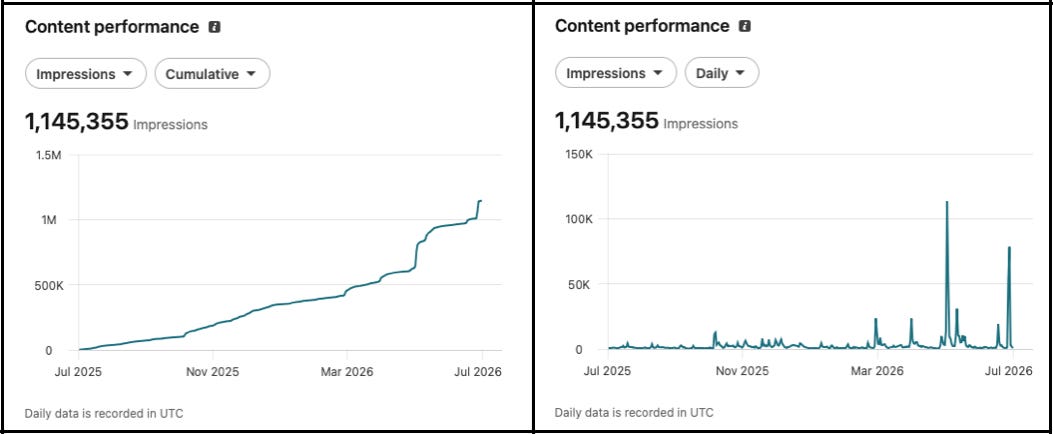
You can’t hack the algorithm (probably). At first, I thought I could do it with the perfect hook, enough value, or an aggressive posting schedule. I couldn’t. The closest thing to an algorithm hack is consistency. The annoying part is that consistency works slowly. For a long time, it looks like nothing is happening. Then you look back and realize that 100 posts did much more than any one “perfect” post.
Random posting times are worth testing. Not sure there is a perfect time to post. If something is ready, I think it is better to publish it now than wait for an “optimal” hour.
Hooks are useful until the post starts sounding like a template. I still try to write good hooks. But if a sentence feels like something I would never say, I usually delete it - even if it should “perform better.”
What feels obvious to you may be completely new to someone else. At the beginning, I skipped lots of ideas because they felt too obvious. Then I mentioned some of them in conversations and realized they were not obvious to other people at all.
Reading about writing is easier than writing. I like reading about it, but one month of publishing probably teaches more than one more book about writing. Same with sales, building products, and lots of other things.
AI can be an assistant without becoming the author. I use AI a lot, so obviously I don’t think it is a problem. Grammar, structure, or checking a sentence - yes. Deciding what I think and writing the whole post for me - no.
Practice teaches you to think in ideas. At the beginning, I often thought, “What can I post about? I have nothing. Who are going to read it?” Now I can notice an idea in a call, a book, or a random thought while walking. It is probably just practice.
Not sure you can choose a niche before writing anything. I would start with 2-3 topics you already think about a lot and see what is still interesting after 20-30 posts.
People don’t see all your posts. It was a BIG discovery for me. Everyone opens the platform at a different time and sees a different feed. Most people won’t see both posts, even if you publish them an hour apart. If you want to post twice, do it.
The point is not to sound like an expert. I don’t have strong confidence in lots of things I write about. Usually I’m just sharing what helped or what I noticed. “I don’t know yet” is a completely fine conclusion too.
Not every post needs to change someone’s life. Some can be just useful, funny, or honest. That is enough.
Remove unnecessary requirements. I often make writing harder by adding optional things: a hook, branded visual, carousel, tag, or perfect time. Most of them aren’t required.
Your first posts are allowed to be small. One lesson, one screenshot with context, one mistake, one useful tool, or one question. You don’t need a complete worldview for every post.
Capture ideas wherever they appear. I don’t wait for an evening writing session. Most ideas come while walking, reading, after calls, or in random notes. I guess at least half of mine come from books, so I try to capture them immediately.
You probably already wrote a few posts without calling them posts. Check Slack messages, emails, or explanations you sent to colleagues. Sometimes the only missing step is to copy the text and edit it a little.
Writing in two languages is not a problem. Choose the language that feels right for each idea. I write in English and Ukrainian. Not sure this needs a strategy. Sometimes an idea just comes in one language, so I post it in that language.
You can start with a question instead of an answer. Sometimes I write because I already know what I think. Sometimes I write because I’m trying to understand it.
Your first post can explain why you are starting. It can be very simple: who you are, what you are learning, why you decided to write, and what you may write about. That is enough for the first post.
You can begin quietly. You don’t need to announce a personal brand or promise 365 days of writing. Publish five posts quietly and see if you even like it.
Don’t judge the experiment after three posts. Decide in advance that your first 20 posts are practice. Their job is to help you find your topics, formats, and routine - not to prove whether you can build an audience with 10,000 followers. I can’t control 1,000 followers. I can control 20 posts. So I prefer the second goal.
At the beginning, I said I’d be happy if this article helps one person publish their first post. So if you were waiting for some sign, maybe this is it :)
Pick one small idea and publish it. Your first post doesn’t need to be impressive.
And if someone came to mind while you were reading, send this to them 🙌