
In November 2025, Eli Lilly became the first pharmaceutical company to hit a $1 trillion market cap.1 Two months later, at JP Morgan Healthcare 2026, Lilly announced over $2.3 billion in AI partnerships in a single week: a $1 billion co-innovation lab with NVIDIA, a $1.3 billion oral obesity deal with Nimbus, and new collaborations with Chai Discovery and Schrödinger.2, 3, 4
This isn’t luck. Lilly has been systematically building something no other pharma has: a full-stack AI drug discovery platform. Most pharma companies are customers of AI vendors, renting tools to find drugs. Lilly rents too, but with a twist: it’s aggregating these partnerships into a proprietary ecosystem. By integrating external tech (Isomorphic, Chai) with internal data and compute (TuneLab, NVIDIA), Lilly isn’t buying software. It’s building the operating system the industry may eventually rent from them.
The Cash Engine
Every aggressive strategy needs fuel. Lilly has the largest cash engine in pharma history.
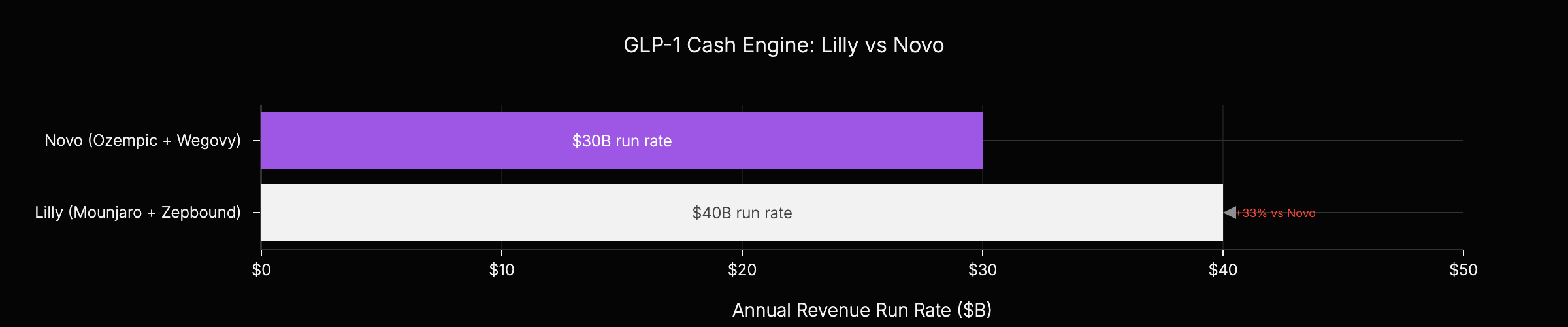
Mounjaro and Zepbound, Lilly’s GLP-1 drugs for diabetes and obesity, generated $19 billion in the first nine months of 2025.5 That’s a $40 billion annual run rate, making them the world’s best-selling drug franchise. For context, Novo Nordisk’s competing Ozempic and Wegovy are at roughly $30 billion.6
This matters because R&D is expensive. Lilly spent $11 billion on R&D in 2024 (up 18% YoY) and is on pace for $12.5 billion in 2025.7, 27 No other pharma can match this combination of growth rate and absolute scale.
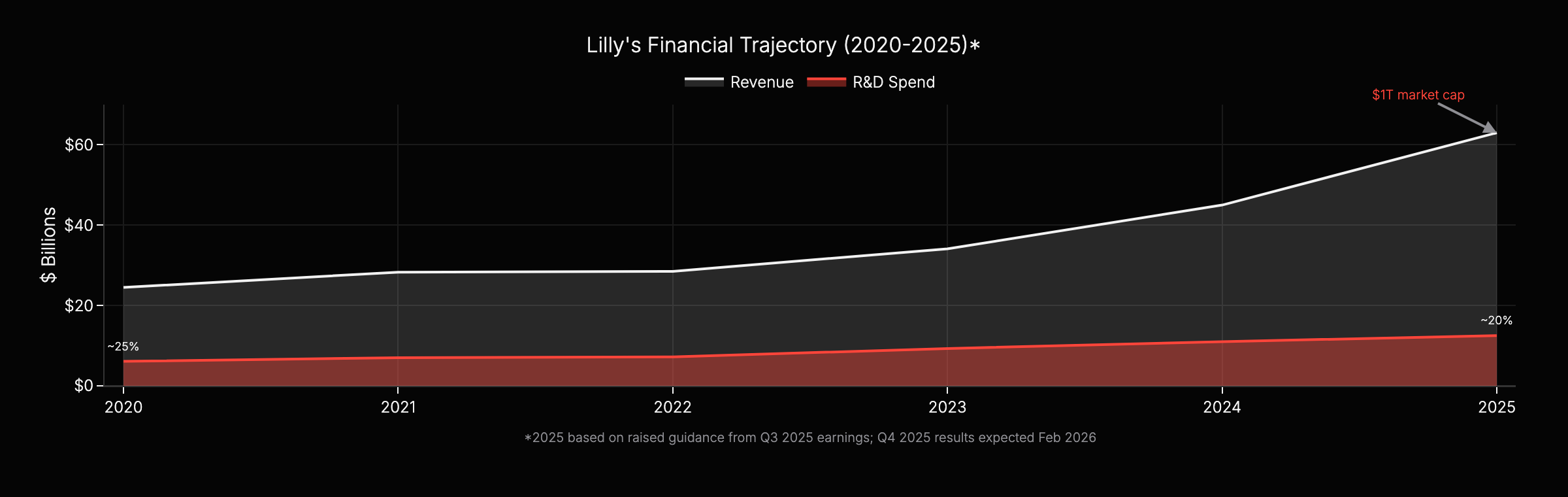
But notice the ratio. R&D intensity actually fell from 25% to 20% of revenue as GLP-1 sales exploded, speaking to Lilly’s commitment to efficient capital deployment. For Lilly’s R&D spending to track their revenue increase, they need entirely new research infrastructure that can absorb that capital in a meaningful way. You cannot just write bigger checks to the same research infrastructure you have established. The AI partnerships aren’t just about finding better drugs. They’re about expanding the ceiling on how much capital Lilly can productively deploy.
The implication: Lilly can afford to place multiple $1 billion bets on AI infrastructure while competitors are forced to pick and choose. Cash buys optionality.
The Partnership Stack
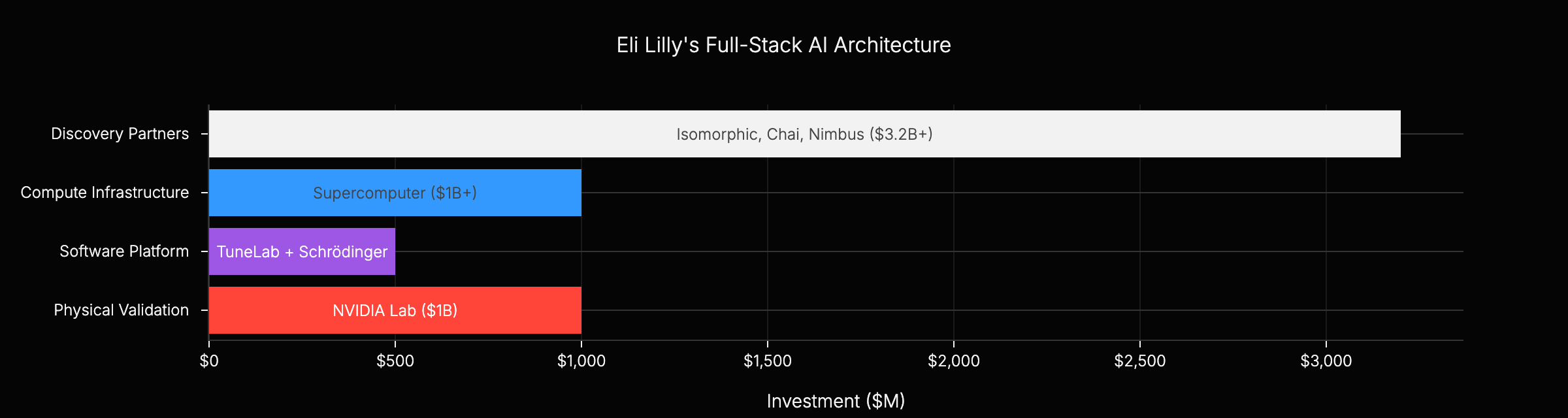
Lilly isn’t just licensing AI tools. It’s building an integrated stack that spans discovery, compute, software, and physical validation.
Layer 1: Discovery Partners
At the foundation, Lilly has partnered with the leading AI drug discovery platforms across multiple modalities:
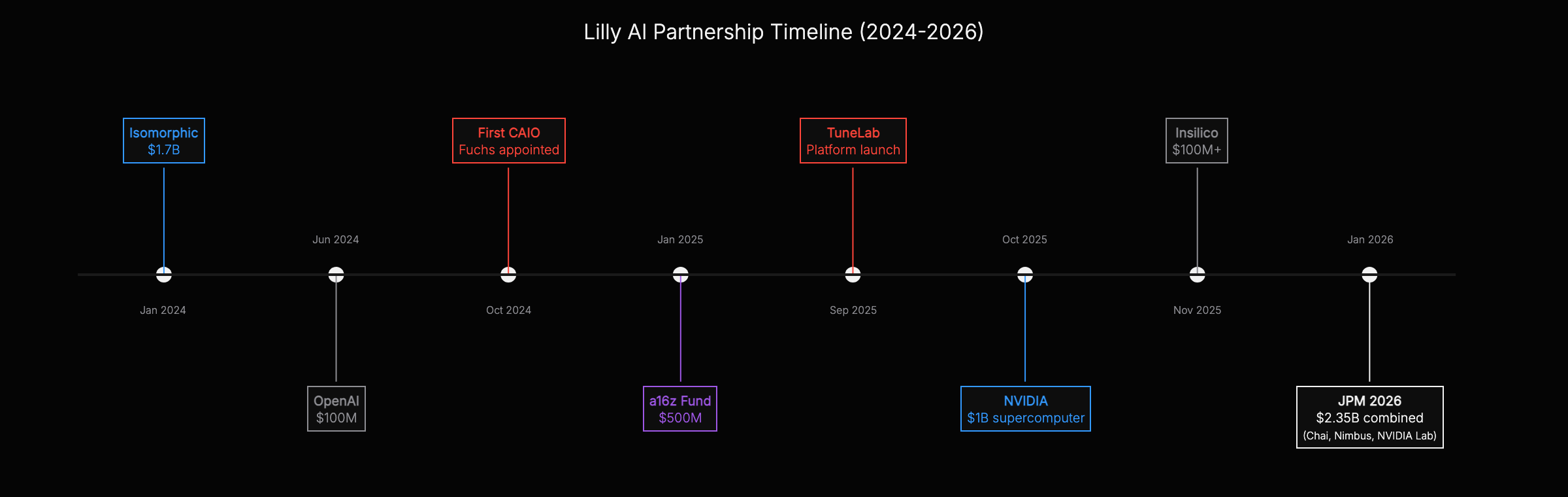
Isomorphic Labs (Jan 2024): $45 million upfront, up to $1.7 billion in milestones, for small molecule discovery using AlphaFold-derived technology.8 As of early 2026, several candidates are in IND-enabling studies, with Phase I trials expected by late 2026.
Chai Discovery (Jan 2026): Collaboration for biologics design using Chai-2, the first zero-shot antibody design platform achieving double-digit experimental hit rates.9 Lilly is also getting a purpose-built exclusive model trained on proprietary Lilly data.
Nimbus Therapeutics (Jan 2026): $55 million upfront, up to $1.3 billion in milestones, for oral obesity drug discovery.10 This expands a three-year partnership on AMPK activators for cardiometabolic disease.
Insilico Medicine (Nov 2025): $100 million+ deal for access to Pharma.AI, an end-to-end AI drug discovery platform.11 Lilly was already a software customer since 2023.
OpenAI (Jun 2024): Collaboration for antimicrobial drug discovery targeting drug-resistant pathogens.12 A moonshot bet on applying foundation models to a neglected therapeutic area.
This portfolio spans structure prediction (Isomorphic), generative chemistry (Nimbus, Insilico), biologics design (Chai), and foundation models (OpenAI). If any AI modality wins, Lilly has exposure.
Layer 2: Compute Infrastructure
Raw computational power determines what AI models you can train. Lilly is building the most powerful AI infrastructure in pharma.
In October 2025, Lilly announced a partnership with NVIDIA to build what they claim is the “most powerful supercomputer owned and operated by a pharmaceutical company.”13 The specs: 1,016 NVIDIA Blackwell Ultra GPUs delivering over 9,000 petaflops of AI performance. For context, a single Blackwell Ultra GPU contains the power of approximately 7 million of the Cray systems Lilly used in 1992.
This isn’t shared cloud compute. Lilly owns and operates the infrastructure, giving them full control over proprietary model training and data security.
Layer 3: Software Platform
The operating system tying everything together is TuneLab, Lilly’s proprietary AI/ML platform launched in September 2025.14
TuneLab provides 18 AI models (12 for small molecules, 6 for antibodies) trained on over $1 billion worth of proprietary Lilly data. The platform uses federated learning: external biotechs can run Lilly’s models on their own data without exposing either party’s proprietary information.
In January 2026, Schrödinger announced TuneLab integration into LiveDesign, their widely-used molecular design platform.15 Schrödinger, whose LiveDesign platform rarely integrates third-party models, will now offer TuneLab as a priority workflow. For Lilly, this means their models become embedded in the industry’s default molecular design environment. The strategic implication: Lilly gets data back from every user, continuously improving TuneLab while embedding their models into the industry’s standard workflow.
Layer 4: Physical Validation
The newest layer, announced at JPM 2026: a $1 billion co-innovation lab with NVIDIA in San Francisco.16
The focus is “physical AI,” connecting computational predictions to robotic wet labs. The goal is 24/7 AI-assisted experimentation where experiments, data generation, and model development continuously inform each other. This creates a closed loop: AI designs experiments, robots execute them, data feeds back to improve AI.
No other pharma has this complete stack.
The Ecosystem Moat
Lilly isn’t just investing in AI for itself. It’s creating infrastructure that others depend on, building network effects that competitors can’t easily replicate.
The a16z Fund
In January 2025, Lilly partnered with Andreessen Horowitz to launch a $500 million biotech ecosystem fund.17 The structure is unusual: Lilly provides 100% of the capital, while a16z Bio + Health manages the investments.
Fund portfolio companies get access to Catalyze360, Lilly’s support program for early-stage biotechs. This creates a deal flow advantage: Lilly sees the most promising AI-native biotechs before anyone else, can invest early, and potentially acquire or partner with winners.
Gateway Labs
Lilly operates five Gateway Labs sites globally (San Francisco, San Diego, Boston, Beijing, and a new Philadelphia location).18 These provide lab facilities and scientific engagement for early-stage biotechs.
The results: 50+ pipeline programs have run through Gateway Labs, and participating biotechs have collectively raised over $3 billion.19 Lilly gets first-look access to emerging science and talent.
TuneLab Federation
TuneLab’s federated learning model creates true network effects. Each biotech that joins contributes training data, improving the models for everyone. The more users, the better the models. The better the models, the more users.
About a dozen startups have joined so far, including Insitro.20 As adoption grows, leaving TuneLab becomes increasingly costly because you lose access to models trained on the entire network’s data.
This is the AWS playbook applied to drug discovery: build infrastructure so valuable that the ecosystem builds on top of you.
The Leadership Bet
Execution requires leadership. Lilly has moved faster than competitors on organizational structure.
In October 2024, Lilly appointed Thomas Fuchs as the industry’s first Chief AI Officer.21 Fuchs isn’t a pharma executive learning AI. He’s an AI expert learning pharma: previously Dean of Mount Sinai’s AI and Human Health Institute, founder of Paige AI (cancer pathology), PhD in machine learning from ETH Zurich.
The appointment signals enterprise-wide AI integration, not just R&D applications. Fuchs oversees AI across drug discovery, clinical trials, manufacturing, and commercial operations.
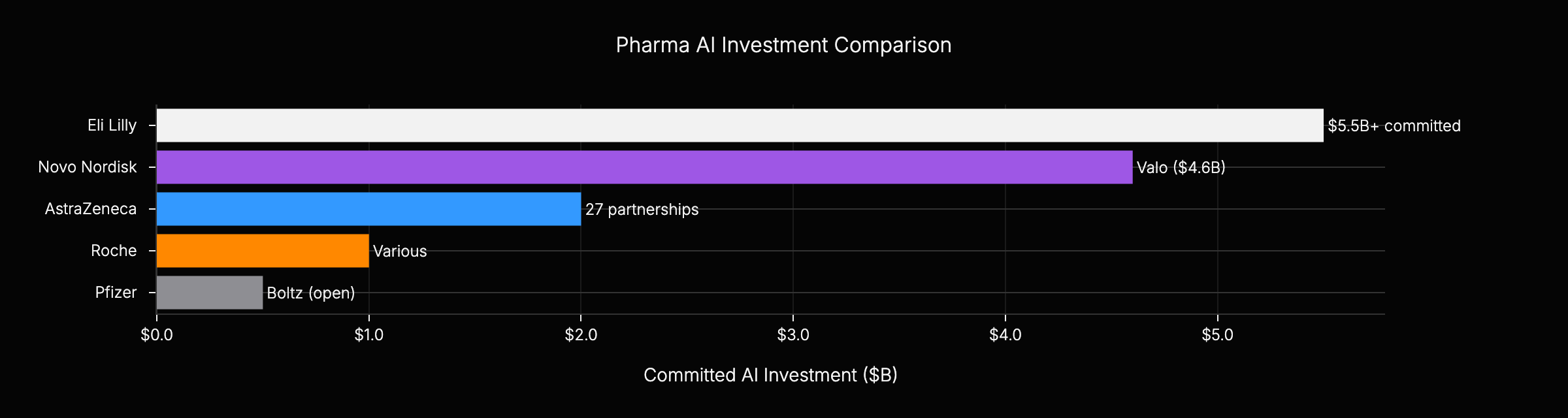
Compare this to competitors: AstraZeneca has 27 AI partnerships (more than anyone) but no dedicated CAIO.22 Novo Nordisk recently appointed Anja Leth Zimmer as CAIO, but Lilly’s 18-month head start gave Fuchs time to build the infrastructure stack now coming online.26 Lilly is betting that AI is strategic enough to warrant C-suite leadership.
Competitive Context
How does Lilly compare to the rest of big pharma?
Novo Nordisk is Lilly’s closest competitor in both GLP-1 drugs and AI investment. Their January 2025 expansion with Valo Health is worth up to $4.6 billion across 20 programs.23 They also have NVIDIA partnership for access to Denmark’s Gefion supercomputer.
But Novo’s approach differs: they’re building a “vertically integrated AI factory” with deeper partnerships on fewer platforms. Lilly’s multi-vendor strategy provides more optionality but less control. The jury’s out on which approach wins.
The rivalry carries historical irony: Novo pioneered the GLP-1 market that Lilly now dominates in revenue. Lilly reached $1 trillion first despite being the follower in obesity drugs. Whether Lilly’s diversified AI portfolio or Novo’s concentrated Valo conviction proves wiser may determine pharma leadership for the next decade.
AstraZeneca leads in raw partnership count (27 major AI collaborations) but hasn’t built the integrated infrastructure Lilly has.22 They’re licensing AI tools, not building platforms.
Pfizer made an interesting counter-bet: partnering with Boltz, a public benefit corporation committed to open-source protein AI.24 Pfizer will fine-tune proprietary models on top, but the foundation is open. If open base models win (as Llama has in LLMs), Pfizer avoids infrastructure lock-in. If proprietary end-to-end stacks dominate, Lilly’s approach is superior.
The Open Questions
The full-stack playbook is clear. Three questions will determine whether it delivers returns:
1. Can clinical validation keep pace?
AI drug discovery promises faster, cheaper development. But we’re still waiting for definitive proof. Insilico’s rentosertib delivered positive Phase 2a results in 2025, but Phase 3 is where most drugs fail.25 The first AI-designed molecules from Lilly’s partnerships (Isomorphic, Chai) won’t hit Phase 1 until late 2026. Until then, the strategy is a bet, not proof.
2. Will competitors catch up or get locked out?
TuneLab’s federated learning model and Gateway Labs’ deal flow create real network effects. But Novo’s $4.6 billion Valo partnership, recent CAIO appointment, and AstraZeneca’s 27 collaborations show competitors aren’t standing still. The question is whether Lilly’s first-mover advantage compounds or commoditizes.
3. Does the ecosystem moat hold?
Platform strategies depend on lock-in. If TuneLab’s models don’t significantly outperform alternatives, startups will leave. If Gateway Labs alumni don’t generate above-market returns, the deal flow dries up. The a16z fund needs winners.
Conclusion
While most pharma companies partner with the AI ecosystem, Eli Lilly is building its own.
The full-stack approach, from discovery partners to compute infrastructure to software platform to physical validation, creates something no competitor currently has: an integrated system where each layer reinforces the others. The ecosystem play (a16z fund, Gateway Labs, TuneLab federation) adds network effects that become harder to replicate over time.
The GLP-1 cash engine funds the transformation. At $40 billion annual run rate and growing, Lilly can afford bets that would break other pharma balance sheets.
The playbook is now visible. Every major pharma will attempt to copy it: diversified AI partnerships, proprietary models, ecosystem investments, physical AI labs.
Most will fail. They lack the cash to make simultaneous bets across all layers. They lack the first-mover advantage in ecosystem development. They lack the organizational commitment of a dedicated CAIO.
Lilly is betting that AI drug discovery isn’t just a tool to license. It’s infrastructure to own. If that bet pays off, every drug in the next generation will run on Lilly’s rails.
References
[1] BioPharma Dive: Eli Lilly $1T market cap. https://www.biopharmadive.com/news/eli-lilly-1-trillion-pharmaceutical-market-value-obesity/721819/
[2] NVIDIA-Lilly Co-Innovation Lab: https://investor.lilly.com/news-releases/news-release-details/nvidia-and-lilly-announce-co-innovation-ai-lab-reinvent-drug
[3] Lilly-Nimbus Deal: https://www.fiercebiotech.com/biotech/lilly-returns-nimbus-13b-deal-create-new-oral-obesity-drug
[4] Chai Discovery Collaboration: https://www.businesswire.com/news/home/20260108131261/en/Chai-Discovery-Announces-Collaboration-with-Eli-Lilly-and-Company-to-Accelerate-Biologics-Discovery
[5] Lilly Q3 2025 Results: https://investor.lilly.com/news-releases/news-release-details/lilly-reports-third-quarter-2025-financial-results-highlights-rd
[6] CNBC: Lilly $1T market cap analysis. https://www.cnbc.com/2025/11/21/eli-lilly-hits-1-trillion-market-value-first-for-health-care-company.html
[7] MacroTrends: Lilly R&D Expenses. https://www.macrotrends.net/stocks/charts/LLY/eli-lilly/research-development-expenses
[8] Isomorphic Labs Partnership: https://www.prnewswire.com/news-releases/isomorphic-labs-announces-strategic-multi-target-research-collaboration-with-lilly-302027392.html
[9] Chai Discovery Details: https://techcrunch.com/2026/01/16/from-openais-offices-to-a-deal-with-eli-lilly-how-chai-discovery-became-one-of-the-flashiest-names-in-ai-drug-development/
[10] Nimbus Therapeutics: https://www.nimbustx.com/2026/01/06/nimbus-therapeutics-announces-research-collaboration-and-license-agreement-with-lilly-for-novel-oral-obesity-treatment/
[11] Insilico Medicine: https://www.fiercebiotech.com/biotech/lilly-continues-ai-push-inking-100m-plus-research-pact-insilico
[12] OpenAI Partnership: https://investor.lilly.com/news-releases/news-release-details/lilly-collaborates-openai-discover-novel-medicines-treat-drug
[13] NVIDIA Supercomputer: https://investor.lilly.com/news-releases/news-release-details/lilly-partners-nvidia-build-industrys-most-powerful-ai
[14] TuneLab Launch: https://investor.lilly.com/news-releases/news-release-details/lilly-launches-tunelab-platform-give-biotechnology-companies
[15] Schrödinger Integration: https://ir.schrodinger.com/press-releases/news-details/2026/Schrdinger-Partners-with-Lilly-to-Make-TuneLab-Platform-Available-in-LiveDesign/default.aspx
[16] NVIDIA Co-Innovation Lab: https://blogs.nvidia.com/blog/jpmorgan-healthcare-nvidia-lilly/
[17] a16z Biotech Fund: https://a16z.com/announcement-andreessen-horowitz-partners-with-lilly-to-launch-first-of-its-kind-biotech-ecosystem-venture-fund/
[18] Gateway Labs Philadelphia: https://www.fiercebiotech.com/biotech/top-our-game-lilly-picks-philadelphia-next-spot-early-stage-biotech-lab-space
[19] Catalyze360 Overview: https://www.lilly.com/science/partners/catalyze-360
[20] TuneLab Details: https://www.statnews.com/2025/09/09/eli-lilly-ai-tunelab-biotech-drug-insitro/
[21] Thomas Fuchs Appointment: https://investor.lilly.com/news-releases/news-release-details/lilly-appoints-thomas-j-fuchs-companys-first-chief-ai-officer
[22] Industry AI Trends: https://www.coherentsolutions.com/insights/artificial-intelligence-in-pharmaceuticals-and-biotechnology-current-trends-and-innovations
[23] Novo-Valo Expansion: https://www.genengnews.com/topics/artificial-intelligence/novo-nordisk-valo-health-ink-expanded-up-to-4-6b-ai-collaboration/
[25] Insilico Rentosertib: https://www.nature.com/articles/s41591-025-03743-2
[26] CDO Magazine: Novo Nordisk Names Anja Leth Zimmer Chief AI Officer. https://www.cdomagazine.tech/leadership-moves/novo-nordisk-names-anja-leth-zimmer-chief-ai-officer
[27] Lilly Q3 2025 Financial Results (raised 2025 guidance to $63-63.5B). https://investor.lilly.com/news-releases/news-release-details/lilly-reports-third-quarter-2025-financial-results-highlights-rd