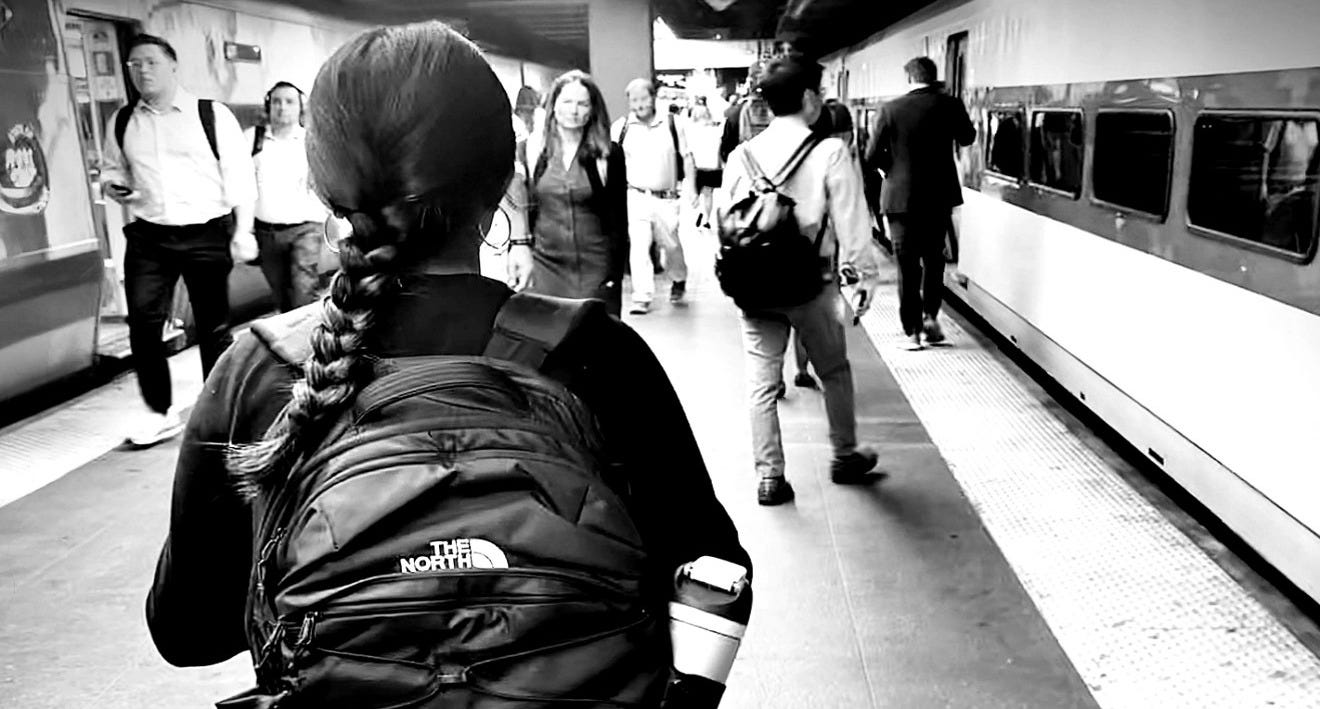
The first time I let my older daughter pick our train home to Pelham, she and I were standing on the platform at Grand Central. A train was pulling in, and she pointed at it. “This one.”
She was already walking toward it before it stopped.
“Are you sure?” I said.
“Yes, Papa, it says Stamford. That’s definitely our train.”
“I’m not so sure. It looks like the express, which doesn’t stop at Pelham.”
She gave me a look. She was 13, she had a party that night, and she was completely sure she was right. “Come on, Papa, let’s go.”
So I said okay.
We got on. She took the window. For 10 minutes neither of us said a word.
Then the train went through Pelham without stopping.
She turned and looked at me. I did not say “I told you so.”
We got off in Stamford, and she figured out the train back to Pelham on her own. She got to her party an hour late. She has never gotten on the wrong train again. Since that night, she reads the departure board top to bottom, twice, before she walks to a train.
Several months later, she took the train home by herself.
• • •
We made the deal over lunch. She would take the 5:01 from Track 3, a 30-minute ride on a train full of commuters, with a conductor walking the aisle. I had a 5:15 meeting with a contractor at my parents’ apartment on 72nd Street. When she stepped off at Pelham, she would text me one word: “Here.” I would not call her, and I would not track her phone. That one word would be the only thing I heard from her until she got home.
She wore a black North Face backpack with a burnt-yellow Owala water bottle sticking out of a side pocket. I walked her down to the platform. She stepped inside, turned around in the doorway, and said, “Bye, Papa.” Then the doors closed.
Most parents I know would have gotten on that train with her. A 30-minute ride on a commuter train should be an ordinary thing for a 13-year-old to do alone. Where I live, it isn’t ordinary, because most kids her age don’t go anywhere or do anything without a parent. Raising kids who never do anything by themselves is a fucking problem, and I don’t understand why more parents don’t see it. Kids today are safer than kids were when I was their age, and they are more afraid. I think most parents made them afraid, even though they meant well. Every time a parent rescues a kid from something she could have handled herself, the parent teaches her to be afraid of it.
The train pulled out. For the next 30 minutes, I thought about how parents became this afraid, and what that fear is costing kids.
Kids today are safer than kids were when I was their age, and they are more afraid. I think most parents made them afraid, even though they meant well.
• • •
Her train was in the tunnel under Park Avenue. I was climbing the stairs to the main concourse, thinking about the first time I rode underground by myself.
I was born in 1972. In the fall of 1982, when I was 10, I started getting myself to school. I took the M5 bus, transferred to the 1 train, switched to the D at 59th Street–Columbus Circle, and then took the M34 crosstown bus to the United Nations International School. The fare was 75 cents, paid with a brass token. Nobody rode with me. Nobody drove me. Nobody told me to be careful.
In ninth grade, after 4 years of riding the subway by myself, I got jumped.
By then I was at Brooklyn Tech, in Fort Greene, which was a much rougher neighborhood then than it is today. I was on the varsity swim team. One evening I was walking from swim practice to the DeKalb Avenue station. It was getting dark. I took a shortcut down a wide street behind a big McDonald’s, where the delivery trucks unloaded. I was listening to my Sony Walkman.
Far ahead, I saw 3 people walking toward me on my side of the street. I crossed to the other side. All 3 of them crossed too. I crossed back. This time they spread out. One stayed where he was, one walked down the middle of the street, and one crossed back to my side. They wore hooded sweatshirts, and they looked several years older than me. I knew that if I ran, they would catch me. So I turned the Walkman down to zero, so I could hear everything around me, and I kept walking toward them.
When I was 2 feet away, all 3 of them lunged at me. They threw me to the ground and kicked me. I curled into a ball with my hands over my head and waited for it to end. It lasted about 15 seconds. When they were almost a block away, I got up. They had not taken my varsity jacket, my Walkman, or my wallet. They had beaten me up for fun.
When I got home, scraped and bruised and shaking, my parents stayed calm. They asked what had happened. They checked me for injuries and asked whether I thought I needed to go to the emergency room. I am certain that a parent today would drive a kid in my condition straight to the ER without asking him. I felt violated. I had crossed the street twice to avoid those 3 guys, and they beat me up anyway. I had done everything I could to stay out of it, and I had no control over what happened. It took me close to 3 years to get over that feeling.
I stayed home from school the next day. The morning after that, I got back on the subway. After swim practice, I walked to the DeKalb Avenue station the same way as before, except that I skipped the shortcut behind the McDonald’s. Nothing happened.
That same year, a man held a gun to my head and took the gold chain my grandfather had given me. I also played football, and Brooklyn Tech didn’t have its own field back then, so the team walked to a park to practice. I was walking there with a few of my teammates when he stopped all of us, pointed the gun at my head, and told me to give him my chain. I handed it over. I’m not sure I ever told my parents.
Getting hurt by a stranger is the thing every parent on that platform is afraid of, and it happened to me twice that year. I was 14, and I kept riding. In 1990, New York City recorded 2,245 murders. Last year it recorded 305. The city has gotten much safer, and yet parents have gotten more scared.
• • •
A few minutes later, her train came up out of the tunnel into daylight above Harlem. I was on the shuttle to Times Square, asking myself why parents today are so much more afraid than mine were.
What the fuck happened? The kids I grew up with rode the subway alone at 10. We came home when we were done. Nobody could reach us until we walked in the door. I got my first cell phone in 1998, when I was 26. Today some kids get one at 8. And most of those kids became parents who drive 14-year-olds 4 blocks.
I think part of the reason is one boy who went missing.
In May 1979, a 6-year-old named Etan Patz walked out of his family’s apartment on Prince Street in SoHo to catch the school bus 2 blocks away. It was the first time his parents had let him go alone. He never got on the bus. I was 7 and lived 5 miles north. His picture went on posters all over the city. In 1983, President Reagan made May 25, the day Etan disappeared, National Missing Children’s Day, and by the mid-1980s Etan’s face was on milk cartons across the country. Many of us who grew up seeing his face on milk cartons brought that fear with us when we had kids of our own.
Peter Gray, a psychology professor at Boston College, has studied children’s play for decades. He dates the change to around 1980, after a few children were kidnapped and murdered by strangers. That’s when parents started keeping their kids inside. Mine didn’t. Two years later, I was taking the M5 bus and the subway to school by myself.
What the milk carton never told us was how rare those kidnappings were. In 2011, a federal study counted 105 children in the entire country who were kidnapped by strangers. There were 74 million children in America that year. The chance that any one of them was kidnapped by a stranger was less than 1 in 700,000.
• • •
Somewhere past 125th Street, her train crossed the river into the Bronx. In less than 20 minutes she would get off at Pelham, a few minutes from our house in Pelham Manor.
We moved from an apartment near Lincoln Center to a house in Pelham Manor 4 years ago. Pelham Manor is probably the safest place my daughters have ever lived. Nobody warned me that in the suburbs, my daughters would go fewer places on their own than they had in the city.
In the city, at 10, my older daughter rode the M11 bus 4 stops up Amsterdam Avenue to school with 2 friends and no adult. In Pelham Manor, most families drive their kids to school twice a day, all through middle school and into high school. Even my younger daughter has asked me to drive her to the library, which is an 8-minute walk. I told her to walk.
In any house with a girl between 12 and 15, you’ll hear the parents say the same things: “Text me when you’re on the train.” “Which car are you in?” “Sit near the conductor.” “Whose mom is going to be there?” Parents mean well when they say these things. But most of it calms the parent. It doesn’t protect the kid. A University of Michigan poll this year found that 50% of parents track the location of their grown children, ages 18 to 25. The most common reason they gave was their own peace of mind.
• • •
I walked into my meeting and put my phone face down on the table so I would not keep checking it. The contractor was there to talk about whether to sand the floors or replace them.
I was not really listening to him. I was thinking about the moment she turned around in the train door, because kids learn what to fear by watching their parents’ faces.
In 1985, psychologists put 1-year-olds on a long table with a glass top. Under one half of the glass, the floor dropped about a foot, so it looked to the baby like a ledge. The glass made it completely safe. Each mother stood on the far side of the drop and made one face at her baby. When the mothers looked happy, 74% of the babies crawled across. When the mothers looked afraid, none did. The babies didn’t look down at the glass to decide whether it was safe. They looked up at their mothers.
Kids keep checking their parents’ faces long after they learn to walk. When my daughter turned around in the train door and said “Bye, Papa,” she was also checking my face.
The babies didn’t look down at the glass to decide whether it was safe. They looked up at their mothers.
Psychologists call what most parents do next “accommodation.” It means changing your own behavior so your child never has to face what scares her. Eli Lebowitz, a psychologist at the Yale Child Study Center, has studied it for years. Most of it is small, and all of it is done out of love. A parent sleeps in her daughter’s bed because the girl is afraid to sleep alone. A parent orders at a restaurant for a kid who is too nervous to talk to the waiter. A parent answers the same worried question over and over. In a 2013 study of kids who had been diagnosed with anxiety disorders, Lebowitz found that more than 97% of their parents did at least some of these things.
At restaurants, I have made my daughters order for themselves since they were 10.
Every time a parent steps in, the kid learns that her fear was right, that the situation was too much for her, and that she needs her parent to handle it. Studies have found that the more parents accommodate, the more anxious their kids tend to be. A 13-year-old can’t break this pattern on her own, because she doesn’t know her parent is doing it. Her parent has to stop it, by trusting her instead of stepping in.
• • •
The contractor walked me through the options for floor finishes. I was wondering what the other parents in Pelham Manor would say if they found out my daughter was on that train by herself. I already knew what the country had said about the last New York parent who did something like that and wrote about it.
In 2008, a New York mother named Lenore Skenazy did what I had just done at Grand Central, and the country called her the worst mom in America for it.
Her son Izzy was 9. For weeks he had begged her to leave him somewhere in the city and let him find his own way home. One Sunday that April, she took him to Bloomingdale’s and left him in the handbag department with a subway map, a MetroCard, a $20 bill, and a few quarters for a pay phone. She did not give him a cell phone, and she did not follow him. He took the Lexington Avenue subway downtown and then the 34th Street crosstown bus. He got home safely and told reporters the trip was “really easy.”
She wrote about it in her column in The New York Sun. Within days she was on the Today show, defending herself to a host and a parenting expert who both thought she had put her son in danger. The papers called her America’s Worst Mom. Nobody wrote a column about my parents when I started riding the subway and buses across Manhattan by myself, 26 years earlier.
Skenazy only got called names. This June, in Williamsburg, Virginia, a mother named Karyann Parkinson let her 5-year-old, Sam, walk half a mile through their gated community to a pond to pick up goose feathers. A neighbor saw him alone and called security. A guard walked him home. Two weeks later, the police arrested her. In August, a judge convicted her of contributing to the delinquency of a minor. She got a 6-month suspended jail sentence, and her name will stay on Virginia’s child abuse registry for 7 years. She’s appealing. Pelham Manor doesn’t have a gate or a guard. But it sure has plenty of neighbors.
• • •
By then her train was somewhere in Westchester. My phone was still face down, and I had not turned it over. Letting a kid ride a train alone is a big decision, but most parents rescue their kids from much smaller problems than that. Every school morning, in most houses, a kid forgets something at home and a parent drops everything and drives it to school.
I have driven every one of those things to school myself, exactly once. My younger daughter forgot her violin. Both of my daughters have forgotten homework folders, lunches, water bottles, and permission slips. The first time each thing was forgotten, my wife asked me to take it, and I did. Then I told the girls I would never do it a second time, and I haven’t.
My mornings are easier for it. Gray makes the same point in his new book, Restoring Childhood. A parent who stops doing things for a kid has less to do.
Here is what I tell them. If you forget your water bottle, you’ll be thirsty until lunch. If you forget your tennis racket, you’ll sit on the bench while everyone else plays. If you get in trouble with a teacher, that’s okay. It isn’t a punishment from me. It’s what will happen to you for the rest of your life. A college professor won’t accept a paper you left in your dorm room. A boss won’t wait while you run home for your presentation. An airline won’t hold the plane because your passport is on the kitchen counter.
At Ohio Wesleyan, I had 3 majors, and one of them was behavioral psychology. The first thing a behavioral psychology class teaches you is that behavior that gets rewarded gets repeated. When a parent drives the violin to school, the kid has been rewarded for forgetting. The parent’s worry goes away, so the parent has been rewarded for driving. Both of them will do it again.
• • •
A bigger version of the violin drive is the email a parent sends to a teacher or a coach. I won’t send that email, and that is why my daughters have heard one sentence from me more than any other. They roll their eyes at it now.
“I’m not your friend. I’m your father.”
I say it after a bad grade, a coach who benched her, or a fight with a friend, and then I tell her to handle it herself. When a parent sends the email, the kid learns that the teacher was wrong, the coach was wrong, and the other girls were wrong. She never learns how to rewrite the paper, earn the spot back, or walk up to 2 girls in a hallway and ask what happened. Nobody ever called my coach.
My daughter has plenty of friends whose job is to take her side. She only has one father. I’d like to be her friend someday, and I’m pretty sure I will be. That comes later, after I’ve done my job.
I’m not your friend. I’m your father.”
My job is to raise 2 daughters who can run their own lives without me. I am not afraid that a stranger will take them. I am afraid that they will reach 22 without ever having solved a real problem on their own. And then something big will go wrong, like getting fired, falling behind on rent, or getting bad news from a doctor. The wrong train at 13 cost her an extra hour and a train back from Stamford. A first real mistake at 25 could cost her a job or an apartment. I want my daughters to have their small failures now, while the cost is small.
I am not afraid that a stranger will take them. I am afraid that they will reach 22 without ever having solved a real problem on their own.
• • •
Parents who already step in too often can still change, and the change helps their kids. Lebowitz found a way to treat anxious kids without ever seeing the kids.
In 2020, his team at Yale took 124 anxious kids between 7 and 14 and split them into 2 groups. Half of the kids went to a therapist. The other half never went to a single session. Only their parents came in, once a week for 12 weeks. Each parent picked one way they accommodated their kid and stopped doing it. When the kid got scared, the parent said some version of one sentence: “I know this is hard, and I know you can handle it.” At the end, the kids whose parents went to therapy had improved about as much as the kids who went themselves.
• • •
By then her train would have been pulling into Pelham. I started thinking about my younger daughter, who will be the next one to take that train alone.
She turns 12 next month. She has already asked me when she gets her turn. “When can I go into the city with my friends?”
I told her, “In a year or two. But first I need to see you walk to the library without asking me for a ride.”
When her turn comes, I’ll walk her down to the platform, and then I’ll let the doors close.
• • •
At 5:32, in the middle of the contractor’s sentence, my phone buzzed.
I turned it over.
here
Devaraj Southworth is a trained investigative journalist whose credentials include Ohio Wesleyan, Esquire, Popular Mechanics and New York Newsday.