I wrote on Quora for over a decade, almost exclusively about mathematics. This mostly kept me free from trolls (with some notable exceptions I would rather not mention) and angry comments. There were only a few times when I received a flood of dissatisfied feedback. In a post last month, I mentioned one.
Let me now introduce you to the most controversial answer that I ever wrote. It is decidedly not what I would have expected. Are you ready?
…It was my answer to How many dimensions does a circle have? from 2019.
It’s an answer that, at the time of writing, has 559 comments on it, and quite a few of them were pissed. Just in case you think I am exaggerating, here are a few of them.
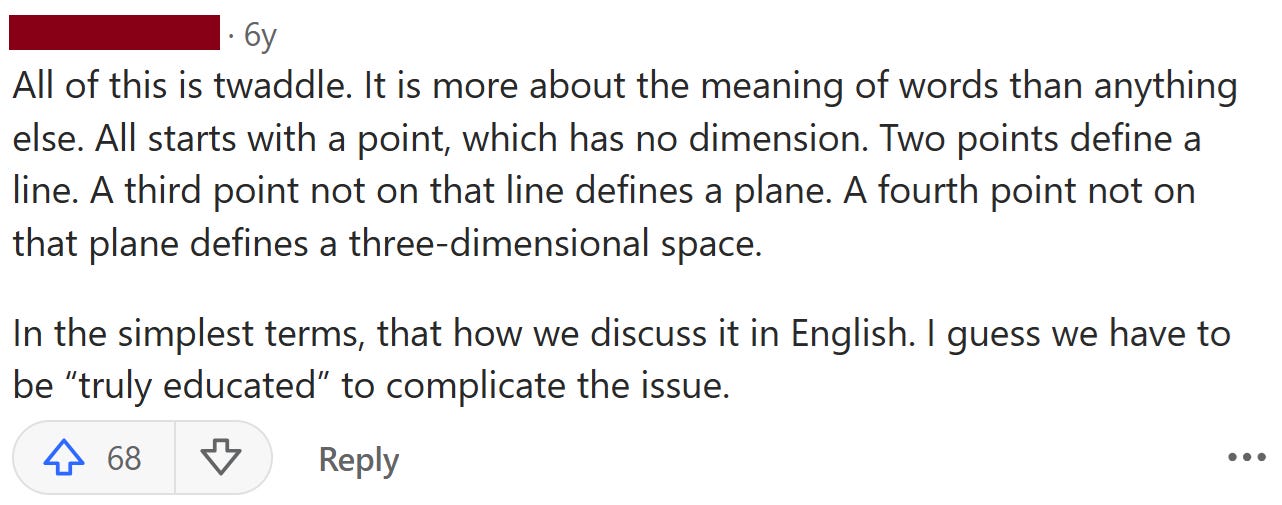
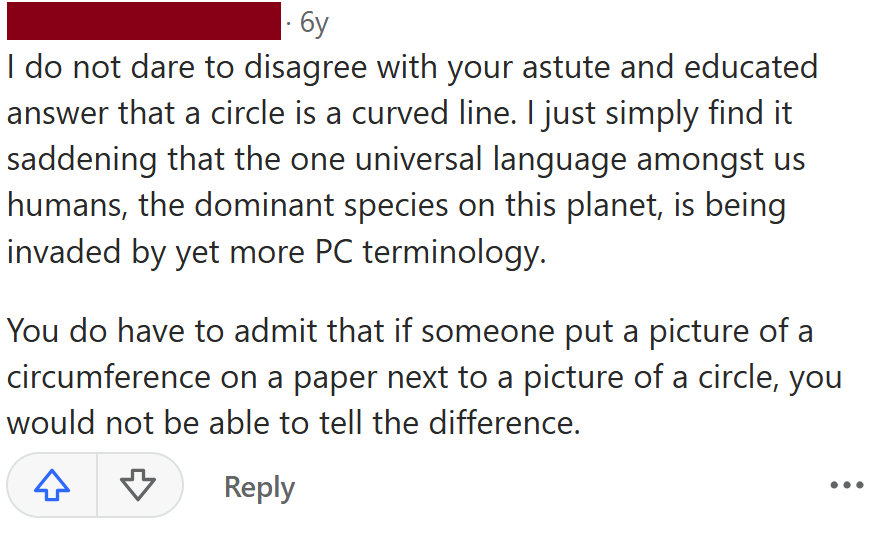

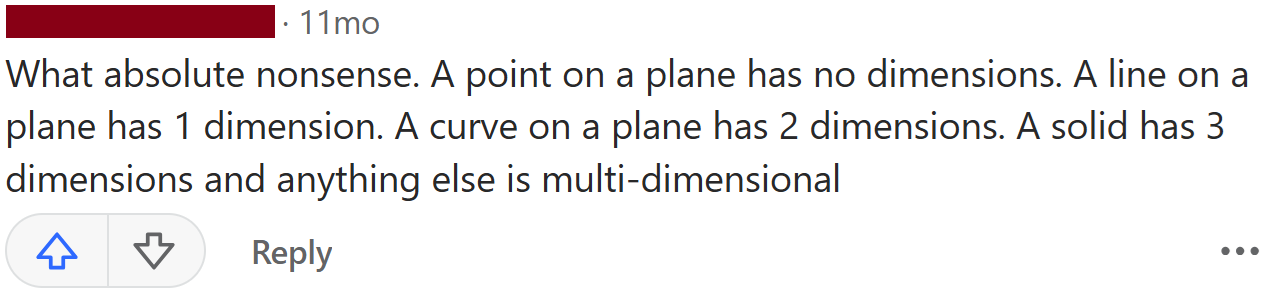
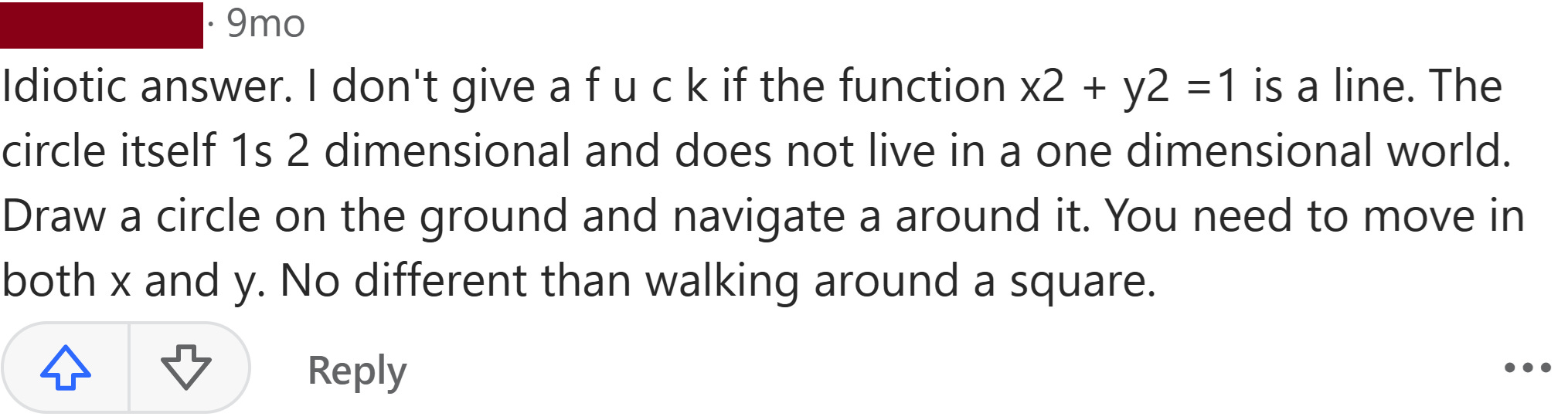
What did I write that was so bad? Very simple: I explained that, going by the standard mathematical definitions, circles are one-dimensional.
Given my experiences over the past seven years, I think I can safely predict that you now have had one of three reactions:
Yeah, obviously? Why would this be controversial?
Wait, really? I never would have thought that.
HOW DARE YOU SUGGEST SUCH A THING?!!
If you are in the last camp, and you are itching to go to the comments to tell me that I am an idiot, please read the original answer and the FAQ that I wrote (using a lot of outside citations) to prevent precisely this sort of thing.
In any case, let me reproduce here the original answer, verbatim.
It saddened me when I saw this question that none of the correct answers were upvoted. So, let me be very, very clear: a circle is a one-dimensional object. It is not a polynomial, like one of the other answers claims. (That answer is at present the most upvoted one! I weep for the state of mathematical literacy.) It is not even a polygon, even if you allow the generalization of having infinitely many sides (you sometimes see that generalization when you are studying hyperbolic geometry). A circle can be defined as the set of points (x,y) satisfying (x−x0)2+(y−y0)2=r2, for some fixed real numbers x0, y0, r.
Now, I know what you want to tell me—there are two variables there, so obviously it is two-dimensional, right? Nope. That isn’t how this works. To understand that this can’t possibly be how this works, consider the set of points (x,y) such that x+y=1. It looks like this.
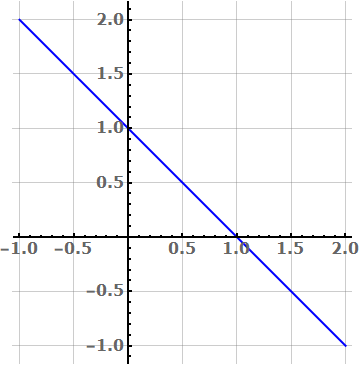
It’s a line. Lines are one-dimensional. If you have any doubts about this (after all, x+y=1 clearly has two variables), note that we can easily rotate this line to get the set of solutions to y=1.
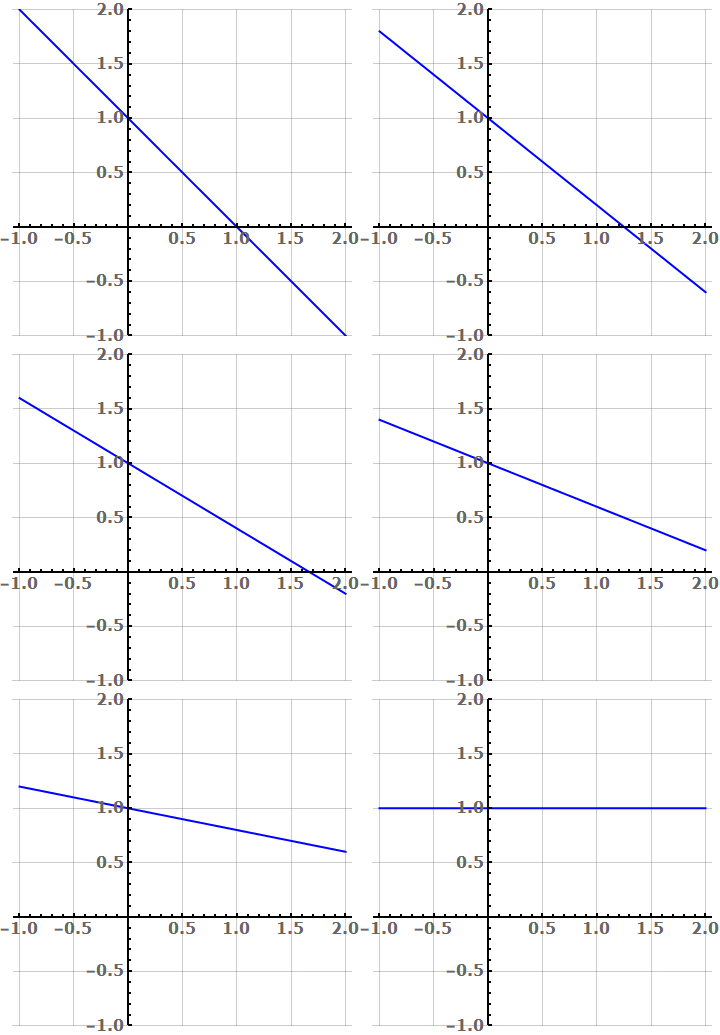
Rotating an object should not change its dimensions—I hope we can agree on this much. In fact, doing any sort of continuous deformation of an object should not change its dimensions—the dimension of an object should be a topological invariant, loosely describing how many independent pieces of information you need to specify a point on it. For a line, this is obviously just one piece of information: you need to know how far along you are on the line away from some fixed point.
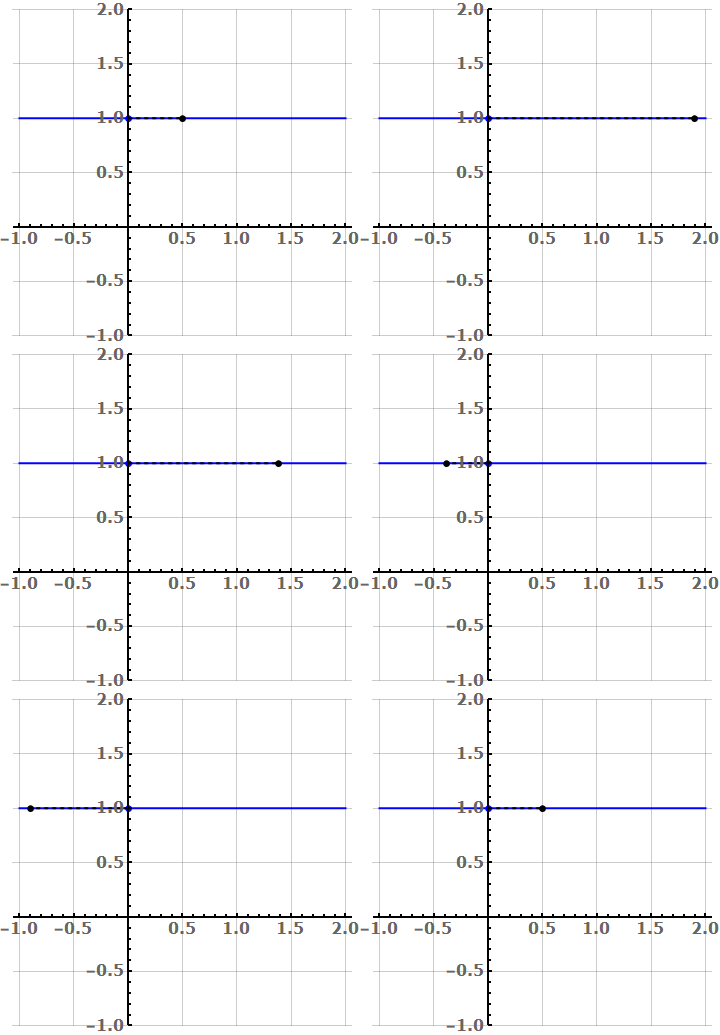
However, for any curve, this will also still hold.
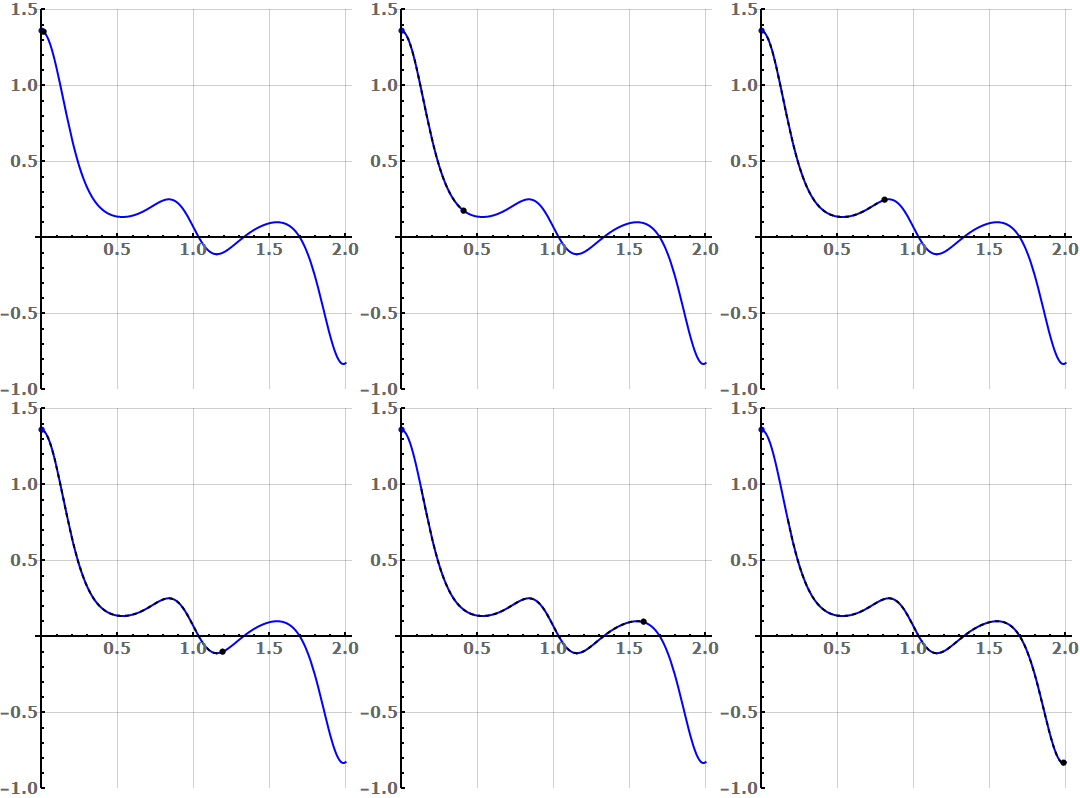
In particular, since circles are curves, they are one-dimensional. The dimension of any object does not depend on what space you have chosen to represent this object in, because that is arbitrary. If that was how we chose to define things, any geometric object could be said to be of any arbitrarily large dimension, simply by drawing it inside of a suitably high-dimensional Euclidean space. Such a definition cannot possibly be useful.
If you are still wracked with doubts, I strongly recommend learning the formal definition of the dimension of a system—once you do that, you will be able to tell without any hesitation. If you want to do that, pick up pretty much any textbook on linear algebra, and I promise that it will be covered within the first three chapters, if not earlier. (Although, this will only tell you the definition for a vector space—if you want to study other topological spaces, you will need to look at the definition of a topological manifold, which I am afraid is harder.)
Five years after I originally wrote this, the almighty algorithm decided that it was time to show everyone this answer again, and I received a fresh wave of angry comments. At this point, I think I was somewhat understandably annoyed, and I decided to add a FAQ as an amendment. The original had a rather irritated tone—I have edited it to something more neutral.
FAQ:
“Are you sure that a circle is the set of all points equidistant to some common center?”
Yes, entirely. You don’t have to take my word for it—just consult any of the following sources:
Wikipedia: Circle - Wikipedia
Wolfram: Circle -- from Wolfram MathWorld
David Hilbert’s The Foundations of Geometry https://math.berkeley.edu/~wodzicki/160/Hilbert.pdf (look at page 15)
Justin Curry’s notes on manifolds https://math.mit.edu/classes/18.952/spring2011/chapter4.pdf (look at the top of page 6)
Of course, if you check Merriam-Webster and many other such dictionaries, you will see that the word “circle” has at least two definitions in standard English: it can either mean the set of points equidistant to some common center, or the set of points enclosed by it. Colloquially, this is fine. But mathematics does not permit ambiguity. So, in technical English, the word “circle” only ever means the set of points equidistant to some common center. If you want to talk about the set of points enclosed by a circle, that is a “disk.” This problem does not exist in other languages, such as Greek, Russian, and Italian, where—even colloquially!—there are two different words for these two notions. This can cause confusion in translation, because translations into English will usually translate both as “circle.”
“But you need two dimensions to draw a circle! How can it be 1-dimensional, then?”
That rather depends, actually. Topologically, a circle is nothing more than a line interval with the ends glued together. You don’t need the plane to represent or define this. Once again, you don’t need to take my word for it: https://math.stackexchange.com/questions/495924/how-does-the-quotient-mathbbr-mathbbz-become-the-circle-s1
But, to be honest, it doesn’t really matter, anyway. As I said in the answer, the dimension of the space in which we draw a figure is not the dimension of the figure itself. Moreover, of the two, the latter is the one that is much, much, much more important. For this, I think that you will, unfortunately, have to take my word for it: that’s just a lived experience thing, having seen for many years which of these notions show up frequently and which don’t.
“Does this mean that triangles and rectangles are 1-dimensional?”
It depends on whether you define them as containing their interior or not. If not, they are 1-dimensional; if you do, they are 2-dimensional. To the best of my knowledge, it is more common to define them as containing the interior, but it isn’t as set in stone as the definition of a circle—I recommend double-checking the definition that the author of whatever you are reading uses.
“Does this mean that spheres are 2-dimensional?”
Yes.
“Are you certain that you have the right definition of dimension?”
Beyond a doubt. Look up the definition of a topological manifold, a differentiable manifold, a Lie group, or an algebraic variety. Hell, look up the Hausdorff dimension, if you so wish. All of them will give exactly the same answer: the circle is 1-dimensional. And, no, you don’t need to take my word for it; consult any of the following sources:
Justin Curry’s notes on manifolds https://math.mit.edu/classes/18.952/spring2011/chapter4.pdf (look at the top of page 6)
https://math.stackexchange.com/questions/37250/how-many-dimensions-does-a-circle-have
https://math.stackexchange.com/questions/4028191/is-a-circle-a-manifold
Ed Segal’s Manifolds https://www.homepages.ucl.ac.uk/~ucaheps/papers/Manifolds%202016.pdf (look at bottom of page 2)
Mercifully, after this, the comments stopped. For better or for worse, I think that had little to do with the added FAQ and much more with the fact that the algorithm tossed the answer aside again, in favor of some new shiny bauble. (You know how it does.)
I am still a little baffled that this answer produced so much pushback—and I wasn’t the only one.

I think that there is something troubling in the extreme resistance toward learning something new, as if not knowing something somehow makes you less of a person. I wholeheartedly do not subscribe to this; each of us is woefully ignorant in a million different areas. Each of us has blind spots that might seem a little strange to other people, and that’s okay. That’s normal.
Perhaps this is naive on my part, but I would like to think that if we could all keep this in mind—toward ourselves and toward each other—that this would make for a better world, and one in which willful ignorance would be less of a problem.