This post returns to the ICP series. Part 1 covered early adopters; Part 2 discussed quality function as a buyer; this post maps the production engineering org that keeps Industrial AI plugged in (or not).
Based on a dozen interviews with manufacturing and controls engineers from American Axle & Manufacturing, Applied Intuition, Blue Origin, General Motors, Kraft Heinz, PepsiCo, Redwood Materials, Tesla, and others.
When production decides to unplug an industrial AI system, it’s rarely one dramatic failure.
You might train someone, and then they’re gone after two years, and then nobody knows how to use it. I’ve seen cameras just sit idle, they unplug them and redo the controls so it always gives a good signal.
— Corporate Controls Lead, Kraft Heinz
Small issues stack up; each stop is minor but the total downtime accumulates quietly. Fixes aren’t straightforward, and someone ends up stuck on the floor Saturday night, trying to get the line back up with no clear path to the root cause. Failures that slipped past alerts turn into customer complaints, and now you’re explaining it to quality and the customer. Operators lose confidence and start working around the system instead of with it.
To understand why industrial AI gets unplugged, you have to understand who’s left holding the bag, why Industrial AI changes their traditional workflow, and what breaks that workflow.
Every factory has engineers whose job is to keep the machines running.
“Manufacturing eng, process eng, controls, industrial eng… It varies from industry to industry, even within the same company. — Jason, 25 years in manufacturing engineering
Their titles vary drastically. Even where they sit in the organization, inside engineering or operations, changes depending on the company. But one thing stays consistent: they all share ownership of the full equipment lifecycle, from cradle to grave, and their core objective is uptime.
To simplify, I call this group production engineers.
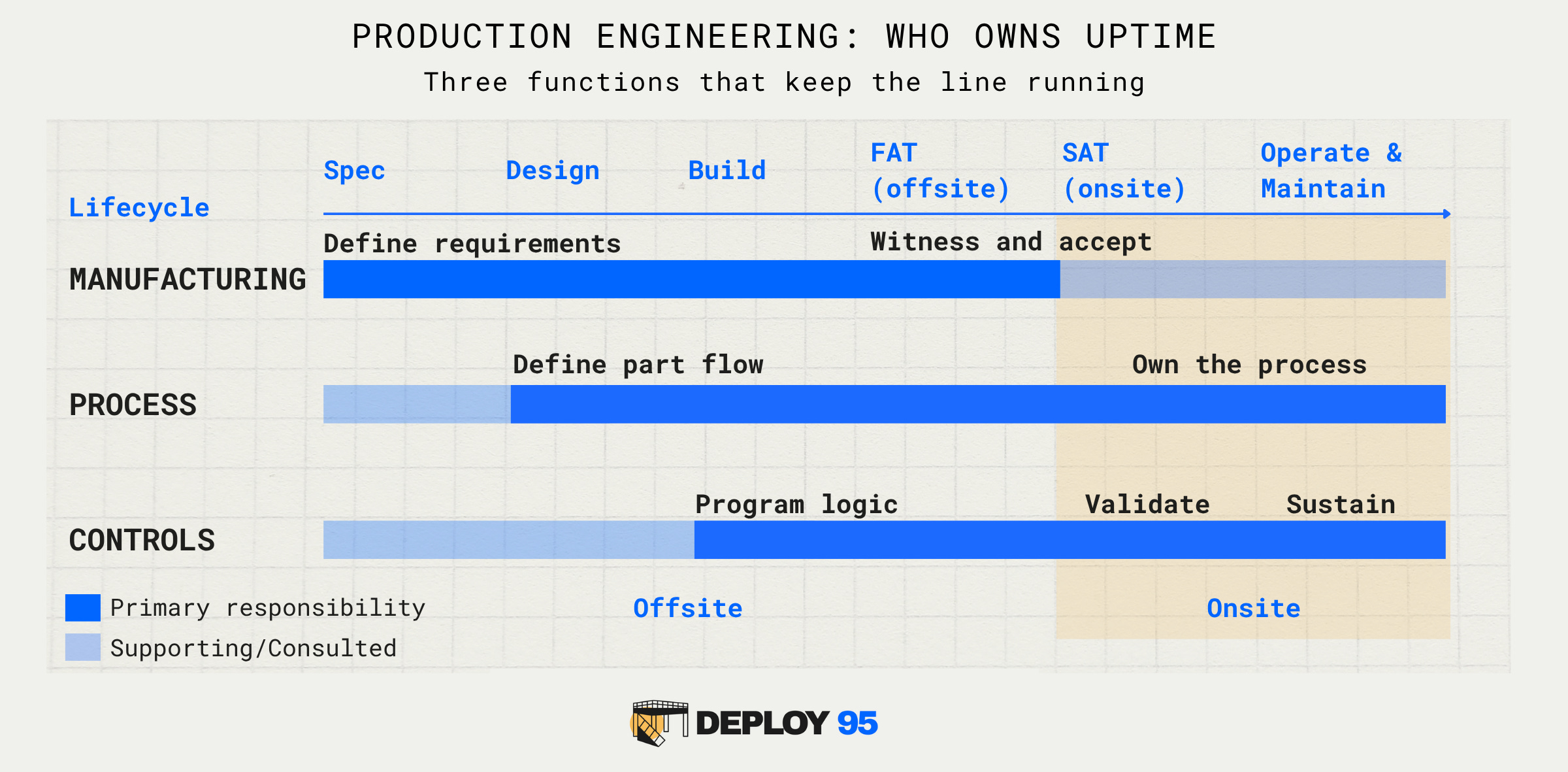
Manufacturing and process engineers know where the bodies are buried. Their shop-floor knowledge lets them spec out the true use case and bridge the gap between theory and reality.
How does the material get to the system? How does it interact with the operators or personnel running the equipment? How does the equipment behave? Like you have a malfunction. What does it do?” - Jason, 25-year Manufacturing Engineer in Automotive
They also hold the information that determines whether a solution is viable: floor layout, production speeds, upstream and downstream dependencies, and operator workflows… They can see conflicts before they become problems.
Controls and automation are the “unicorns”. They are involved in every step because that’s what helps get the system running and keep it running.
“Controls are the layer that makes machines intelligent: converting physical stimulus in the real world to electricity. Converting that electricity to some sort of binary that a computer can consume. Doing the logic on a computer and then publishing that data so dev folks can do whatever that is.” - ex Controls Lead, Blue Origin
This means connecting multiple layers of hardware and software: device-level instrumentation, control-level logic (PLCs), supervisory interfaces (HMIs and SCADA), and operations systems (MES and ERP). They also own maintenance. When the line stops, they’re the first ones called.
When a system provider hands a machine to production, they test that it works. FAT (Factory Acceptance Test) happens at the provider’s factory. SAT (Site Acceptance Test) happens on the production floor. If the system passes both tests, it’s ready for production, and controls takes ownership.
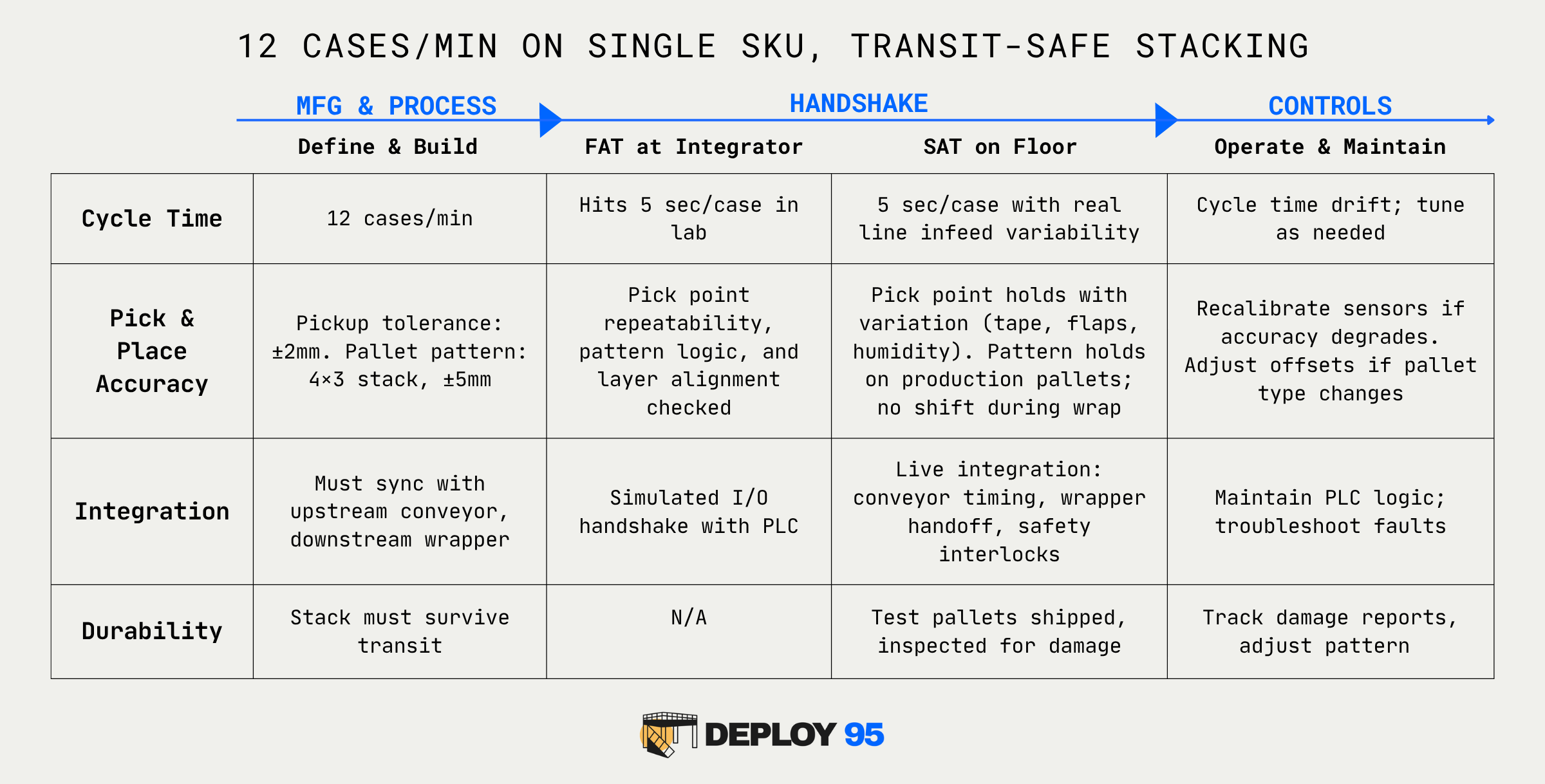
This process relies on one core assumption: factory equipment is deterministic. It does the same thing every cycle, forever. Passing the test once means it should keep working the same way.
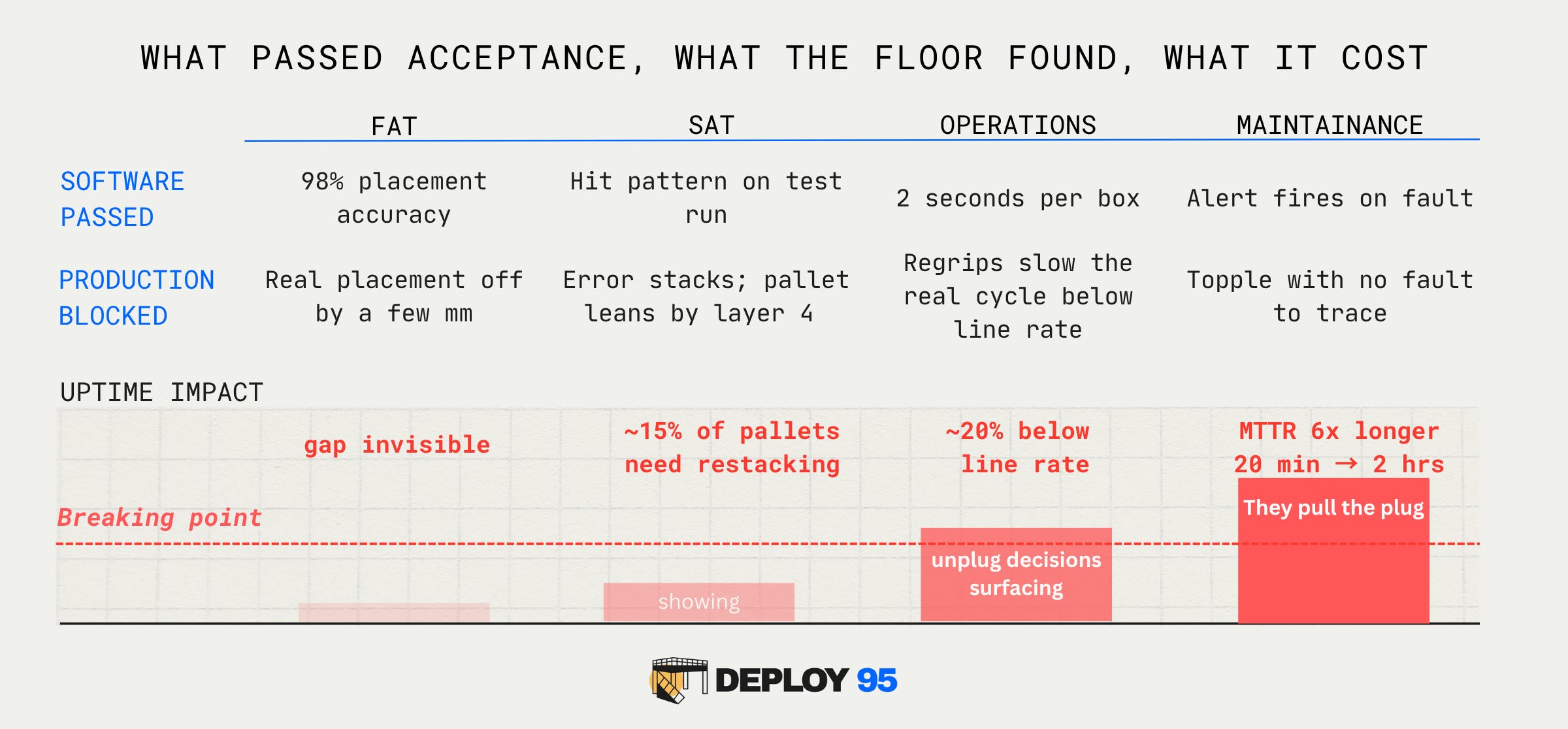
Sometimes, Industrial AI enters an organization through a software buying path. For example, the innovation team approves a smart camera because they validated the model; a project manager signs off on a PPE compliance tool connected to CCTV footage. These projects enter midway through the typical hardware evaluation process, and the people who maintain the system never see it until it’s already on the floor.
“Some companies have the Innovation or AME groups. They lob stuff over the fence. Here you go, plant, I’m done, move on. “ — Jason, 25-year Manufacturing Engineer in Automotive
Moreover, they got accepted on the wrong criteria: model accuracy, inference speed, and edge-case performance. These software metrics don’t translate to performance at the physical level. As a result, production inherits a system they never vetted.
How do you use AI safely on a PLC? I have a 100-foot kiln that is 600 to 700 degrees Celsius and spinning; if I ask AI to change 5 lines of code, should I do it? Because if you don’t have any idea what it is going to do, you can kill someone. Is it even good engineering practice to do that?” - Controls Lead, ex Blue Origin
Industrial AI is fundamentally different from rule-based automation.
Traditional equipment is deterministic and fails visibly at edge cases. When conditions hit a constraint the program doesn’t cover, it stops. You notice immediately. To fix it, you edit the logic. Annoying at first but it stabilizes.
Industrial AI is probabilistic and fails invisibly when confidence drift causes false accepts to accumulate. When an outage happens, fixing it isn’t a quick edit. It requires new data, labeling, retraining, validating, and redeploying, and coordination across quality, operations, and data engineering.
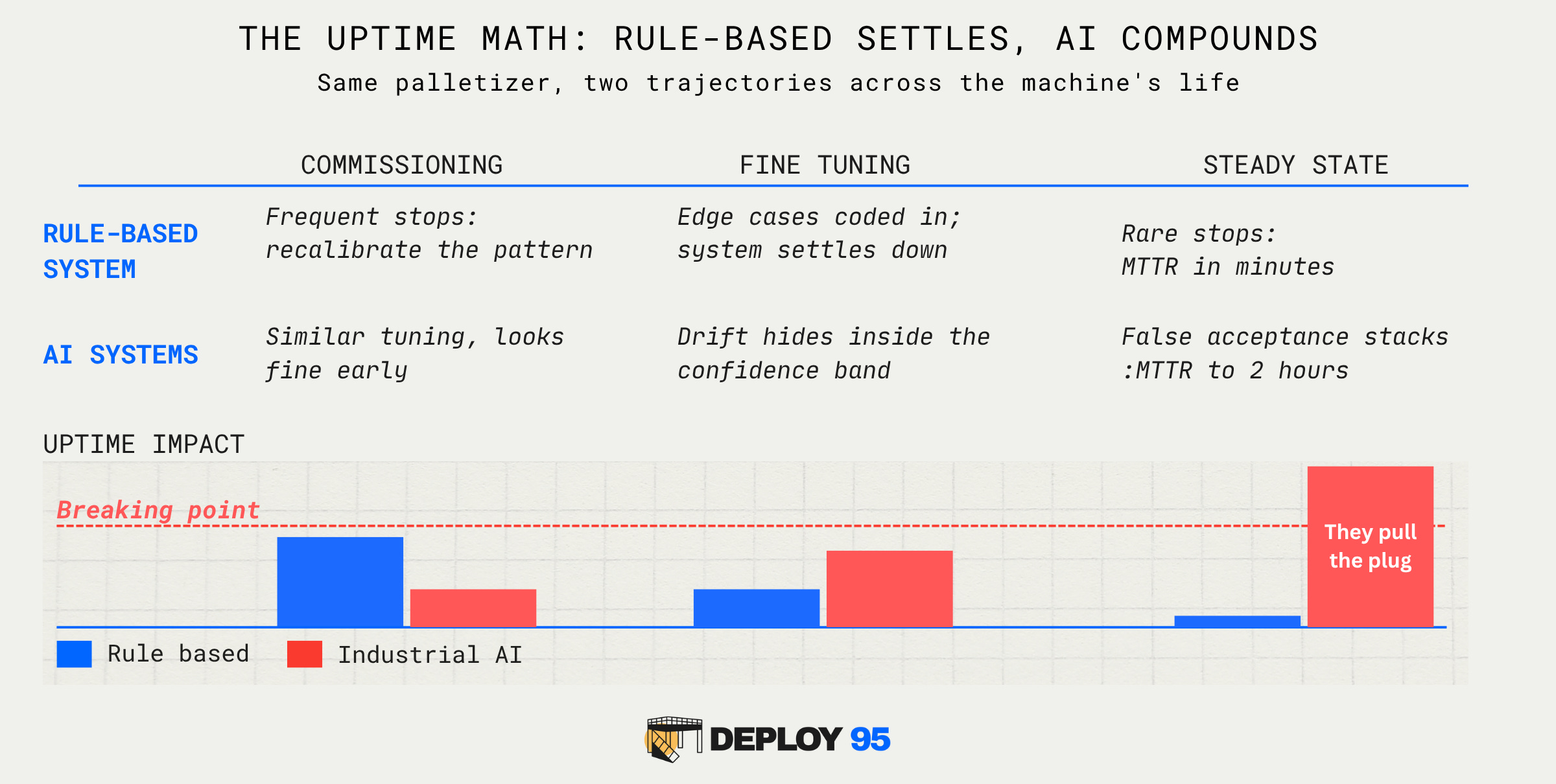
Rule-based systems work within the current acceptance process, but they’re limited. That’s why Industrial AI opens up tasks that don’t fit deterministic logic. In the example below, AI-driven palletization adapts to varying upstream conditions, which is something rule-based systems can’t do.
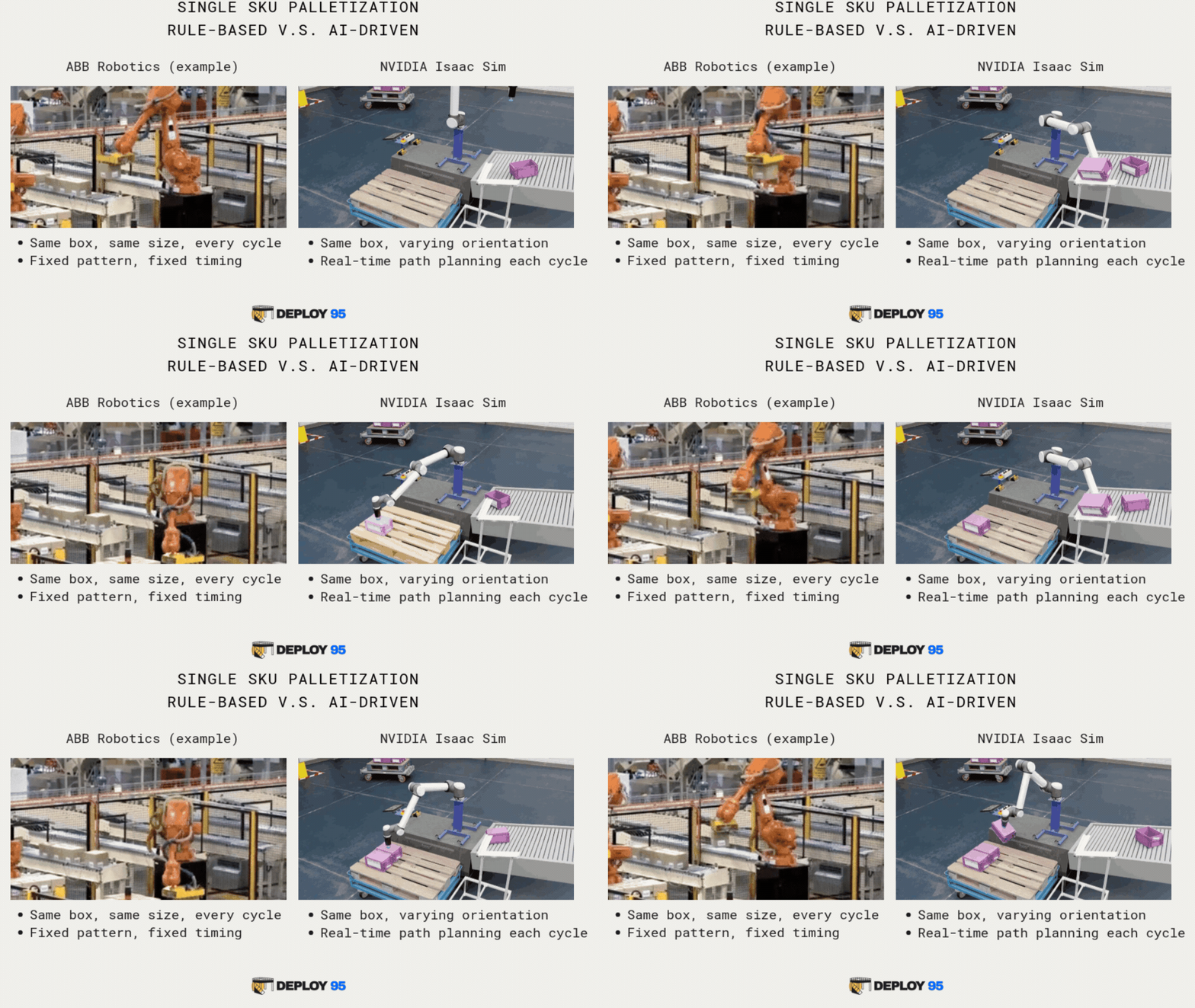
But promises alone couldn’t guarantee adoption on the floor. Industrial AI changes how systems are assessed and maintained, so GTM need to be able to educate the users.
“When you’re new process introduction focused, you’re already somewhat risk-forward. So you want to contain the risk on your vendor side as much as possible. If they’ve done it, they can educate you to minimize your risk.”— Controls Lead, Redwood Materials
The solutions are roughly broken into two buckets:
Production engineering gets bypassed because it’s not always obvious they’ll be impacted. The project looks like software. The buyer is a data team or a plant manager. Controls never gets looped in.
If your Industrial AI drives production decisions, and it has a direct impact on uptime, you need to loop in the production engineering team early. This way, you can ensure the system is aligned with production context, from initial build requirements to operations and maintenance protocols. The earlier you engage them, the less your system looks like a problem they are about to inherit.
“If you can get in at the design phase of the line, you come in integrated.” — Aaron, ex-Tesla manufacturing engineer
The learning curve of Industrial AI has a lasting impact on how users adopt the technology and keep it running in production.
“A lot of the stuff obviously can be kind of complicated, right? If this is a new sensor, new part, how is this gonna work with everything else that we usually use? People want things to already be done, tested, with concrete steps you can de-risk through this innovation journey.” — Zach, Controls Engineer
The biggest gaps are in two areas: the acceptance process, which wasn’t designed for probabilistic systems, and post-deployment support, where vendors need to guide users through adoption, maintenance, and recalibration with proven deployment experience.
This is where most buyers are most vulnerable, and often least supported. Most GTM processes front-load the sale, but for Industrial AI, this is the least glamorous part of the pitch, and the part that keeps you plugged in.
Industrial AI runs on a broad spectrum, from software that provides recommendations on staffing decisions to hardware that directly decides production output. Not all systems face the same risk of being unplugged from the floor. The graph below maps the two characteristics that drive this risk: the system’s level of agency (is it purely consultative or does it act directly?) and the “blast radius” of a system failure.
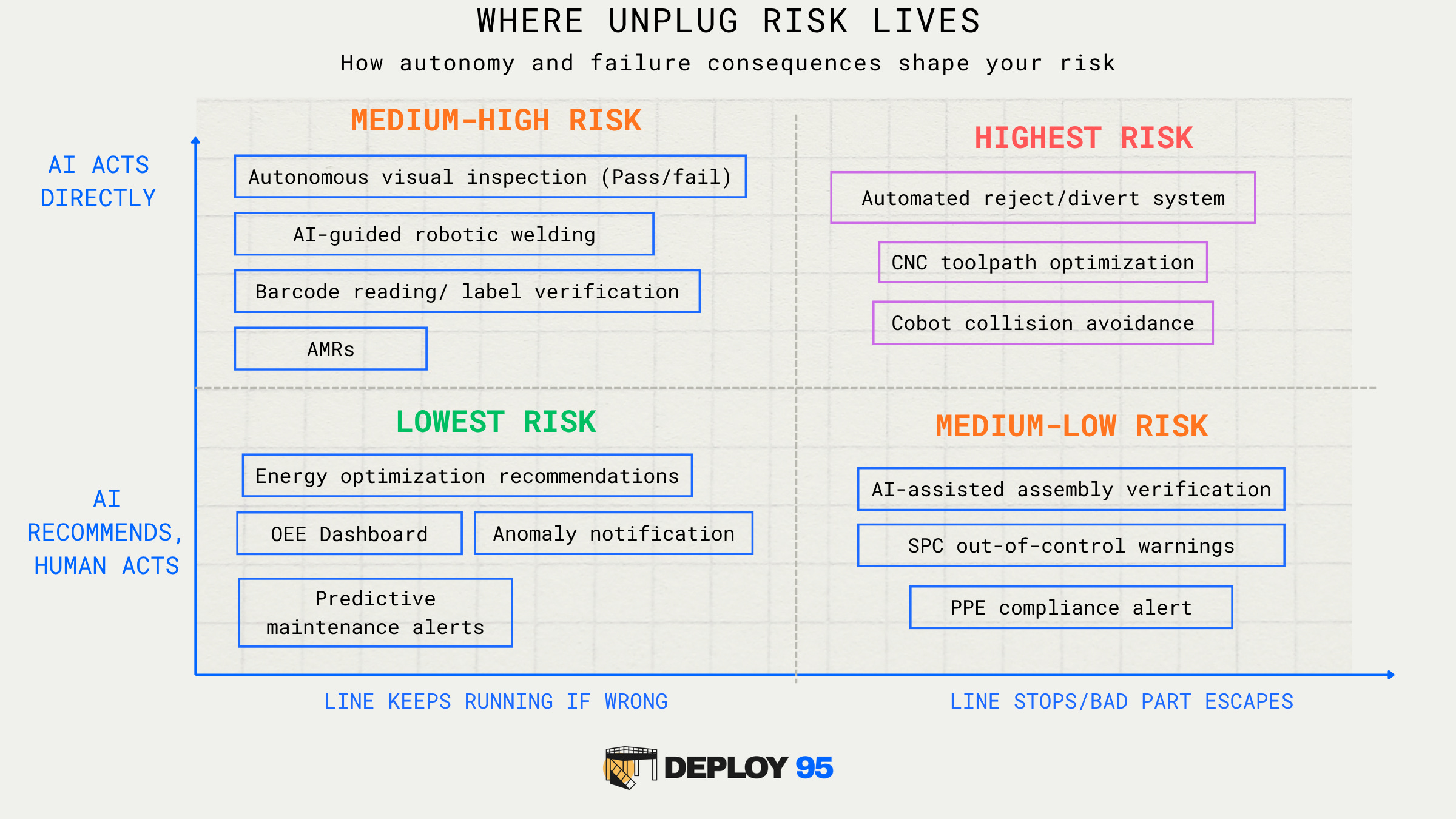
The deeper your system sits in production and the bigger the impact it can make on production metrics (throughput, cycle time, yield, etc.), the more risk it inherits if you’re not deliberate about your GTM process.
The core solution is to loop in production engineering during the innovation process, spec with them, and make sure they’re supported through deployment and beyond.
My writing is drawn from dozens of conversations, and it has limitations. If your experience doesn’t reflect what I’ve written, I genuinely want to know, it would make my work more comprehensive.
Hi! I’m Trista, and you’re reading Deploy 95. Only 5% of industrial AI pilots convert to full deployment. This newsletter is about that gap: what happens between your model and the factory floor.
Most sales processes are organized around titles. But titles don’t capture how manufacturing and industrial companies actually work. The same title means different things at different companies. I’m writing this series to find the real signals among the noise. If titles vary, what doesn’t? What patterns hold across organizations that can help you build a more reliable ICP and sales motion?
Check out the other posts in this Series:
Part I: Believers Make the Market
Part II: Quality Follows Risk, Not the Org Chart
Building in this space? Let’s connect on LinkedIn
ICP (Ideal Customer Profile): Traditionally, a tool in the sales process, a detailed description of the type of company or buyer most likely to benefit from and purchase a product.
FAT (Factory Acceptance Test): A test performed at the equipment supplier’s facility to check if the system meets specifications before it gets shipped to the customer site.
SAT (Site Acceptance Test): A test done at the customer’s production facility to verify the system works correctly in its actual operating environment. It can sometimes run for a defined period of time after it is all wired and plugged in.
HMI (Human-Machine Interface): The screen or panel operators use to monitor and interact with machines and production systems on the factory floor. Controls and automations engineers often program it to meet the internal operation process.
MES (Manufacturing Execution System): The software system that tracks raw material input and finished good outputs to provide an overview on the production performance, connecting shop-floor equipment to business systems.
PLC (Programmable Logic Controller): An industrial computer used to control manufacturing processes and machinery through programmed logic. Controls engieners often program it to keep every equipment on the floor running.
PPE (Personal Protective Equipment): Safety gear such as helmets, gloves, goggles, or vests that workers wear to protect against workplace hazards. Compliance of PPE is often required by law.
SCADA (Supervisory Control and Data Acquisition): A system architecture that allows operators to monitor and control industrial processes across multiple machines or an entire facility from a central location.