Summer is winding down, and I’ve noticed some readers are still catching up on older issues. So on the 6-month mark of Deploy 95, I thought: why not write a recap of what I’ve learned over the last six months?
It has truly been a wonderful journey. I’ve had 127 organic conversations with founders and investors, largely through the reader network, and these conversations constantly challenged how I think about GTM in industrial AI.
When I started Deploy 95, I thought that industrial AI needed its own GTM playbook. But these conversations made me realize the problem is upstream. Founders often approach GTM without recognizing that the industrial market behaves differently. They carry over assumptions from SaaS, which lead to wrong diagnoses and underperforming GTM decisions.
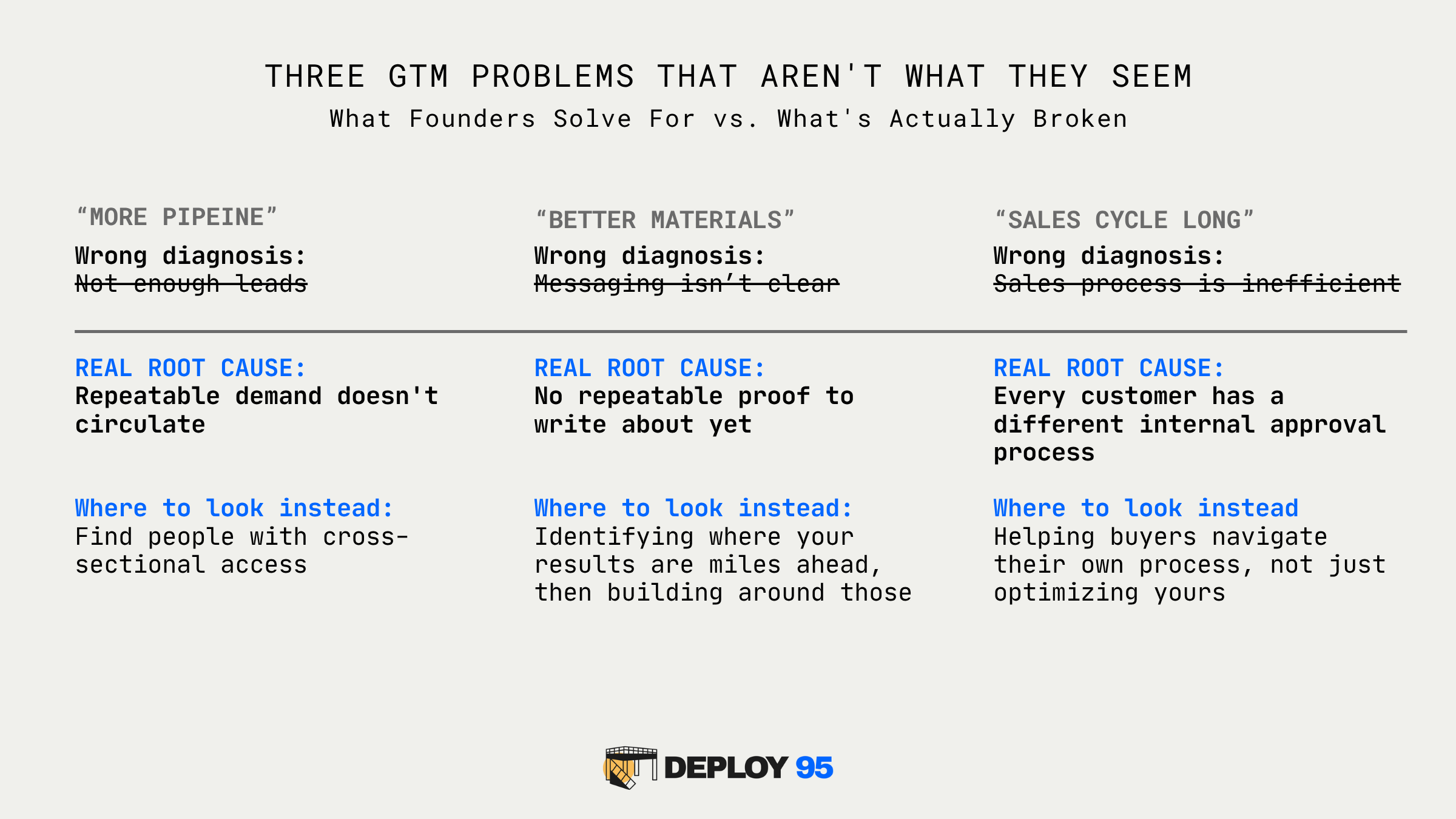
Here are the top 3 “misdiagnoses” I see most often.
In early outreach, founders often describe the surprise of low conversion from cold outreach. Interest seems scattered: some customers like this feature, others like the other. Leads come from unexpected places, but few are concentrated or repeatable.
The diagnosis: This is a lead gen problem.
If our best conversion rate from email outreach is 5%, which is super low, then we either have a messaging problem, or we have a volume problem…
What is actually happening: Founders are trying to generate demand before understanding where repeatable demand exists.
Manufacturing is built on proprietary processes: factory-to-factory, plant-to-plant. That’s why what worked at Plant A doesn’t transfer to Plant B. A CVC can validate your product against their own process; a factory can comment on how to develop features to fit their own line, but neither can confidently tell you whether the solution transfers to a different company because they’ve never seen it. Factories don’t tend to exchange manufacturing secret sauce.
The cross-sectional data that would tell a founder “these five plants share the same pain under similar conditions” simply don’t circulate. But clusters of replicable demand do exist. They are held by people who have cross-sectional access, such as consultant, forward deployment engineers.
When I was at IDEO, we were able to visit various factories across. Most founders never get that cross-sectional view. - former Managing Partner, IDEO
A more effective approach: Dedicate structured time to discovering pockets of repeatable use cases, instead of searching for a needle in a haystack.
After early traction, founders move to build out materials: product descriptions, feature lists, and case studies. The goal is to make it easier for the next buyer to understand what they do.
The diagnosis: This is a messaging problem.
“We don’t have one single use case across many customers. Each of our customers has a different use case. Our sales team is grabbing whatever comes our way; they’re not targeting a specific use case.”
What’s actually happening: The materials can’t be written because the underlying product-market fit focus doesn’t exist yet.
Factories are used to working with system integrators who co-develop solutions for their specific process. For a product company, this creates a tension. How do you separate what’s customized for one customer from what’s part of your standard product feature?
When there is pressure to grow revenue and sales volume, confining yourself to a fixed set of features becomes a hard tradeoff. The easier path is expansive marketing collateral that checks every box. But when you can be everything to anyone, where do you draw the line between a product company and a system integrator?
A more effective approach: Flip the thinking. Identify the use cases where your result is miles ahead of others and build around those. If you don’t have any deployment data, develop the hypothesis on that “killer differentiation”, and approach sales as hypothesis validation. “Here is what we believe to be true about your process; What needs to be true for this to work?” It lowers the stakes for the buyer and helps you discover the value proposition you have.
My biggest piece of advice that I give founders, and it is very contrarian to what most of the time your VC will tell you, is that in terms of sales, you have to learn how to say no. - Eric, Partner, Lemnos Lab
When founders talk about the long sales cycle, there’s often an implicit assumption that the buyer’s process is an obstacle to overcome. And their response is to codify and optimize: AI-powered outreach, GTM engineering, and whatnot.
The diagnosis: This is a sales efficiency problem.
Going through procurement committees, finance committees, health and safety reviews, GDPR compliance, cybersecurity approval, and IT approvals, each adding weeks or months to the process. If I go through this process at this pace, I’m going to have to employ 20 salespeople. It’s insane.
What’s actually happening: Your customer’s processes are unstandardized, and maybe underdeveloped.
From the 57 conversations I had with industrial AI buyers, every company showed up with a different evaluation process. Even two factories under the same OEM can have drastically different internal workflows.
A major factor in the long sales cycle is their internal approval process. A champion may want to push an AI initiative because he or she is up for promotion. Still, procurement sees additional approval with marginal benefit, or IT considers the integration risk not worth the hassle. Each stakeholder is rational. Streamlined BDR outreach and a polished sales pitch deck won't solve this internal coordination problem.
Consider being the solution to your buyer’s coordinator problem: What buyers often need is someone to align stakeholders toward an outcome they all benefit from, and that’s a role the seller can play.
All these misdiagnoses share a root cause. The founder reaches for a standard GTM fix, before resolving the upstream problem that makes the fix productive. And this is rooted in the unique market reality for industrial AI. Repeatable demand is hard to find. Sales cycles are long. The playbook has to start there.
In the months ahead, I’ll dig deeper into what the upstream work actually looks like. How to find repeatable demand? How to scope for product-market fit?
To every single one of you who subscribes or follows Deploy 95: Thank you! I know how crowded your inbox is, and I don’t take that real estate for granted.
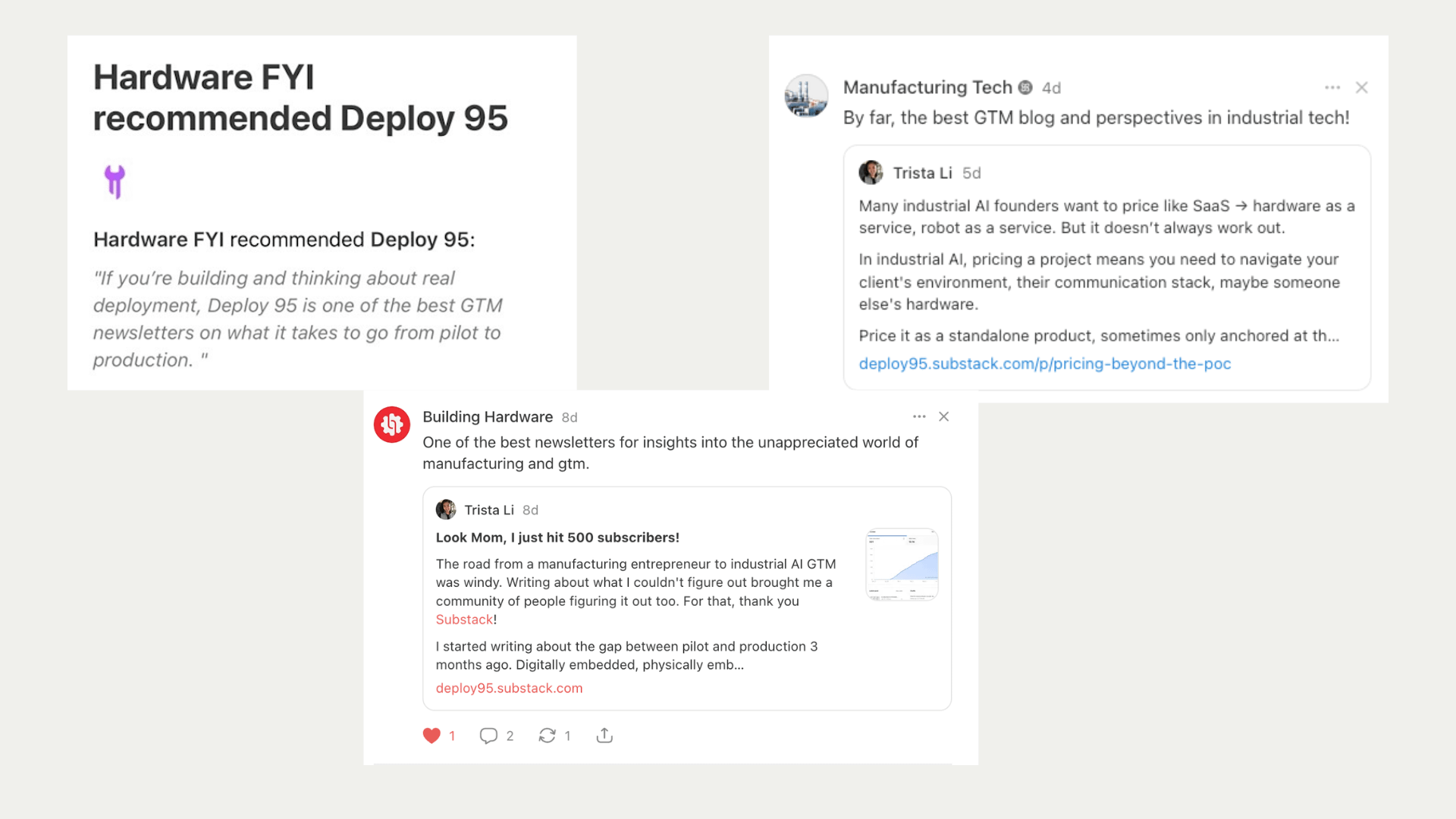
Deploy 95 wouldn’t exist without the publications that gave it a platform early on. They cover the hardware and manufacturing world in ways no one else does. If you don’t already follow them, consider subscribing.
Hardware FYI | Breaking the Bottleneck | Exponential Industry
Building Hardware | WattFactory
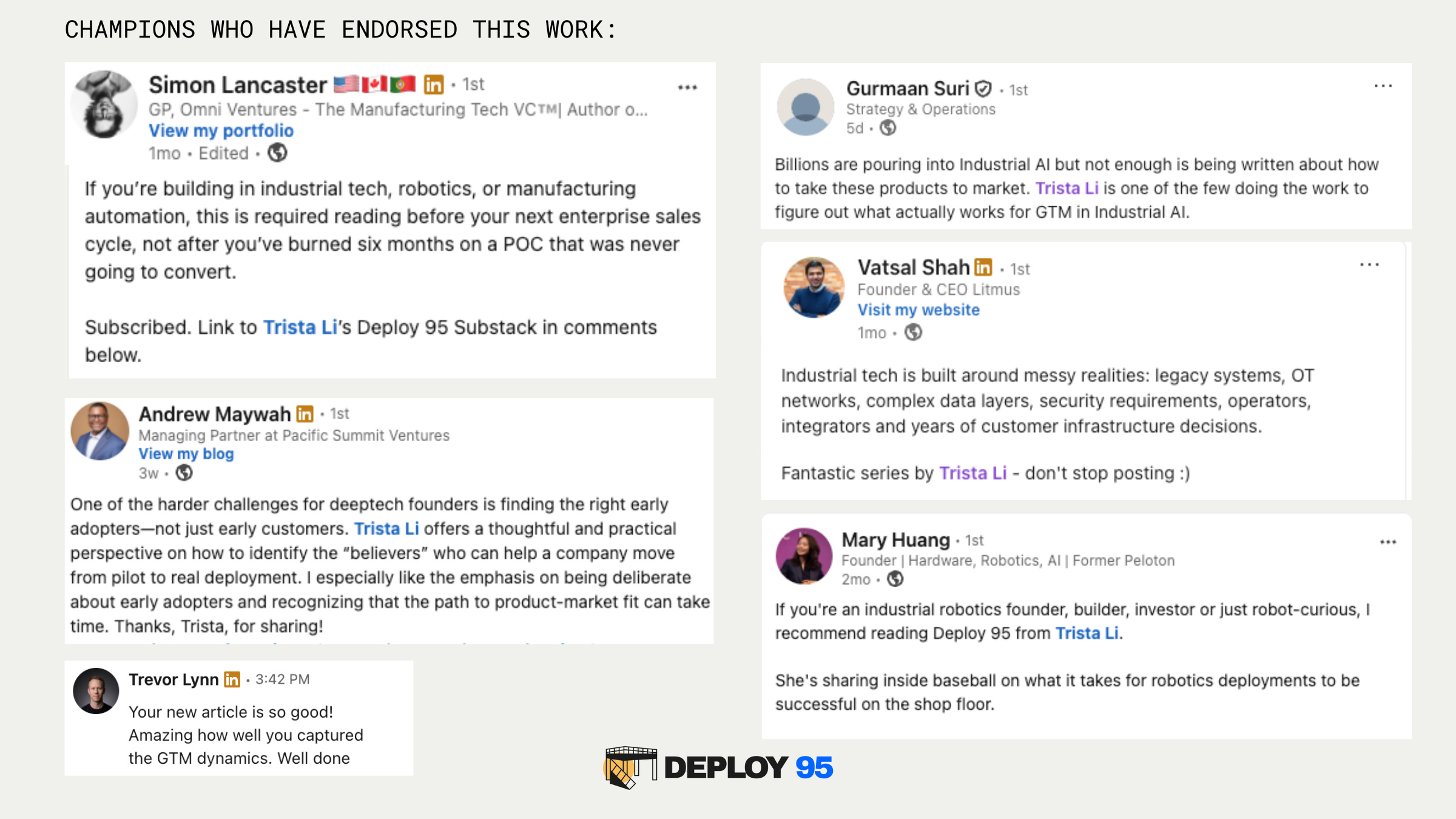
Here is also something I’ve learned in six months: the industrial tech world is smaller than it seems, but harder to reach than you’d think. The founders who need this content most are often buried in pilot deployments. They live in WhatsApp groups, Slack channels, and corners of the internet I can’t reach.
So if you know someone building for the factory floor, send this their way! That’s the best way to support this work.
If you have a minute, take a 3-question survey. It helps me write about what you’re actually facing.
Here’s to six more months of figuring this out together.
Trista
P.S. You can always find me on LinkedIn.