This is Part 5 of a six-part series on selling technology with a physical footprint into legacy industries: manufacturing, industrial, and operationally complex enterprises.
If you’re new here, welcome! Part 1 introduced the POC Valley. Part 2 covered the qualification test before committing. Part 3 discussed tactics for navigating through. Part 4 examined the economics underneath.
This part tackles the question founders avoid the longest: how do you actually price this stuff?
Everyone has an opinion on how to price Industrial AI. Copy SaaS. Charge per unit. Offer pilots for free to land the logo. The advice is endless because the problem feels unsolved.
But the problem isn’t that pricing is mysterious. It’s that most teams price from the only thing they know: the POC. And POC pricing fails because you’re making decisions with 20% of the information you need.
Three structural gaps sit between your POC quote and a real deal.
You quoted $25K. They see $150K. The gap is everything you don’t control: integration, fixtures, controls, IT, validation, and three weeks of your engineer at a Holiday Inn Express in rural Ohio. Most organizations underestimate these costs by 40–60%.
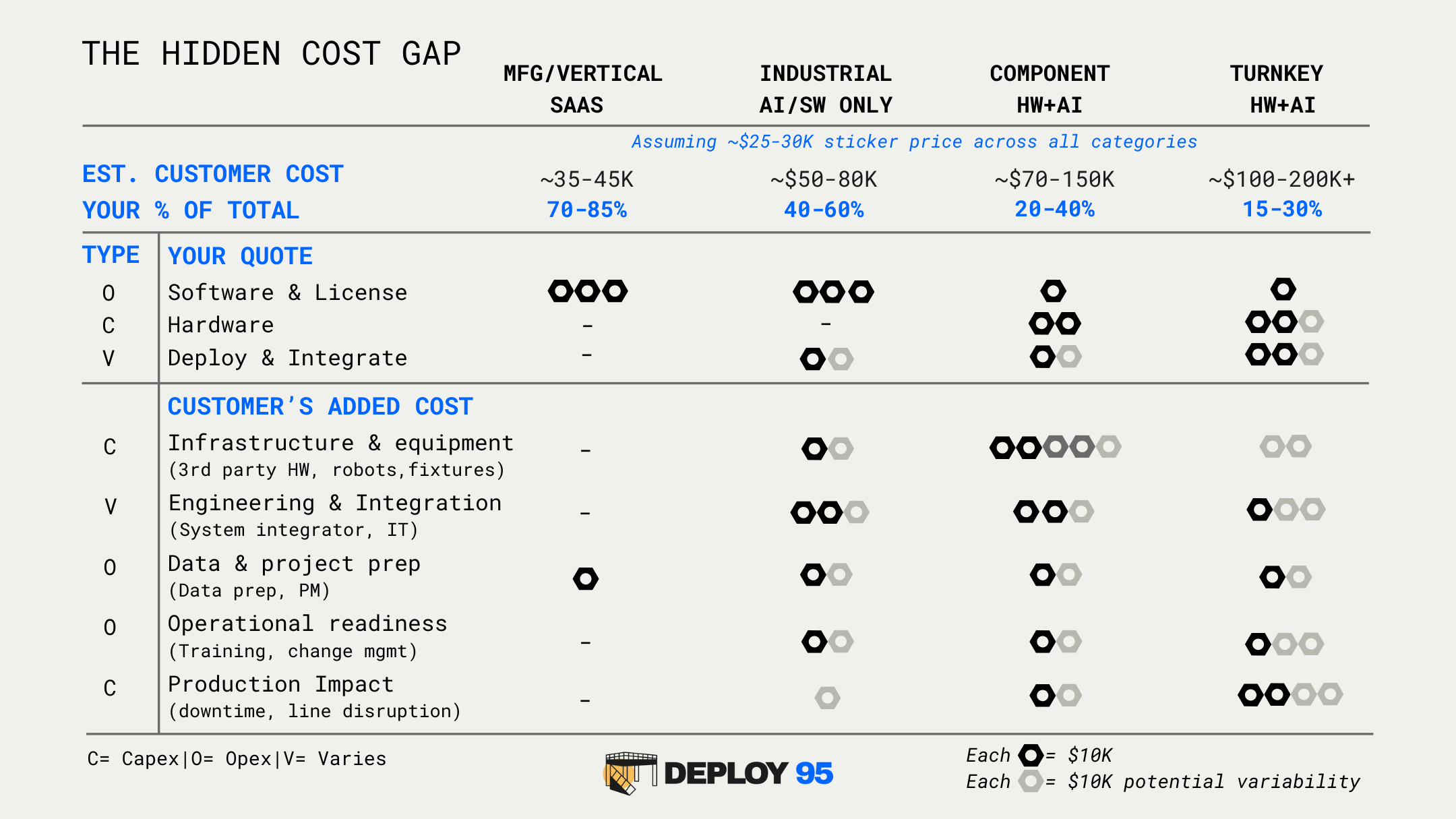
“What an AI vision company sees as a $20 to 25K sale is four to five times that amount to the customer once you include robots, integration, controls engineering, and travel.” — Paul, Seasoned sales leader in Automotive
Why this kills deals: Your champion has to defend the total project cost to executives who weren’t in the room. The gap surprises everyone, and you take the blame.
The fix: Price your POC to earn access to their total cost information, not to close the deal.
You built an OpEx model hoping for recurring revenue. Your customer buys CapEx.
A $500K capital purchase gets depreciated over five years, comes from a different budget, and often has a higher approval threshold. But here’s the counterintuitive part: for the right buyer, the bigger CapEx number is easier to approve because it doesn’t hit this year’s operating budget.
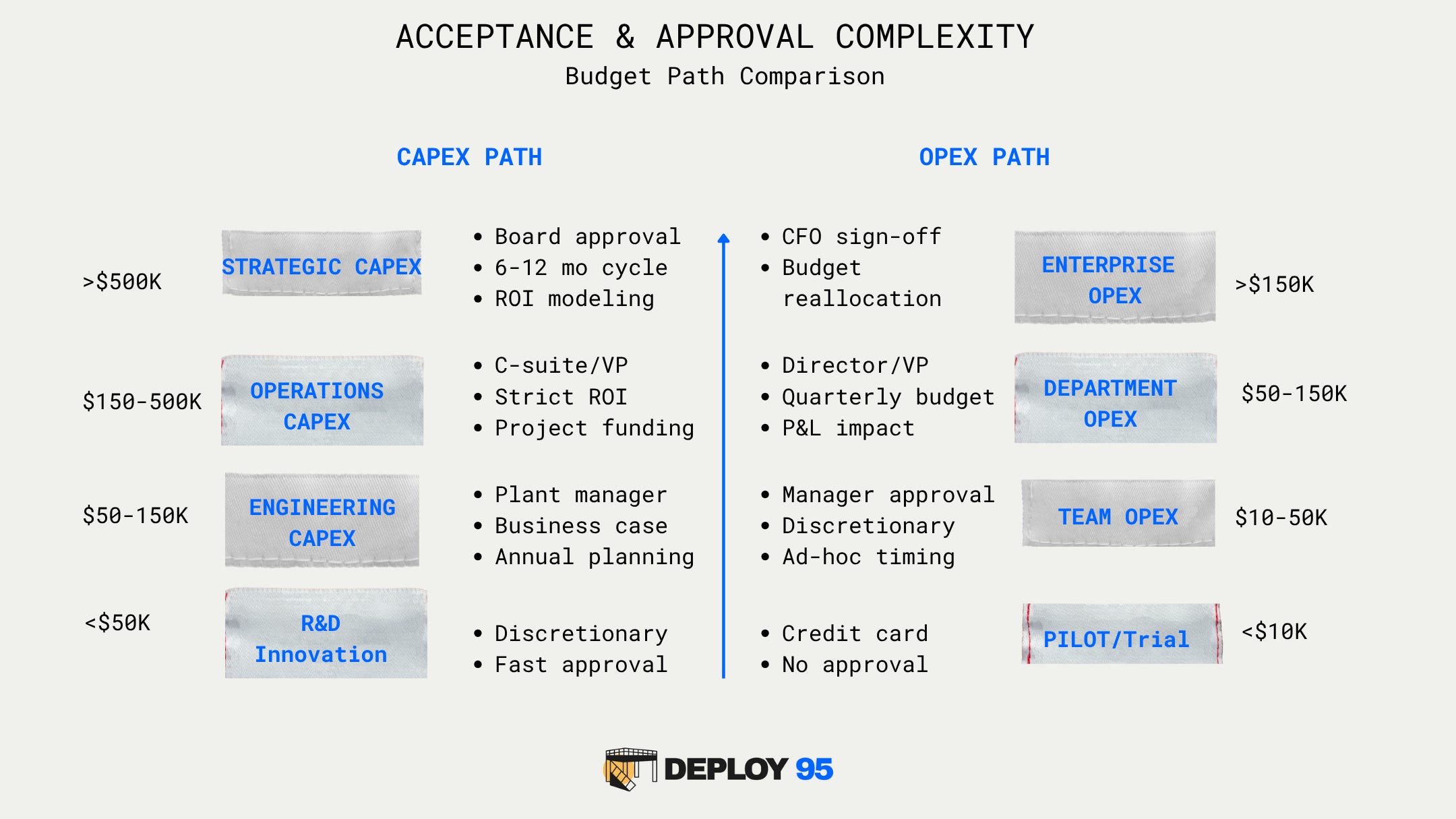
“For a sophisticated customer, they’d prefer hardware CapEx because they get the tax benefit at the end of amortization. The ones who choose year-to-year recurring often end up piloting and walking away.” — Head of Product, EV Charging Infrastructure
Why this kills deals: Small, OpEx-friendly POC numbers attract the wrong buyers. Customers who want optionality, not commitment. The subscription lets them stay in pilot mode indefinitely.
The fix: Ask early: “Is this coming from capital or operating budget?” Match their structure, not your preference.
SaaS assumes infinite renewal. Industrial assets have bounded lifetimes.
Vehicle platforms average 6.7 years in production. A complete cycle plan spans 10-15 years, but capital investments are only well-defined for five. When the line refreshes, your contract ends, whether you planned for it or not.
“For a large program like the GM Chevy pickup, they’re going to have a project update roughly every 5 years, and a refresh at about the 2 to 2.5 year point. The massive upgrade project is $6 billion, which is hard for new equipment to be priced in.” — Paul, Seasoned Executive in Automotive
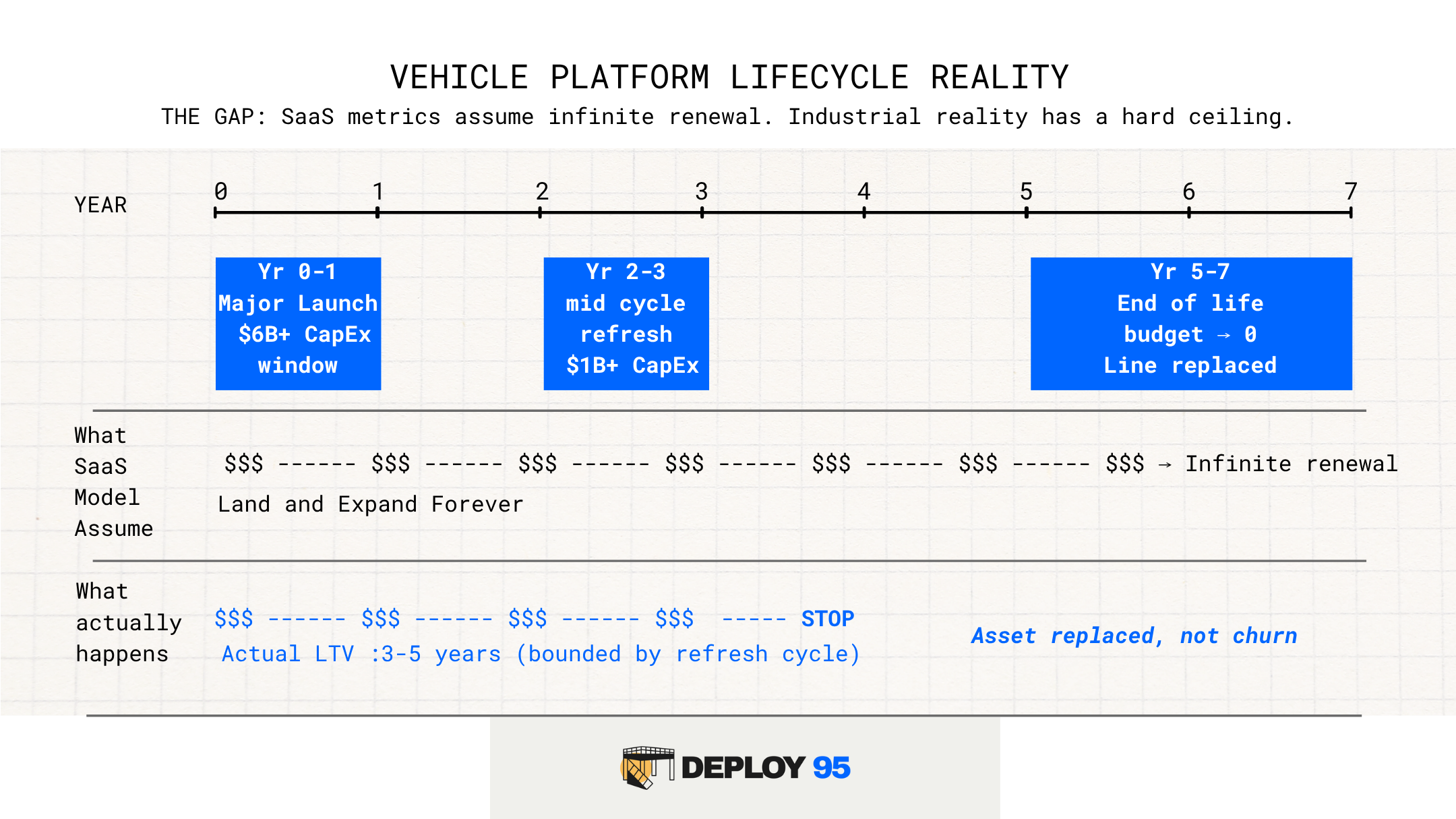
Why this kills deals: If you price like SaaS, low upfront, make it up on renewals, your LTV isn’t infinite. It’s bound by their refresh cycle.
The fix: Know when their next retooling happens. That’s your real contract duration, plan accordingly.
These gaps reveal the fix: stop pricing your product in isolation and start pricing into their reality, their project scope, their budget structure, their decision timeline.
Define your Deployment Unit before you price anything.
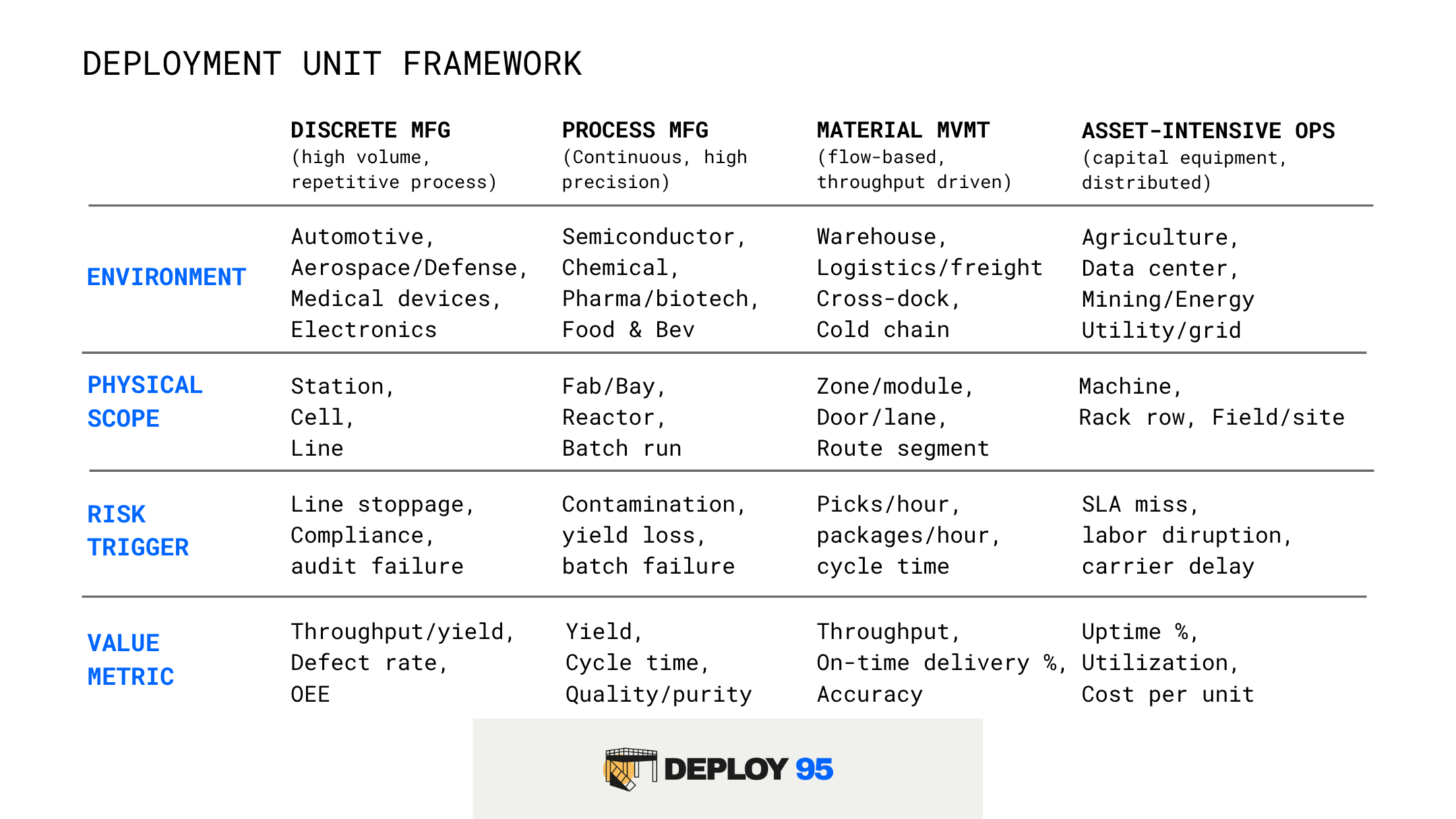
The test: can you write “Deploy Unit X at Site Y and expect Value Z”? If you can’t fill in all three confidently, don’t price.
Once you’ve defined the unit, establish your price range using the following anchors:
Your ceiling is their problem size. What’s the cost of the problem you’re solving at this unit?
Your floor is your cost to deliver. What does it actually cost you to deploy one unit, fully loaded?
Your pricing model needs to match their budget structure. Is this CapEx or OpEx? What approval thresholds exist?
“Have an OpEx pricing model, but be ready to quickly default to CapEx. While people are starting to open up to OpEx, it’s still the minority. Carve out CapEx for our hardware, even in our OpEx pricing to make sure we at least cover hardware costs upfront to protect cash flow.” — Caleb, Solutions Manager, UnitX
Your validation success is heavily integrated into your client’s environment, at least in most industrial AI use cases. Identify the minimum viable units you’re willing to commit based on the commitment your client is willing to make.
You only earn your right to have that conversation when you’ve delivered on your product promise, and you have a perspective of what it costs per facility” — Global Revenue Leader, AI and Frontier Tech
Customers who see multimillion-dollar impact need you to help them move fast. The customers worth building with will share the uncertainty with you.
What to charge at each stage: Your price should reflect what it costs you to deliver and what they’re committing in return.
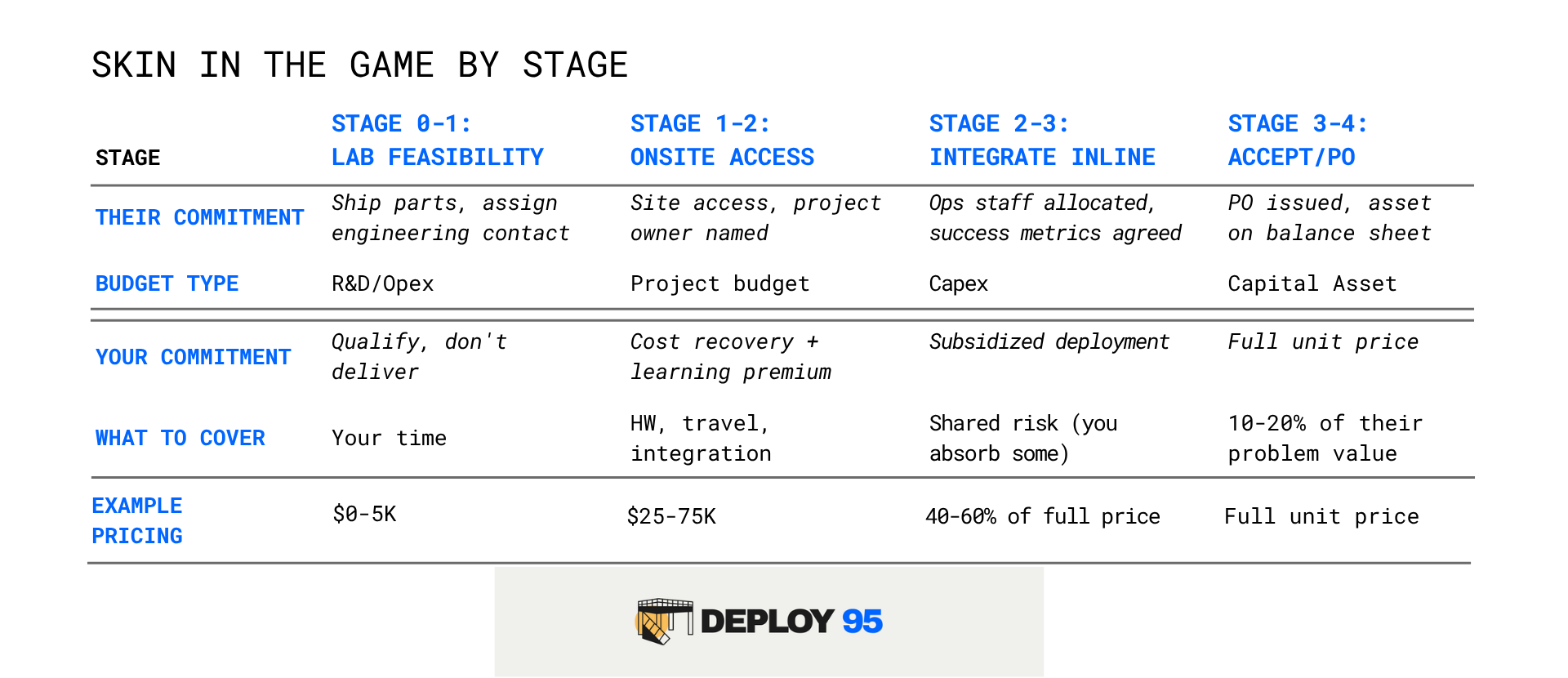
If your client isn’t committing anything and asking you to pay for shipping, for example, you’re subsidizing too hard, and that will impact your margin.
Capital budgets have less flexibility than OpEx. They may be project-specific and dependent on multi-year planning. As a founder with a heavily subsidized POC, the key is timing your conversations to give yourself maximum leverage.
That negotiation window is mid-pilot. The later the stage, the more leverage you have.
“ Let’s assume it is a three-month POC. It will take 45 days into the POC for you to have results showing that the data works. Now that we know it works, let’s work on a revenue model that helps scale this through the organization. ” — Global Revenue Leader, AI and Frontier Tech
This mutual learning process allows the customer to see your product’s value while you understand the cost of delivery specific to this company, which will impact your margin too.
The framing should sound like this: “The results are strong. Before we finalize the pilot report, let’s align on what Stage 2 looks like: scope, timeline, and how we’d price a broader rollout.”
And there are three things you need to push for:
Price range for Stage N+1: “Based on what we’re seeing, full deployment will be in the $X–Y range. Does that fit your planning?”
Success criteria that trigger a PO: “If we hit [metric], what’s the path to having this on full-time?”
Timeline: “Can we target a decision on Stage 2 by [date], assuming results hold?”
If there’s room to negotiate, you’ll hear “Let me see what I can do.” If there isn’t, you’ll hear “We can’t discuss that until the pilot is formally complete.” Both answers are useful. The trap is waiting. Every day past the midpoint, leverage shifts from you to them.
If you’re basing your solution on each customer’s problem, how can you predictably price? In the early stage, each deployment looks different because your market is fragmented. Industrial AI payback takes longer than anyone wants to admit, only 6% of companies see ROI in under a year.
You can’t subsidize learning indefinitely, but you also can’t rush deployments that need time to prove value. The path forward is making each deployment teach you something that reduces the cost of the next one.
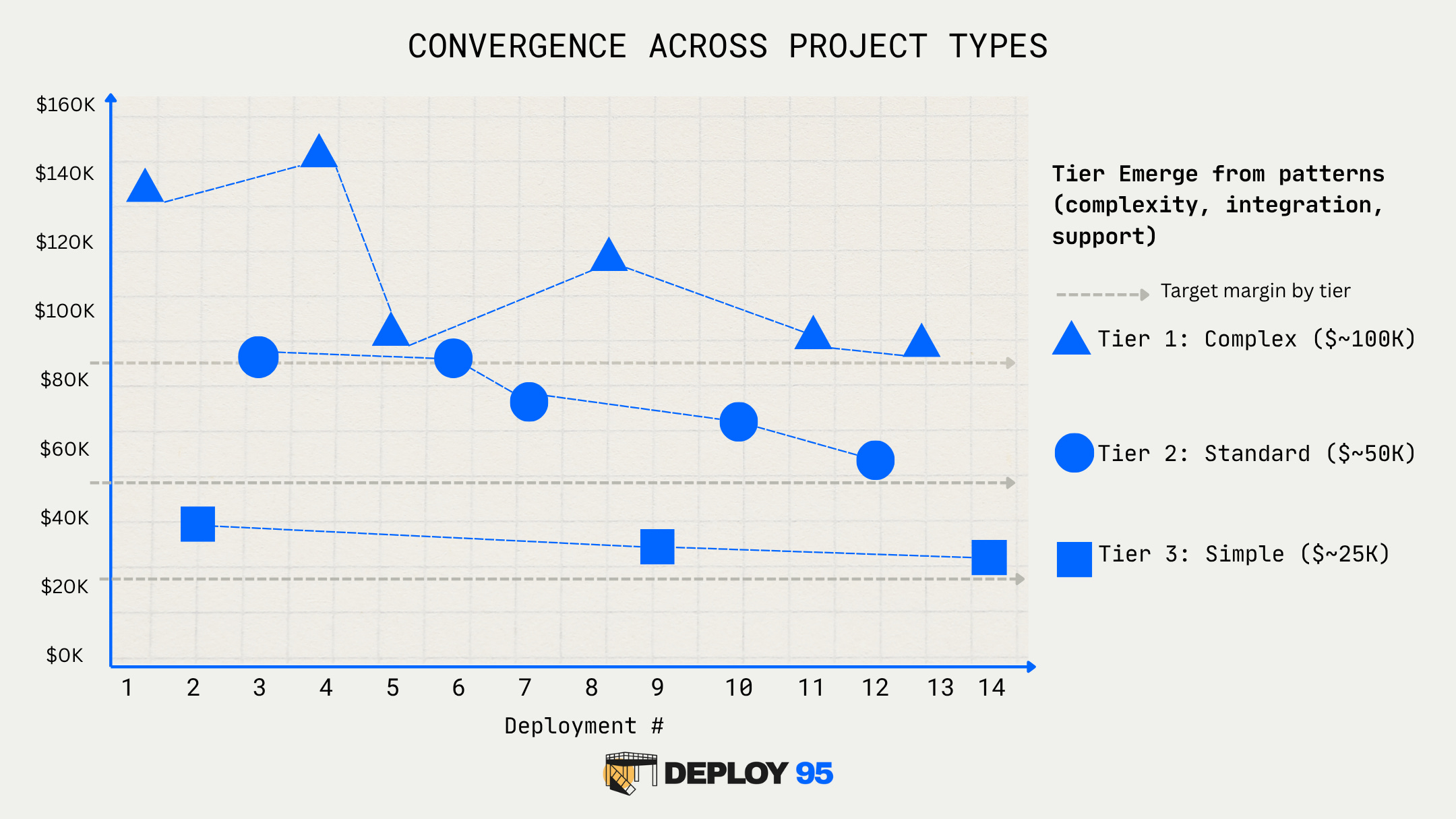
After a few deployments, convergence should emerge. You’ll start to see project types, at least in broad trends, thanks to actively seeking out similar projects, driving costs down through developed playbooks, and saying no to projects that don’t fit. The result is pricing convergence that leads to packaged offerings.
How can you convince your VC you can generate returns without a subscription model?
Here’s what most founders miss: VCs don’t actually need ARR. They need predictable returns over a defined horizon. The subscription model is just the easiest way to demonstrate that. It’s not the only way.
“You need to demonstrate that if it’s not an annualized purchase, you can get the same return over a three-to-five year basis. If you can do that to a VC and you have a sticky product, they’re generally in.” — Former VP Sales, Climate AI
A hybrid structure (CapEx hardware, OpEx software, expansion pricing tied to deployment units) can pencil out better than pure subscription.
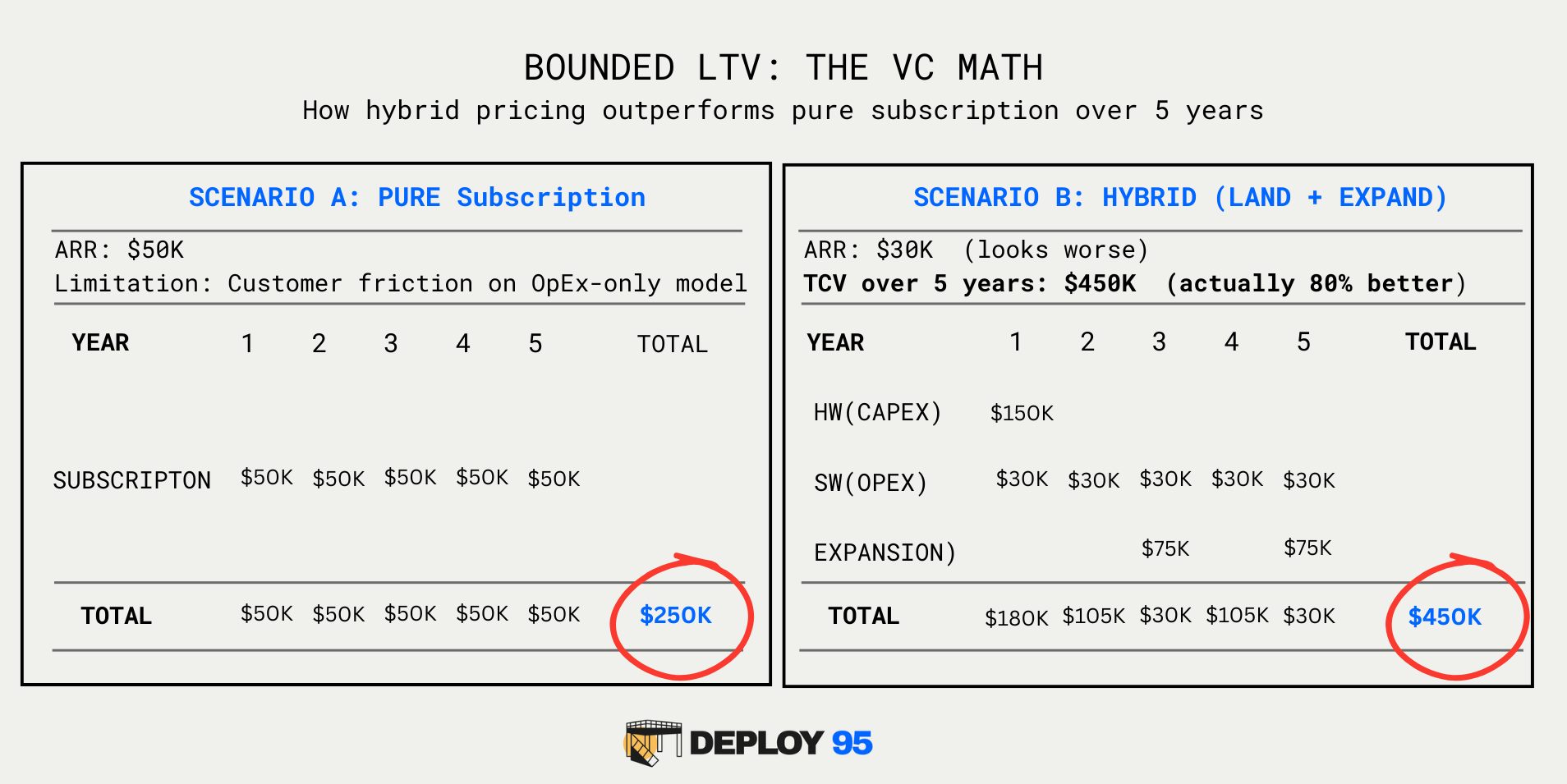
If a customer’s refresh cycle is five years, and you can show CapEx revenue in year one plus software subscription for years two through five plus expansion to additional lines, your total contract value may exceed what a pure subscription would have captured and it matches how the customer actually buys.
Pricing in industrial AI is about building structure that fits how customers actually buy. Map their budget before you quote. Design pricing stage-by-stage. Negotiate when leverage peaks. Track whether your costs are converging.
The founders who get this right stop asking “what should we charge?” and start asking “how does this customer buy?”
If you’re evaluating vendors, four questions reveal whether they’ve figured this out: What’s included in their quote, and what isn’t? How do they structure pricing across pilot, validation, and production? What does a typical five-year cost look like? How many similar deployments have they done? If the answers are vague, especially on that last question, you’re likely paying for their learning curve.
That’s fine if you negotiate like it: more flexibility on scope, more involvement in defining success, and pricing that reflects the uncertainty.
Next in the series: Part 6 examines how to think about customer acquisition.
Hi! I’m Trista, a former founder, early GTM at UnitX, now a GTM strategist for technical founders deploying into legacy industries.
This series grew out of conversations with founders, operators, and enterprise leaders working at the intersection of hardware, automation, and manufacturing over the past 18 months. Special thanks to Adam, Caleb, Matt, and Paul, who allowed me to quote their insights that shaped this analysis.
If you’re building in this space, or buying, or stuck somewhere in between, I’d love to hear from you.
ARR (Annual Recurring Revenue): The annualized value of subscription or recurring revenue contracts. A key metric VCs use to evaluate SaaS businesses, though often misapplied to industrial contexts with bounded customer lifecycles.
CAC (Customer Acquisition Cost): The total cost of acquiring a new customer, including sales, marketing, and deployment expenses.
CapEx (Capital Expenditure):Funds used to acquire, upgrade, or maintain physical assets. Typically depreciated over multiple years and often comes from a different budget than operating expenses.
OEE (Overall Equipment Effectiveness): A manufacturing metric measuring the percentage of planned production time that is truly productive.
OpEx (Operating Expenditure): Day-to-day expenses including software subscriptions, maintenance, and services. Hits the current year’s budget rather than being depreciated.
TCV (Total Contract Value): The total value of a contract over its full duration, including all revenue streams.
MES (Manufacturing Execution System): Software systems that track the transformation of raw materials to finished goods, serving as the operational backbone of manufacturing facilities.
Platform Lifecycle: The typical duration a manufacturing platform remains in active production before replacement. Defines the natural boundary for customer relationships.
Land and Expand: A sales strategy of winning initial small deployments with the intention of growing the account through demonstrated value.