This is Part 4 of the ICP series. Part 1 covered early adopters, Part 2 discussed the quality function as a champion, Part 3 covered production engineers as the core users. This post covers the commercial validation stage, and the tough topic of capex.
I’ve seen many founders struggle with capex, and the story usually goes like this: The engineering manager said with confidence that he’d push it forward. We’d spent three months on a POC, and then we never heard from him again. We had checked every technical box, so why did we lose momentum?
“There’s an allocated budget that’s set in the beginning of the year. It depends who is actually going to fight for the capex.” — Nashay Naeve, manufacturing executive
Once industrial AI moves onto the floor, it stops being an opex line. Capex justification is challenging for many industrial founders because it breaks the usual software sales motion. It doesn’t fit the models founders and investors find attractive, like subscriptions and recurring revenue.
To understand it, I interviewed Nashay Naeve, whose experience spans John Deere, Caterpillar, DuPont and Redwood Materials, most recently as president of Tsubaki Nakashima’s engineered plastics component business unit. I also spoke with a handful of capex owners at Amazon, PepsiCo and Kraft Heinz.
Three questions guided my interviews: How is the capex pool set? How does a project earn its share? Who ranks and approves it?
Most companies allocate their capex budget in one of three ways: they dedicate a percentage of expected revenue, they use what’s left after projected cash flow, or they base it on total depreciation.
Each method comes back to the projected P&L for a given plant. A company with large revenue is more likely to have a larger capex budget. A company with strong cash flow would have more capex than one with tight cash flow. And a heavy-equipment business might have more depreciation than an asset-light business.
Either way, the size and type of the business determine how much capex it has. For example, a $150K project at a $20M plant looks very different from one at a $200M plant, and differs again for a cash-flow-driven versus a depreciation-driven business.
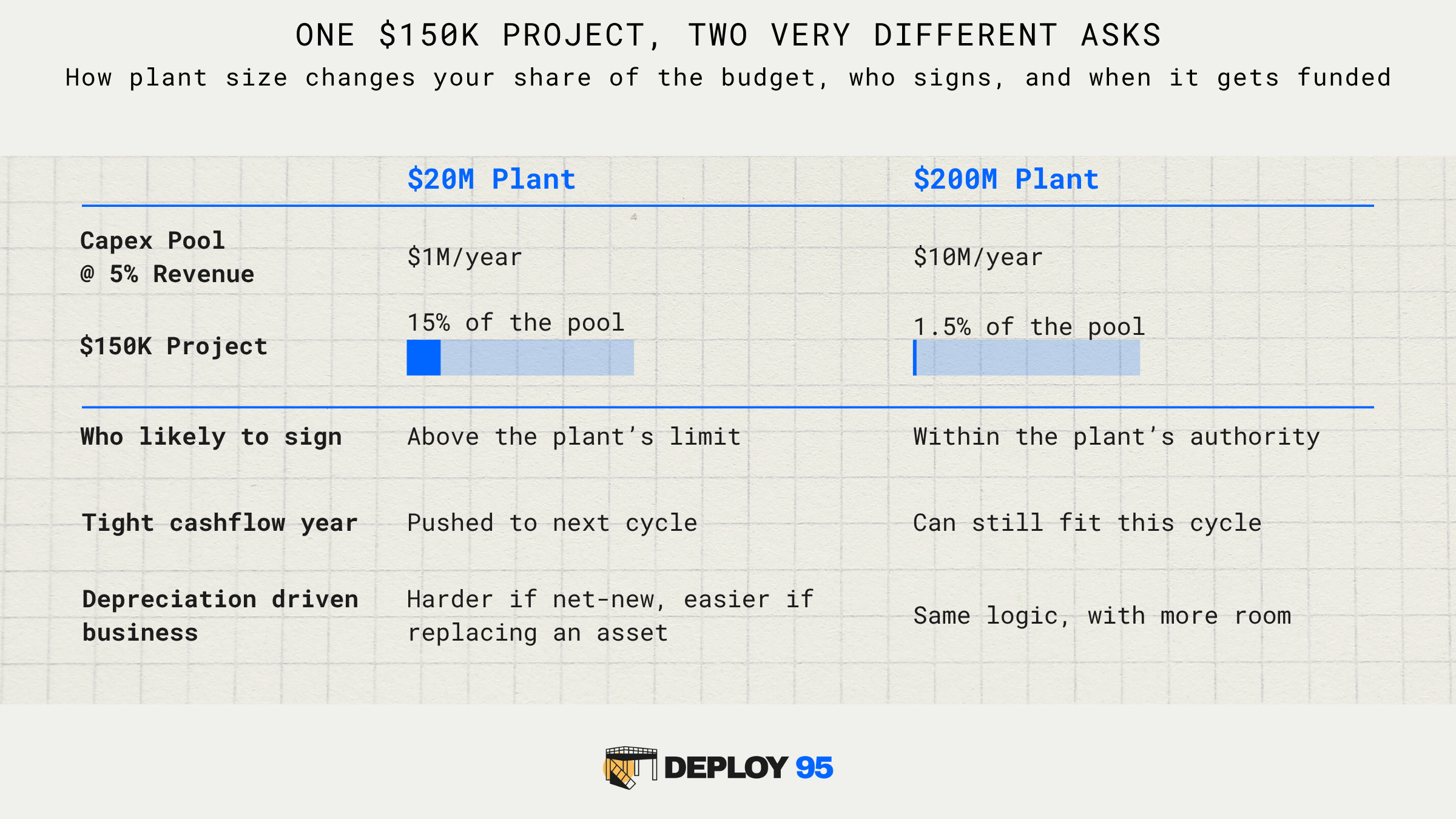
The best vendors ask about the budget first. Because without knowing the budget and timeline, you may arrive at the wrong time: you validate the technology, but the money won’t exist until the next capex cycle.
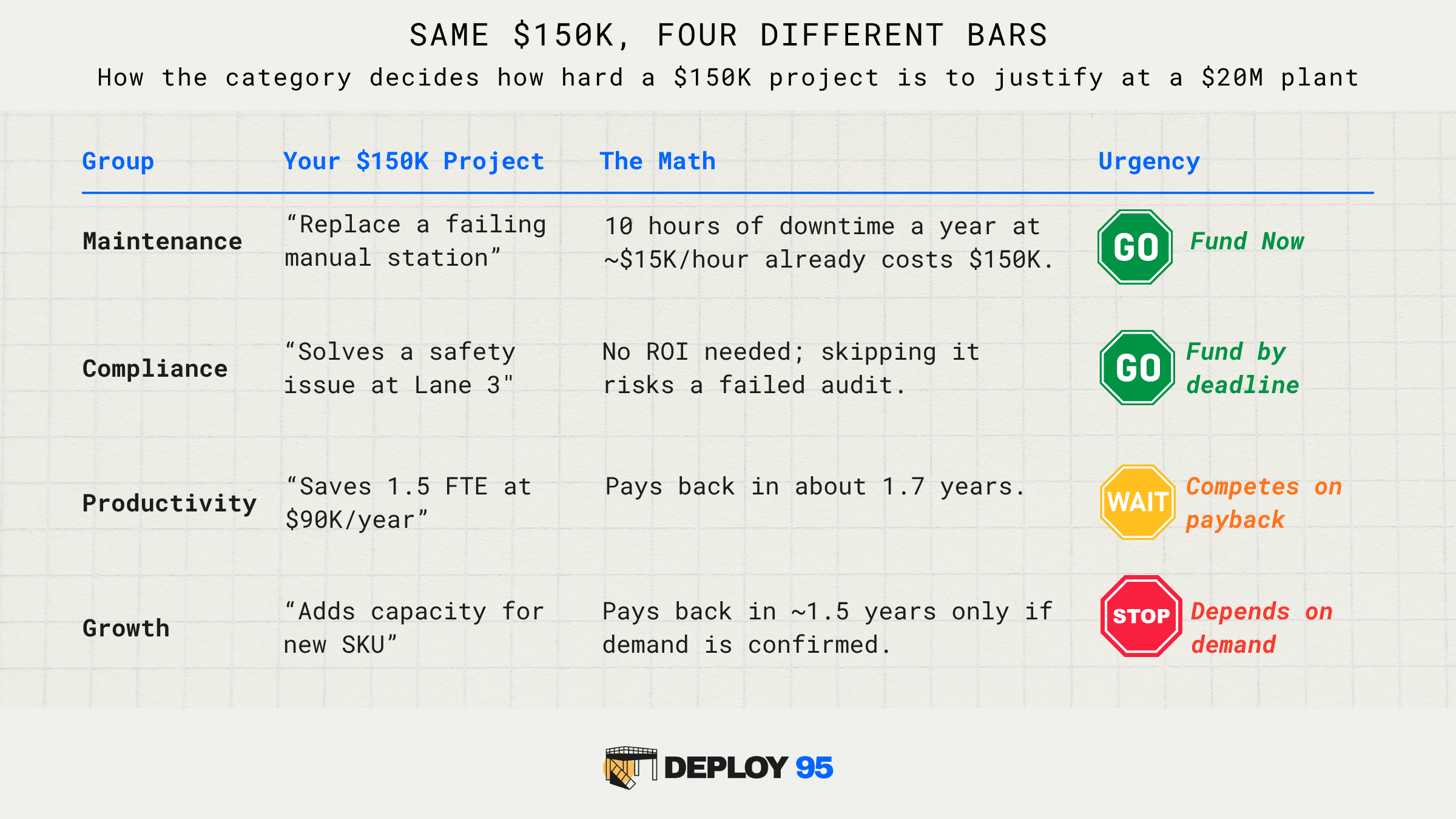
Approvers evaluate every request with one question in mind: “Is this the best use of our money, and what else could we do with it?” That’s why capex is usually divided into four categories, ranked by how urgent they are to the business.
At a $20M plant with about $1M in annual capex, a $150K project can lead to very different decisions, depending on its category.
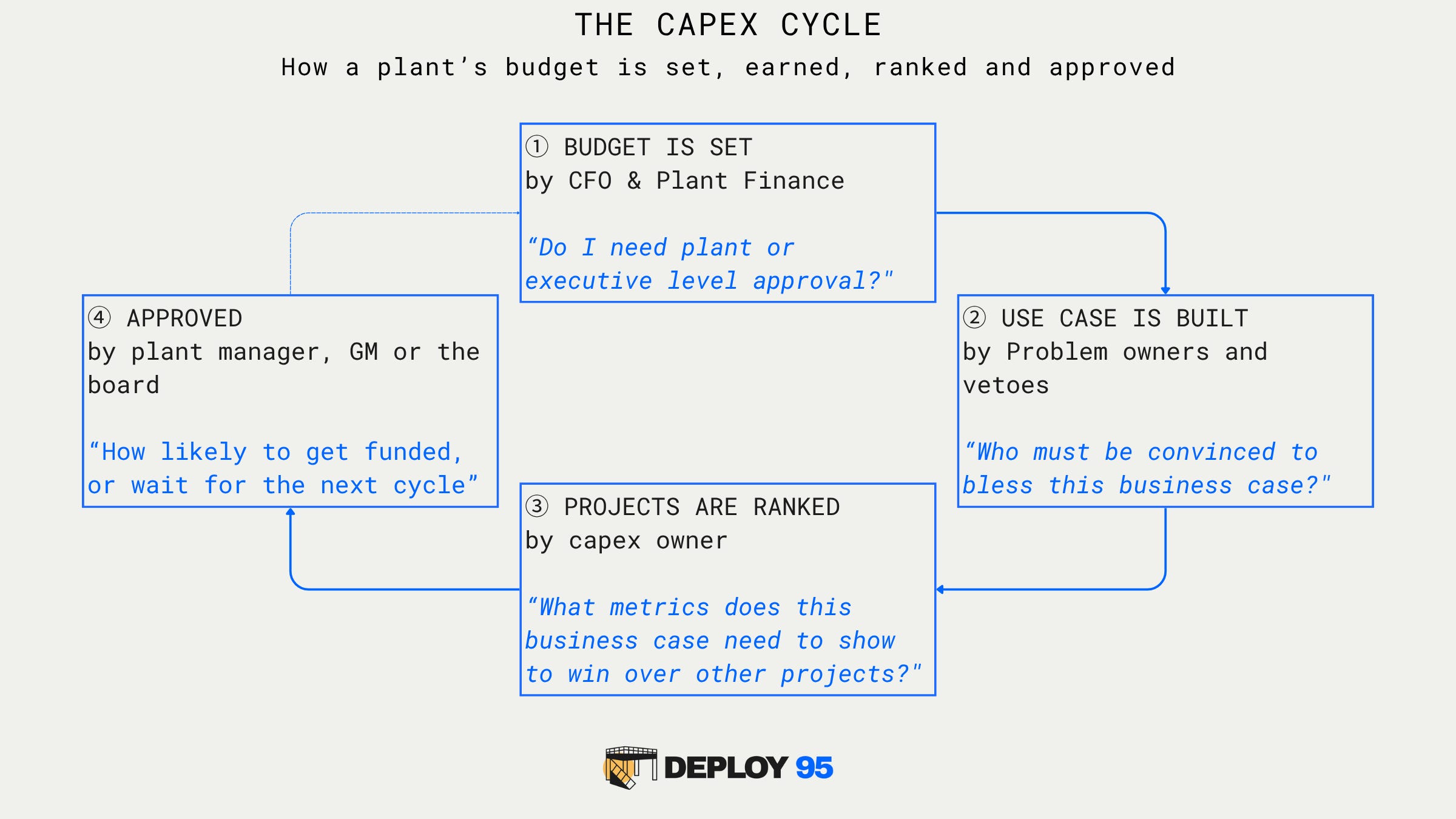
A capex project needs more than a sound ROI. It also needs planning. Because most capex projects are cross-functional, the project owner has to get buy-in across functions before even submitting a proposal.
At a smaller company, resources are constrained, so competing for capex means arriving with a clear business case and an ROI that already has internal buy-in. At a larger company, the capex pool is bigger, but getting approval involves many more stakeholders, which makes buy-in more complex:
Even though I’m the owner of the project, I still need to request funding for the pilot… There are like 20, 30 approvers. — Physical AI Product Lead, Amazon
As a result, the purchasing committee is often multi-layered. At the center are the problem owners, who prepare the business case and the ROI. Around them are their counterparts who decide whether the project can actually be deployed.
Some vendors help by offering a free audit that becomes the foundation for the business case:
What I’ve seen lately is companies coming in and saying, we’ll do an audit and write up a report for your team. That basically acts as the base for the business case to do the pilot. — Corporate Controls Lead, Kraft Heinz
When proposals add up to $1.6 million against a $1 million capex pool, someone has to cut $600K. That someone is the capex owner:
There’s usually somebody that owns the capex, like a capex project manager… who owns the capex plan for the plant or the line… Then it would go up to the general manager and probably the CFO. — Nashay Naeve
Depending on the size of the company, this role can be someone who takes it on for three months of the year, or an entire dedicated department. Either way, the job requires them to rank the requests, challenge the weak ones, and decide what makes the plan. At Nashay’s last company, an engineering director held the whole company’s capex budget, questioned each plant on whether a project was really needed, and moved money between plants when one had a stronger case than another.
Here’s what that ranking could look like:
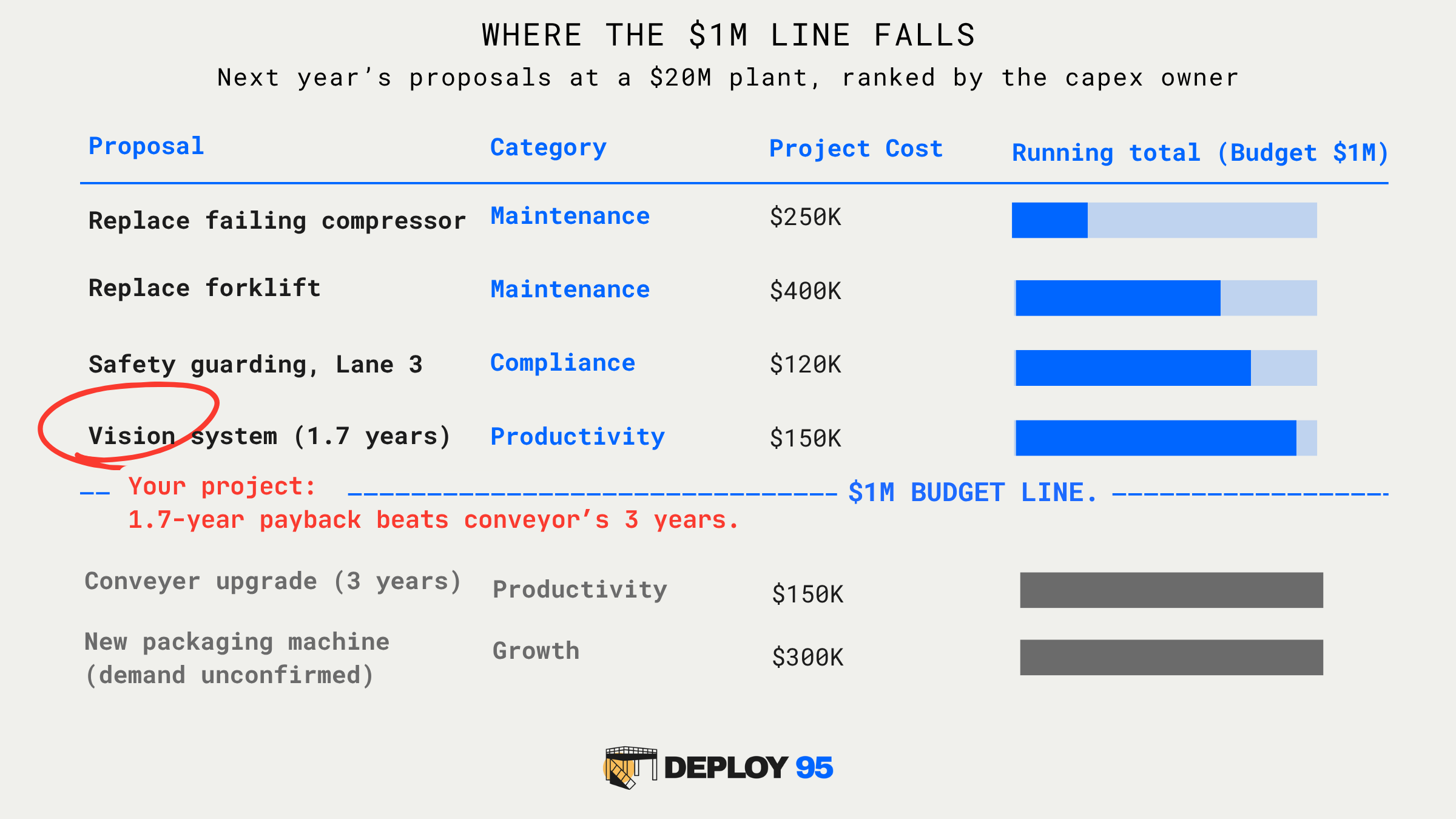
Once the urgent categories are funded, everything else competes for what’s left, and your ROI is no longer judged on its own. It’s judged against the project right below it. If you want to replace a project already in this year’s budget, you have to help the project owner articulate why your project deserves the space more than the one already there:
Instead of this new machine that I had allocated $300,000 for, I want to buy this instead because it has a better ROI. — Nashay Naeve
Some vendors go one step further and bring proof from a similar plant so the project owner can defend the ranking with proven outcomes, which is more convincing than an ROI estimate.
You can go to capex committee and… say, hey, we ran this at our Michigan plant, we saved X amount of dollars. Here’s our ROI on five years… If they see you beat hurdle rate… there’s really no reason to decline a project. — Corporate Controls Lead, Kraft Heinz
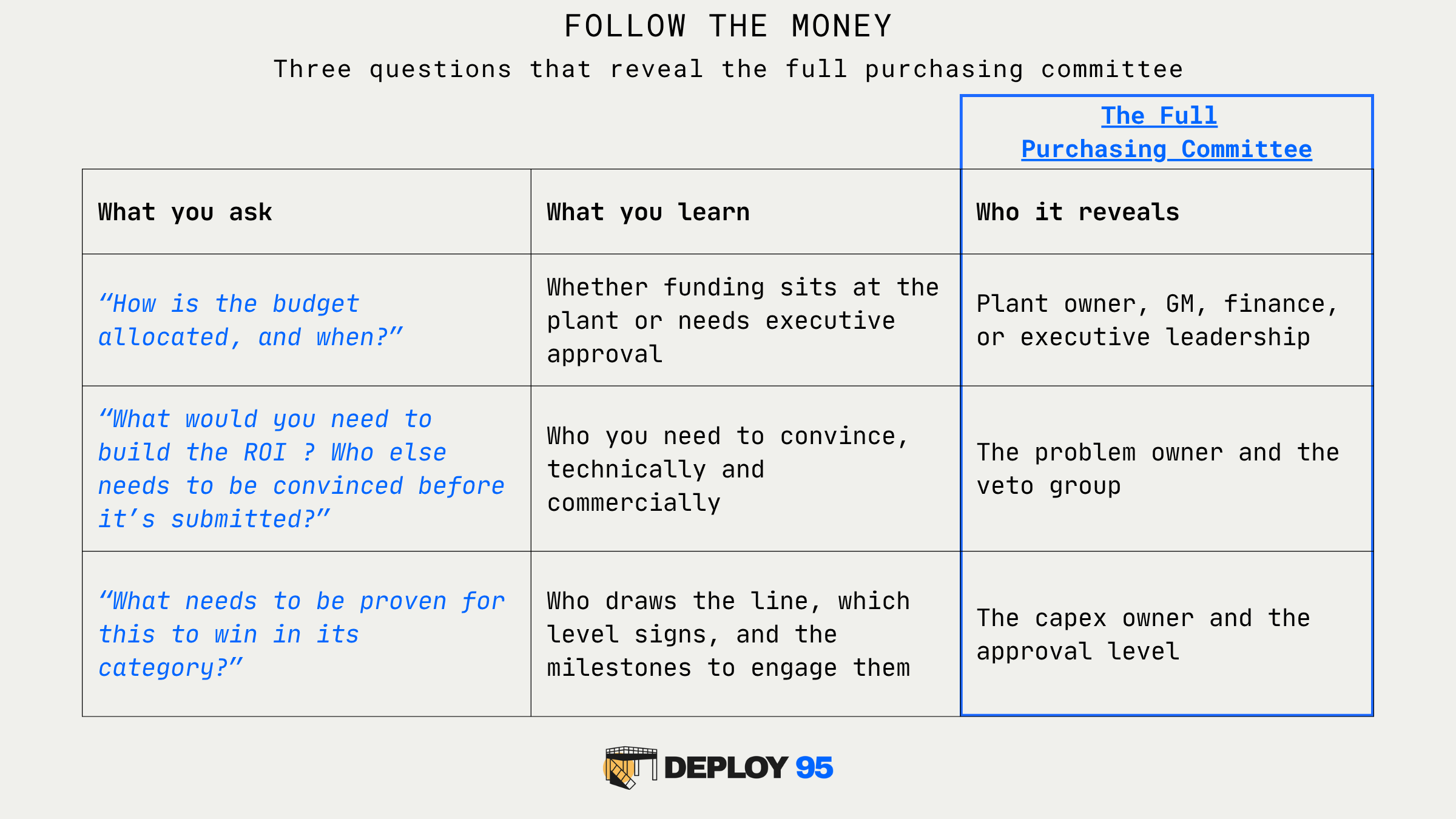
Follow the money, and you’ll find the entire purchasing committee.
Ask how the budget is allocated, and you’ll know whether the funding sits at the plant level or requires executive approval.
Help the problem owner build the business case, and it will surface the rest of the purchasing committee, especially the people you need to convince on technical and commercial viability.
Think through how the project wins in its category, and you’ll find the capex owner, the level of approval it needs, and how to engage them throughout the sales process, with clear milestones and feedback along the way.
The biggest gap in the software sales process is that it misses budget approval entirely. You end up working in the dark, without knowing what you’re working toward.
Capex is a rigid process, but a few moves can add speed and flexibility: finding strategic alignment, identifying a guide, and offering pricing options that fit the company’s budget.
This is a map drawn from a dozen conversations, not a law. If you’ve closed a large deal with a committee that didn’t look like this, I’d genuinely like to hear how.
Hi! I’m Trista, and you’re reading Deploy 95, a newsletter that helps builders in industrial AI think about GTM, with the goal of converting pilots into full deployments.
If you want to go beyond the purchasing committee, check out the other posts in this series:
Part I: Believers Make the Market
Part III: Who Keeps Your Industrial AI Plugged In?
Building in this space? Let’s connect on LinkedIn.
Know a founder stuck waiting on a capex decision? Send this their way.
Capex (Capital Expenditure): Money spent on equipment and assets the company will own and use for years, like machines, conveyors or vision systems. It’s planned once a year and approved through a formal process.
Opex (Operating Expenditure): Ongoing costs of running the business, like labor, maintenance, software licenses and services. It sits on the plant’s monthly P&L and is usually more flexible than capex.
Capex owner: The person who owns the capex plan for a plant, line or business. They rank requests, challenge weak ones and decide what makes the plan.
Purchasing committee: The group a capex project has to pass through: the problem owner, the veto group, the capex owner, and the plant or board level that approves it.
P&L (Profit and Loss): The statement of a business’s revenue, costs and profit over a period. The projected P&L shapes how much capex a plant can spend.
Depreciation: The value equipment loses each year, recorded as a cost on the P&L. Some companies set capex relative to depreciation so they at least replace what wears out.
Payback period: How long it takes for a project’s savings to cover its cost. Productivity projects are often expected to pay back within two to three years.
Hurdle rate: The minimum return a project must show before a capex committee will approve it.
FTE (Full-Time Equivalent): A unit equal to one full-time worker, used to estimate labor savings.